Berlin Layover Near Hackescher Markt
Part of the full Berlin Layover Guide: What to Do Before a Flight Out of BER
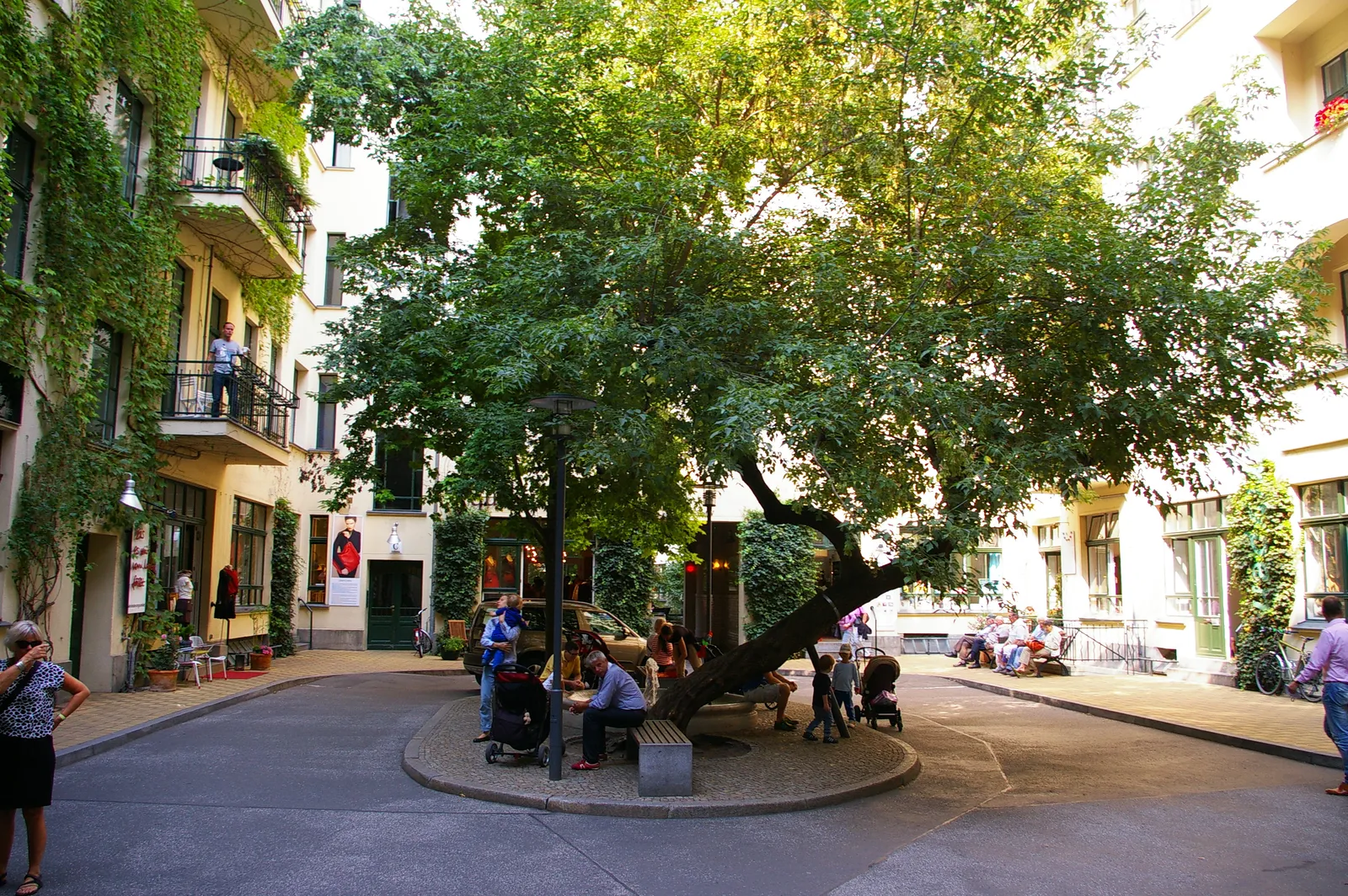
At Hackescher Markt, walk the eight linked courtyards of the Hackesche Höfe, then the unrestored one next door at Rosenthaler Straße 39 with its free Otto Weidt museum, before catching the S9 straight to BER.
Eight courtyards behind a single archway
Berlin’s building code once made deep, narrow plots the norm, and the answer was the Hof: a courtyard behind the street front, then another behind that, and another, running the depth of the block. The Hackesche Höfe are the grandest surviving example, opened on 23 September 1906, listed since 1972, and at around 27,000 square metres the largest single courtyard complex in the country.
The first courtyard, straight in from Rosenthaler Straße, is the famous one: August Endell faced it in blue and cream glazed brick in full Art Nouveau, wrapping the entrances to a variety theatre and a cinema that are both still working. Behind it the chain gets progressively quieter and more residential, which was the original plan; Kurt Berndt laid the courtyards out so that entertainment sat at the front, workshops in the middle, and flats at the back.
Walking the whole chain to Sophienstraße and back takes about twenty minutes and costs nothing. The passages between courtyards are narrow archways, several with raised sills and a few steps, which is exactly the geometry a wheeled case handles worst.
Number 39, which nobody restored
Leave the Höfe, turn left, and the next doorway on Rosenthaler Straße opens into something that looks fifteen years and one political argument away. Haus Schwarzenberg was taken over by an artists’ association after reunification and deliberately never smartened up: the plaster is bare and patched, every reachable surface is stickered and tagged, and the walls carry large murals that change.
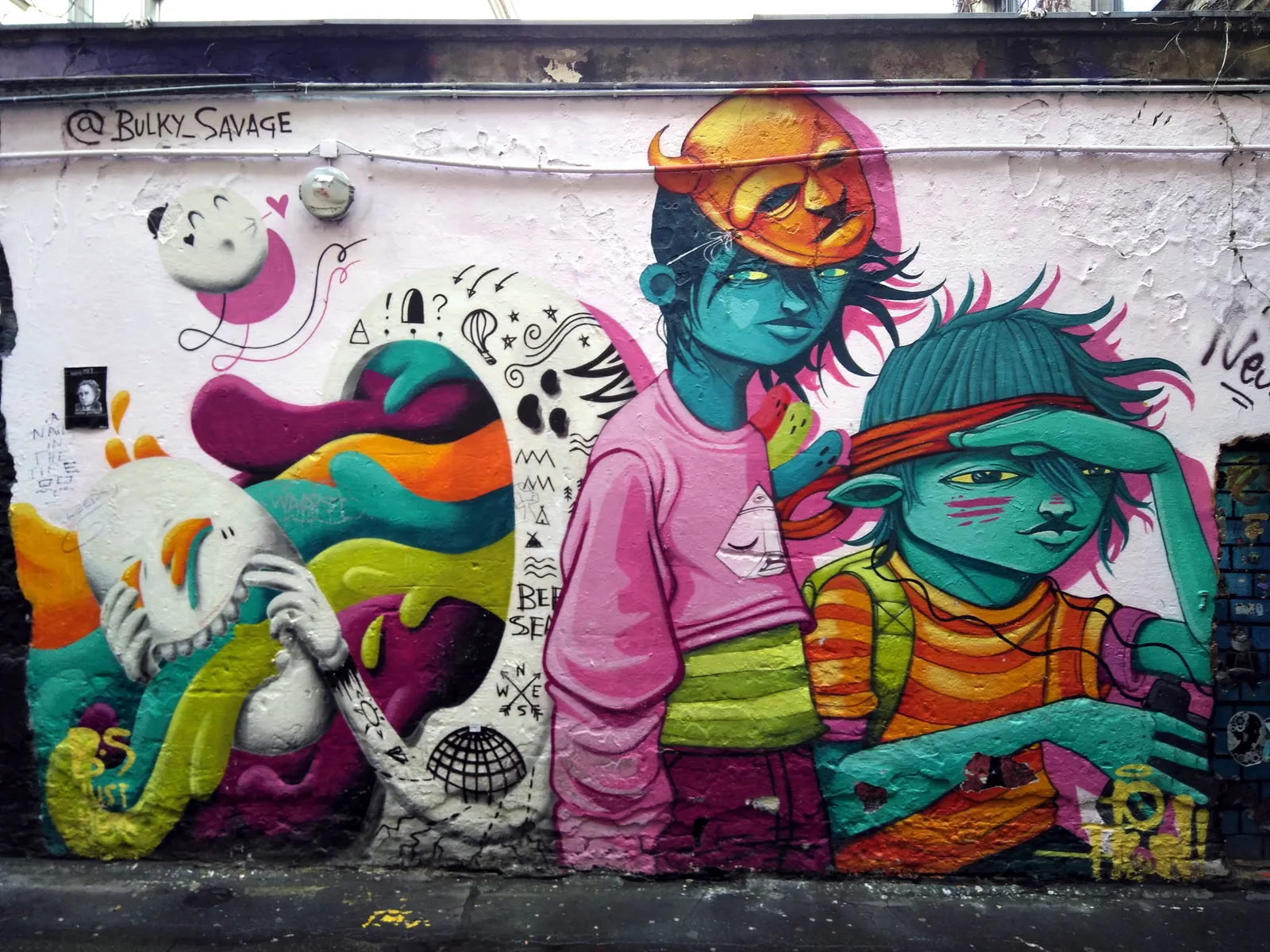
Most people photograph the courtyard and leave, which means they walk past the door on the left of it. Behind that door is the Museum Blindenwerkstatt Otto Weidt, and it is the reason to come to this address rather than the one next door.
Weidt ran a small workshop here making brooms and brushes, staffed mainly by blind and deaf Jewish workers. Because the workshop was classified as essential to the war effort, he was able to shield his employees for a time, and when that stopped working he forged papers, bribed Gestapo officers, hid a family in a sealed back room of the workshop itself, and followed one of his workers to Auschwitz to try to get her out. The museum is the actual workshop, small enough to see properly in half an hour, and the hidden room is still there. Admission is free, and it opens 9am to 6pm on weekdays and 10am to 6pm at weekends.
Seven minutes west, a gilded dome
Walk out to Oranienburger Straße and the ribbed gold dome ahead of you belongs to the Neue Synagoge, finished in 1866 and, at the time, the largest synagogue in Germany, built in a Moorish revival style deliberately unlike anything else on the street.
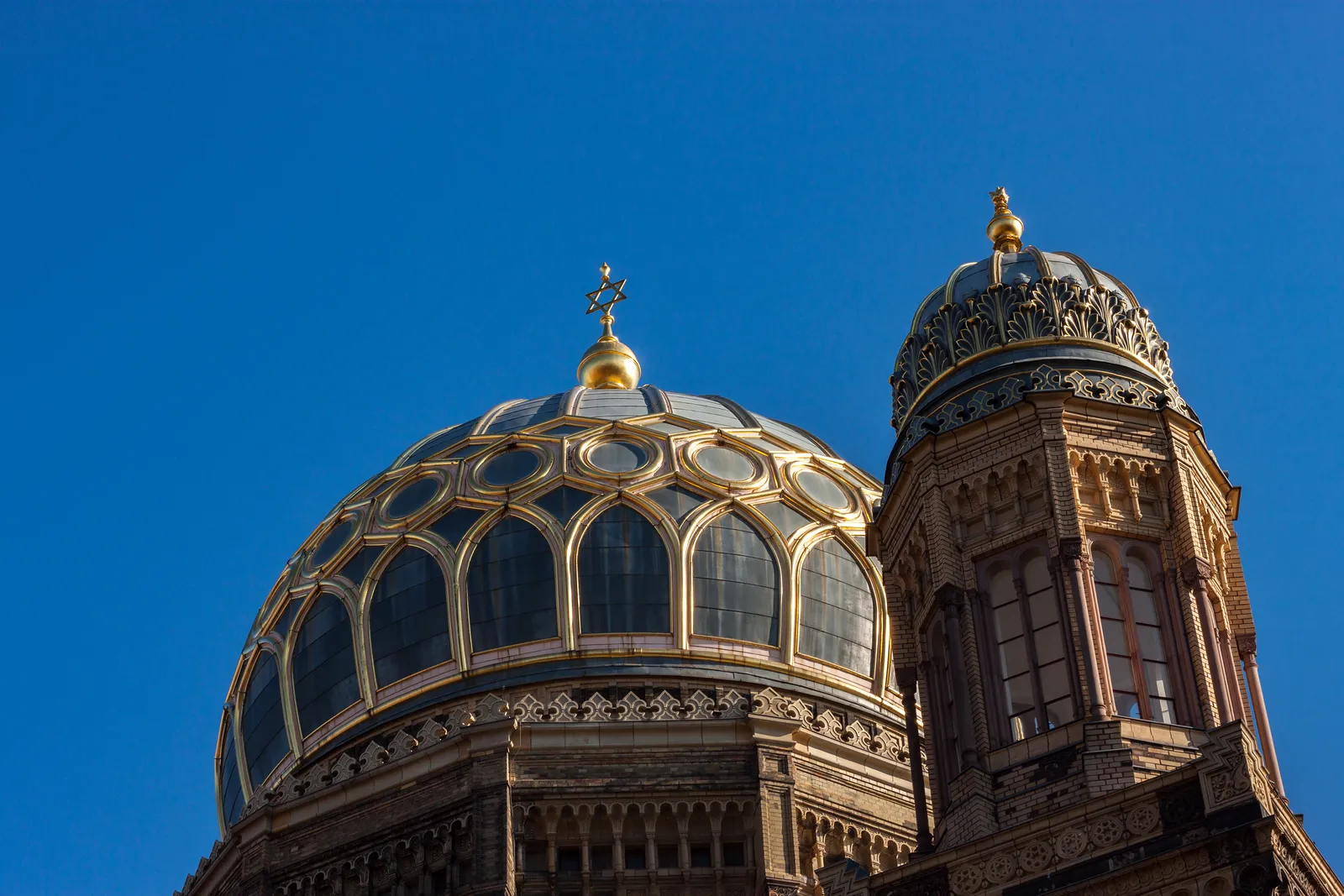
What stands now is mostly front. The building survived the November 1938 pogrom largely because a local police officer, Wilhelm Krützfeld, faced down the mob and called the fire brigade, then was heavily damaged by bombing in 1943 and the ruin of the main hall was cleared in 1958. The facade and dome were rebuilt in the 1990s, and the space where the prayer hall stood is now marked out on the ground behind it. This whole district was the centre of Jewish Berlin before the war, which is the thread running through everything on this page, including the workshop at number 39.
A layover measured in doorways
This is a small itinerary geographically and a dense one otherwise: about a kilometre of walking, one restored courtyard chain, one deliberately unrestored one, a free museum in a room where people were actually hidden, and a dome you can see from three streets away. It works on a two-hour window and it does not need a single ticket. The archways are the only awkward part, and only if you are dragging something through them.
Frequently asked questions
Can I walk the courtyards at any time of day?
The chain works as a public route through the block between Rosenthaler Straße and Sophienstraße in daytime, and you can follow it without going into a single business. The rear courtyards are residential, though, so it quietens down considerably in the evening and the far end is not somewhere to be wandering loudly at night. Around forty shops and workshops, the cinema and the Chamäleon variety theatre all keep their own hours, so an early morning window gets you the architecture with almost nobody in it but nothing open.
What is at Rosenthaler Straße 39?
Haus Schwarzenberg, the courtyard immediately next door that was deliberately never restored. Inside it are the Museum Blindenwerkstatt Otto Weidt, which is free and opens 9am to 6pm on weekdays and 10am to 6pm at weekends, along with the Anne Frank Zentrum and the Silent Heroes Memorial Center. It is roughly thirty seconds' walk from the polished version and looks like a different decade.
Can I get to BER from here without changing?
Yes. Hackescher Markt is on the east-west S-Bahn, and the S9 runs from this platform to the airport with no change, which makes it one of the more forgiving places in central Berlin to leave from. If you would rather have the faster train, it is two stops west to Friedrichstraße and then on to Hauptbahnhof for the FEX.
Does this work with a pushchair?
Partly, and it is worth knowing in advance. The passages linking the Höfe run through narrow archways, several with raised sills and short flights of steps between courtyards, so a buggy means lifting it more than once. The workaround is to see the first courtyard from Rosenthaler Straße and then walk round the block on Sophienstraße at street level instead of threading the chain.