Los Angeles Union Station: Chinatown on Foot
Part of the full Los Angeles Layover: Downtown Walk From LAX
Chinatown’s Central Plaza, the 1890 Garnier Building that holds the Chinese American Museum, and 32 acres of parkland on an old railyard all stand within a mile of Los Angeles Union Station, and none of them charges admission.
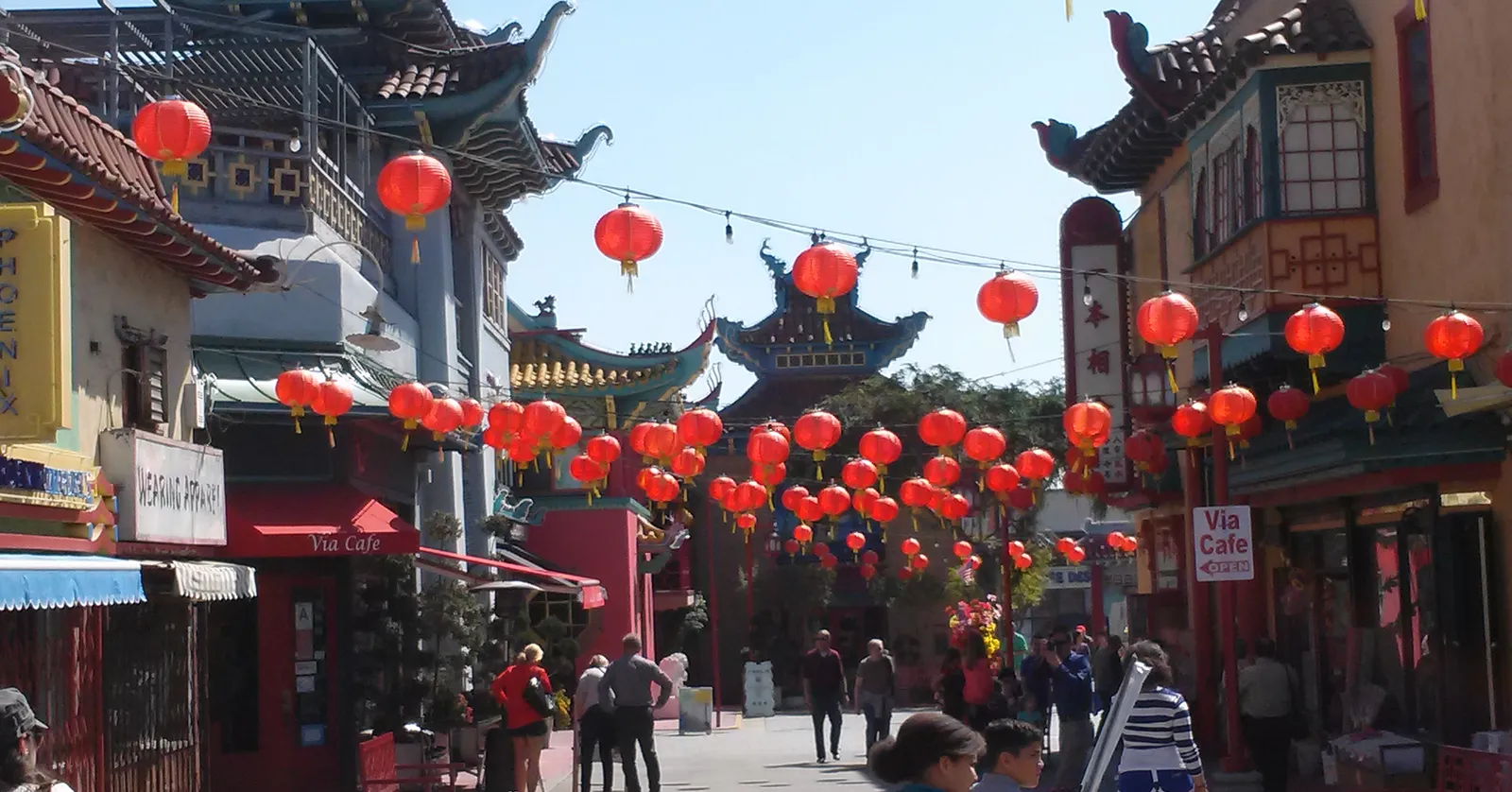
Chinatown’s Central Plaza has hung lanterns over Gin Ling Way since 1938
Central Plaza sits between North Broadway and Hill Street, about fifteen minutes on foot from Los Angeles Union Station or one stop north on the train. It was dedicated on 25 June 1938, and the thing that makes it worth the walk is who built it: after the original Chinatown was demolished to clear ground for the railway terminal, a group led by Peter Soo Hoo Sr. bought the land and laid out a replacement themselves, making this the first Chinatown in the country planned and owned by the Chinese community living in it. Hollywood set designers were brought in on the look, which is why the pagoda roofs, the painted eaves and the neon read as theatrical rather than transplanted.
The lanes carry their own names, Gin Ling Way, Bamboo Lane and Chung King Road, and the East Gate at the Broadway end is the Gate of Filial Piety. In the middle of the plaza is a wishing well that Professor Henry Liu shaped by hand in 1939, modelling concrete over rebar into a miniature of the Seven Star Caverns in Guangdong, with slots and basins to aim coins at. Hundreds of red lanterns hang on wires overhead, and after dark the whole block runs on neon.
The Chinese American Museum occupies the 1890 Garnier Building
The Chinese American Museum is at 425 North Los Angeles Street, inside the El Pueblo de Los Angeles historic monument and about five minutes from the station doors. The building around it is the exhibit as much as anything inside: Philippe Garnier put it up in 1890 with Chinese tenants in mind, and it is the oldest structure left in the city with that connection to the Chinatown that stood here before the railway took the site.
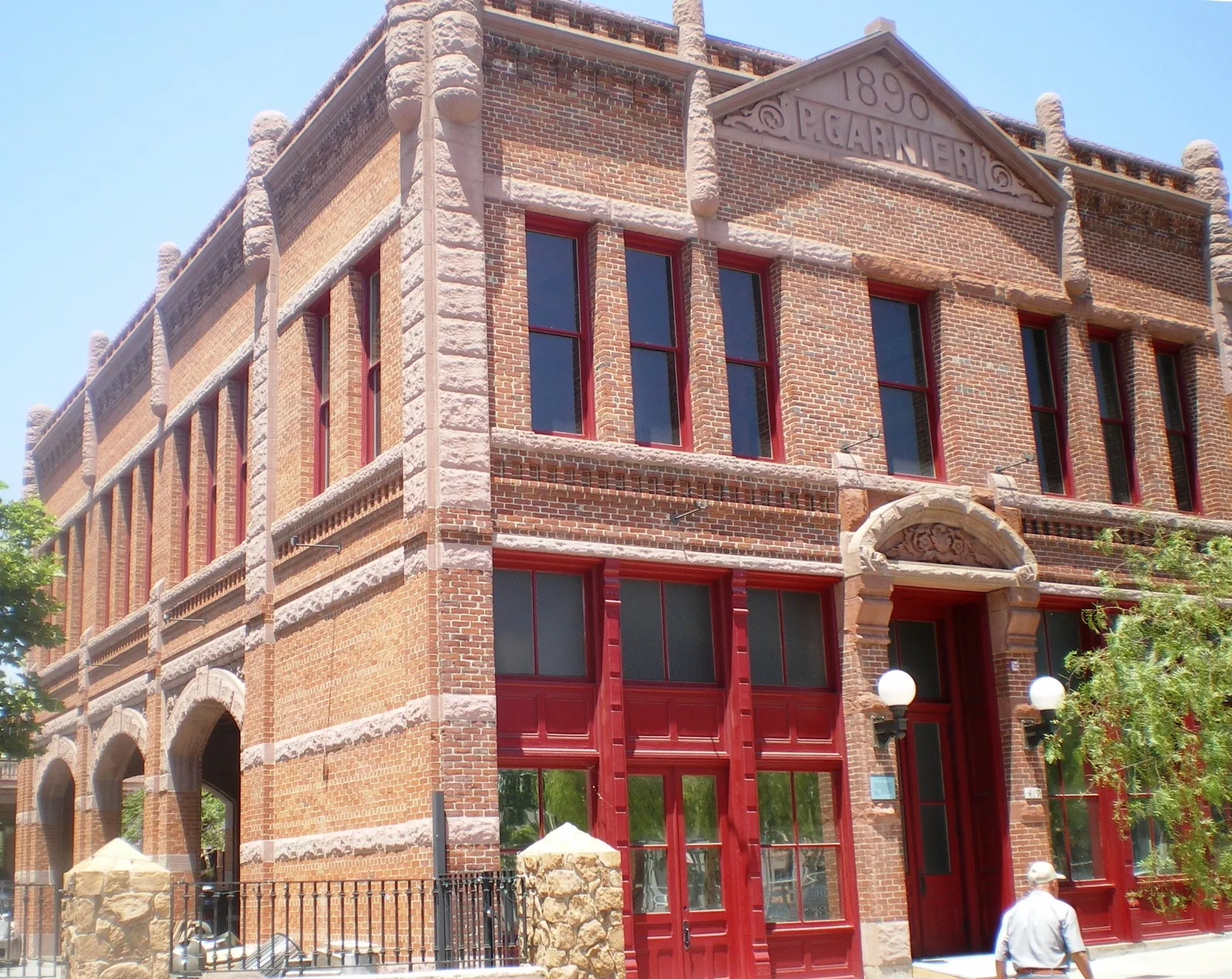
Admission is free with a suggested $3 donation, and the galleries run Tuesday to Sunday from 10am to 3pm, which is the tightest set of hours on this route. The permanent displays cover the herb shop, the association halls and the family businesses that filled these blocks before demolition, so the building and the story in it are the same story. For anyone who would rather have the surrounding blocks explained than read plaques, a downtown architecture walking tour can be booked ahead and covers this end of the city on foot.
Philippe the Original sells its French dip over a sawdust floor
Philippe the Original stands at 1001 North Alameda Street, roughly ten minutes north of the station on the same street. Philippe Mathieu opened it in 1908 further down Alameda and moved it here in 1951 when the Hollywood Freeway took the original building. Wood shavings still go down on the floor every day, the tables are long and communal, and you order standing at a counter from carvers working a line rather than from a screen. A beef dip runs $14.95 and the doors are open daily from 6am to 10pm.
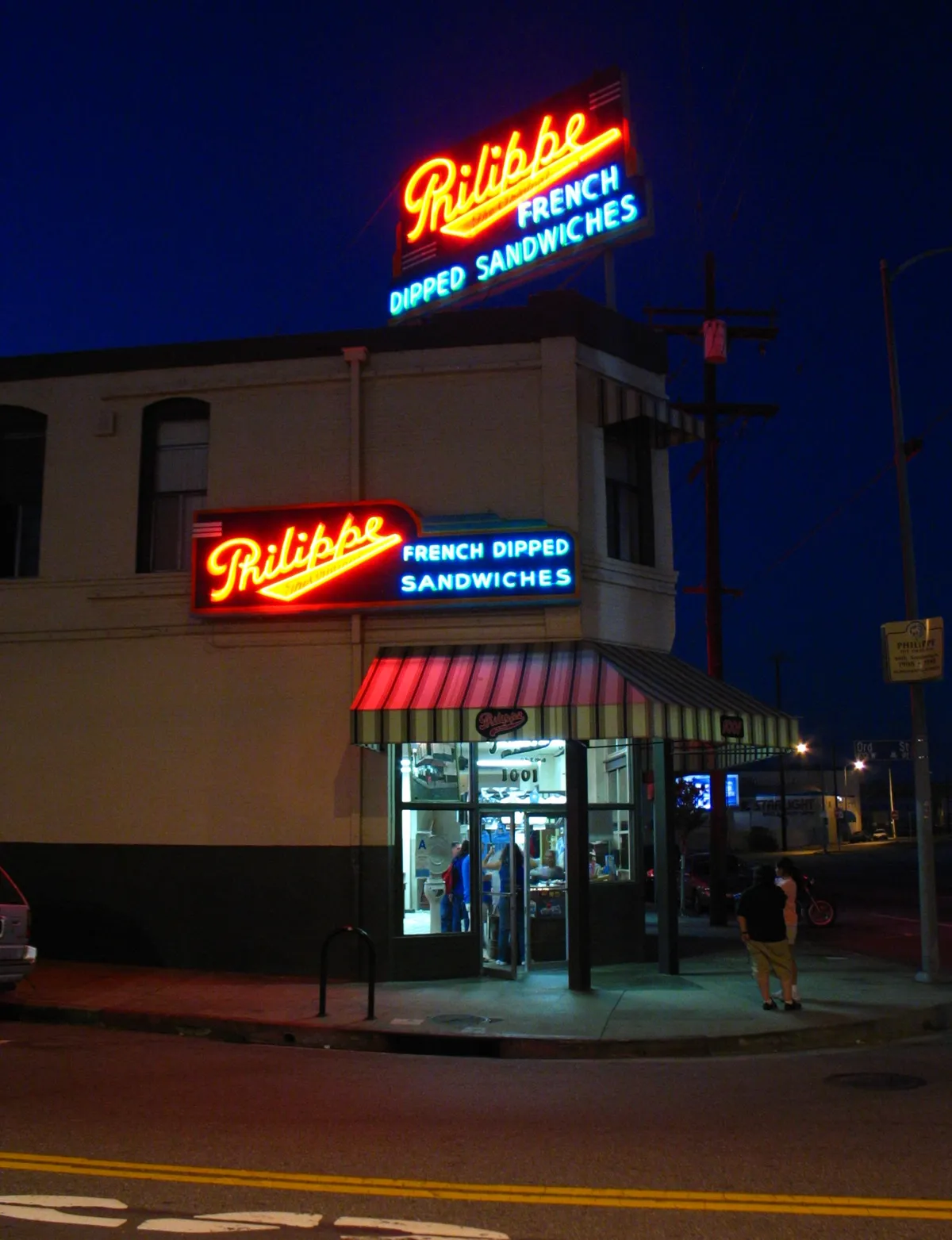
Whether the French dip was actually invented here is not settled: Cole’s, a few blocks southwest, makes the same claim for the same year, and both have been making it for a century. The house detail worth knowing is the coffee, which sat at nine cents a cup from 1977 until 2012, when it finally went up.
Union Station has no public lockers, at the concourse or anywhere else in the building: the self-service ones came out on security grounds and never came back, and the Amtrak baggage desk handles checked bags for ticketed rail passengers rather than day storage.
One bus runs nonstop to the airport while the train needs two changes and a shuttle
The FlyAway leaves from Bay 1 at the Patsaouras Transit Plaza on the Vignes Street side of the station and runs to every terminal at Los Angeles International Airport without stopping in between, $9.75 one way, using the toll and carpool lanes for most of the distance. Departures come every 20 to 30 minutes through the day and drop to hourly overnight, and tickets are sold at the staffed kiosk on the plaza or from any Metrolink ticket machine in the station. The ride itself is 35 to 55 minutes depending on traffic.
Metro costs $1.75 with transfers free for two hours, but it is not one vehicle: the B or D Line subway from beneath the station to 7th St/Metro Center, the E Line west to Expo/Crenshaw, the K Line south to the LAX/Metro Transit Center, and then a free shuttle from Bus Bays 1 and 2 into the terminals, since the automated people mover that will eventually link the station to the gates is still in testing with no opening date announced. Budget two and a half hours from here for the trip, check-in and security either way, and note that the trains stop around midnight while the airport bus does not.
Los Angeles State Historic Park covers 32 acres of former railyard
Los Angeles State Historic Park runs along North Spring Street on the north edge of Chinatown, a mile from the station and a short walk from the train stop that serves this neighbourhood. With four hours or more before a flight it is the obvious addition to everything above: open lawn, gravel paths, native planting and an unobstructed line of sight to the downtown towers, free, open daily from 8am.
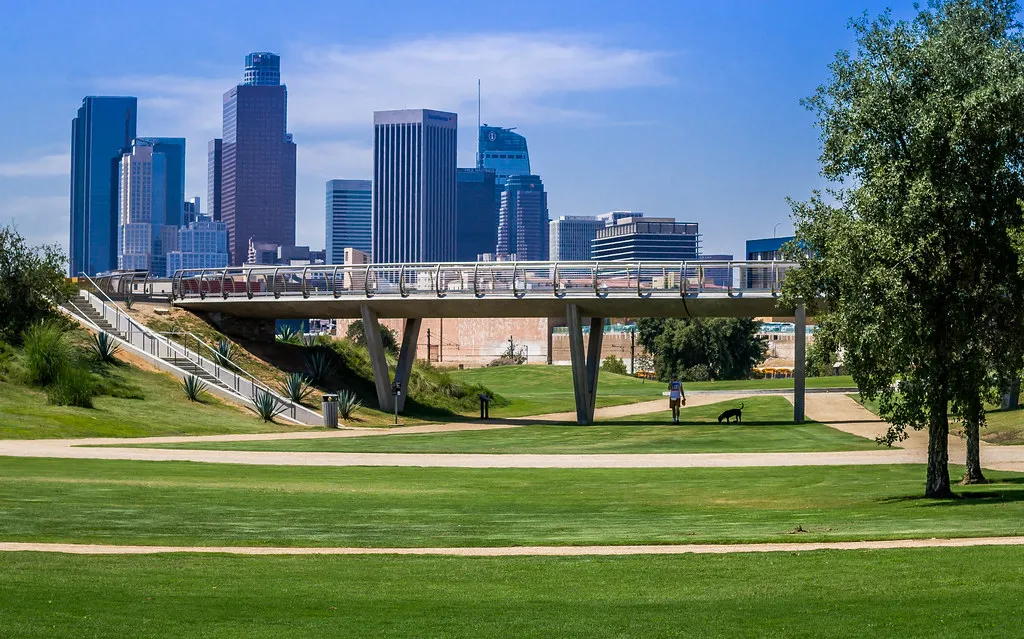
The ground has a longer record than the grass suggests. Southern Pacific’s River Station stood here from the 1870s, the point where most arrivals to Los Angeles first stepped off a train, and a five-foot section of the Zanja Madre, the ditch that carried river water to the original pueblo, was dug up on the site in 2001. Locals called the derelict yard the Cornfield for the corn that grew from kernels dropped by freight cars, and the park opened on the cleared ground in April 2017. Dodger Stadium is on the hill above it, and the shuttle up to games is free with a ticket from the same station plaza the airport bus uses, so seats for a home game are worth a look if your dates line up. If you would rather spend the time on buildings than open ground, the downtown walk from the Broadway market up Bunker Hill starts a couple of stops away and covers a funicular, a free art museum and the oldest house in the city.
Everything on this route is a street, a lawn or a counter you eat standing near, which is the argument for arriving at all of it with your hands free.
Frequently asked questions
Does Los Angeles Union Station have luggage lockers?
No. The self-service lockers were taken out for security reasons years ago and were never put back, at Union Station or at the airport. Amtrak runs a baggage desk inside the station, but that is for ticketed rail passengers with checked bags, not a general left-luggage counter, so anyone stepping out to walk around the neighbourhood needs to settle a suitcase somewhere off the concourse first.
When is the Chinese American Museum open?
Tuesday to Sunday, 10am to 3pm, and it is shut on Mondays as well as Thanksgiving, Christmas Day and New Year's Day. That is a short window by museum standards, so it is the one stop here worth checking the clock against: everything else in this neighbourhood is either outdoors or open long hours. Admission is free, with a suggested donation of $3 for adults and $2 for seniors and students.
What can you do near Los Angeles Union Station without spending anything?
Almost all of it. Central Plaza in Chinatown is an open street with no admission, the wishing well in the middle of it takes coins only if you feel like throwing one, the Chinese American Museum asks for a donation rather than a ticket, and Los Angeles State Historic Park is a free state park. The station's own vaulted hall and its two garden courtyards are open to anyone who walks in. The only thing on this route with a fixed price is lunch.
How early can you get breakfast near Los Angeles Union Station?
Six in the morning, every day of the week, at Philippe the Original on North Alameda Street. It opens at 6am and runs until 10pm, which makes it one of the few sit-down options near the station that is already going before the first commuter trains fill the concourse, and it serves breakfast plates as well as the sandwiches it is known for.