Casablanca Layover Near Ain Diab Corniche
Part of the full Casablanca Layover: Hassan II Mosque, CMN
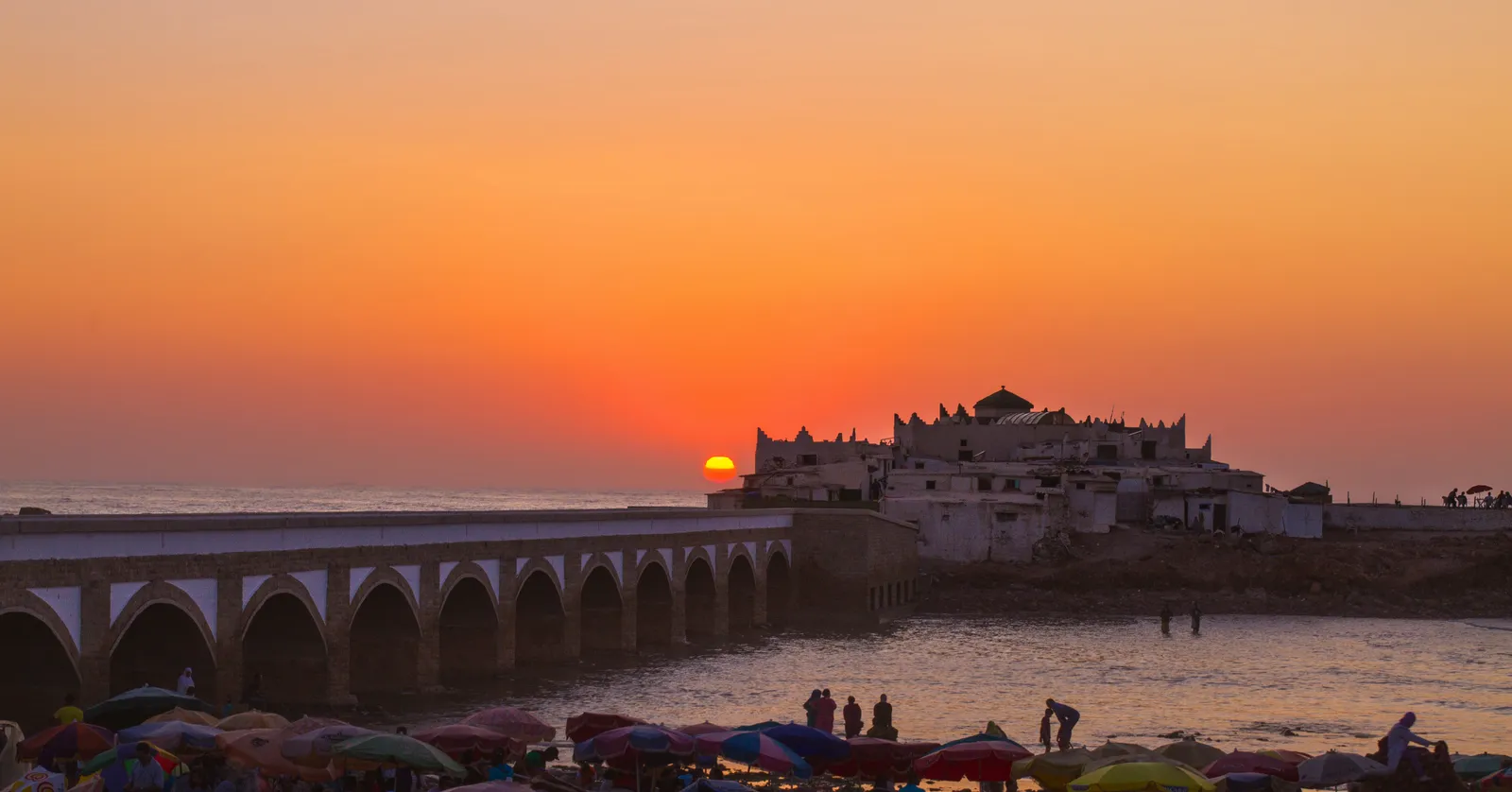
Casablanca’s Ain Diab corniche is a seafront boulevard with the El Hank lighthouse standing over one end of it, a saint’s shrine on a rock offshore at the other, and two public beaches and a long run of café terraces in between.
El Hank’s lighthouse has been lit since 1920
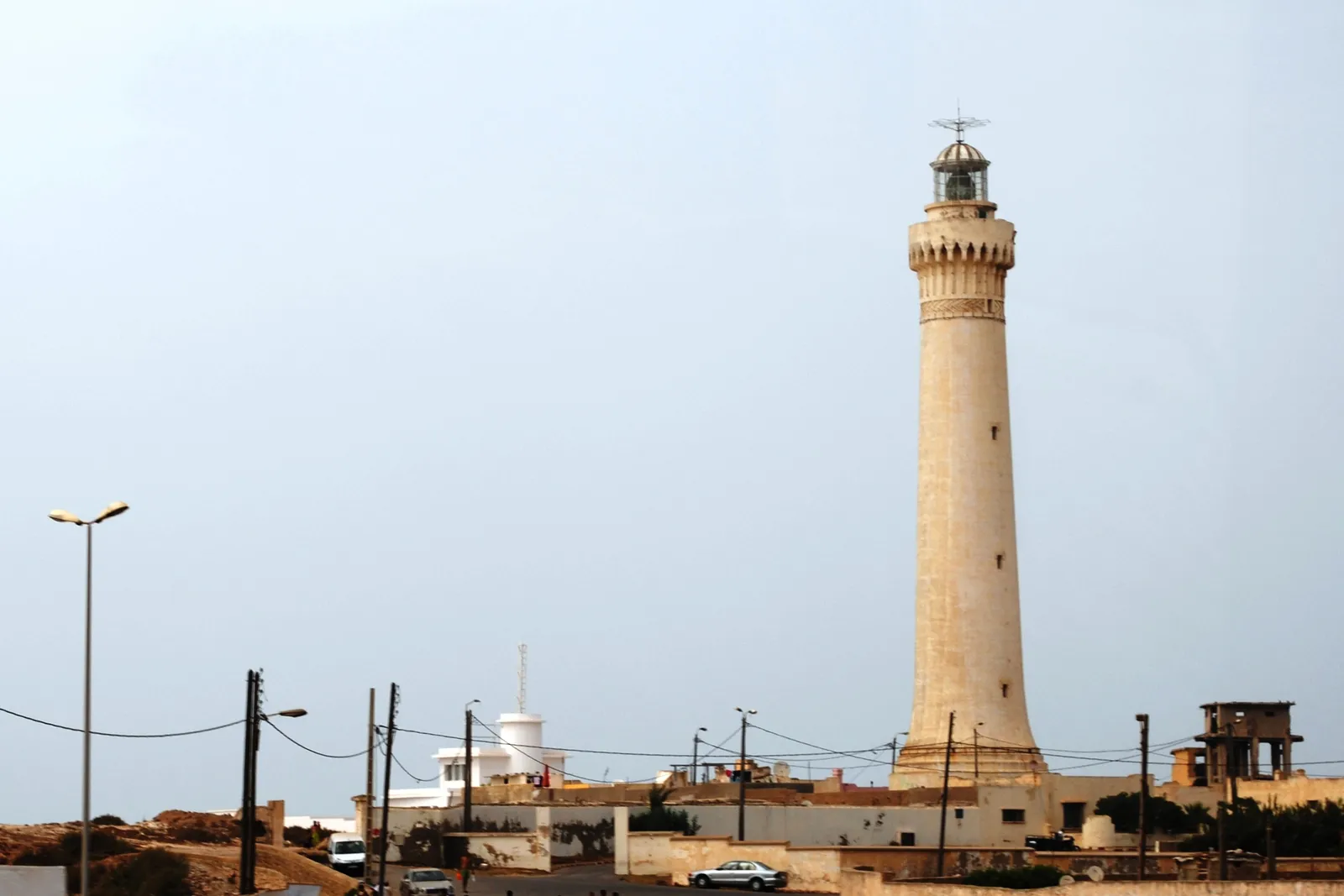
Morocco’s tallest lighthouse stands on the El Hank headland, west of Casablanca’s port, at the eastern end of the corniche: 51 metres of tapering stone over a base 6.6 metres across, on a site Albert Laprade restored in 1916. It is still a working light. There is no ticket desk and no set admission: the keeper unlocks the stairs, walks you up the 256 steps to the upper platform, and is generally handed 30 to 50 dirhams for the trouble.
What you get at the top is the whole coast at once, the corniche running southwest and the Hassan II Mosque about two kilometres east along the shore. Seeing the inside of that building is a separate exercise: non-Muslim visitors are admitted only on the mosque’s own scheduled tours, and a slot on one can be held in advance rather than chanced on the day. The streets immediately around the lighthouse are ordinary residential blocks rather than anything laid on for visitors, which is worth knowing before you go looking for a café at this end.
Two public beaches sit below Boulevard de la Corniche
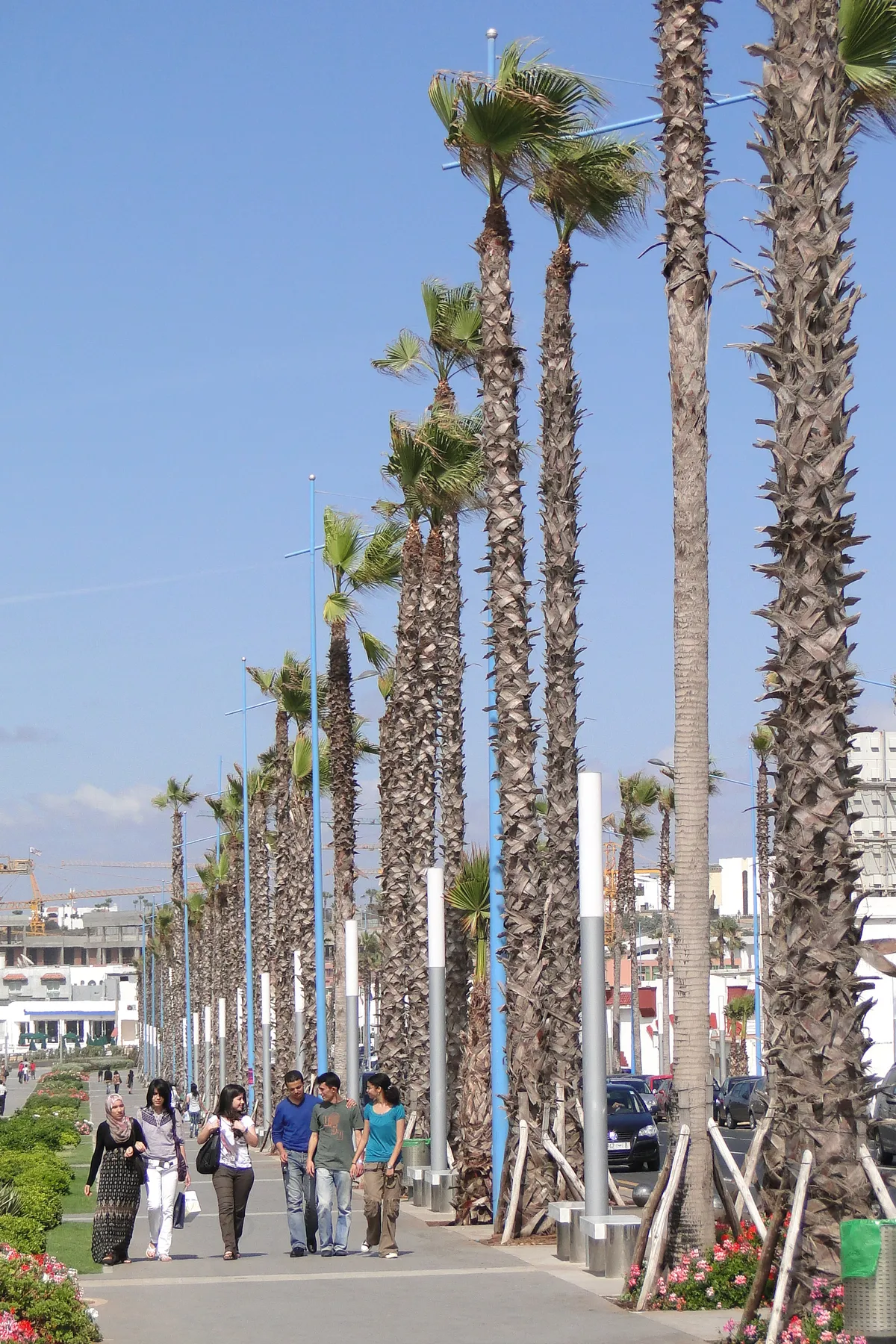
Boulevard de la Corniche runs roughly five kilometres from the headland down to the Sidi Abderrahman rock, and the free sand along it is at Lalla Meryem and Ain Diab, wedged between the private beach clubs, the hotel frontages and a more or less continuous line of café terraces and ice cream counters. The promenade above the sand is flat, wide and almost entirely unshaded. The tram’s western terminus sits at the beach end of the boulevard, and every journey on that network costs a flat 8 dirhams no matter how far you ride.
These roads were a Formula One circuit once, briefly. The Royal Automobile Club of Morocco laid out a 7.6-kilometre course on the public roads here in 1957, eighteen turns strung together from the coast road past Ain Diab and the Azemmour road through the Sidi Abderrahmane forest, and it took six weeks to build. The 1958 Moroccan Grand Prix on 19 October was the last round of that season and the title decider: Stirling Moss won it in a Vanwall, Mike Hawthorn finished second and became Britain’s first world champion, and Stuart Lewis-Evans died in an English hospital eight days later of burns from a crash on the same afternoon. No championship race ever came back, and the coast road went back to being a coast road.
Nothing on this stretch starts on a platform. You arrive by tram or by taxi at one end of a five-kilometre boulevard and leave from wherever you finish walking, so anything you are carrying comes the whole way with you rather than waiting where you got off.
Sidi Abderrahman’s shrine sits on a rock off the sand
A tight cluster of whitewashed houses and a domed tomb covers a rocky outcrop just offshore at the southwestern end of the corniche, and the tomb is the reason the rest of it is there. Sidi Abderrahman, a saint venerated locally as a healer, came from Baghdad, ran aground on this beach and lived out his life on the rock; the tomb has drawn pilgrims for generations, along with a standing trade in fortune-telling in the lanes around it. Non-Muslim visitors can cross and walk between the houses, but the mausoleum itself is closed to them.
An arched footbridge carries you out there, put up in place of a crossing that only worked at low tide, and it is the only dry way on and off. For the walled medina, the civic square and the market halls that make up the rest of the city, Casablanca’s city-centre itinerary starts down at the port and works inland instead.
Morocco Mall’s aquarium is a glass cylinder you walk around
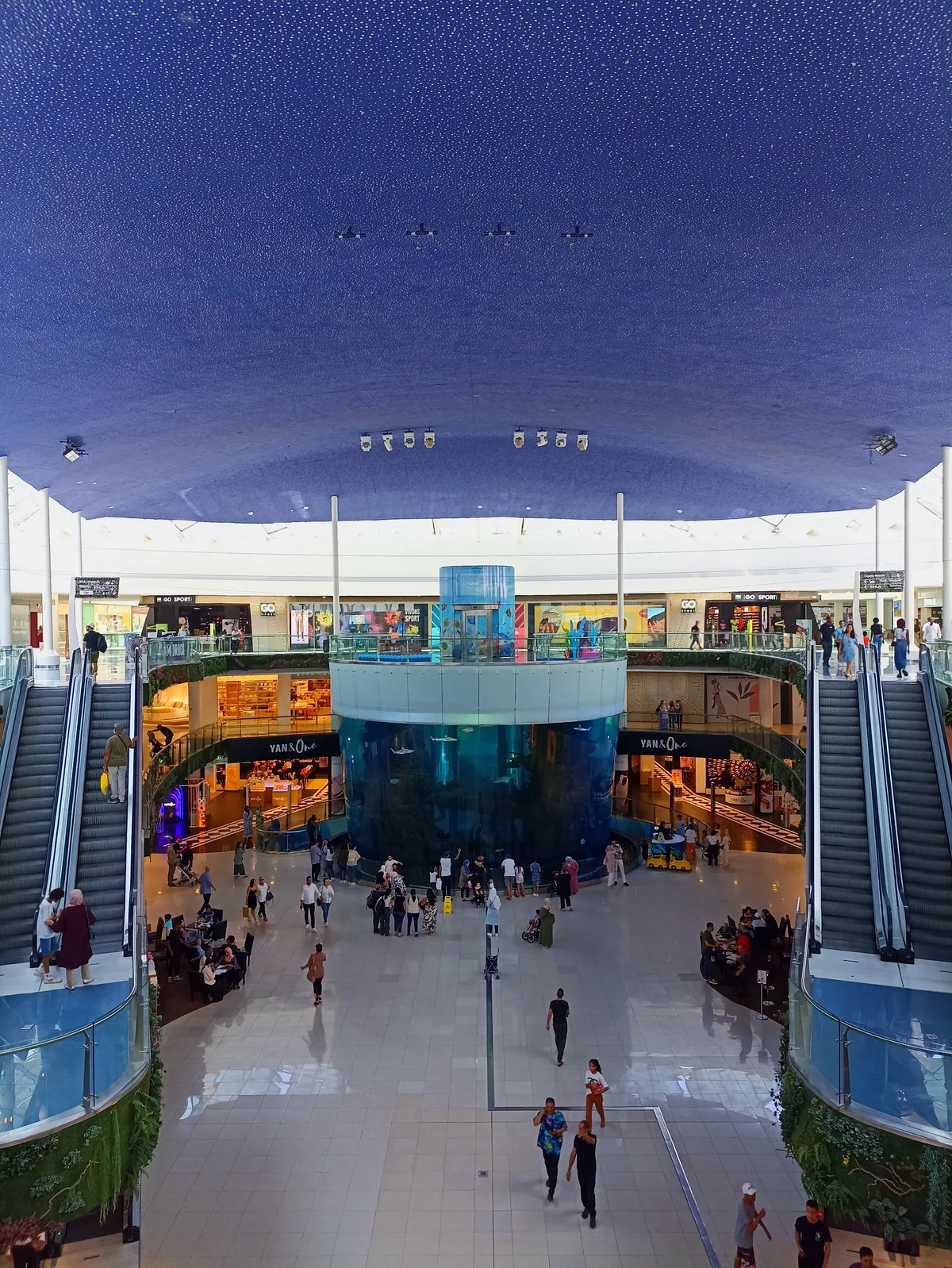
Aquadream stands in the middle of the atrium floor at the southwestern end of the corniche: a single cylindrical tank holding around a million litres of seawater and more than forty species of fish, with a lift inside a central tube that runs down through the water while you look out at it. A qualified diver can arrange to go into the tank with an instructor. The aquarium charges admission; the mall around it, 190,000 square metres of it opened on 1 December 2011, costs nothing to walk into.
This is also the corniche’s answer to bad weather. The promenade is exposed to the open Atlantic along its whole length, and when the wind comes in off the water there is no shelter between the lighthouse and here.
No airport train calls anywhere near the corniche
The ONCF service to Mohammed V International Airport (CMN) runs from Casa-Port through Casa-Voyageurs and Oasis to the terminal, and the nearest of those is about six kilometres back east of Ain Diab beach, with Casa-Voyageurs nearer eight. Tram line T2, the one that ends at the beach, calls at neither: for Casa-Voyageurs you change onto line T1 in Maarif, where T2’s Anoual stop and T1’s Abdelmoumen stop are a short walk apart. Departures for the airport come about once an hour, second class costs around 50 dirhams, the ride is roughly 35 minutes from Casa-Voyageurs and 45 from Casa-Port, and the last one leaves the city late in the evening.
Two legs and a change is the honest description, so a petit taxi straight from the boulevard to the terminal is the version worth paying for when the clock is tight. Either way this is the furthest out of town you can get on the tram and still be looking at the sea, and the walk back up the promenade is a different exercise with your hands empty than with a suitcase rolling over five kilometres of paving.
Frequently asked questions
What should I do during a layover near Ain Diab Corniche in Casablanca?
Start at the El Hank lighthouse on the headland at the eastern end of the boulevard: it has been lit since 1920, it is Morocco's tallest at 51 metres, and the keeper will take you up the 256 steps for a tip. From there the corniche runs roughly five kilometres southwest past two public beaches, Lalla Meryem and Ain Diab, to the rock where Sidi Abderrahman's shrine stands behind a row of whitewashed houses, reached now by a footbridge rather than at low tide. Four to five hours covers the length of it comfortably. The aquarium at the Morocco Mall end is the piece to drop first, or the piece to keep if the Atlantic wind is up.
How do I reach the Ain Diab corniche from central Casablanca?
The tram is the cheap way: one line ends at Ain Diab Plage, right at the beach end of the boulevard, and every journey on the network is a flat 8 dirhams whatever the distance. Trams come around every ten minutes. A red petit taxi does the same trip in about ten minutes from the centre, which is worth it in the middle of the afternoon; insist on the meter or agree the fare before you get in.
Can I walk out to Sidi Abderrahman's rock at any time of day?
Yes, now. The crossing used to depend on the tide, which meant timing a visit to the hour, and an arched footbridge has taken that problem away: it carries you over whatever the water is doing, and it is the only dry way back. What the bridge does not get you is the mausoleum itself, which is closed to visitors who are not Muslim. The rest of the rock is not: the whitewashed houses and the fortune-tellers' doorways between them are open to walk among.
Is the corniche any good with kids?
Better than the city centre, with one caveat. The promenade is flat, wide and unshaded, the beaches are free to walk onto, and the aquarium at the Morocco Mall end is a single cylindrical tank of around a million litres with a lift running down through the middle of it. The caveat is the water: this is the open Atlantic rather than a sheltered bay, so swimming belongs on the stretches with lifeguards on them rather than anywhere along the sand.