Berlin Layover Near Ostbahnhof and the East Side Gallery
Part of the full Berlin Layover Guide: What to Do Before a Flight Out of BER
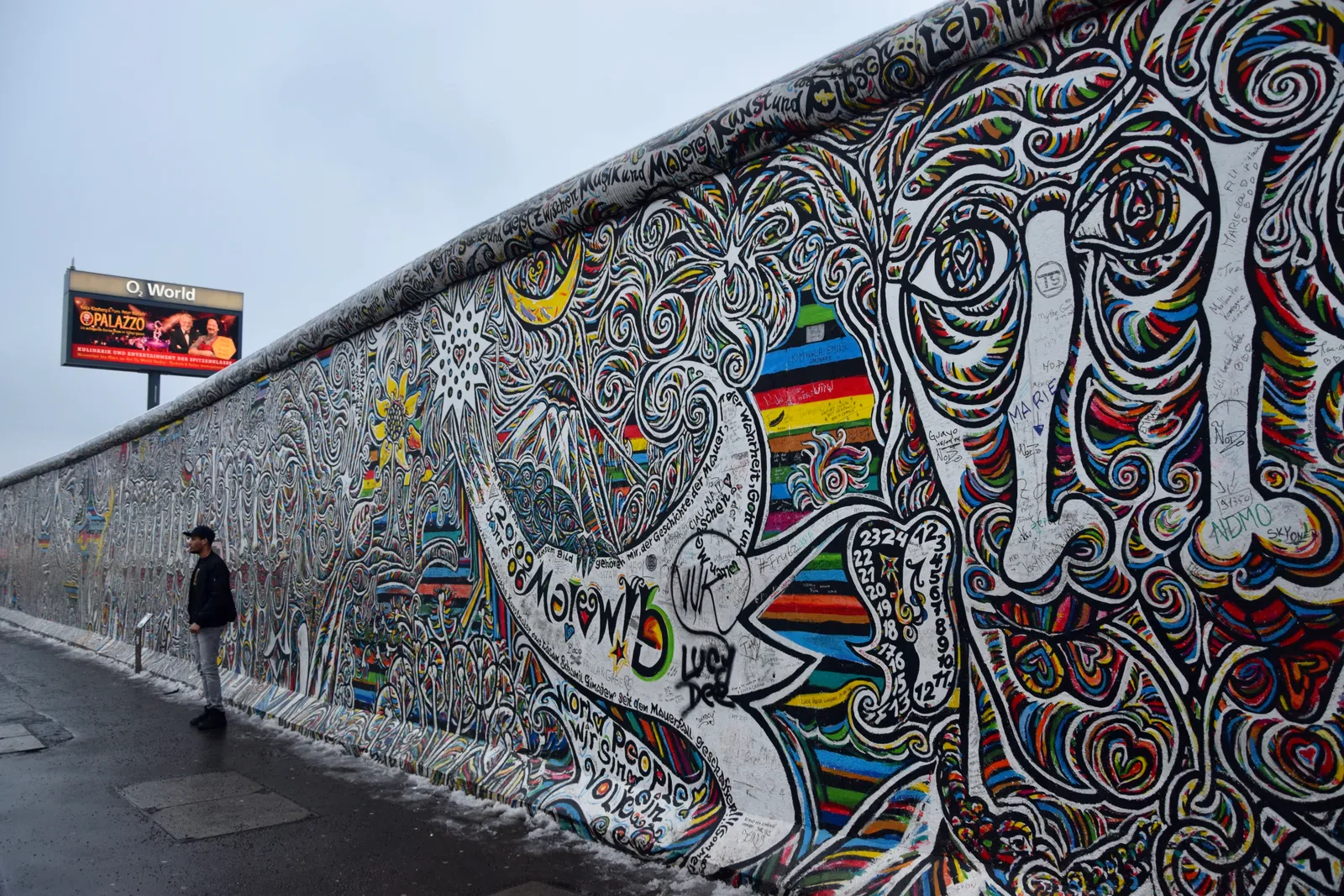
From Berlin Ostbahnhof, walk the 1,316 metres of the East Side Gallery to the Oberbaum Bridge, the longest surviving stretch of the Berlin Wall, then pick up the S9 back to BER without changing trains.
The longest piece of the Wall left standing
Almost all of the Berlin Wall is gone. What survives is mostly fragments: a line of cobbles in the road, a preserved section behind glass, a watchtower marooned between office blocks. The exception is here, five minutes east of Berlin Ostbahnhof, where 1,316 metres of it still runs along Mühlenstraße beside the Spree.
This piece survived because artists got to it first. Painting began within weeks of the border opening in November 1989, and by the time the East Side Gallery formally opened on 28 September 1990 there were 118 artists from 21 countries working on it. In 1991 the whole strip was given protected monument status, which is the reason it is still standing while the river frontage behind it has been comprehensively built on.
It is worth understanding what you are looking at, physically. This was the inner wall, the one facing East Berlin, which is why it is smooth and unbroken: the graffiti-covered wall in every photograph from the 1980s was the western face of a different barrier, and East Berliners could not get near this side of it at all. The paintings are on the surface nobody was allowed to touch.
The panels people actually stop at
Nobody looks at all 100-odd murals with equal attention, and there is no need to pretend otherwise. Three or four do the work.
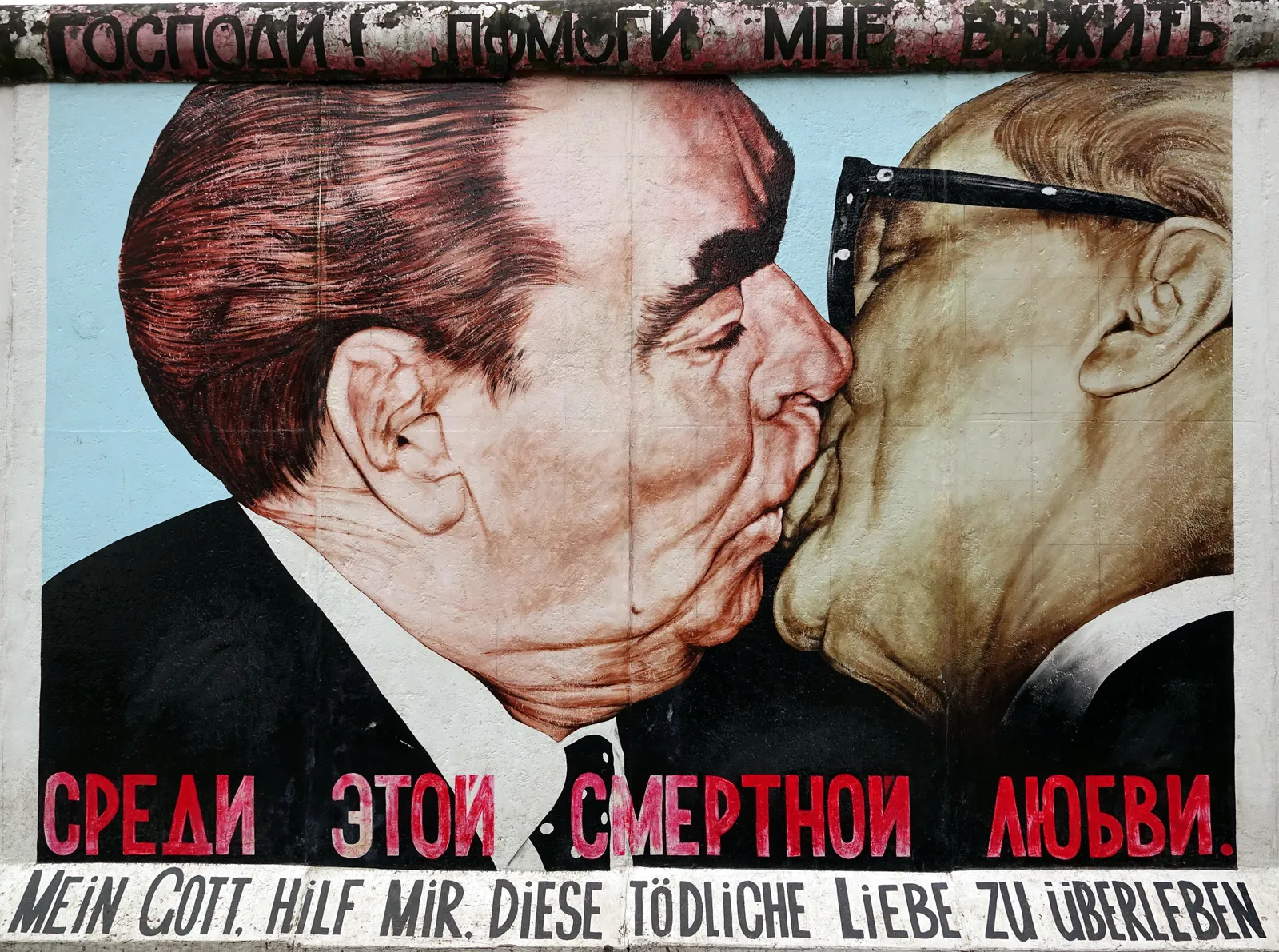
The famous one is Dmitri Vrubel’s painting of Brezhnev and Honecker kissing, copied from a 1979 press photograph of the standard socialist fraternal greeting, captioned “My God, Help Me to Survive This Deadly Love.” It is roughly two thirds of the way along from the Ostbahnhof end and there is usually a small crowd in front of it.
The other one everybody photographs is Birgit Kinder’s Trabant driving straight through the concrete with an East German number plate reading NOV 9-89. Between them are a hundred other panels ranging from genuinely good to student-union mural, and the pleasure of the walk is in not being told which is which.
The bridge at the end of it
The gallery finishes at the Oberbaumbrücke, and you should walk onto it rather than turning round at the last panel. It is a double-decker in red brick with two neo-Gothic towers, carrying the U1 on a viaduct above the road, and from 1961 to 1989 it was a border crossing: for most of that period a pedestrian-only one, usable by West Berliners in one direction under tightly controlled conditions.
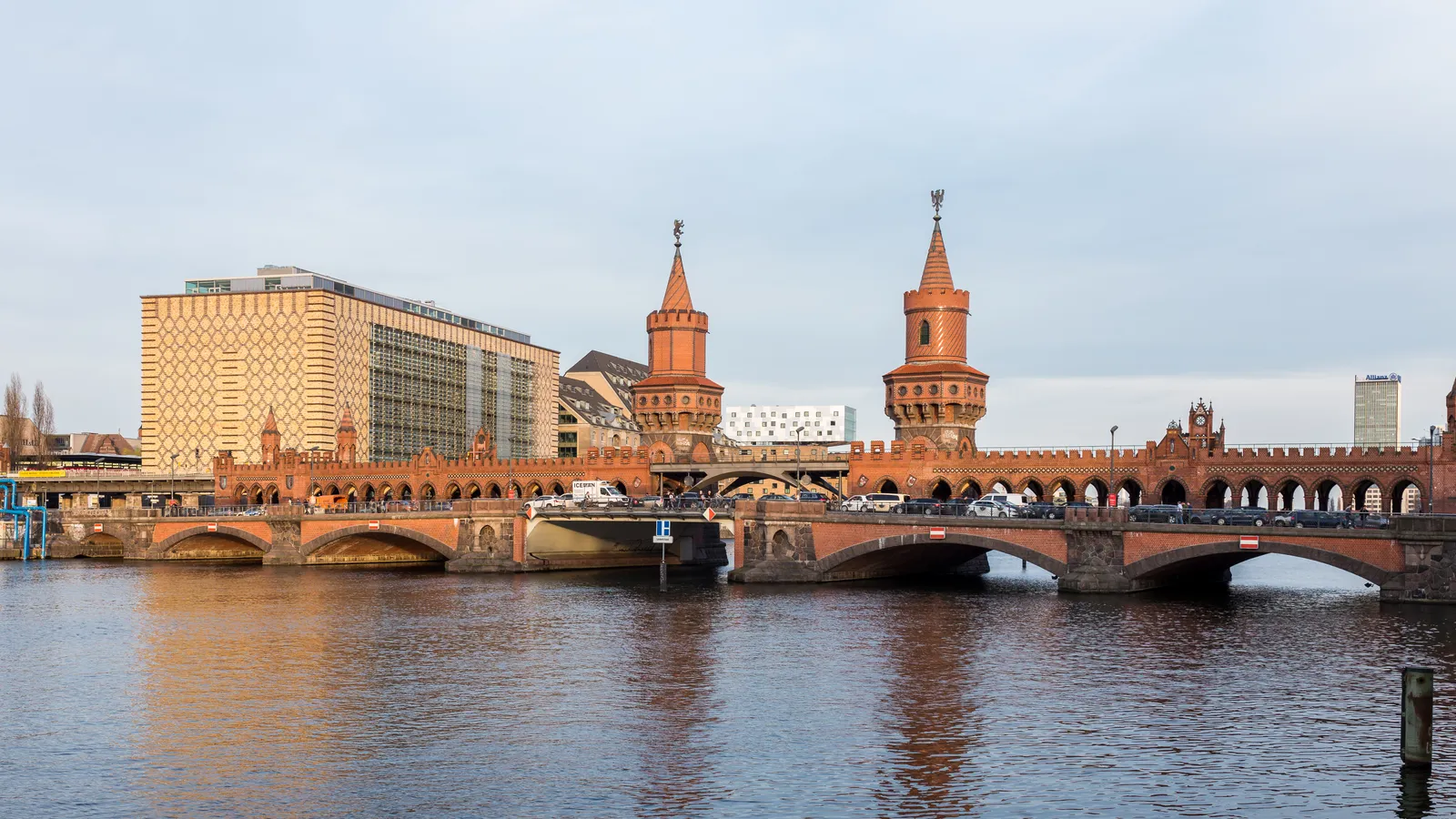
If your window runs into the evening, look up at the middle of the railway arch. Set into the central spandrel since 1997 are two round light boxes about a metre across, holding neon outlines of a fist, a flat hand and two splayed fingers. It is a permanent work by Thorsten Goldberg called Stone, Paper, Scissors: the two boxes play the game against each other, changing at random every few seconds, all night. The artist’s point was that which side of this bridge you were born on, and therefore how your life went, was decided by nothing better than a hand game. It runs from dusk until around 1am, costs nothing, and almost nobody standing underneath it notices.
The catch with this whole itinerary is its shape. The paintings face one way along a single straight line, so seeing them means walking out and coming back, and 1,316 metres each way with a case on wheels is a different proposition from the same walk unencumbered.
An extra hour belongs in Friedrichshain
If you have time after the bridge, do not get back on a train. Head north into Friedrichshain instead, where Boxhagener Platz and the streets around it are the ordinary residential version of the neighbourhood the tourists on the wall never see, full of second-hand shops and cafés with tables on the pavement. It is roughly fifteen minutes’ walk from Warschauer Straße, and the Sunday flea market on the square is the one day it gets genuinely busy.
Two stations, one wall
This is the least complicated layover in Berlin: one straight line, one subject, no tickets, and a station at each end. Ostbahnhof also happens to be one of the few places in the city with a direct train to the airport, so the whole thing closes cleanly. Get the bag out of the equation first and the rest of it is just a walk beside a river.
Frequently asked questions
Should I start at Ostbahnhof or Warschauer Straße?
Ostbahnhof if you are arriving by long-distance train, since the wall starts about five minutes from its eastern exit and the walk then runs downhill in interest toward the bridge. Warschauer Straße is the other end, on the U1 and U3 with the trams. The practical argument for Ostbahnhof is the return: the S9 runs from here to BER without a change, so you never have to double back through the centre.
Is the East Side Gallery free, and is it ever closed?
It is a public street, so there is no ticket, no gate and no closing time. It was declared a protected monument in 1991, roughly a year after it opened as a gallery, which is why the wall itself has survived the development that has gone up all around it. The murals draw more than three million visitors a year and it still costs nothing to see any of them.
Are these the original 1990 paintings?
Mostly not the original paint, though largely the original artists. The murals weathered badly through the 1990s and 2000s, and a restoration around 2009 brought many of the original painters back to repaint their own panels on a prepared surface. Tagging over the top is constant and gets cleaned off periodically, so exactly what you see varies month to month.
Is this walk bearable in summer heat?
The wall side is the problem: it runs along Mühlenstraße facing traffic, with very little shade and almost nowhere to sit for most of its length, so an August afternoon on that side is hot and loud. The fix is to walk one direction on the wall side and come back on the grass strip behind it along the Spree, which has trees, benches and a breeze off the water.