Marseille Layover: Vieux-Port From MRS
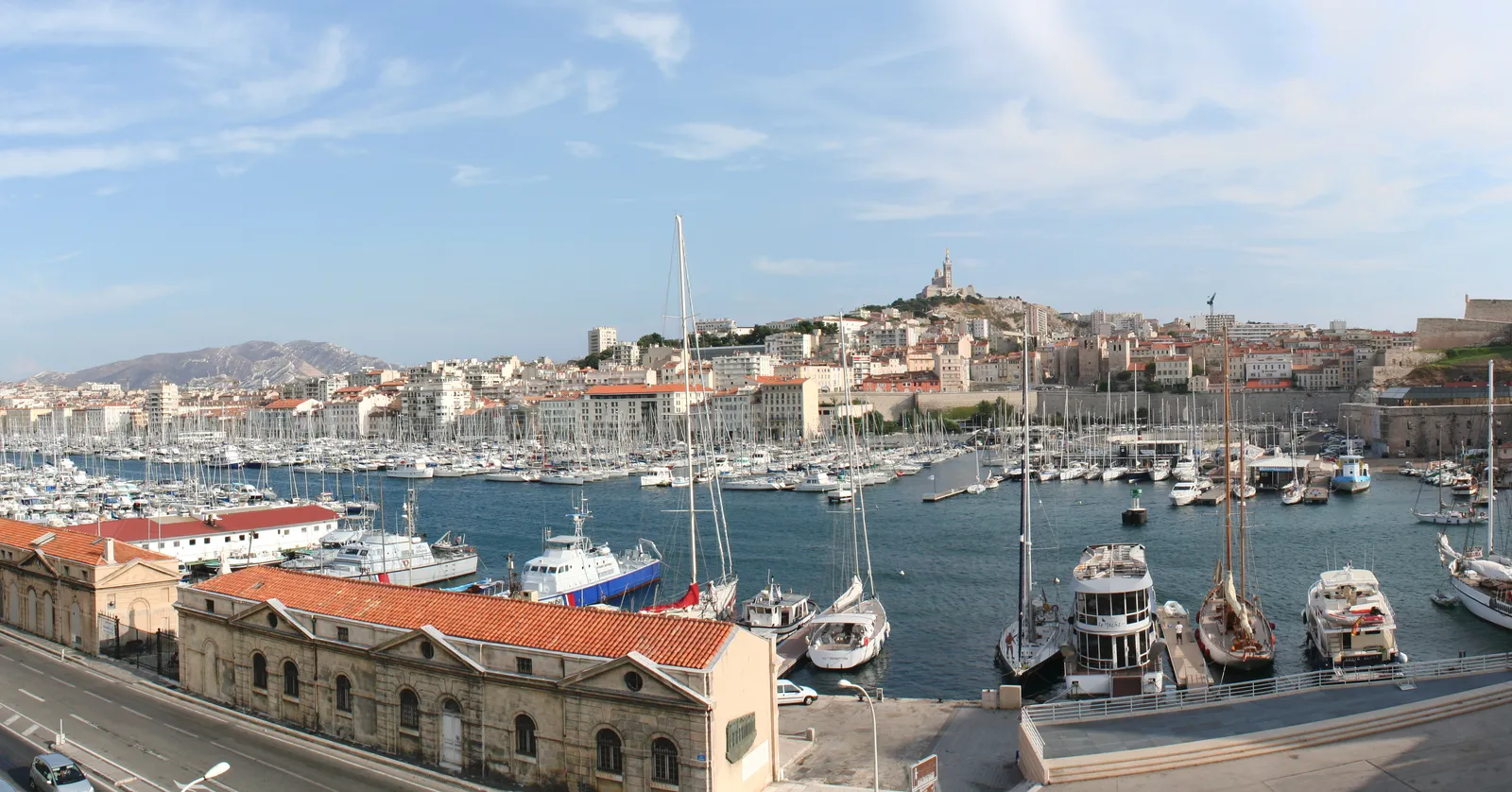
Marseille’s Vieux-Port sits at the foot of the hill Notre-Dame de la Garde crowns, with Fort Saint-Jean’s ramparts guarding the harbor mouth on one side and the cobbled lanes of Le Panier climbing away from the water on the other.
Fort Saint-Jean’s ramparts cost nothing to climb
Fort Saint-Jean has guarded the harbor entrance since 1660, built under Louis XIV on ground the Knights Hospitaller had held for centuries before that. Its ramparts and gardens are open to the public for free, and two footbridges lead off them: one south to the MuCEM, one north into Le Panier.
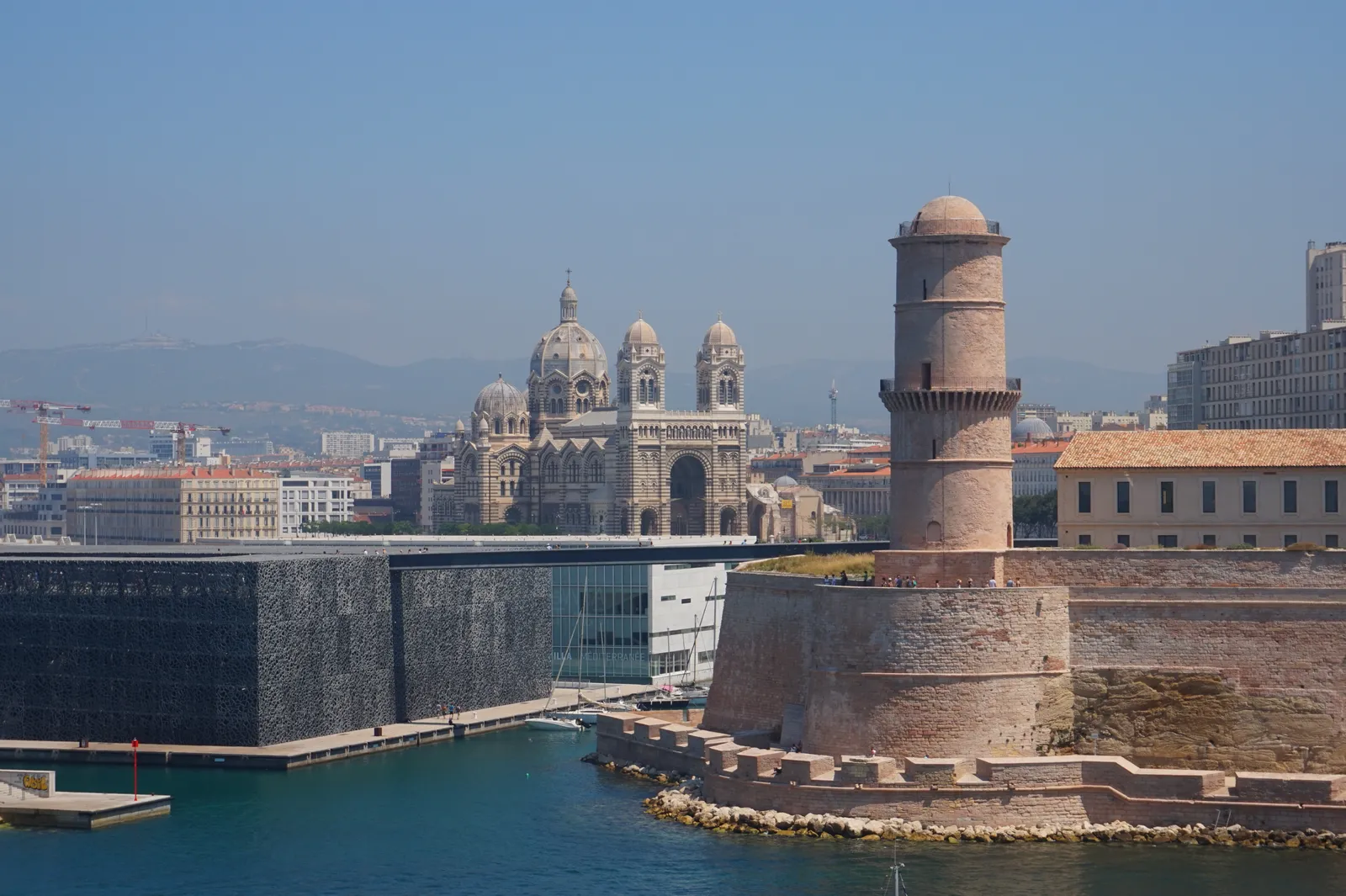
The southern bridge lands at the MuCEM, the Museum of European and Mediterranean Civilisations, opened in 2013 in a building wrapped in black concrete lattice. The esplanade around it and the fort’s own ramparts cost nothing to walk regardless of what’s showing inside; the exhibition floor itself runs about 9.50 euros and shuts on Tuesdays, and a timed entry ticket booked ahead through a tours and activities platform is worth having before you land. On the same esplanade, Cosquer Méditerranée reconstructs a Mediterranean cave whose real entrance sits about 37 meters underwater off Cap Morgiou: visitors ride six-seat electric cars through a 220-meter tunnel past painted handprints and animal engravings copied from the original. It’s timed entry only, no walk-ins, so a ticket booked in advance is the only way to see it.
Le Panier’s cobbled lanes are the oldest streets in Marseille
The northern bridge off Fort Saint-Jean lands directly in Le Panier, a hillside quarter of narrow streets and staircases climbing over three low rises above the harbor. Its lanes are paved in cobblestone and often stepped outright, lined with ochre and pastel buildings and the street art that turns over every few months.
At the top of the climb, La Vieille Charité opens onto a courtyard ringed by three storeys of arcaded galleries, built between 1671 and 1749 as an almshouse to a design by the sculptor and architect Pierre Puget. A domed chapel with an egg-shaped roof sits at the courtyard’s center.
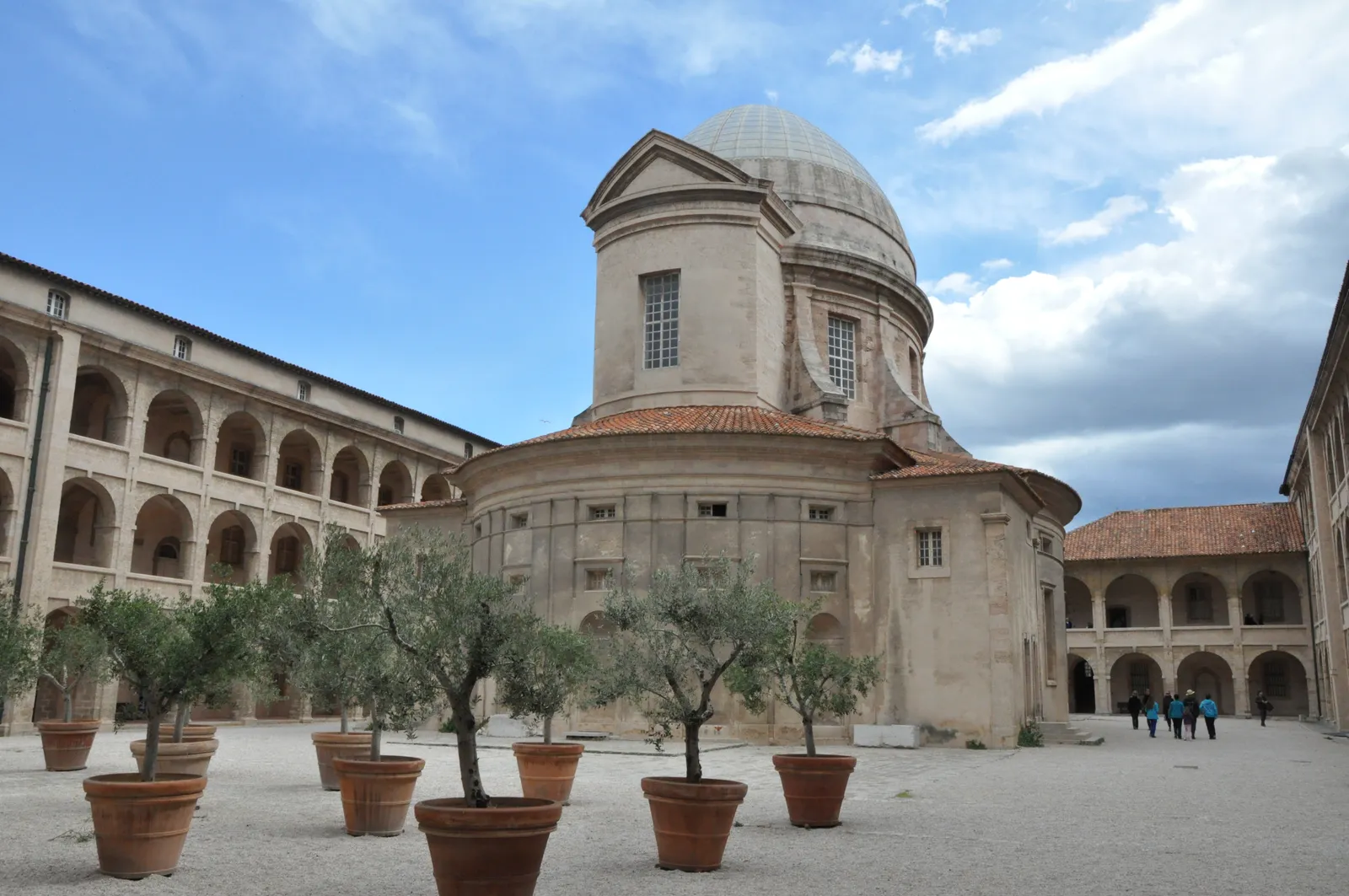
Walking into the courtyard costs nothing; the two museums housed in the galleries charge separately, and the whole complex is shut on Mondays apart from Easter and Whitsun. The lanes getting there are the hardest stretch of this walk on a wheeled suitcase, stepped in places and uneven everywhere else.
Marseille Cathedral’s striped domes rise at the harbor’s edge
Marseille Cathedral, known locally as la Major, stands where a fourth-century church once stood, on a low rise between Le Panier and the water. Construction on the building seen today began in 1852 and ran for four decades, in a Romanesque-Byzantine style that alternates pale limestone with darker green stone in horizontal bands; it was the only new Catholic cathedral raised anywhere in France during the whole of the 19th century.
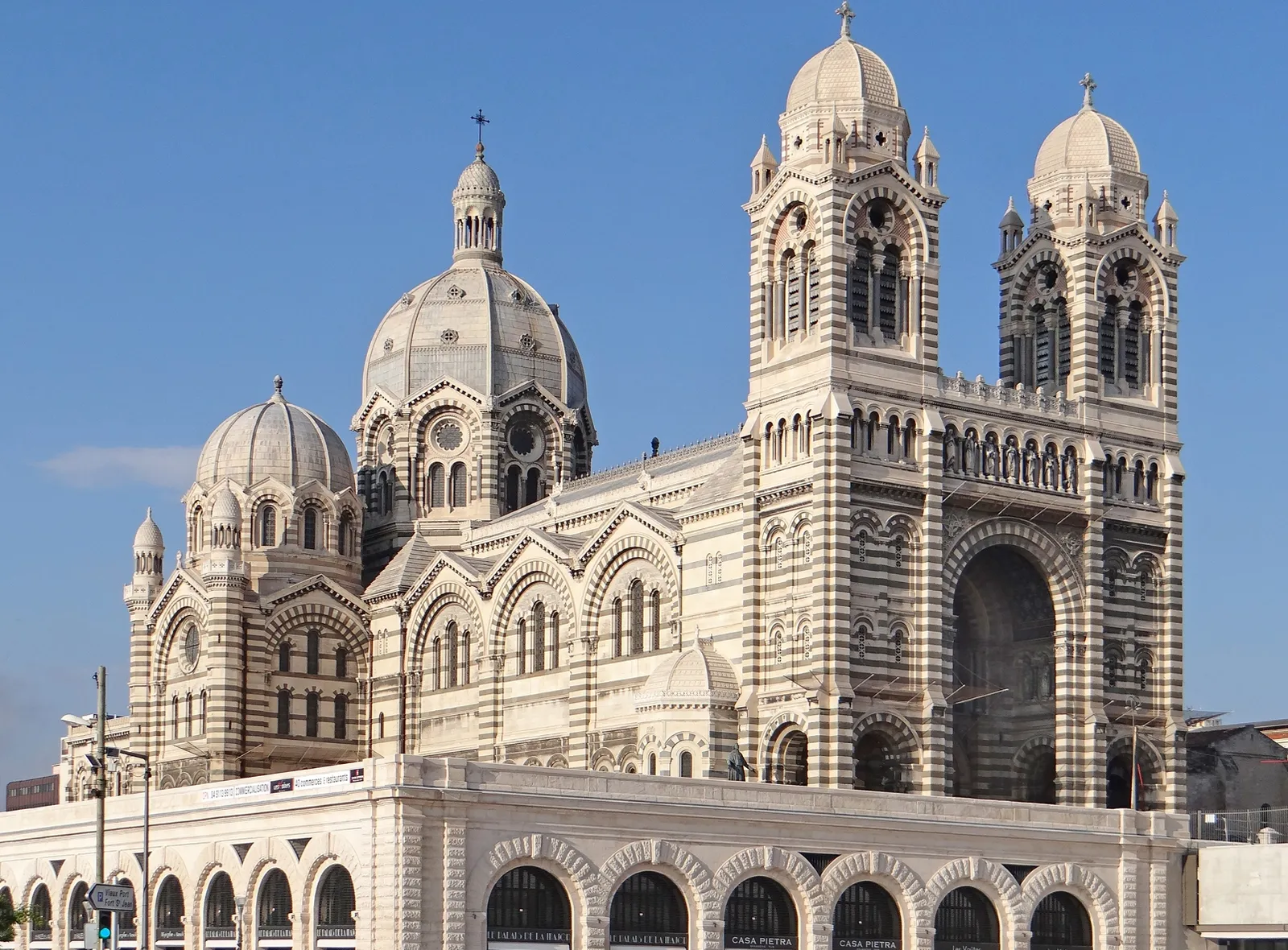
Getting inside costs nothing, and the scale is easiest to judge from the esplanade in front of it, where the five domes and twin bell towers stand clear of anything else nearby.
Notre-Dame de la Garde watches the harbor from 149 meters up
Notre-Dame de la Garde was built between 1853 and the 1890s on a limestone outcrop south of the old town, on the foundations of a much older fort. A gilded statue of the Virgin Mary tops its bell tower, and the terrace in front of the basilica looks back down over the whole port, with the Frioul islands visible offshore on a clear day.
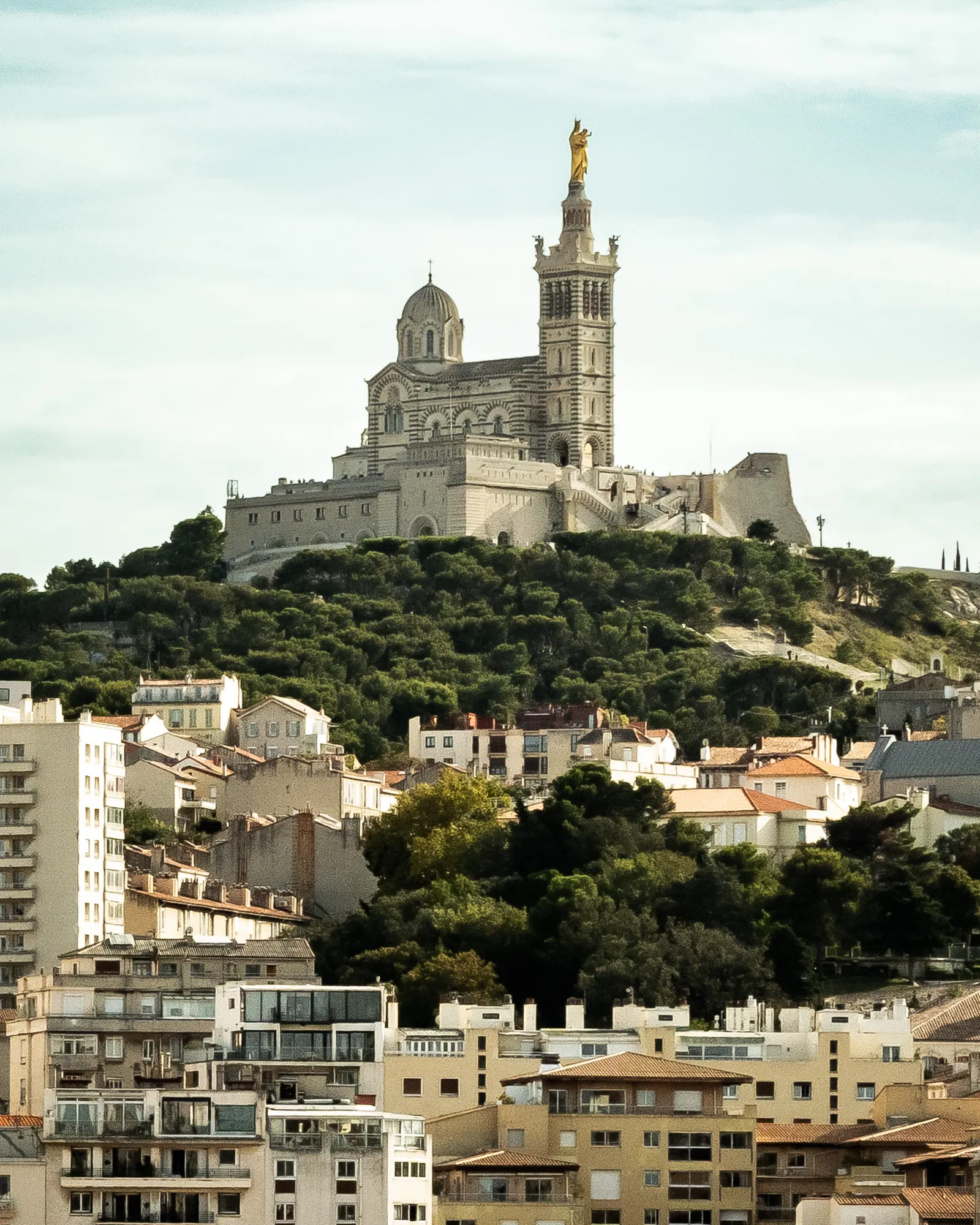
Entry is free, and the doors stay open until 8pm from April through September, 7pm the rest of the year. A funicular used to make the climb until it stopped running in 1967; today a public bus does the job in about 17 minutes, or it’s a steady 45-minute walk gaining real elevation the whole way. For a quieter dose of the same history at sea level, Abbey of St Victor sits on the south quay of the Vieux-Port, its crypt dating to the 5th century and holding sarcophagi displayed there since 1968; entry to the crypt runs about 2 euros, the basilica above it is free, and guides who cover both note it draws a fraction of Notre-Dame de la Garde’s crowds despite sitting a few minutes from the water.
Marseille Provence Airport has no train, only a direct shuttle
A shuttle bus, line 91, runs nonstop between Saint-Charles station and the airport terminal with no stops in between, every 10 minutes from 7am to 8pm and every 20 minutes outside that window, daily including holidays. The ride typically takes about 25 minutes on the motorway but can stretch toward 50 in heavy traffic. A one-way adult fare is 10 euros, 7 euros for ages 12 to 25, and 5 euros for children 6 to 11. Travelers connecting by train instead can take a free shuttle bus from the terminal to Vitrolles Aéroport Marseille Provence station in about 5 to 7 minutes, then a regional TER train into Saint-Charles in roughly 25 to 30 minutes. International check-in generally calls for arriving about three hours ahead, which leaves comfortable room even on the shuttle’s slower days.
Whatever’s still on your back at Saint-Charles is what came down every one of Le Panier’s cobbled lanes and back up Fort Saint-Jean’s ramparts. That’s the argument for leaving the suitcase at a storage point instead and making the walk with your hands free.
Frequently asked questions
What should I do during a layover in Marseille?
Walk the harbor mouth first: Fort Saint-Jean's ramparts and gardens are free, linked by footbridge to the MuCEM and, across a second bridge, to Le Panier, whose lanes climb to La Vieille Charité's courtyard. Marseille Cathedral's striped domes stand a few minutes from the water, free to enter. With four hours or more, add Notre-Dame de la Garde on the hill above the port for the view. The MuCEM's exhibition floor and Cosquer Méditerranée both run on timed entry and are worth booking before you land; everything else on this route is free and walk-up.
Is Marseille good for a layover on a budget?
Mostly, yes. Fort Saint-Jean's ramparts, Le Panier's lanes, La Vieille Charité's courtyard, Marseille Cathedral and Notre-Dame de la Garde all cost nothing to enter. The only admission fees on this route are the MuCEM's exhibition floor, which runs about 9.50 euros, and Cosquer Méditerranée, the replica of a Mediterranean cave whose real entrance sits underwater near Cap Morgiou, which starts at about 19 euros. Both are skippable without breaking the rest of the walk.
Does Marseille Saint-Charles station have its own left-luggage service?
Yes. La Bag Mobile is the station's official left-luggage desk, open daily from 8:15am to 9pm, charging by bag size, roughly 5 to 9.50 euros for 24 hours. Outside those hours, a storage point elsewhere in the city is the fallback, since the desk itself is unattended overnight.
How do you get up to Notre-Dame de la Garde without a car?
A public bus climbs from near the Vieux-Port in about 17 minutes; on foot it's closer to 45 minutes and gains real elevation. A funicular used to make the climb until it stopped running in 1967, so today a bag goes up either by bus or on your back. The basilica itself is free, open until 8pm from April through September and 7pm the rest of the year.
Does Marseille's mistral wind affect a layover?
It can, mostly between October and April, when the wind can gust to Beaufort force 6 or 7 for a day or two at a stretch. The open esplanade around Fort Saint-Jean and the MuCEM is the most exposed point on this route, and boat crossings out to the Frioul islands and Château d'If are the first services to cancel; nothing in the walking route itself depends on a boat, so a windy day mostly just means holding onto your hat.