Marseille Saint-Charles Station Layover
Part of the full Marseille Layover: Vieux-Port From MRS
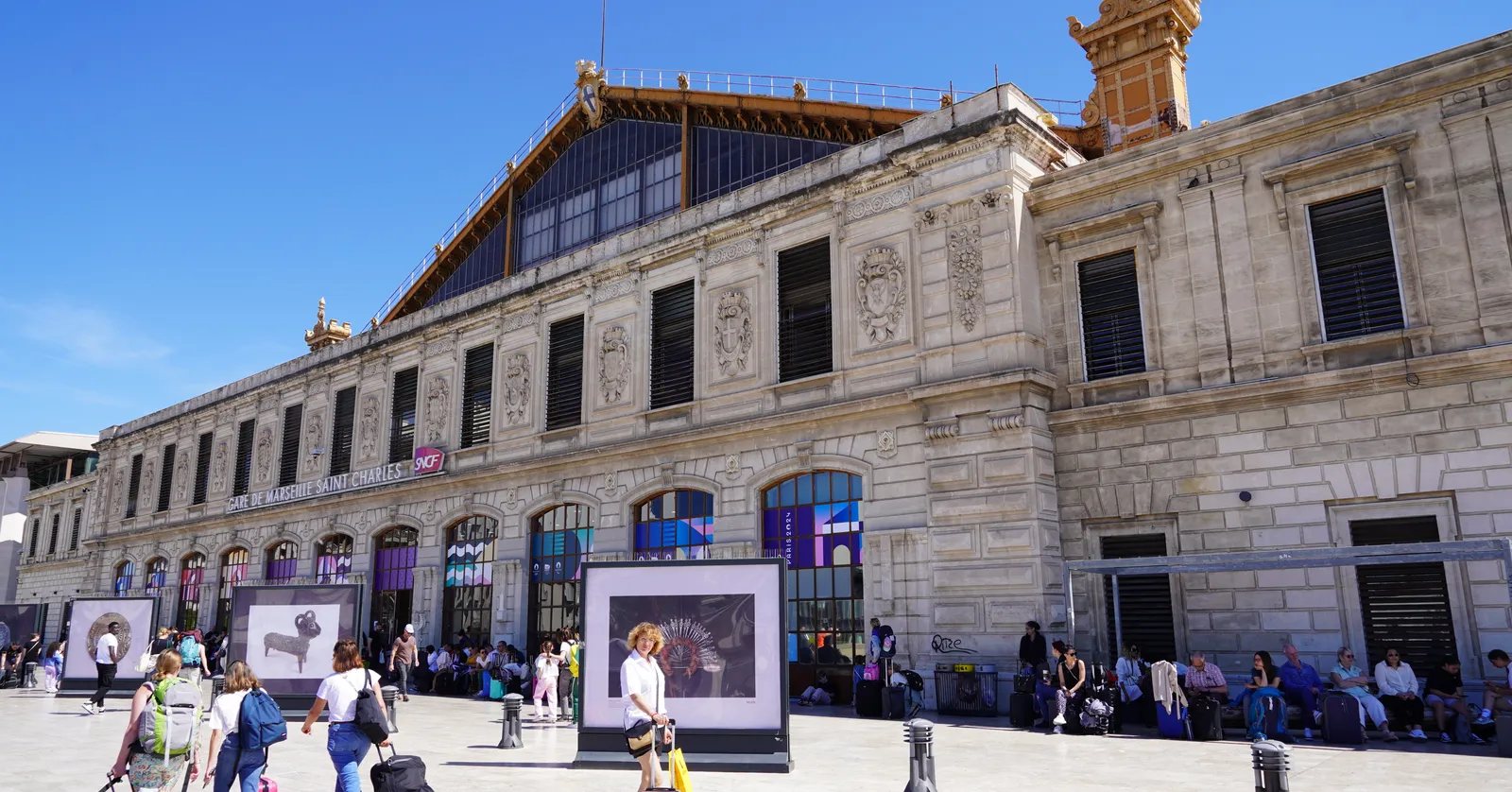
Marseille’s Saint-Charles station stands at the top of a 104-step staircase, ten minutes above the spice stalls of the Marché des Capucins and the twin spires of Les Réformés at the head of the Canebière, the boulevard that runs down to the harbor, with Palais Longchamp’s fountain and two free museums a short ride east.
Marché des Capucins, the street market in Noailles
Rue du Marché des Capucins and the lanes around it, ten minutes downhill from Saint-Charles station in the Noailles quarter, hold the busiest food market in central Marseille. The stalls run heavily to North African produce: spice sacks open at the top, preserved lemons, harissa, dates, dried fruit and stacks of flatbread, alongside the fruit and vegetables the city actually shops for. It is open Monday to Saturday, 8am to 7pm, and closed on Sundays.
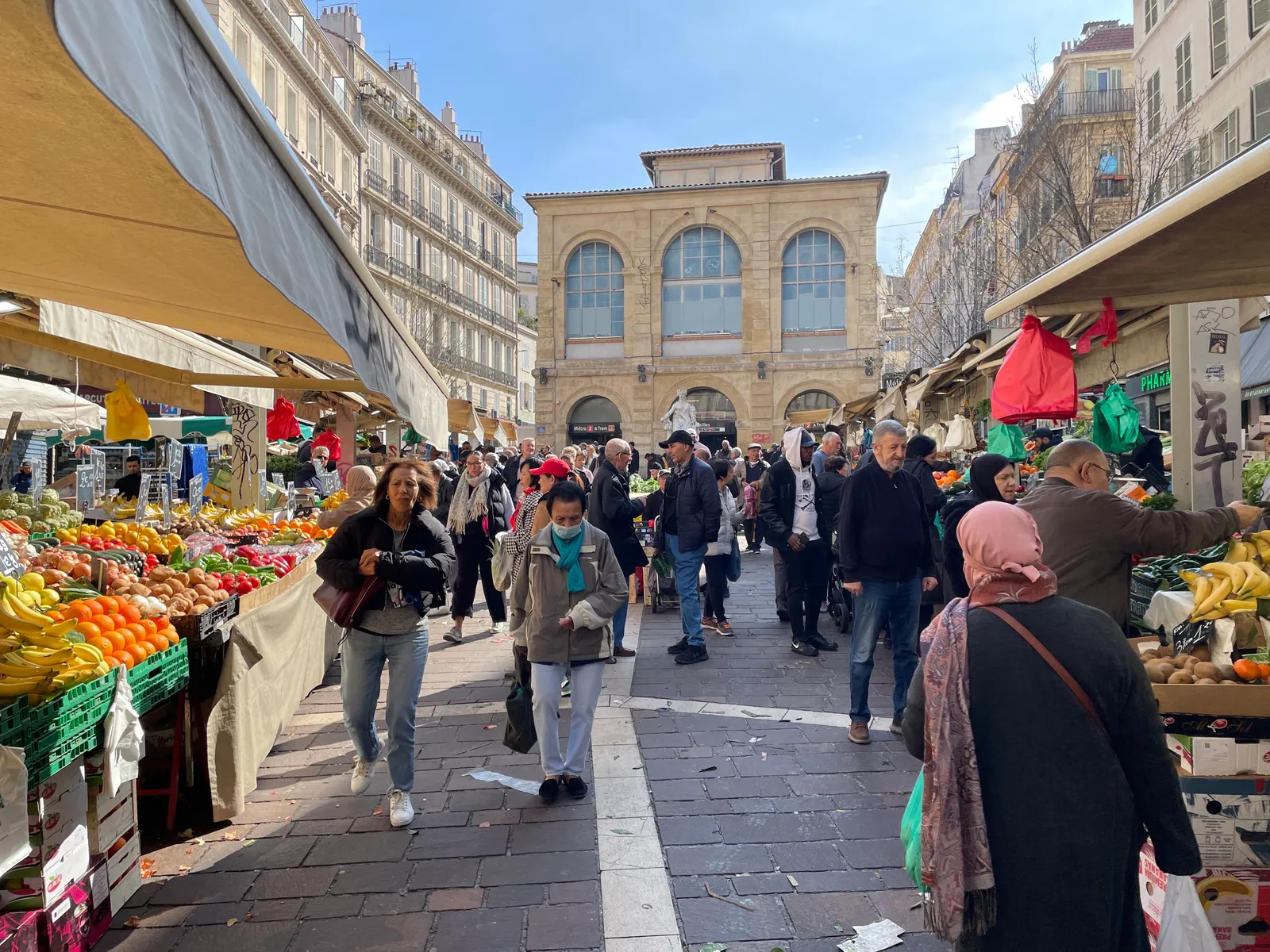
Nothing here needs a ticket, and half an hour of walking the lanes costs whatever you decide to eat. If you would rather have the stalls explained than guess, a guided walking food tour booked through a tours and activities platform covers these streets with tastings built in, which is worth booking before you land rather than on the platform.
Saint-Charles station’s 104 steps down to Boulevard d’Athènes
Eugène Sénès and Léon Arnal won the competition to connect the station to the city below in 1911, though the seminary buildings in the way were not demolished until 1921 and the first stone went down in 1923. What they built is 15.5 metres of stone flights broken by seven landings, opened to the public in December 1925 and formally inaugurated on 24 April 1927 with the president of the republic, Gaston Doumergue, standing at the top.
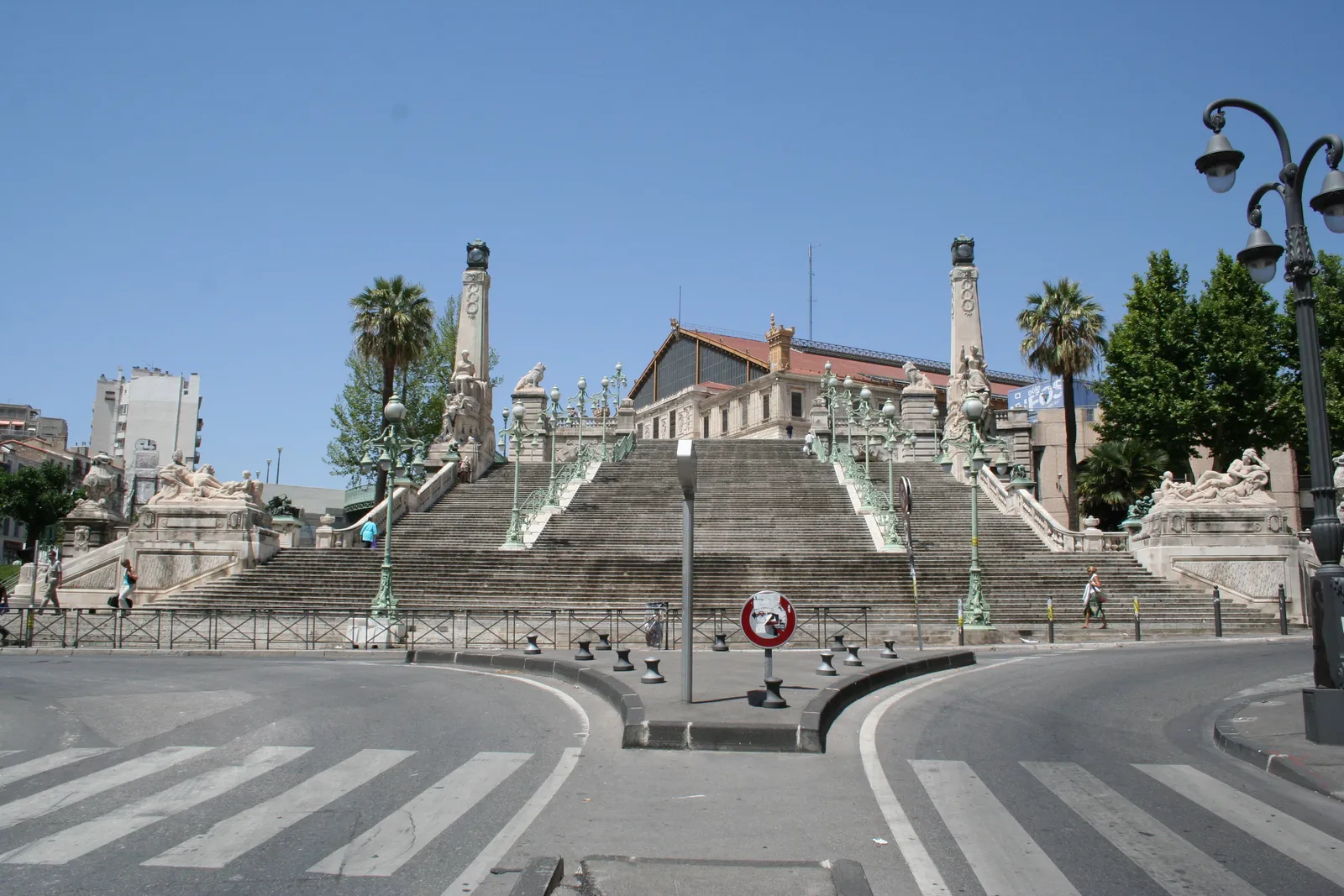
The sculpture is the reason to look up rather than down. Auguste Carli, Ary Bitter and Henri Raybaud filled the pylons and landings with figures of Marseille as the gateway to the East, the French colonies in Asia and Africa, and the produce of Provence: the grape harvest, the fruit, the flowers. There is no ramp and no escalator on the staircase itself, so at peak regional-train times the landings back up with luggage coming down.
The twin spires of Les Réformés at the head of the Canebière
Saint-Vincent-de-Paul, which almost nobody in Marseille calls anything but Les Réformés after the reformed Carmelites who had the site before it, went up between 1855 and 1886 in a neo-Gothic style borrowed wholesale from northern France. Its two spires stand 70 metres over the top of the boulevard, which makes them the thing you steer by walking down from the station.
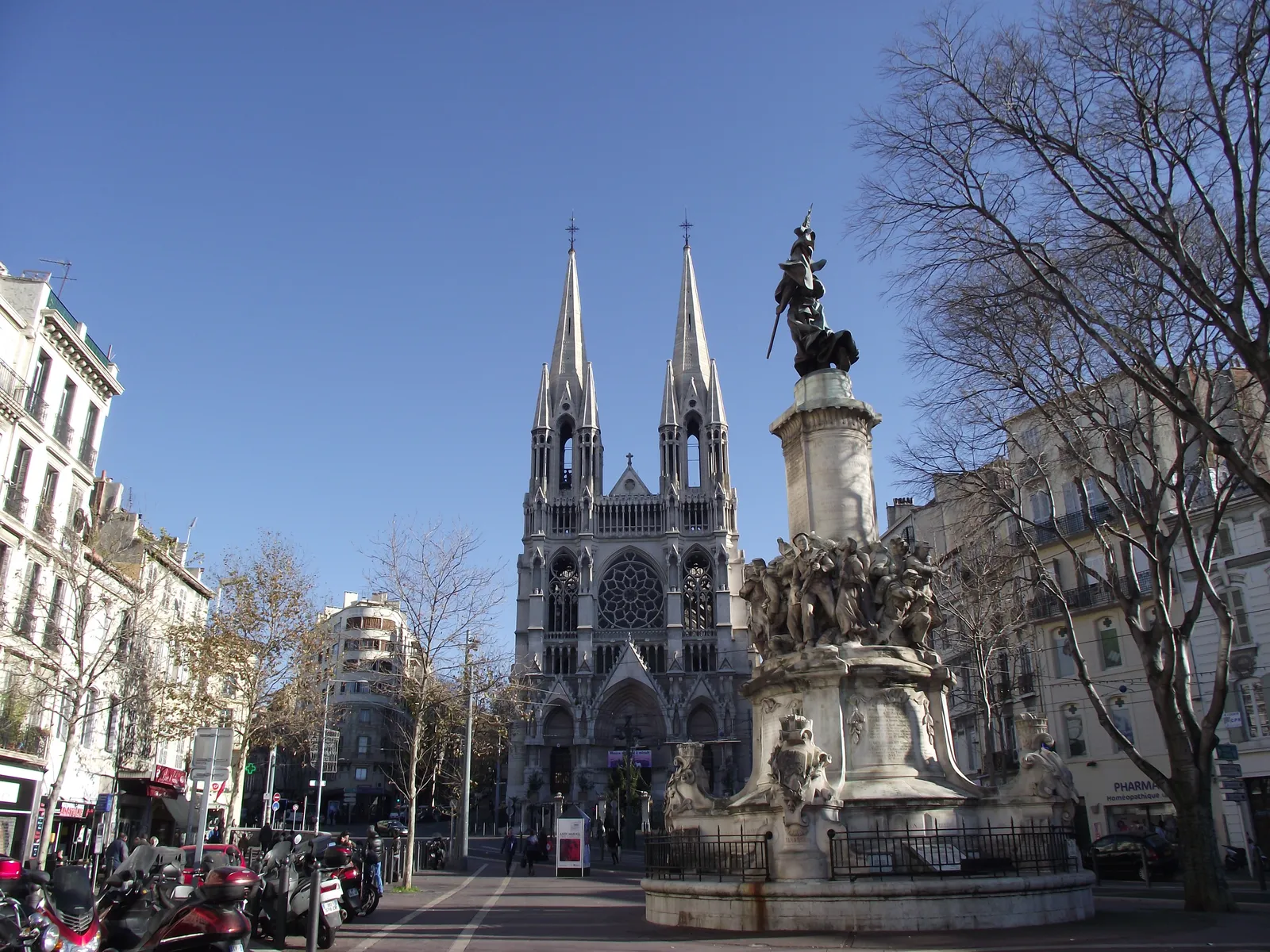
Entry costs nothing and the doors are open 9am to noon and 1pm to 4.30pm, Monday to Saturday. Five minutes from the station and mostly empty, it is the easiest place on this route to sit down out of the sun.
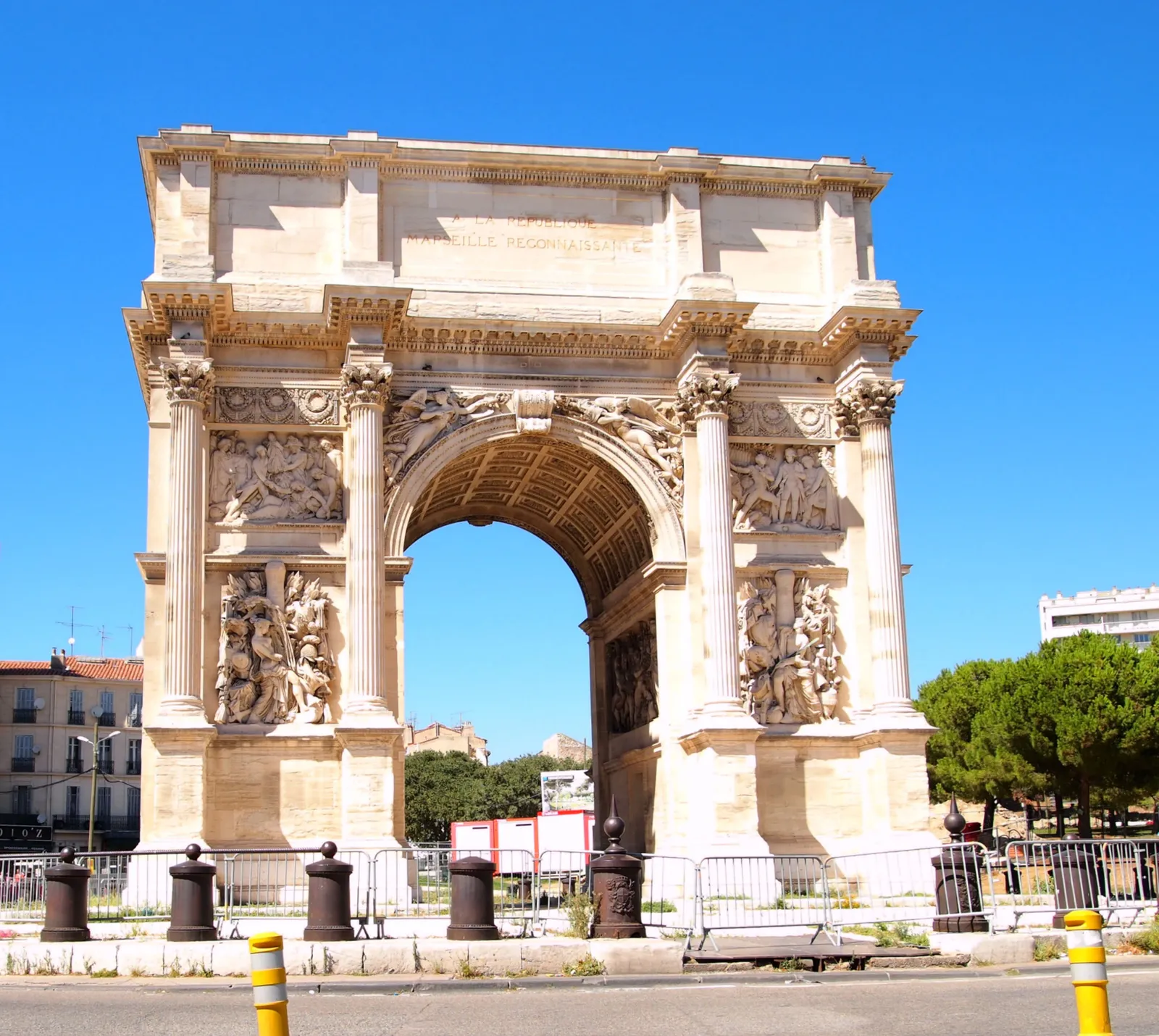
Porte d’Aix, the triumphal arch on Place Jules-Guesde
Michel-Robert Penchaud drew the arch on the model of the Roman one at Orange, work started in 1823, and it was finished in 1839 under Louis-Philippe. It marks where the road to Aix-en-Provence used to begin, and the relief panels across its faces, by David d’Angers and Étienne-Jules Ramey, were carved for a monument that changed its dedication more than once while it was being built.
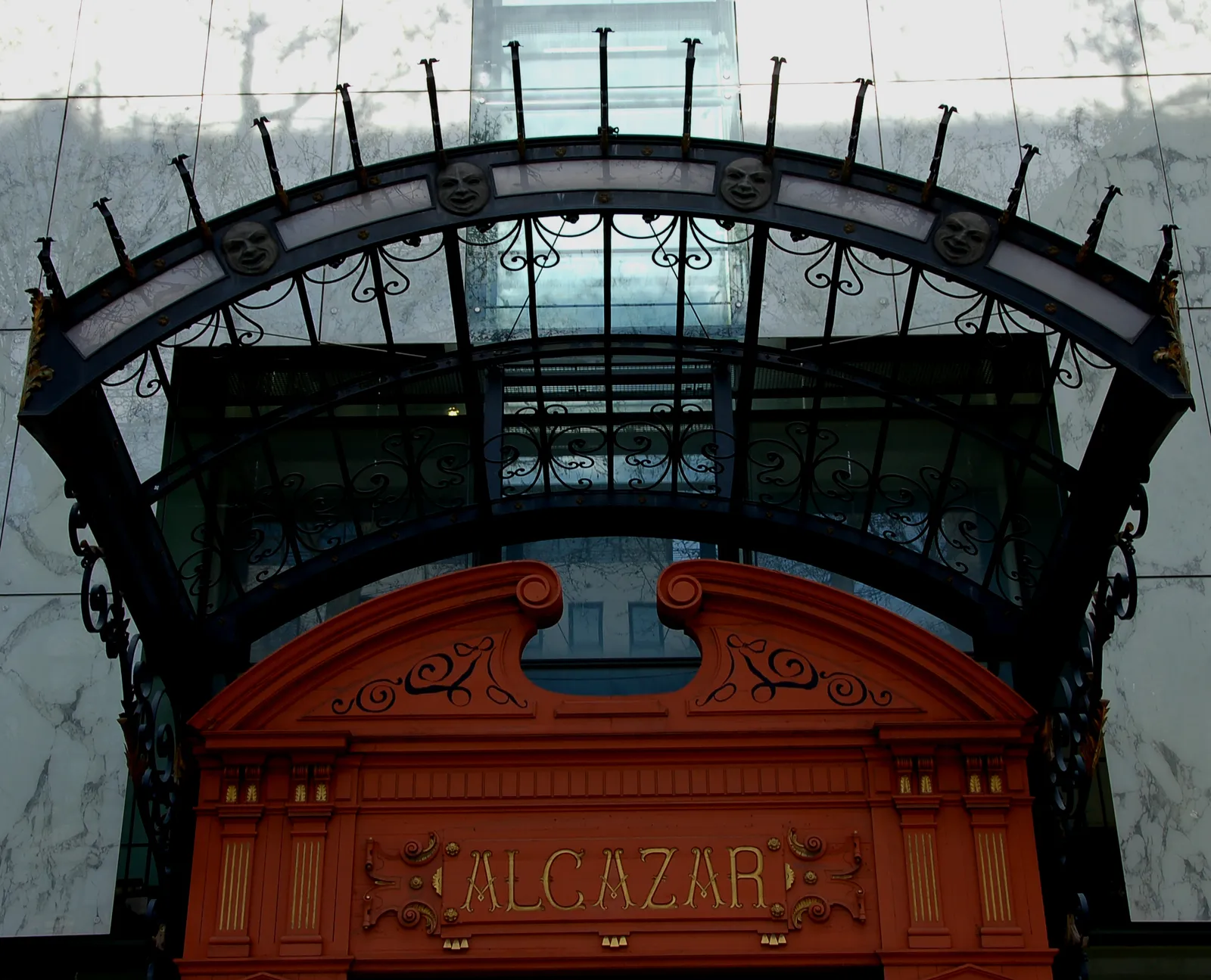
Between the arch and the Canebière, Cours Belsunce carries a red and gold marquee that reads Alcazar, kept from the café-concert hall that opened here in 1857 and seated around two thousand. Raimu, Fernandel, Tino Rossi and Yves Montand all started on that stage before leaving for Paris, and Montand sang his first song there on 21 June 1939. The hall closed for good on 9 August 1966 and the city put its main library in the shell in 2004, so what stands behind the old canopy now is four floors of books, roughly 350,000 of them on open shelves, free to walk into Tuesday to Saturday, 11am to 7pm.
Palais Longchamp’s fountain and its two free museums
Henri-Jacques Espérandieu built the palace between 1862 and 1869 to mark what the Canal de Marseille had done for the city, which was bring Durance river water to a port that had run short of it. The result is less a building than a curved colonnade linking two wings, with a water staircase dropping through sculpted groups of the Durance, the vine and the wheat at its centre.
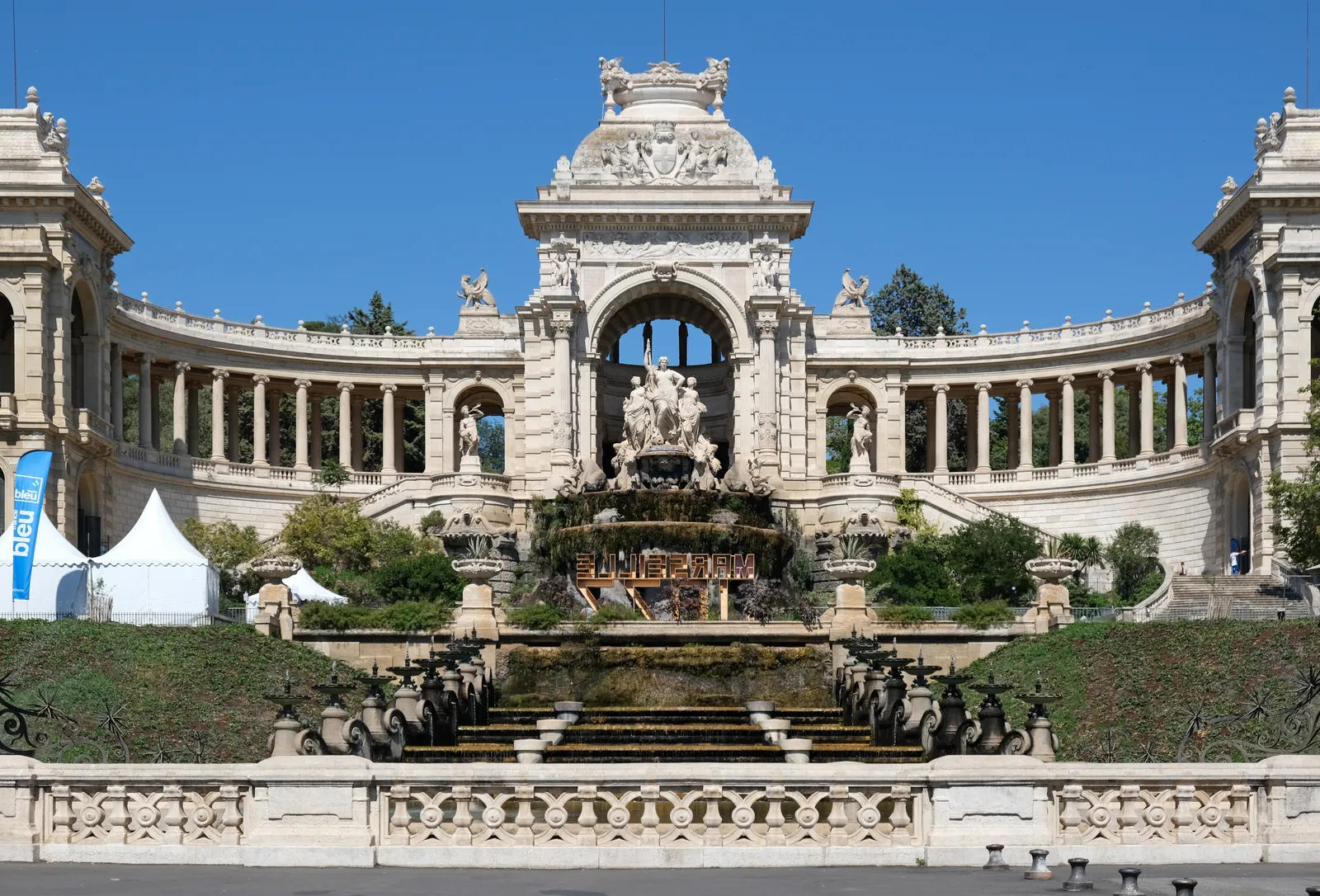
Each wing holds a museum, fine arts on the left and natural history on the right, and the permanent collections in both are free to everyone, Tuesday to Sunday, 9am to 6pm, with the desk shutting at 5.30pm. It sits about twenty minutes east of the station on foot, or a few minutes by metro. Worth knowing before the walk: the park can close during heavy mistral wind, which takes the museum entrances with it. The harbor, Fort Saint-Jean and the lanes of Le Panier are all on the far side of the Canebière and belong to the main Marseille layover route rather than this one.
The 91 shuttle leaves from the station’s own bus deck
Twenty-five minutes of motorway, up to 50 when the traffic is bad, separates this station from Marseille Provence Airport (MRS), and the 91 shuttle bus covers it with nothing in between, leaving from the bus deck on the station’s northern side every 10 minutes from 7am to 8pm and every 20 minutes either side of that, seven days a week. An adult one-way fare is 10 euros, 7 euros for ages 12 to 25, and 5 euros for children aged 6 to 11. There is a rail version too: a regional train to Vitrolles Aéroport Marseille Provence in 25 to 30 minutes, then a free bus to the terminal in 5 to 7.
Both leave from the same building you came down those 104 steps from, which is the argument for keeping the afternoon inside this radius. Come back up the sloping street rather than the staircase and the last leg is a walk across a concourse.
Frequently asked questions
What should I do during a layover near Saint-Charles station in Marseille?
Everything worth the walk here is downhill and inside a mile. The Marché des Capucins in Noailles is about ten minutes below the station and runs Monday to Saturday until 7pm; Les Réformés, with its two 70-metre spires, closes the top of the Canebière five minutes from the station door; and the Porte d'Aix, a triumphal arch finished in 1839, stands about eight minutes north. Palais Longchamp and its two free museums are twenty minutes east on foot, or a few minutes by metro, and are the one stop that needs a plan, since the museums shut on Mondays.
Is Palais Longchamp free to get into?
Yes, and so are both museums inside it. The colonnade, the fountain and the park behind cost nothing, and the permanent collections of the fine arts museum in the left wing and the natural history museum in the right are free to everyone, open Tuesday to Sunday from 9am to 6pm with the ticket desk closing half an hour early. Temporary exhibitions are the only paid part, and they are free on the first Sunday of the month. One caveat worth calling ahead about: the park can close during strong mistral wind, which shuts the route to the museum doors with it.
Is there a step-free way down from Saint-Charles station?
The monumental staircase has 104 steps, seven landings and no ramp or escalator, so it is not the way down with wheels. The station has two lifts, one opposite platforms B and C and one by the bus deck, and the sloping streets either side of the staircase get you to Boulevard d'Athènes without steps. It takes a few minutes longer than the direct flight of stairs and saves carrying anything down fifteen metres of descent.
What is closed on Mondays near Saint-Charles station?
The two museums at Palais Longchamp, which shut every Monday apart from Easter and Whit Monday, and the Alcazar library on Cours Belsunce, which opens Tuesday to Saturday from 11am to 7pm. The Marché des Capucins runs the opposite way round: Monday to Saturday from 8am, closed Sunday. Les Réformés and the Porte d'Aix are the two stops on this route that never depend on the day of the week.
How long does the airport shuttle take from Saint-Charles station?
The 91 shuttle bus runs nonstop between the station and Marseille Provence Airport (MRS) and takes about 25 minutes on the motorway, stretching toward 50 in heavy traffic. It leaves every 10 minutes from 7am to 8pm and every 20 minutes outside those hours, daily. A one-way adult fare is 10 euros, 7 euros for ages 12 to 25 and 5 euros for children 6 to 11. The rail alternative is a regional train from the station to Vitrolles Aéroport Marseille Provence in 25 to 30 minutes, then a free bus to the terminal that takes 5 to 7.