Palermo's Parks and Planetarium, Buenos Aires
Part of the full Buenos Aires Layover Guide: Recoleta From EZE
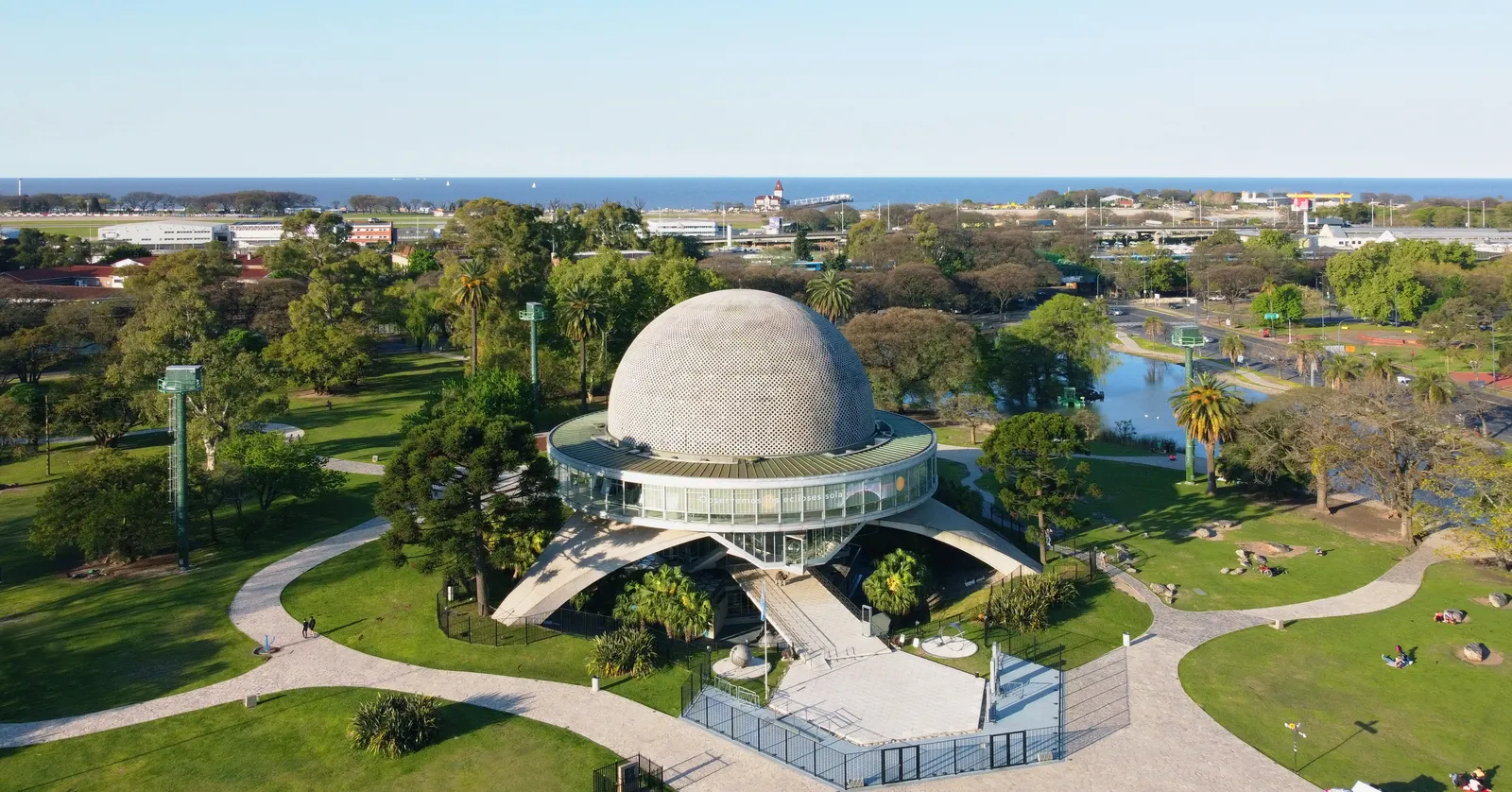
The Bosques de Palermo, 400 hectares of parkland and the largest open space in Buenos Aires, hold a planetarium built as a sphere on three concrete arches, a rose garden laid out in 1914, and boats for hire on the lake beside it.
The Galileo Galilei planetarium stands on three concrete arches
Enrique Jan’s building went up from 1962 on the eastern edge of the park and was inaugurated on 20 December 1966, though the public did not get in until April 1968. From outside it is a perforated grey globe balanced on three curved concrete legs, with a glazed ring of offices around its waist, and it has aged better than most things built in Buenos Aires that decade. Inside, a 20-metre aluminium-lined dome covers 360 seats, and the projection now runs off six digital projectors putting some 8,900 stars, constellations and nebulae overhead.
The seats are the catch. Tickets are sold through the city government’s own website and nowhere else, released roughly a week in advance, and they go quickly in the school holidays. Shows run a couple of times a day midweek and more often at weekends, so a fixed number of hours between flights is unlikely to line up with one unless you booked before leaving home.
What nobody stops you doing is walking up to the entrance apron, where the planetarium keeps iron meteorites recovered from Campo del Cielo in Chaco province, fragments of a body that broke up over northern Argentina roughly four thousand years ago. They sit out in the open on the paving, no barrier and no ticket, and the planetarium’s own guidance is that visitors may put their hands on them. There is also a piece of the Moon inside the building, brought back by Apollo 11 and handed over by Richard Nixon, but that one is behind the turnstile.
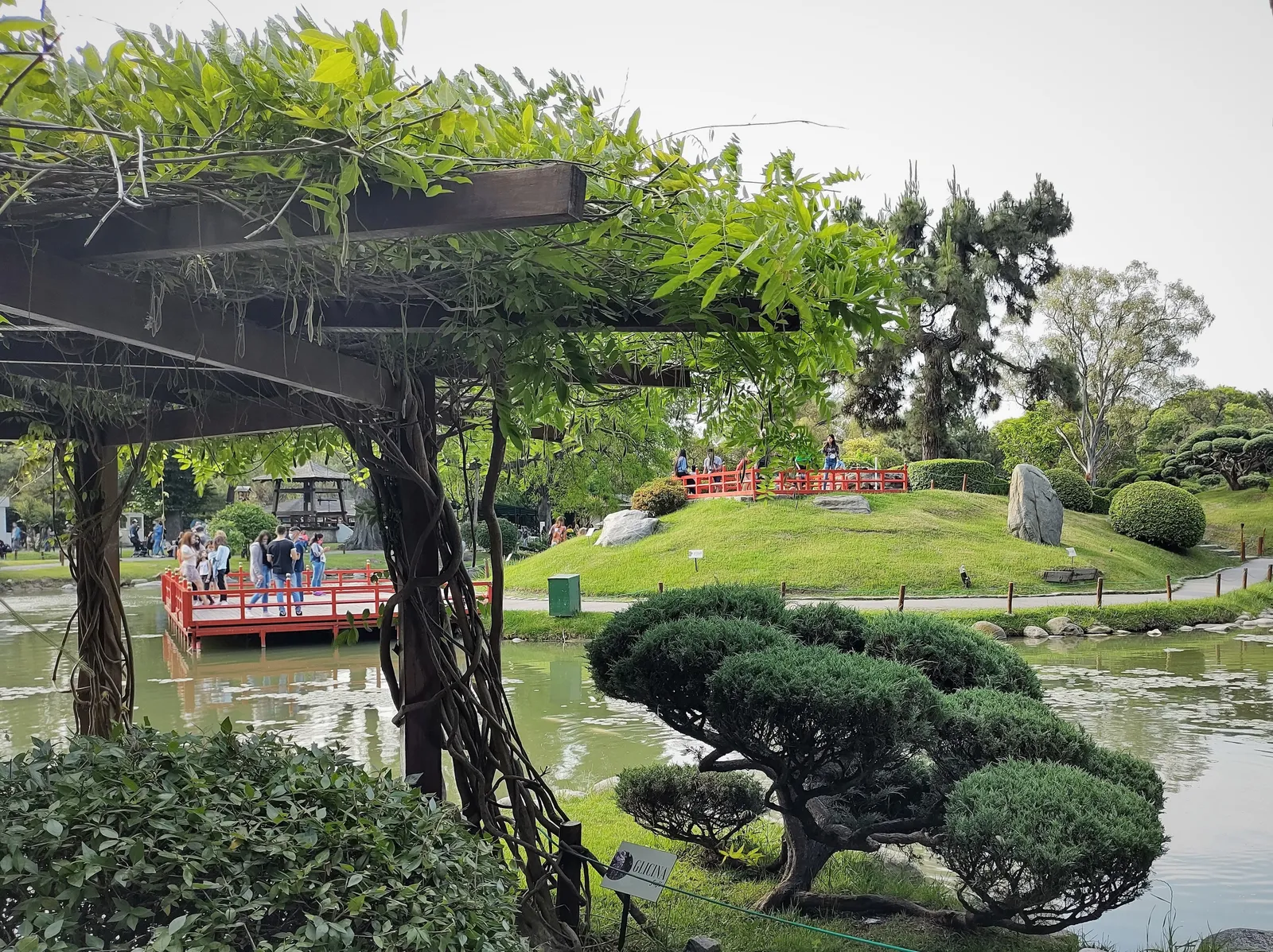
The Japanese garden’s carp lake and its two named bridges
The Japanese Argentine Cultural Foundation finished this garden in 1967 and it was opened during the state visit of Crown Prince Akihito and Princess Michiko, with its entrance on Avenida Figueroa Alcorta. It is a compact set-piece rather than a park: a carp lake crossed by two named bridges, the Divine Bridge and the Truncated Bridge, an island planted with Japanese medicinal herbs, stone lanterns, a greenhouse of bonsai and an open-air theatre.
It charges a gate fee, and it is the one thing in this corner of Palermo that opens seven days a week, from 10am to a quarter to seven, which makes it the fallback when the Monday closures have taken everything else out. Under-12s go free. A city law also gives residents one free day a week and one day of the third weekend each month, which is worth knowing mainly because those are the days the paths get busy.
El Rosedal’s rose beds and the Greek pergola on its lake
The mayor Joaquín Anchorena wanted a rose garden inside the park, and the agronomist Benito Carrasco, who had written his thesis under Carlos Thays, delivered one on 24 November 1914: 14,650 bushes across 1,189 varieties, a Greek-style pergola running along the water, a landing stage, and a Greek-arched bridge at the Avenida Infanta Isabel end. Roughly 18,000 bushes are in the beds now. They flower from September through November, and November is when the place is worth crossing the city for.
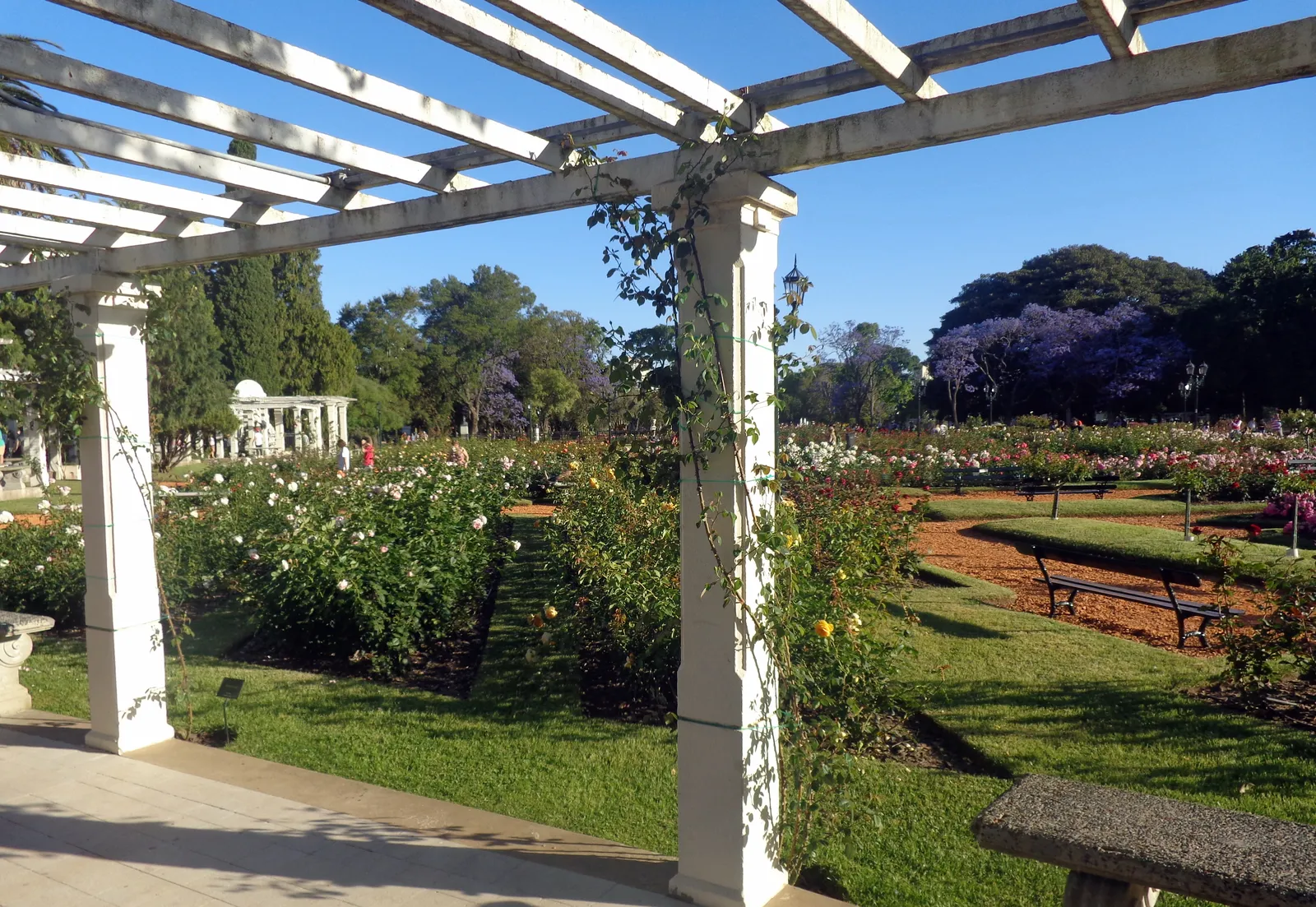
The rest of the year the structure carries it. The Poets’ Garden inside the same enclosure holds busts of Alfonsina Storni, Dante and Shakespeare among others, the tiled Andalusian patio next to it was a gift from the city of Seville, opened on 13 October 1929 and built from majolica shipped over from the Triana potteries, and there is a small amphitheatre behind. All of it is free, open Tuesday to Sunday, closing as late as 8pm in summer and around 6pm in the winter months.
The park runs to 400 hectares with long open stretches between one sight and the next and very little shade on them, and nothing inside it takes luggage, which is the argument for arriving without any.
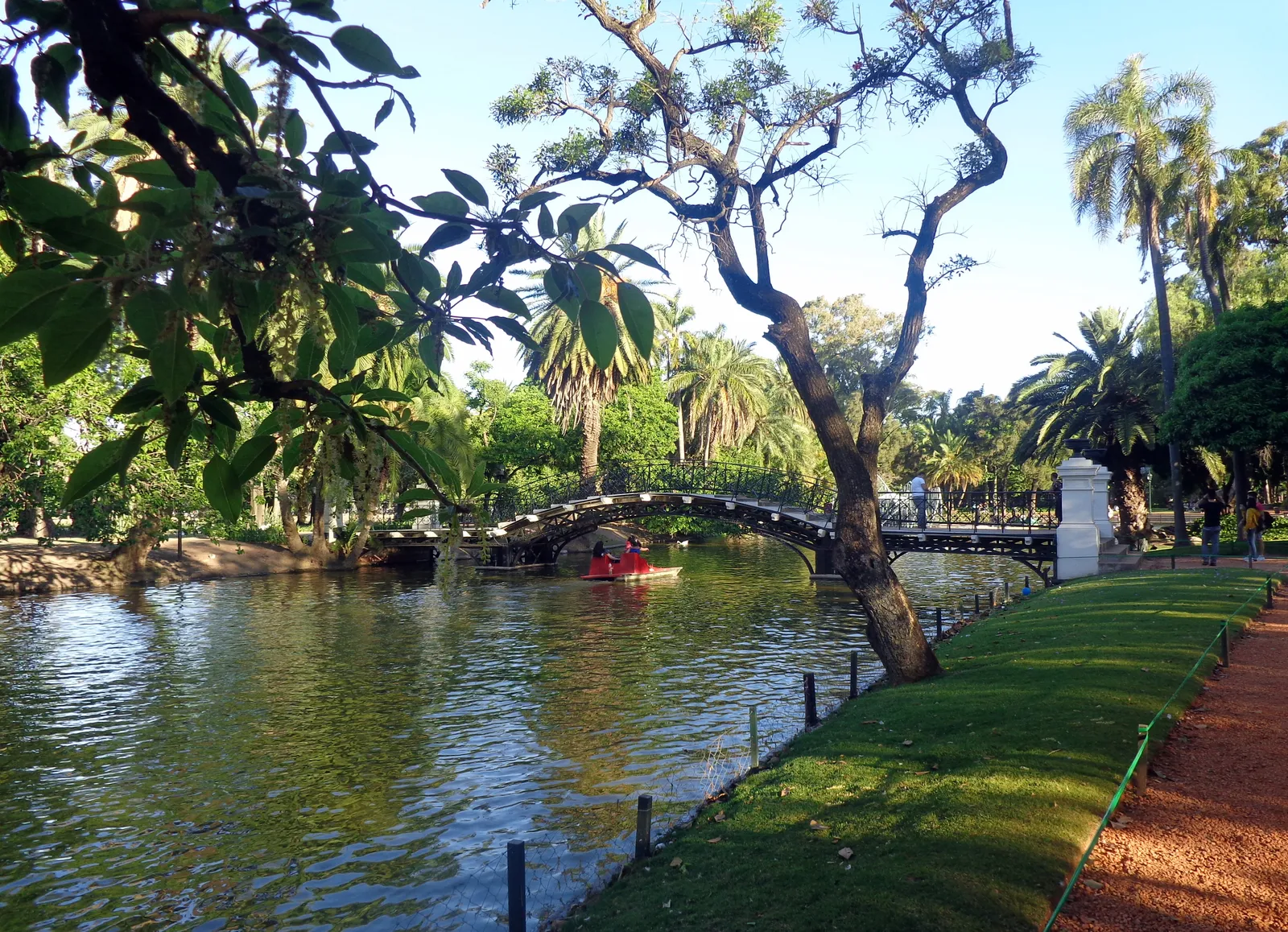
Boats for hire on the Rosedal lake
Rowing boats and pedal boats go out from Avenida Infanta Isabel 410, on the water the pergola runs beside, and they are let by the half hour: rowing boats for four, pedal boats in sizes up to six people and a child. The season sets the hours, mid-morning to early evening in summer and shutting an hour and a half earlier in winter. The lake is small and there is nowhere to get lost, which is the point of it.
Four lakes sit inside the park in total, Regatas, Rosedal, Planetario and Victoria Ocampo, and the other three are for looking at rather than boating on. With more than four hours, the part of Palermo worth adding is not more parkland but the low blocks south of Avenida Juan B. Justo, where the murals are: a guided walk through the street art there is bookable through a tours and activities platform, and it is a fifteen-minute ride from the rose garden.
Aeroparque is ten minutes from the park, Ezeiza an hour and a half
Aeroparque Jorge Newbery sits about three kilometres east of the planetarium, on the river, so a taxi from the rose garden to that terminal takes ten to fifteen minutes. The riverfront guide from that terminal covers what else is on that side.
Ministro Pistarini International Airport (EZE) is the other story. From Plaza Italia station, the park’s own subway stop, Line D runs down Avenida Santa Fe to 9 de Julio at the Obelisco in about fifteen minutes, which puts you beside Terminal Pellegrini at Pellegrini 971; Tienda León’s express minibus leaves there roughly hourly for the hour-long run out to the airport, and no rail line reaches it at all. Count on an hour and a half from the rose garden to the check-in desk, and more if you are relying on the shuttle’s timetable rather than a taxi. If the day turns out shorter than you thought, the historic centre in the main Buenos Aires guide is the denser use of the same hours.
Frequently asked questions
What should I do during a layover near the Bosques de Palermo in Buenos Aires?
Take the two ticketed things first, because they are the ones that can be shut. The Galileo Galilei planetarium sells its show seats online only and they go quickly, and the Japanese garden charges at the gate but opens every day of the week. Then the free half: the Rosedal rose garden, laid out in 1914 around a lake with a Greek pergola along one bank, and boats for hire on the water beside it. Three hours is enough for all four if you keep to the eastern corner of the park rather than crossing it. Almost everything here closes on a Monday.
Can I get into the planetarium without a ticket?
As far as the terrace, yes, and the best thing outside is free anyway. Real meteorites from the Campo del Cielo strewn field in Chaco province sit on the entrance apron, iron lumps that came down roughly four thousand years ago, and you are allowed to put your hands on them. The show inside the dome is a different matter: seats are sold through the city government's own website only, released about a week ahead, and they sell out fast in school holidays. Turning up on spec gets you the building, the meteorites and the lawn around them, which is not a wasted trip.
Is this a good few hours with kids?
Better than anywhere else on a Buenos Aires layover, if the timing works. A planetarium show, pedal boats on the lake and meteorites you are allowed to touch is an unusually good run for one corner of a park, and the whole thing is flat and pram-friendly. Two catches. Planetarium seats need booking days ahead rather than on the day, and the park has almost no shade on the open lawns between the sights, so a hot afternoon means hats, water and sticking to the tree-lined paths.
Is the park gated, or can I walk in at any hour?
Both, depending which bit you mean. The wider Bosques de Palermo is open parkland with roads and paths through it and no gates at all, so the lawns, the lakeside and the walk past the planetarium are there whenever you are. The three things worth planning around are separate enclosures inside it, each with its own fence and its own hours: the Rosedal, Tuesday to Sunday with a seasonal closing time, the Japanese garden, daily until a quarter to seven, and the planetarium, which is a ticket rather than a gate. Arriving at eight in the evening gets you a park and nothing else.
When are the roses actually out?
Spring, which in Buenos Aires means September through November, and November is the peak. Outside those months the Rosedal is still worth the walk for its structure rather than its flowers: the Greek pergola along the lake, the Seville-donated Andalusian patio, the little amphitheatre, and the Poets' Garden with its busts of Alfonsina Storni, Dante and Shakespeare among others. Entry is free year round, it opens Tuesday to Sunday, and the closing time moves with the season, as late as 8pm in summer and around 6pm in winter.