Santa Monica Pier: A Los Angeles Layover
Part of the full Los Angeles Layover: Downtown Walk From LAX
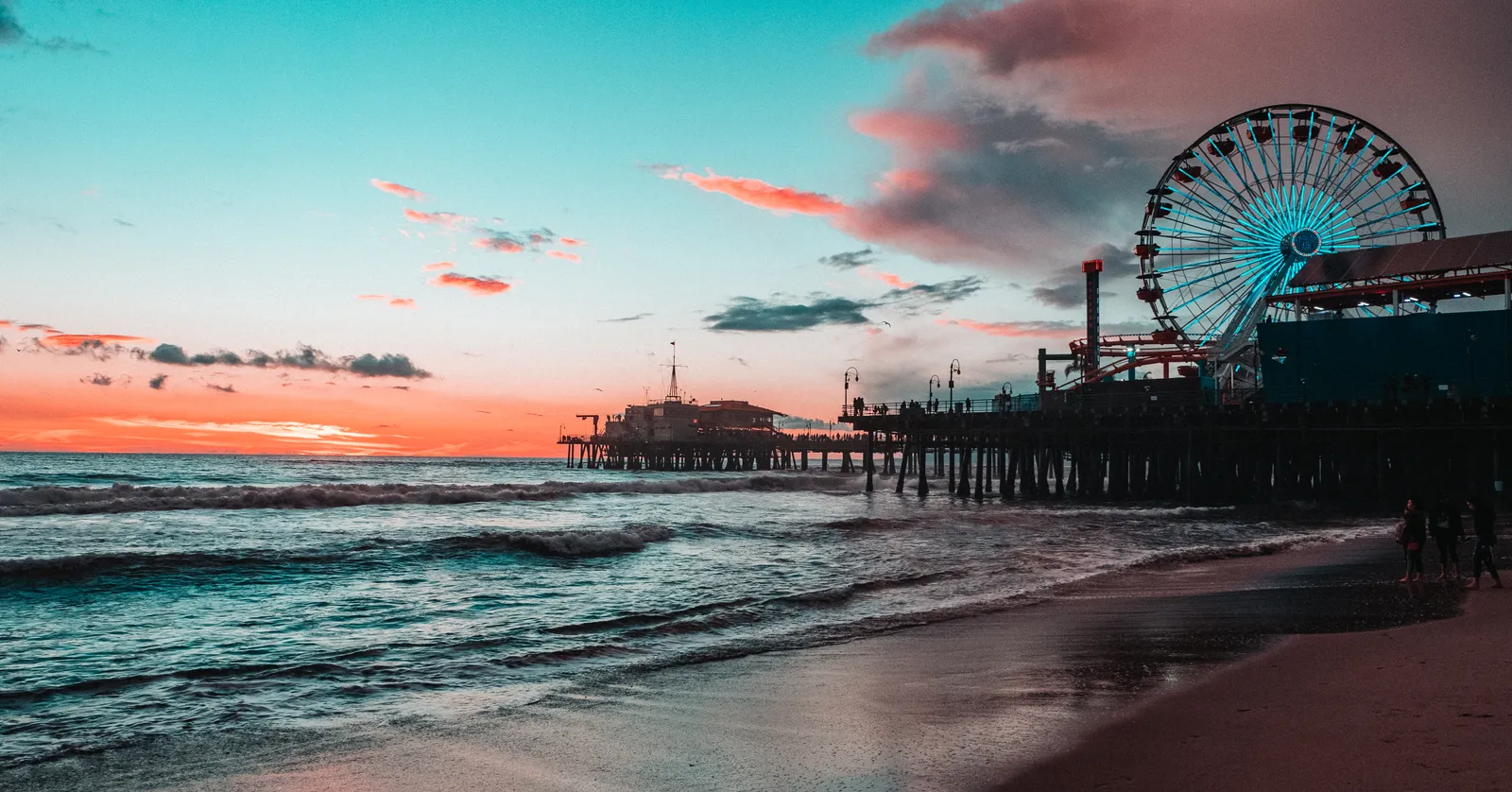
Santa Monica Pier is free to walk onto, and the original Muscle Beach, the car-free Third Street Promenade and a mile and a half of bluff-top park all stand within walking distance of it on the western edge of Los Angeles.
Santa Monica Pier has carried a public deck since 1909
Santa Monica Pier runs out into the Pacific from the foot of Colorado Avenue, and it has been there in some form since September 1909, when the city built the first one to carry a sewage outfall. There is no gate at the landward end and no ticket booth: the deck is a public street that happens to be over water. What sits on it is a small amusement park, an arcade, a row of food counters, a fishing deck at the far end, and the sign marking the western end of Route 66.
The oldest thing out there is the Looff Hippodrome, the wooden building near the entrance with the deep red roof, which Charles Looff put up in 1916 and which has been a National Historic Landmark since 1987. Inside it is a Philadelphia Toboggan Company carousel from 1922: 44 hand-carved horses, a rabbit, a goat, two sleighs, and 1,100 bulbs overhead. It is $3 a ride and it does not open every day of the week, so it is worth a look at the board before counting on it. The rides at the other end, the solar-powered Ferris wheel among them, are priced individually or covered by an unlimited-ride wristband you can buy ahead.
The deck narrows sharply between the carousel building and the amusement park gates, and that pinch point is where the whole pier’s foot traffic funnels through.
The original Muscle Beach still has its 1934 rings and bars
Muscle Beach stands on Ocean Front Walk on the sand immediately south of the pier, and the Works Progress Administration built it in 1934 as Depression-era public works: parallel bars, chinning bars at four or five heights, a set of travelling rings, and a padded area for tumbling. It is the original one. The Venice site a couple of miles down the coast took the name later and is now better known for it, which is the sort of thing worth knowing before you go looking in the wrong place.
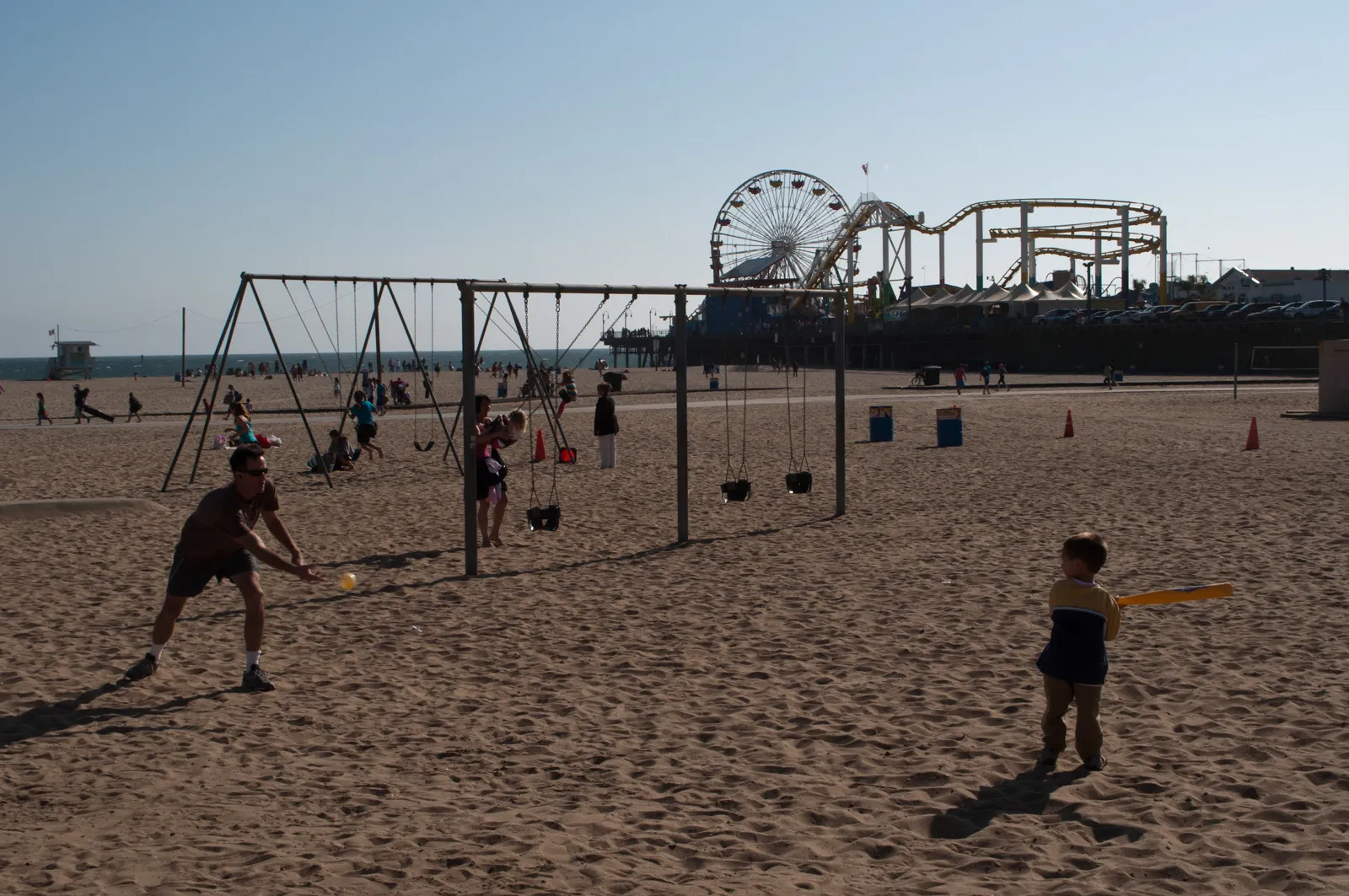
All of it is free and none of it is supervised. On a weekday afternoon it is mostly gymnasts and regulars working the rings, plus a steady trickle of people who wandered down off the pier and are finding out how far apart the bars actually are. Watching costs nothing and takes ten minutes, and the sand runs wide enough here that the equipment sits well back from the water.
Third Street Promenade has been closed to cars since 1965
Third Street Promenade covers three blocks of downtown Santa Monica, one block inland from Ocean Avenue. The city shut it to traffic in November 1965 as the Santa Monica Mall, tore it up and rebuilt it under its present name in 1989, and it has been a pedestrian street the whole time since. Shopfronts run down both sides, street performers work the middle, and there is enough tree cover to make it bearable in the middle of a hot afternoon.
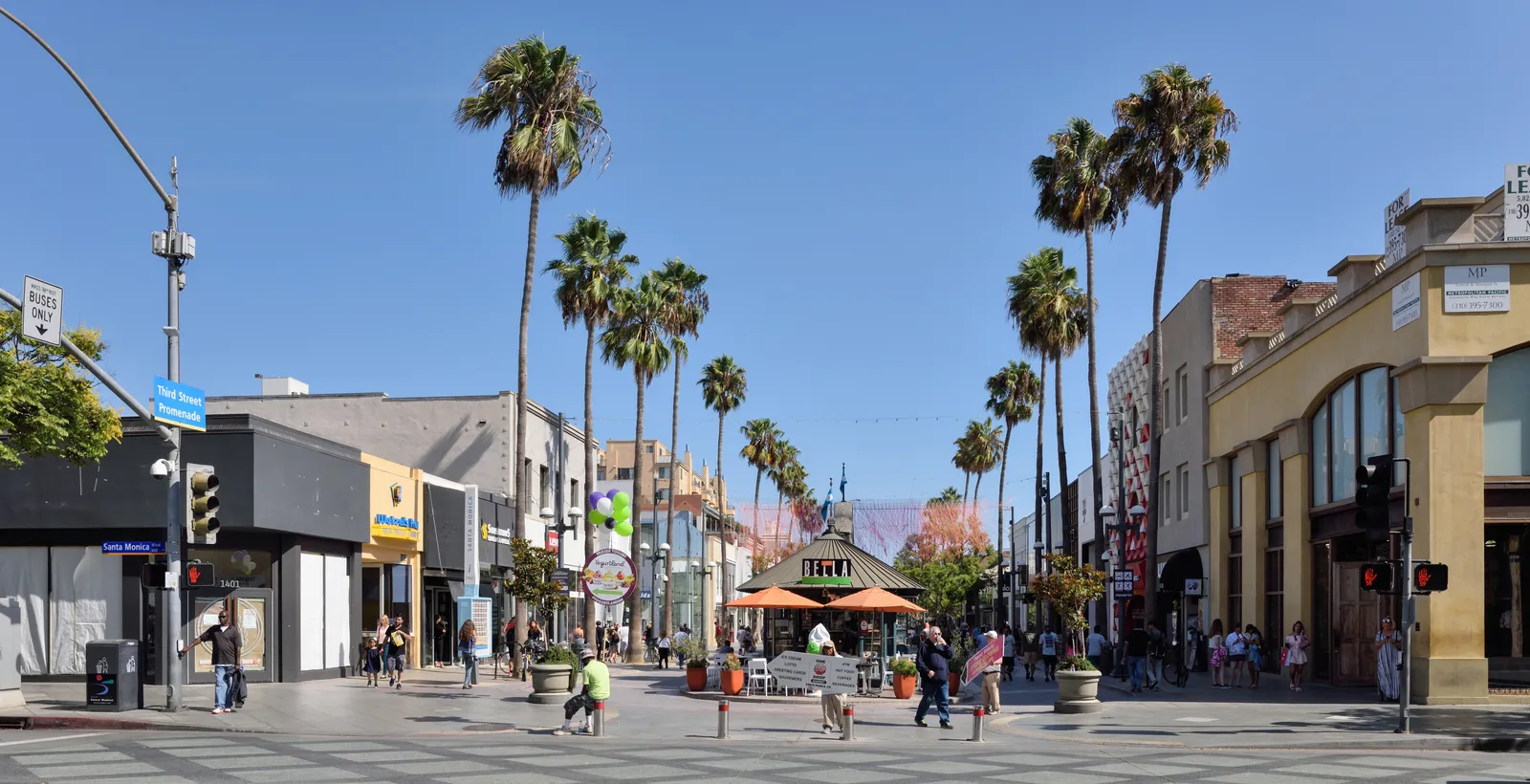
For a flight day the useful thing about it is that it sits directly between the rail terminus and the pier, so it costs nothing in time to walk it rather than around it. Santa Monica Place, the open-air mall at the south end, has a rooftop level with food and a view back over the bay.
Palisades Park runs a mile and a half along the Santa Monica bluff
Palisades Park is the strip of green on the ocean side of Ocean Avenue, laid out in 1892 on the edge of the coastal bluff and running 1.6 miles north from Colorado Avenue. It is narrow, sometimes only a few dozen metres wide, and all of it looks out over the water: lawn, tall palms, a footpath, benches turned toward the horizon, a rose garden, and a set of pétanque courts that get used.
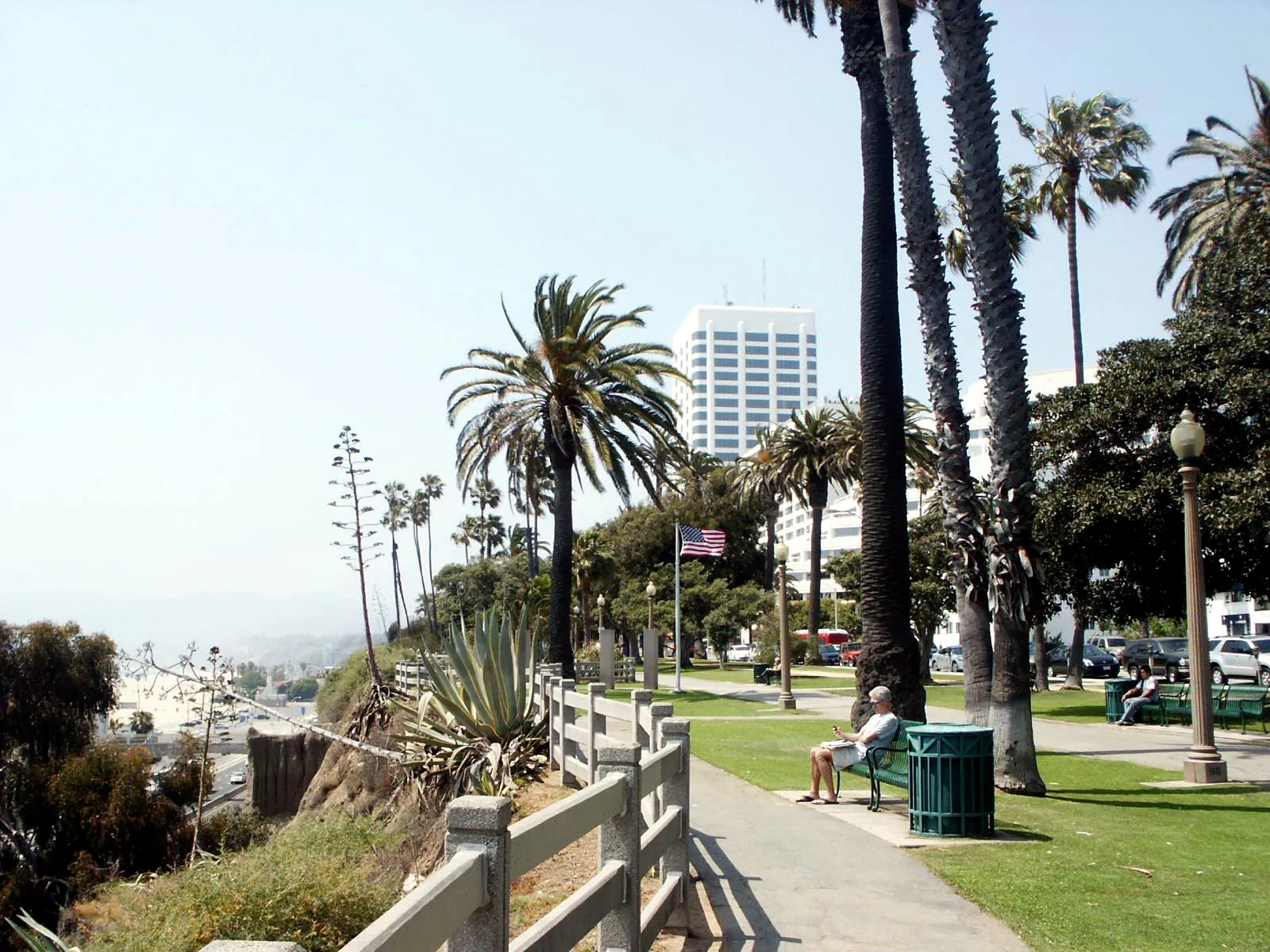
The bluff itself is unconsolidated sediment and it does erode, which is why sections of the seaward edge are fenced off and why the path wanders. Below it, the Marvin Braude beach path runs along the sand in both directions, flat and paved, and if you would rather cover ground than walk, a guided ride down the coast to Venice covers the stretch south in about the time the walk to the end of the park would take. With more than five hours before a flight, going inland instead makes sense: the downtown Los Angeles walk picks up a 1917 food market, a funicular and the city’s oldest house in a mile of streets, at a completely different pace from this one.
The cheapest way back to LAX is a $1.25 bus
Big Blue Bus Route 3 runs south down Lincoln Boulevard from Santa Monica to the LAX/Metro Transit Center, and it costs $1.25 with a transit card, including a free transfer within two hours. At the transit center you change to the free shuttle at Bus Bays 1 and 2, which runs into every terminal. That is one bus and one shuttle, and the whole trip comes to $1.25.
Metro is the alternative and it is a train rather than a bus: the E Line east from the terminus at 4th and Colorado to Expo/Crenshaw, then the K Line south to the same transit center, around 55 to 60 minutes of riding for $1.75 with free transfers. Neither option reaches the terminals directly. The airport’s automated people mover, which will eventually run between the transit center and the gates, is still in testing with no announced opening date, so the shuttle bus is doing that leg either way. Allow two hours from the pier for the trip, the shuttle and check-in, and note that the trains stop running around midnight while the buses on Lincoln run later.
None of this walk wants a suitcase along for it: the pier deck, the sand at Muscle Beach and the fenced path along the bluff are all better with your hands empty, and the coast is a place to be out in rather than a corridor to get through.
Frequently asked questions
Is Santa Monica Pier free?
Walking out onto the deck is free, and there is no gate and no ticket booth on the pier itself. What costs money is everything bolted to it: the amusement park rides, the arcade, the carousel at $3 a ride, the food, and parking, which runs from a few dollars in the beach lots to considerably more on the pier deck. The beach either side of it and the gymnastics equipment at Muscle Beach are free as well, so a visit here can cost nothing at all if you want it to.
How far is Santa Monica Pier from the train station?
About half a mile, or ten to twelve minutes on foot. The rail terminus sits at 4th Street and Colorado Avenue, and Colorado runs west from there straight to Ocean Avenue and the pier entrance, downhill the whole way. Third Street Promenade is one block off that route, so the walk from the platform picks up two of the four stops here without any detour.
Will the coast be foggy in the morning in summer?
Often, in late spring and early summer specifically. The marine layer that Southern Californians call May Gray and June Gloom sits over the coastline overnight and through the morning during May and June, and it usually burns off around midday as the air warms. The odd thing about it is how local it is: the basin inland can be bright and warm while the beach is grey and damp. For a layover in those two months, an afternoon slot on the coast is a much better bet than a morning one, and the rest of the year the pattern mostly disappears.
Is there a direct bus from Santa Monica to LAX?
Close to it. Big Blue Bus Route 3 runs down Lincoln Boulevard from Santa Monica to the LAX/Metro Transit Center for $1.25 with a transit card, and the free shuttle from Bus Bays 1 and 2 there covers the last leg into the terminals. It is one bus and one shuttle rather than a true door-to-door service, but it is the cheapest way to the airport from this side of the city and it avoids the two-train transfer the Metro route needs.