Chicago Layover: Willis Tower and the Skydeck
Part of the full Chicago Layover: Millennium Park From ORD
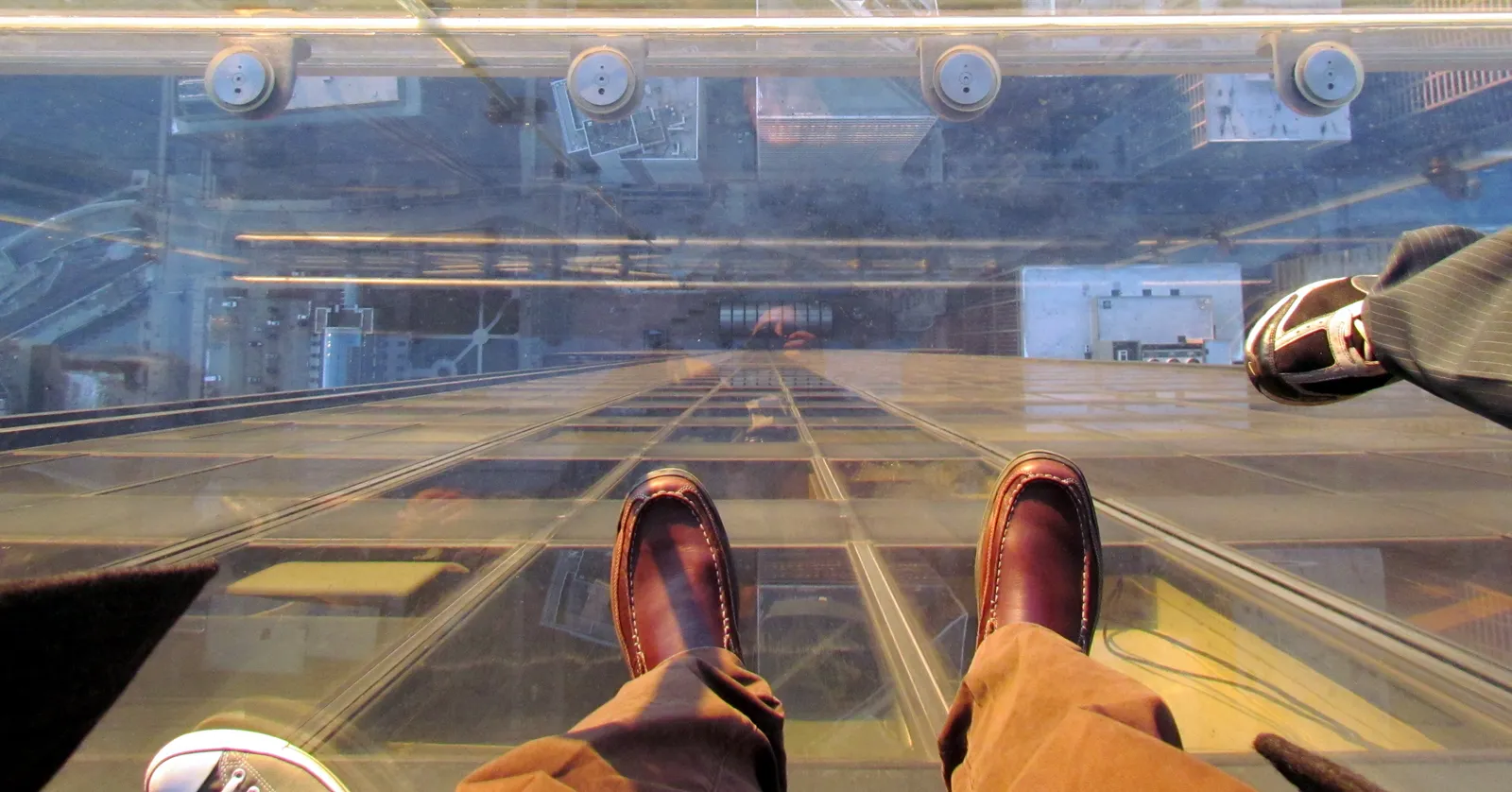
Willis Tower’s Skydeck puts you on the 103rd floor in Chicago, 1,353 feet up, standing on a glass box that hangs off the side of the building. Down at street level, the Art Deco tower that closes off LaSalle Street and a lobby lined with Tiffany glass mosaics both cost nothing to look at.
The Ledge, the glass boxes off Willis Tower’s 103rd floor
Skydeck Chicago is the highest observation deck in the United States, and the elevator covers the 103 floors in about a minute, with enough pressure change on the way up to feel it. The deck opened in June 1974, a year after the tower itself, and for its first 35 years it was a room with windows. The Ledge arrived on 2 July 2009: retractable glass balconies that push out about four feet from the facade, floor included, so the street is directly under your shoes. A 2021 remodel added another one and rebuilt the whole floor around them.
Admission starts at $32 for adults and $24 for ages 3 to 11, with under-3s free. Summer hours run 9am to 10pm daily, from 8:30am on Saturdays, and shorten the rest of the year; last entry is always 30 minutes before closing. The queue is the variable, not the view, so a timed entry ticket bought before you leave the airport is the single thing that changes how long this takes.
Everyone goes in through the Jackson Boulevard doors, where bags go through a scanner and people through a metal detector before joining the elevator line, and a suitcase is slow through both.
The Art Deco Board of Trade tower at the end of LaSalle Street
LaSalle Street runs south from the river between unbroken walls of stone, and one building stops it dead at Jackson Boulevard. The Chicago Board of Trade Building opened on 9 June 1930 to a Holabird and Root design, 604 feet and 44 stories, the first building in the city to pass 600 feet and the tallest in Chicago for the next 35 years until the Daley Center went up in 1965.
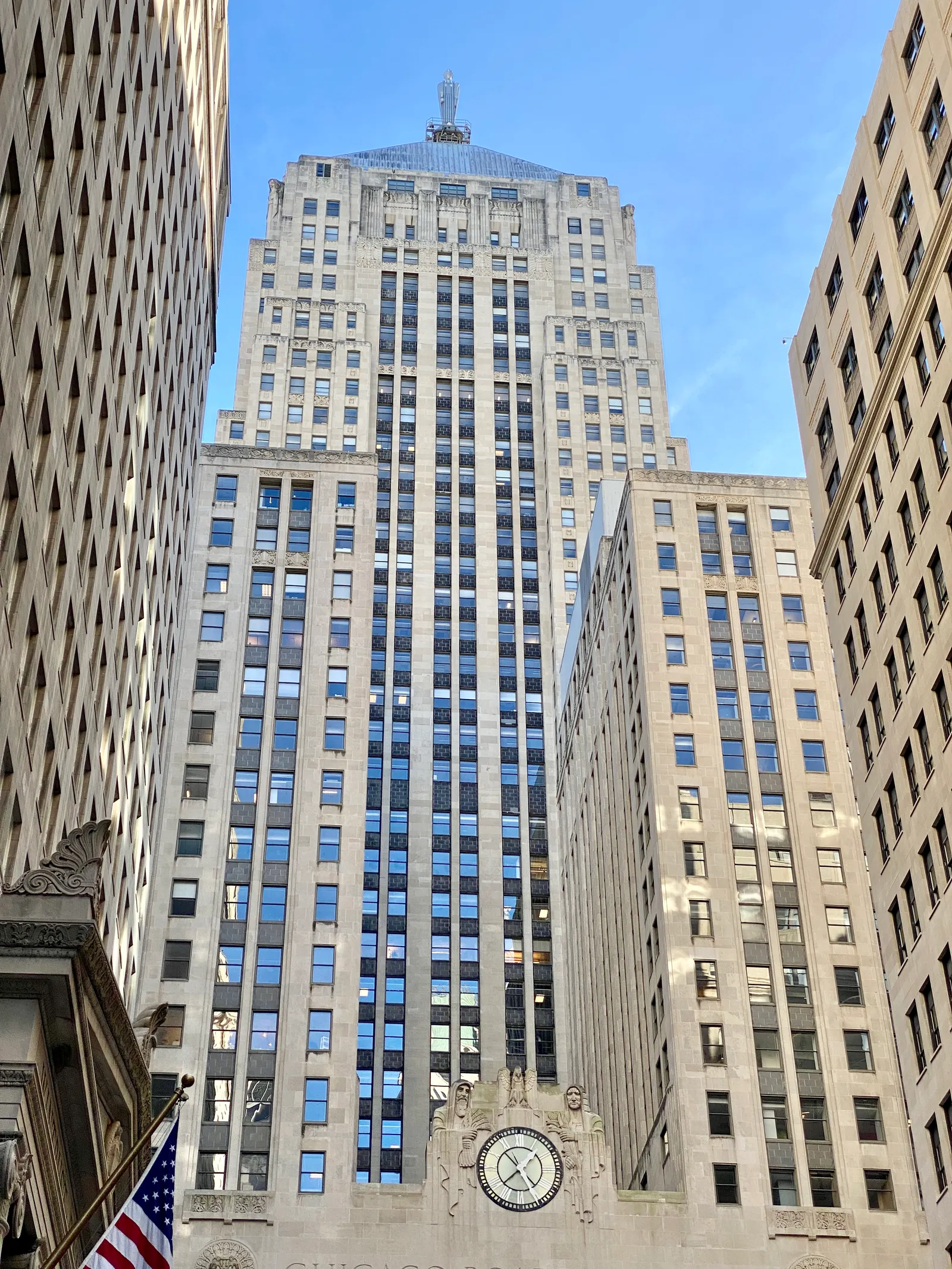
A 13-foot clock sits above the entrance, flanked by two hooded stone figures, a Babylonian and a Native American farmer. On the roof stands Ceres, Roman goddess of grain, 31 feet of aluminum assembled from 40 pieces by the sculptor John Storrs. She has no face. Storrs worked on the assumption that nothing that high would ever be looked at closely, which held until the Skydeck opened two blocks west and about 750 feet above the top of her head.
The trading floor that made the building famous is not open to the public, so this one is a facade and a clock rather than a visit. The Chicago Architecture Center runs guided walks of the Loop’s older towers that take this block in properly, and a place on one is worth reserving if you would rather have the street explained than guess at it.
Tiffany mosaics in the Marquette Building’s lobby
Holabird and Roche finished the Marquette Building at 140 South Dearborn in 1895, and its two-story lobby is free to walk into from 7am to 10pm every day of the week. A band of mosaic panels runs the whole way around the hexagonal balcony rail above the elevator doors, worked in lustered Tiffany glass, mother-of-pearl and semi-precious stones, and they tell the story of Jacques Marquette’s expedition down the Illinois River in the 1670s and the people he met on it.
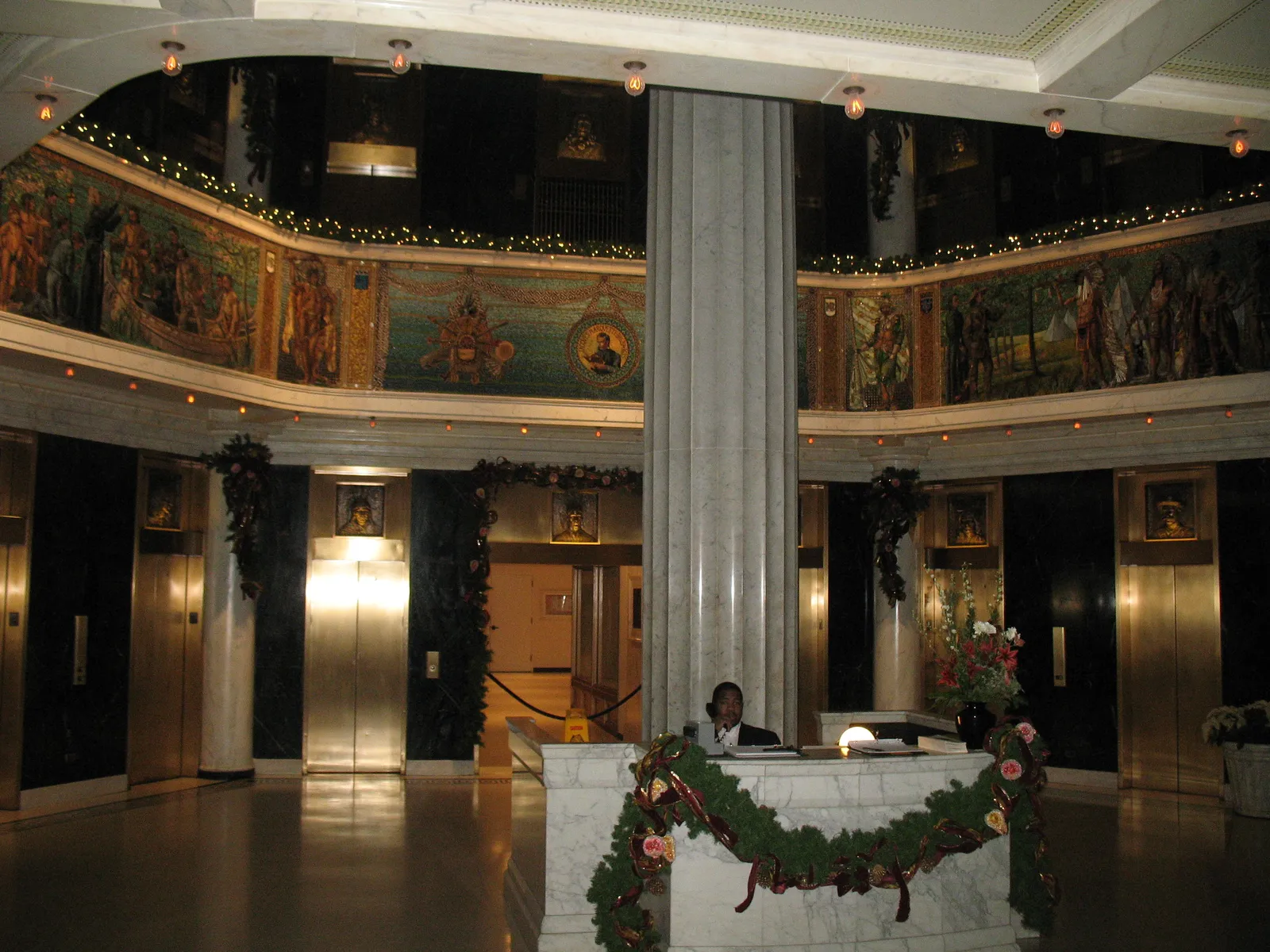
Louis Comfort Tiffany’s chief designer, J. A. Holzer, drew them, which is the same hand behind the glass dome in the Chicago Cultural Center on the other side of the Loop. Outside above the door, four bronze relief panels by Hermon Atkins MacNeil carry the same story further, ending with Marquette’s burial. The MacArthur Foundation owns the building, restored the lobby and added a free ground-floor exhibit about it in 2007, which is why a working office building has an interpretive display in the entrance hall.
Quincy station, rebuilt to look the way it did in 1897
Quincy stands at 220 South Wells Street and opened on 3 October 1897, and it is the most intact of the original elevated stations around the Loop. Alfred M. Hedley built it out of wood and stamped metal, and a restoration between 1985 and 1988 by the Office of John Vinci took it back as close to its opening-day appearance as the records allowed, including a ticket agent’s booth replicated from the 1897 drawings. The city made it a landmark in 2017, and an $18.2 million modernization finished in December 2018 put two elevators in without touching the look of the place.
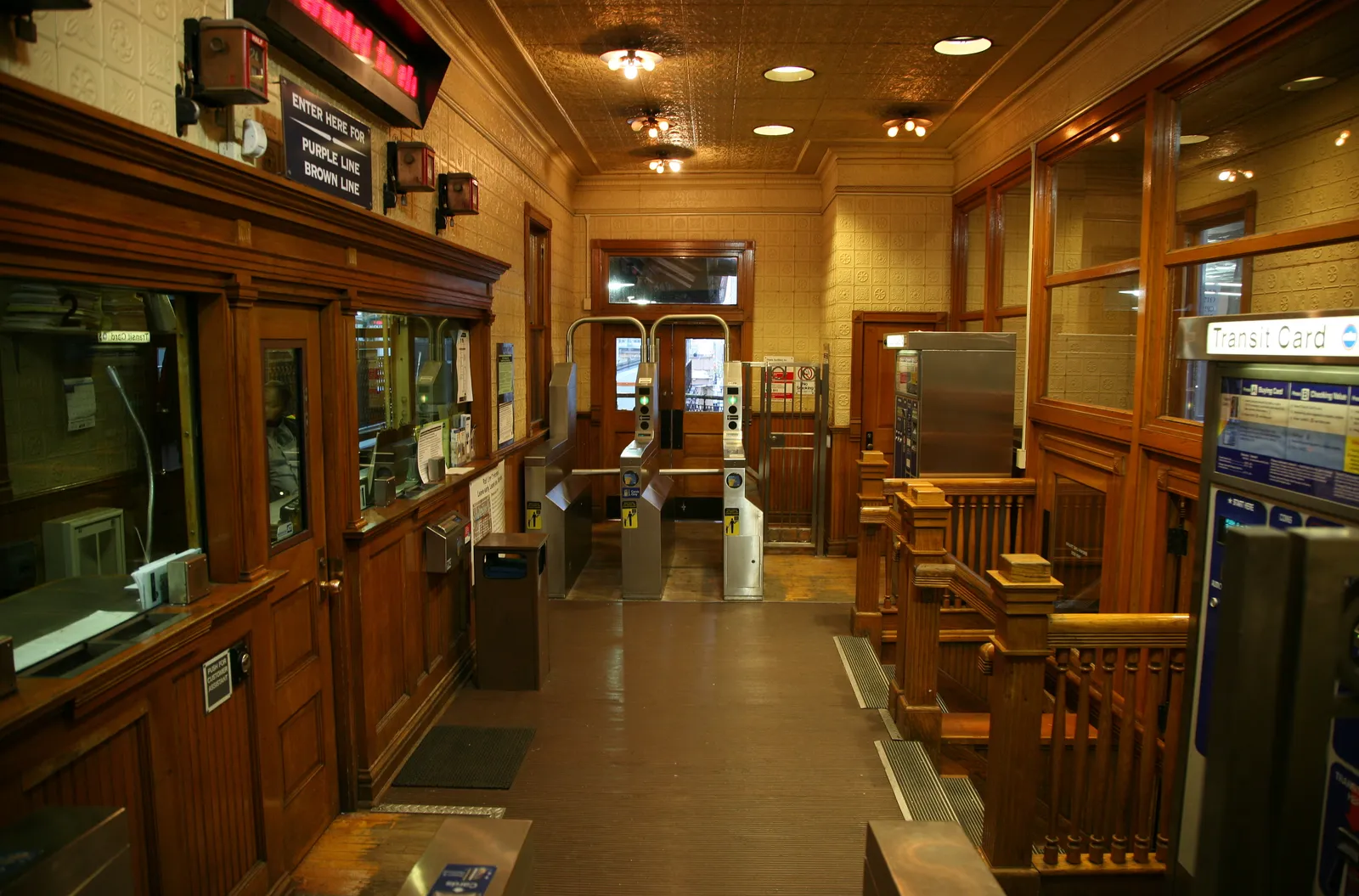
The paneling, the booth and the pressed-metal ceiling all sit on the near side of the turnstiles, so this costs nothing unless you get on a train. It is a working station with commuters going through it, not a museum piece behind rope.
With more hours than the tower and these two lobbies need, the free walk around Millennium Park and the Chicago Riverwalk starts about fifteen minutes east and covers different ground, and Union Station and the West Loop are a similar distance the other way if you arrived on a train rather than a plane.
No airport train stops at Willis Tower itself
Two stations on the Blue Line, the train out to O’Hare, sit about eight minutes away in different directions: Jackson, on Dearborn at Jackson Boulevard, roughly 45 minutes from the airport, and LaSalle, down at Congress Parkway, a similar walk southeast. Trains run around the clock and the fare boarding downtown is the standard $2.50, because the $5 surcharge applies only to trips that start at the O’Hare station. Leave two hours for the ride, the long walk out to the terminal and security.
Six blocks cover everything on this page, all of it flat, and the Marquette lobby and the Skydeck both stay open until 10pm, which makes this one of the few downtown itineraries that still works if you only get free at six in the evening. The one queue in it is the scanner on Jackson Boulevard, and that goes faster without a suitcase.
Frequently asked questions
What should I do during a layover near Willis Tower in Chicago?
With four to six hours, the Skydeck on the 103rd floor is the one thing here worth paying for: 1,353 feet up, with glass balconies you can stand out on. Everything else within a few blocks is free, including the Art Deco Chicago Board of Trade Building at the south end of LaSalle Street, the Tiffany glass mosaics in the Marquette Building lobby on Dearborn, and the 1897 elevated station at Quincy. Book the Skydeck ahead, since the entry queue is the only part of this that can run long, and drop the rest if you are short on time.
How long does a Skydeck visit actually take?
Budget about an hour, and more on a clear weekend afternoon. Everyone entering goes through a bag scanner and a metal detector on Jackson Boulevard, then queues for the elevator, which covers the 103 floors in about a minute. Upstairs, each group of two gets roughly 60 seconds inside a ledge box for photos. An expedited entry upgrade starting at $55 cuts the elevator queue, which is only worth it if the line is already long when you arrive.
Does the Skydeck refund tickets if the city is fogged in?
No. The deck stays open in low cloud and even zero visibility, and no refund is issued for weather, visibility or wait time, though rescheduling is usually possible. Check the sky before you buy rather than after, and if the tops of the towers are in cloud from the street, spend the money on something at ground level instead.
What is there to see around Willis Tower for free?
More than most of the Loop. The Marquette Building lobby at 140 South Dearborn is free and open 7am to 10pm daily, mosaics and all. LaSalle Street between the river and Jackson Boulevard costs nothing to walk down, with the Board of Trade closing off the far end and its 31-foot aluminum Ceres on the roof. Quincy station is a working elevated stop restored to its 1897 look, and the woodwork sits on the near side of the turnstiles.
How do I get from Willis Tower out to O'Hare?
The Blue Line is the airport train and it does not stop at the tower itself. Jackson, on Dearborn at Jackson Boulevard, is about eight minutes' walk east and roughly 45 minutes from O'Hare; LaSalle, at Congress Parkway, is a similar walk southeast. Trains run 24 hours and the fare boarding downtown is the standard $2.50, since the $5 surcharge only applies to trips starting at O'Hare.