Chicago Union Station Layover: The West Loop
Part of the full Chicago Layover: Millennium Park From ORD
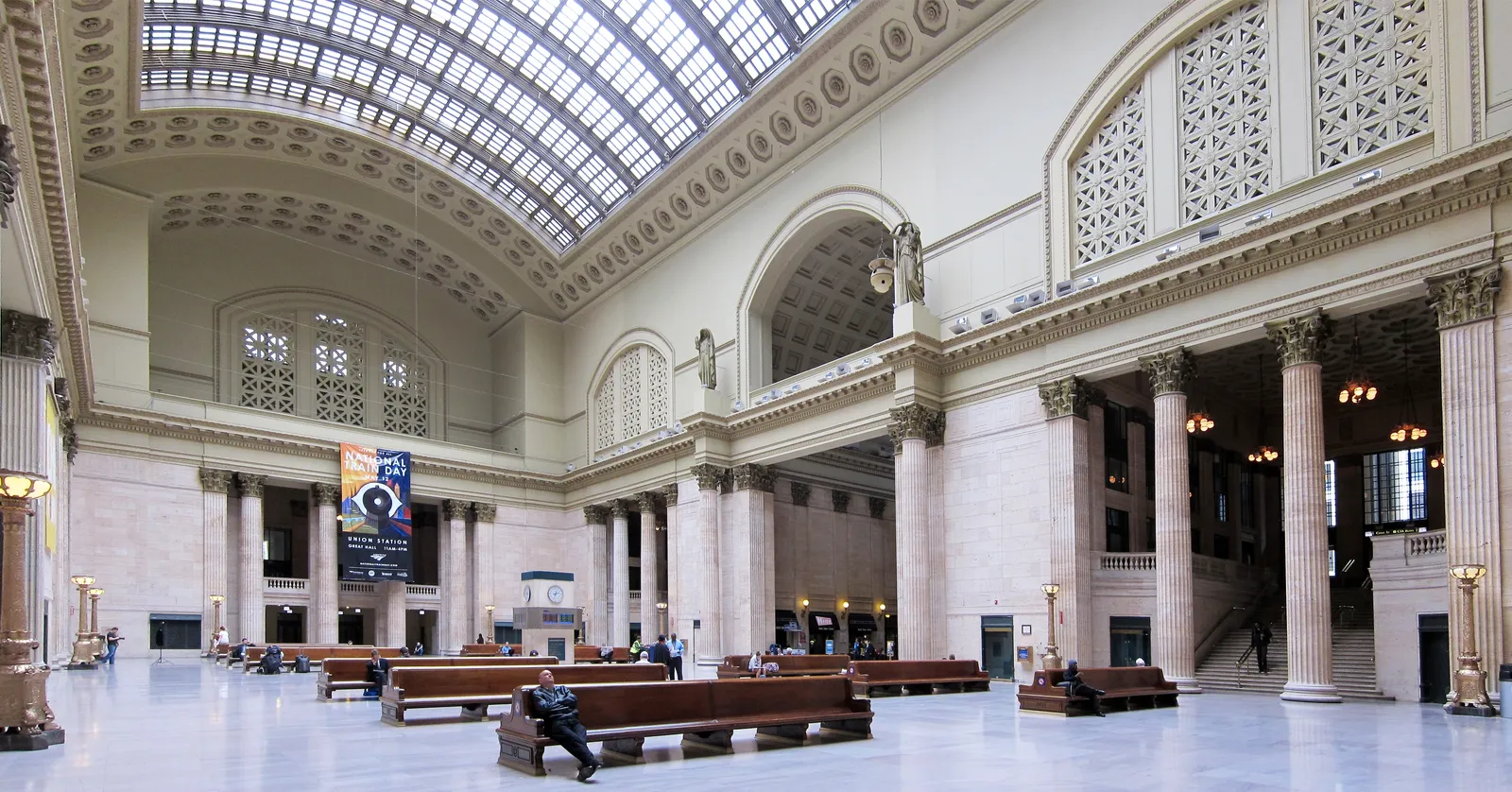
Chicago Union Station’s Great Hall costs nothing to walk into, and the West Loop around it holds the oldest church building in the city and a landmarked district of meatpacking warehouses now full of restaurants, all within about fifteen minutes on foot. The Blue Line train out to O’Hare leaves from Clinton, two blocks south of the station.
The barrel-vault skylight over Union Station’s Great Hall
The headhouse just west of Canal Street opened in 1925 and the waiting room inside it is the reason to arrive early rather than late. Graham, Anderson, Probst and White gave it rows of Corinthian columns, a marble floor, and a barrel-vaulted skylight 219 feet long and 115 feet above the benches.
For decades that skylight was dim, glazed in wire-embedded glass that had gone cloudy. A $22 million restoration finished in 2019 replaced more than two thousand of those panes with clear glass and built a second weatherproof skylight above the original, which is why the hall now reads as a daylit room at noon instead of a lit one.
The wide stone staircase in the hall is the one from The Untouchables, where Brian De Palma sent a baby carriage bouncing down through a shootout in 1987. It is still an ordinary working staircase with commuters on it, which is most of the charm.
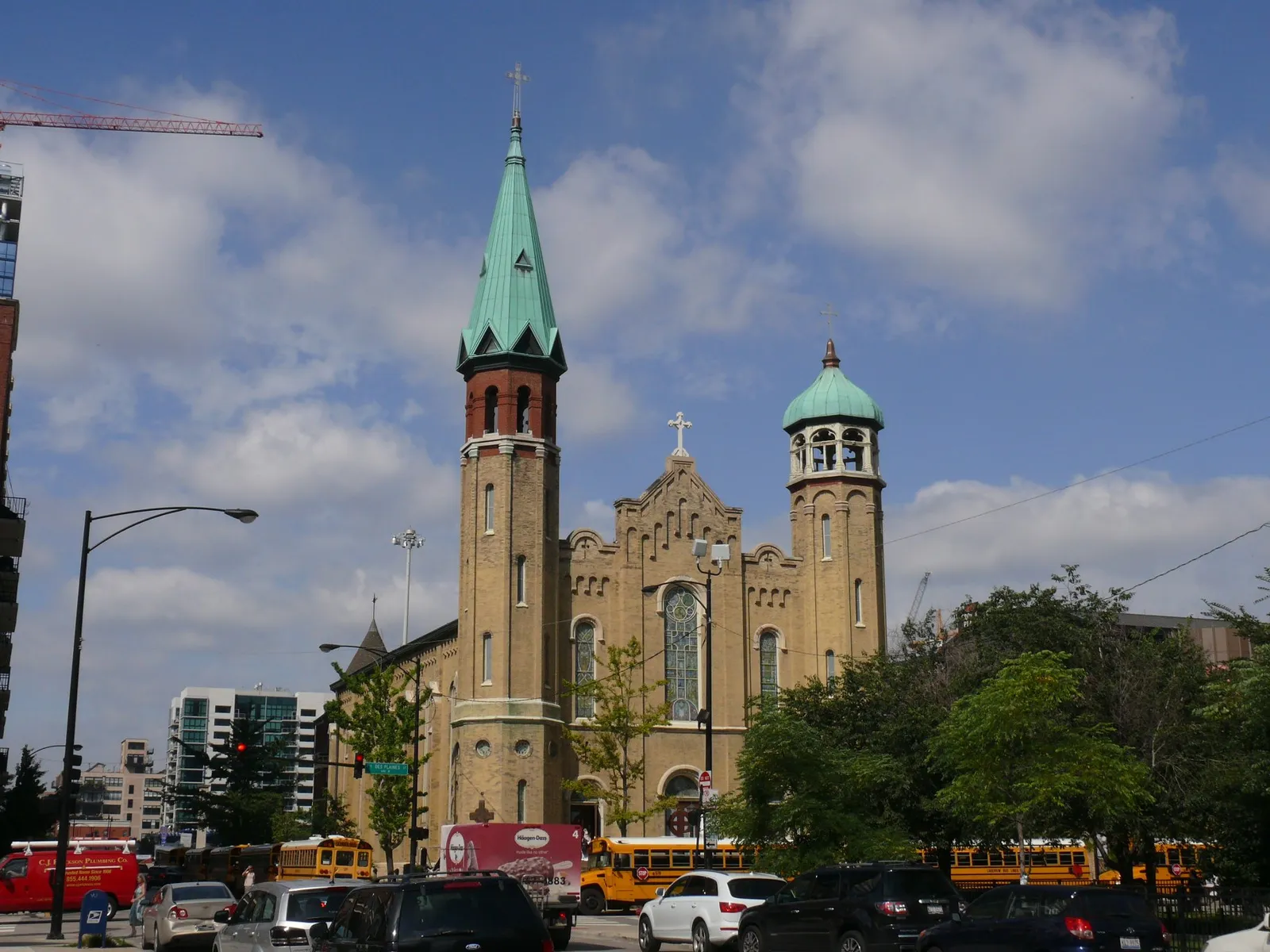
Old St. Patrick’s, the oldest church building in Chicago
Three blocks west at 700 West Adams, Old St. Patrick’s was dedicated on Christmas Day 1856 and is one of the handful of buildings downtown that the 1871 fire went around. It is built of yellow Cream City brick hauled down from Milwaukee, and the two octagonal spires added in 1885 deliberately do not match: one pointed, one domed, said to stand for the Western and Eastern churches.
Inside is the part almost nobody outside the parish knows about: fifteen stained-glass windows that Thomas A. O’Shaughnessy designed, made and installed himself between 1912 and 1922, twelve of them worked up from the interlace patterns in the Book of Kells after he saw the Celtic art shown at the 1893 world’s fair. The parish schedules tours rather than keeping open visiting hours, so that one takes planning; the spires do not.
Arriving here by train means you are standing in the West Loop with your suitcase from the first minute of the day rather than picking it up at the end of a ride in from the airport, and the station’s own parcel check runs $20 a bag.
Randolph Street’s Restaurant Row in Fulton Market
Fifteen minutes northwest, the Fulton-Randolph Market District is a hundred-odd brick and timber buildings that spent a century as Chicago’s wholesale food trade: produce on Randolph from the 1850s, then Armour and Swift running the meatpacking end of Fulton Market by the 1950s. The city landmarked the whole corridor in 2015, which is why the loading docks, canopies and painted wall signs are still there under the new tenants.
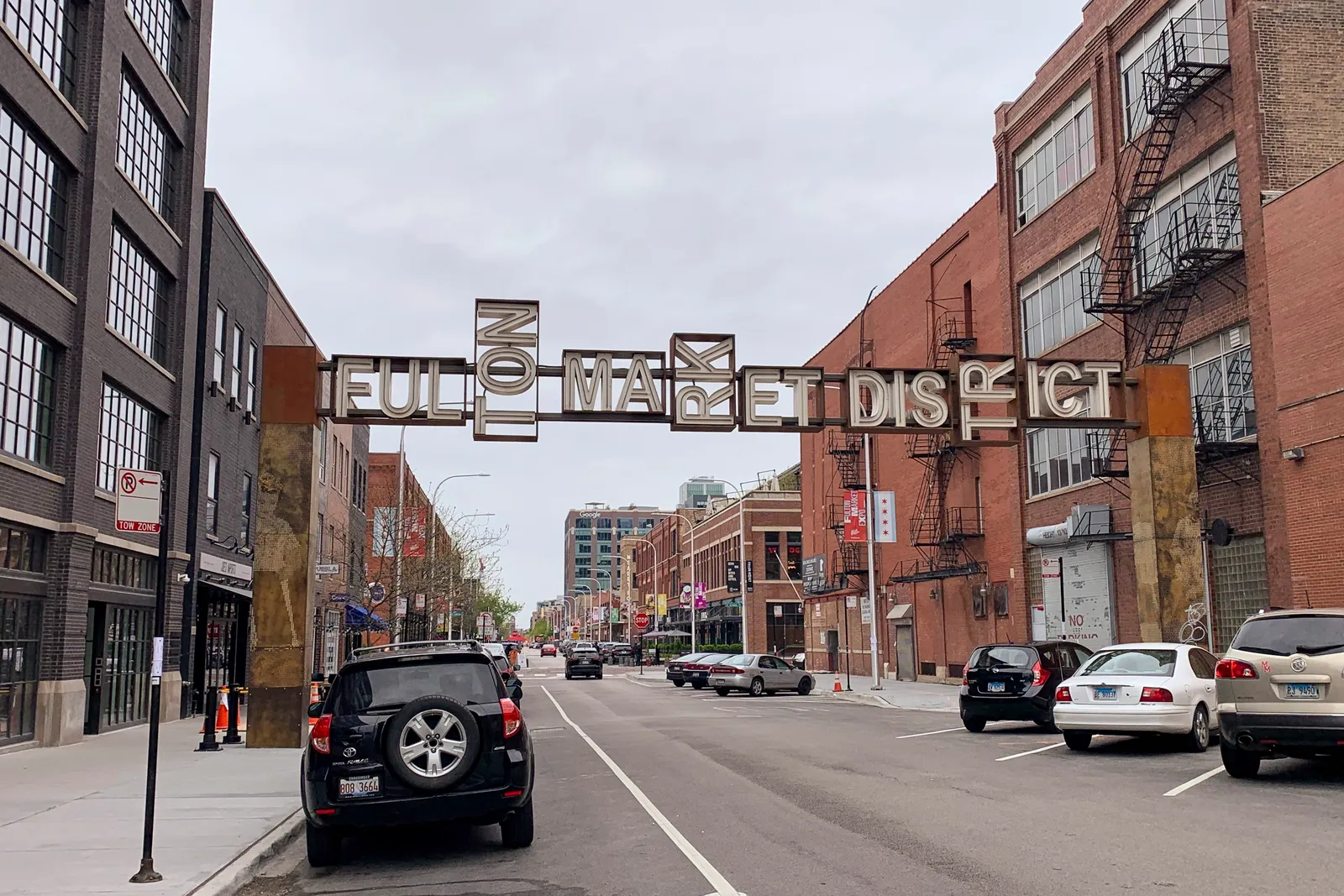
What moved in is the restaurant strip locals mean when they say Restaurant Row, running along Randolph roughly from Halsted west. If the walk sounds long, the Green and Pink lines run from Clinton, a few minutes north of the station, to Morgan in the middle of the district, one stop.
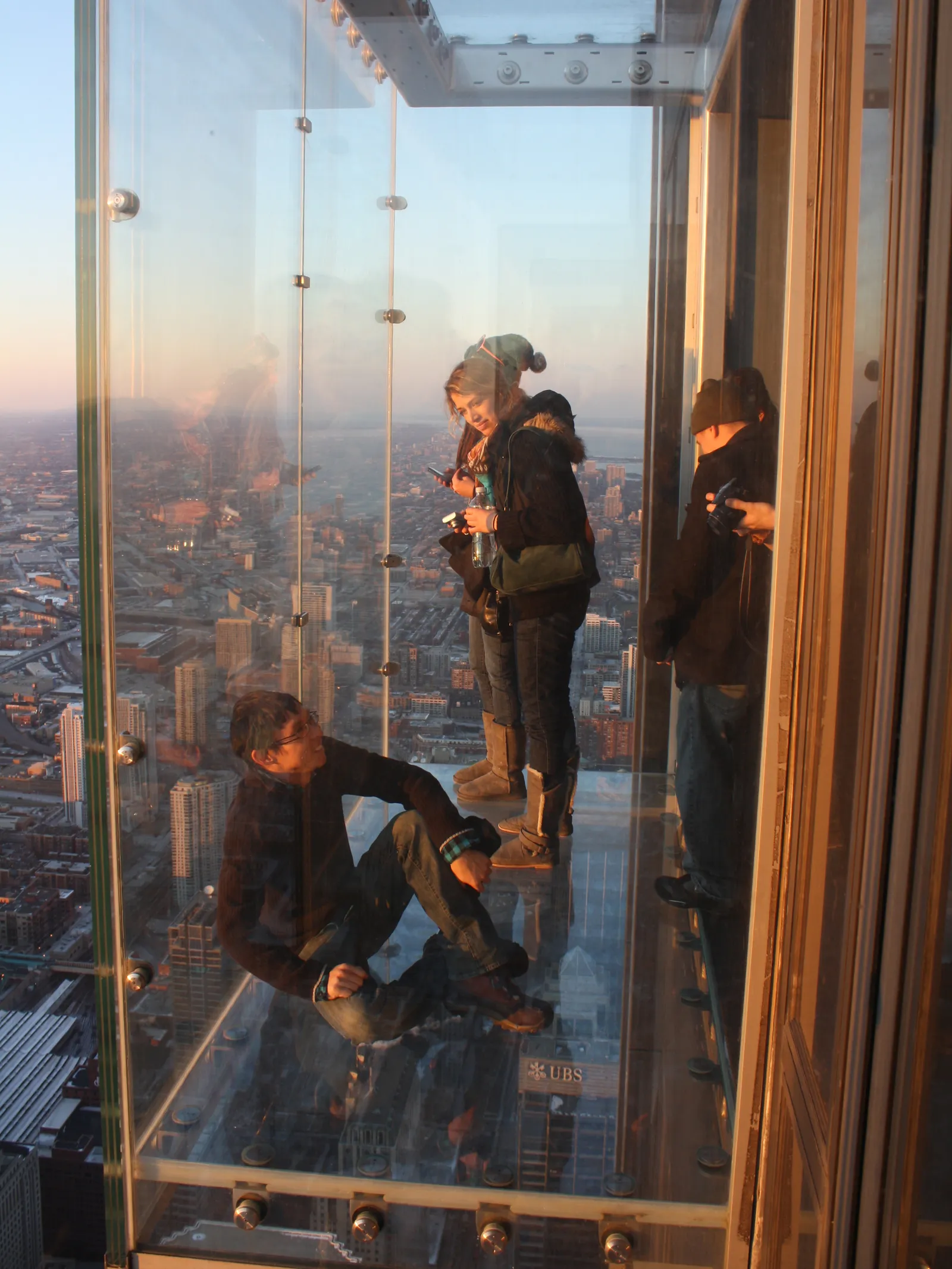
The Skydeck’s glass ledge at Willis Tower
Ten minutes east on Adams and you are at the base of Willis Tower, which puts the only real vertical option of this itinerary within easy reach: the Skydeck on the 103rd floor, and the glass boxes cantilevered off the side of it. It is weather-dependent and the walk-up line can eat half an hour on a busy afternoon, so a timed entry ticket is worth deciding on before you set out rather than after.
The downtown walk from Millennium Park to the Riverwalk is the other way to spend the same hours, on the far side of the Loop, if free and outdoors suits you better than paying for altitude.
No elevator down to the Clinton Blue Line platform
Getting back out is the simplest part of this trip: two blocks south along Clinton Street from the west side of the Great Hall, in under the Van Buren Street viaduct, and the Blue Line runs direct to O’Hare with no change of train, close to 50 minutes on the schedule. There is no elevator at that entrance, though. If steps are a problem, the station’s own advice is to take a 1, 7, 28, 126 or 151 bus east to Dearborn Street and pick up the Blue Line there instead.
Between the station walk, the Fulton Market loop and the ride out, that is a good three hours of being on your feet in a part of town with almost no reason to backtrack. Leaving the suitcase behind at the start is what keeps it a walk rather than a haul.
Frequently asked questions
How long does the Blue Line take from Union Station out to O'Hare?
Close to 50 minutes on the schedule, plus about five minutes to walk from the station down to the Clinton platform, so budget an hour before you even reach the terminal. It is a direct ride with no transfer, trains run around the clock, and the fare into the airport is the standard $2.50; the $5 surcharge only applies to trips that start at O'Hare.
Is there a step-free route from Union Station to the Blue Line?
Not directly. The Clinton Blue Line entrance is stairs down under the Van Buren Street viaduct, and the station's own advice for accessible boarding is to take a 1, 7, 28, 126 or 151 bus east to Dearborn Street instead and pick up the Blue Line there. Union Station itself is ADA compliant, with an accessible entrance and a street-to-concourse elevator on Clinton Street.
Is the Skydeck worth booking ahead from Union Station?
Willis Tower is about ten minutes' walk east, which makes it the one ticketed thing genuinely close enough to fold into this day, and the entry queue is the whole risk: a timed Skydeck entry ticket booked before you land removes it. Skip it entirely if the day is overcast, since the view is the product.
Can I actually get inside Old St. Patrick's to see the windows?
Not on a walk-in basis you can count on. The parish schedules tours of the church rather than keeping set visiting hours, so arrange one ahead if the O'Shaughnessy glass is why you are going. The exterior, the yellow brick and the two mismatched spires, is visible from Adams Street at any hour, and Mass times are published on the parish site.
Where can I leave a bag inside Union Station itself?
The station runs a parcel check on the concourse level at $20 per bag. Amtrak's separate checked-baggage service is $20 a bag as well but only covers ticketed passengers travelling between stations that both offer it, and the Metropolitan Lounge with its luggage storage is limited to business class, sleeping car and higher-tier Guest Rewards members.