Chicago Layover on the Magnificent Mile
Part of the full Chicago Layover: Millennium Park From ORD
Chicago’s Magnificent Mile is the stretch of Michigan Avenue running north from the Chicago River to Oak Street, with an observation deck and a tilting glass platform 1,000 feet up at the far end, around 150 fragments of foreign landmarks set into Tribune Tower’s wall near the river, and the 1869 Water Tower standing in the middle of it.
360 Chicago’s deck and tilting platform at 875 North Michigan
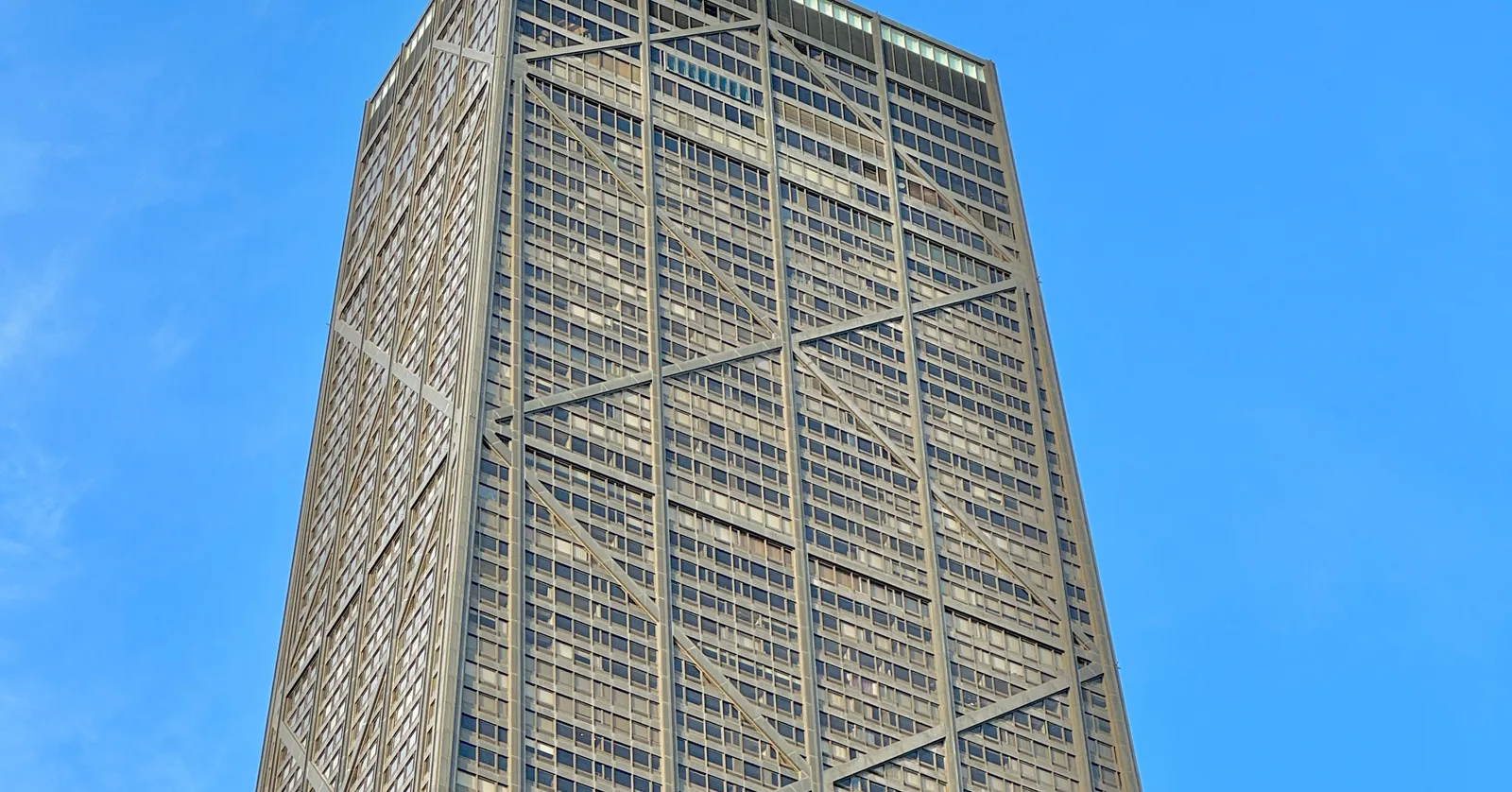
875 North Michigan Avenue is the tapering black tower with giant white X-braces running up its front, and the express elevator inside covers the 94 floors to the deck in about 40 seconds. The deck sits at 1,000 feet, and on a clear day the view crosses the lake far enough to take in parts of Indiana, Michigan and Wisconsin as well as Illinois. Admission starts at $30 for adults and $20 for ages 3 to 11, and the deck is open daily from 9am to 11pm, with last entry an hour before closing, which makes it the rare Chicago attraction that still works at nine in the evening.
TILT is the other thing sold up there: a glass platform on the north face that eight people at a time hold onto while it leans out over Michigan Avenue for about two minutes. Riders have to be 42 inches tall, it costs roughly $15 more than the plain deck ticket, and the slots go on busy evenings, so booking a time before you set out settles both questions at once.
The Museum of Contemporary Art on East Chicago Avenue
One block east of Michigan Avenue at 220 East Chicago Avenue, the MCA holds the city’s main collection of art made since 1945 and puts on the sort of large single-artist shows that would otherwise mean a trip out of the center. Adult admission is $21, under-18s are free, and Illinois residents get in free on Tuesdays with an ID showing it. A direct-entry ticket is the practical version if you are working to a flight rather than an afternoon.
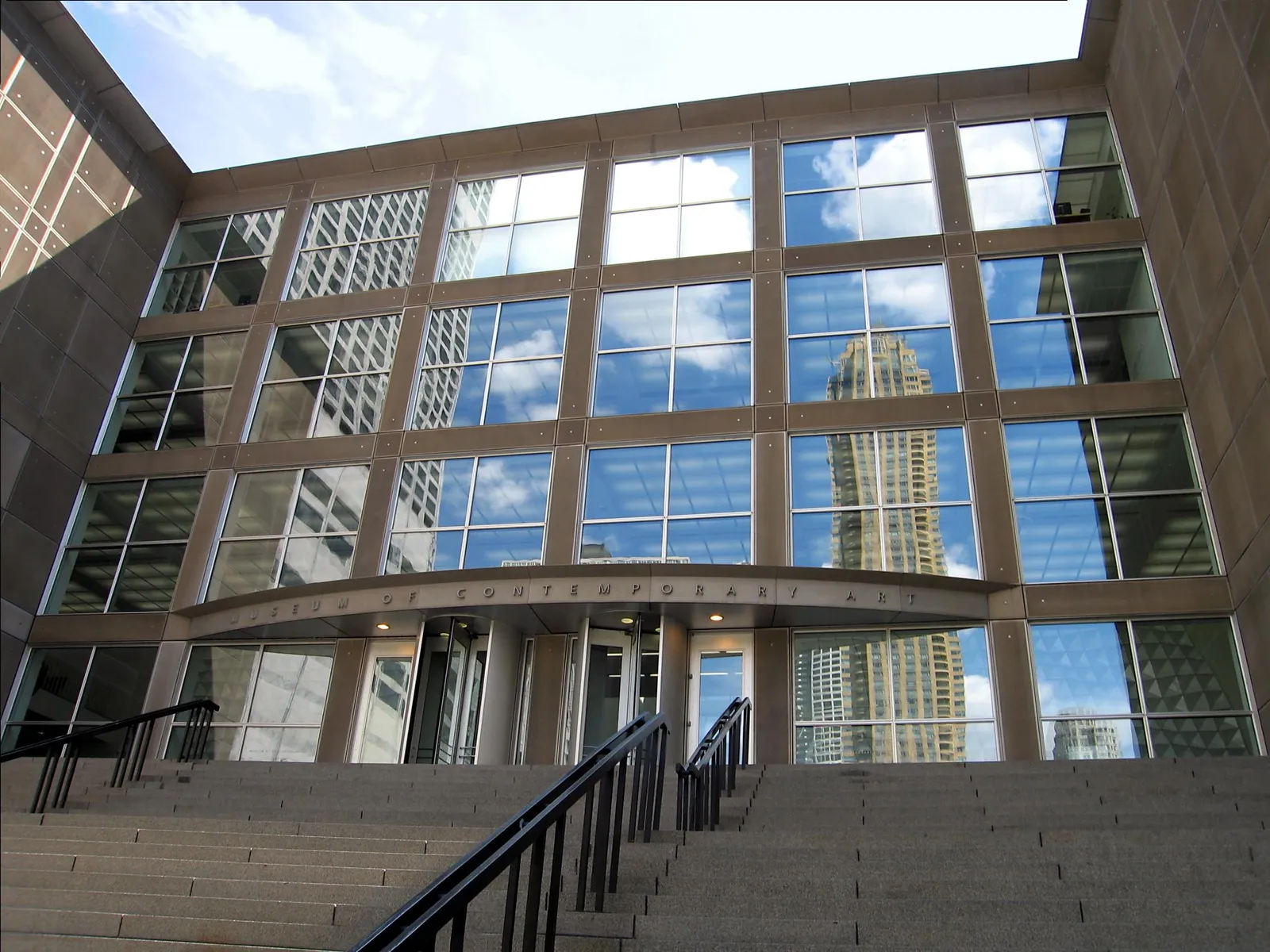
Check the day before building anything around it: the museum is shut on Mondays, open until 9pm on Tuesdays and until 5pm from Wednesday to Sunday. Both ticketed stops on this street have a rule about luggage, and they are not the same rule: the observation deck refuses large bags and suitcases outright and has nowhere to put them, while the museum keeps big bags out of the galleries but will take them at a free coat check.
Around 150 pieces of other countries’ landmarks in Tribune Tower’s wall
Colonel Robert McCormick had correspondents bring back fragments of famous buildings while the Chicago Tribune’s headquarters was going up in the mid-1920s, and they were set into the limestone at the base of 435 North Michigan Avenue as they arrived. Close to 150 are there now, each with its origin engraved in the stone beside it: the Parthenon, the Great Wall of China, the Taj Mahal, Westminster Abbey, the Colosseum, the Alamo, the White House, the Pyramid of Cheops and a chunk of the Berlin Wall.
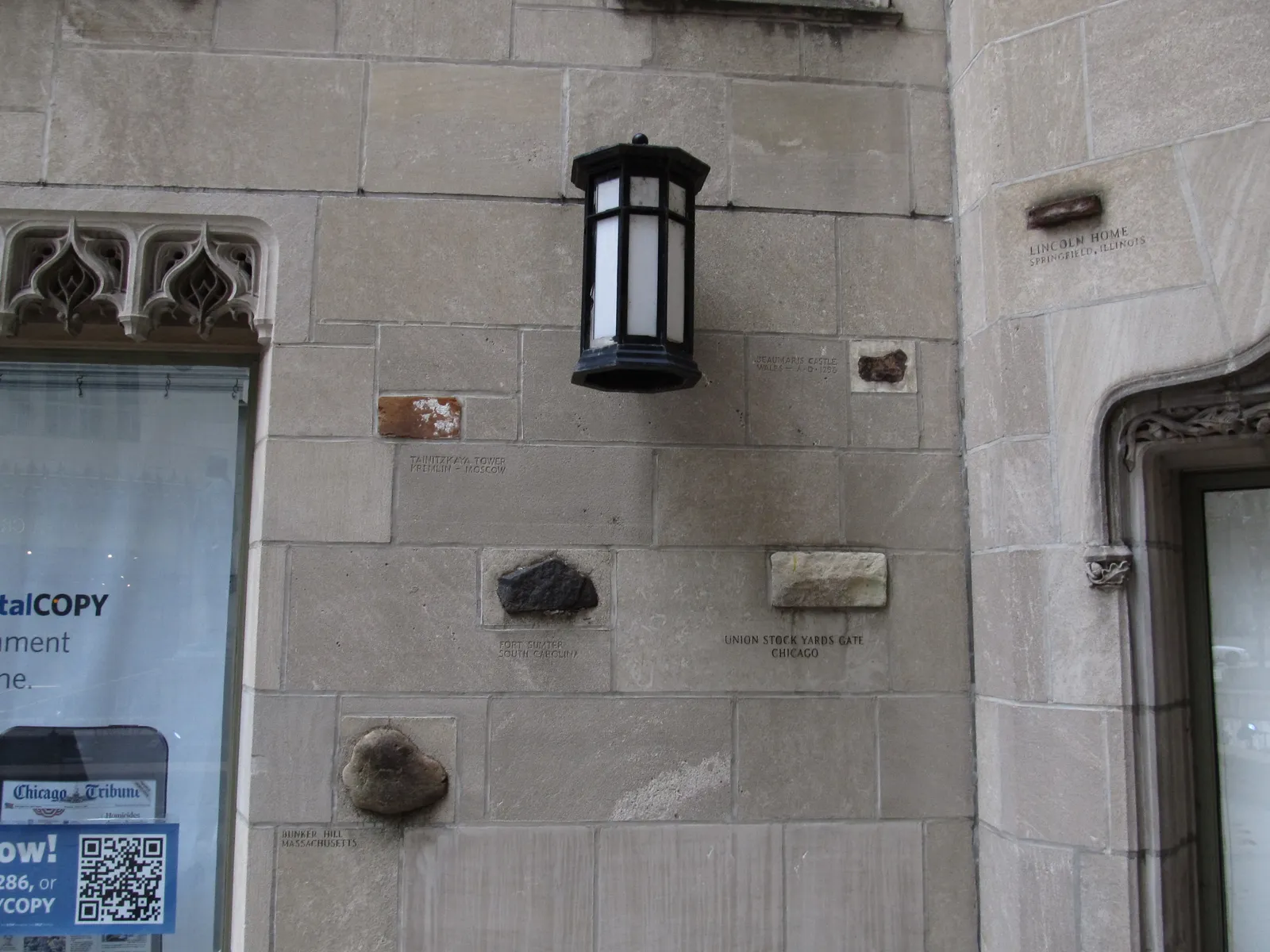
They sit at eye level on a public sidewalk, which is the whole appeal: no ticket, no hours, no queue, and about fifteen minutes if you actually read the labels. The tower itself became 162 condominiums in 2021, so the inside is somebody’s home now and the outside is the visit.
The Wrigley Building’s clock tower where Michigan Avenue crosses the river
Two connected towers in white terracotta stand on the north bank at 400 North Michigan, the south one finished in 1921 and the north annex in 1924, both by Graham, Anderson, Probst and White. The clock tower carries four dials 20 feet across, one to each direction, and the terracotta was graded deliberately from grey at the bottom to near-white at the top so the building reads as brighter the higher you look. Floodlighting was part of the design rather than a later addition, and the reflector system got the building national attention while it was still going up.
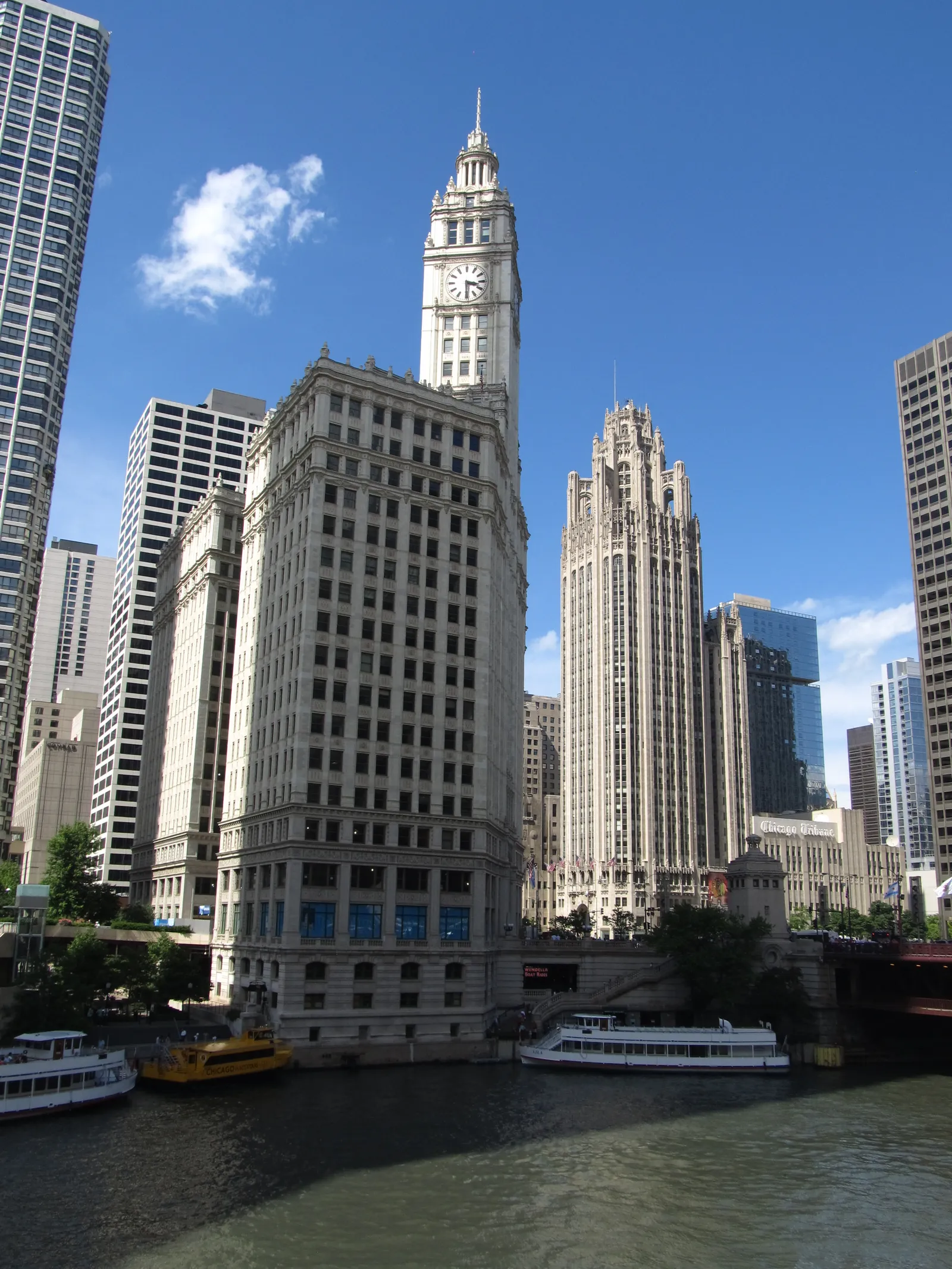
The bridge underneath is DuSable Bridge, opened in May 1920 as the first double-deck, double-leaf bascule bridge ever built, with four Beaux Arts bridgehouses at its corners carrying bas-relief panels of scenes from Chicago’s history. The southwest one is a small museum about the river and the bridge machinery, open Wednesday to Sunday from May to October on a pay-what-you-can basis, with $8 suggested.
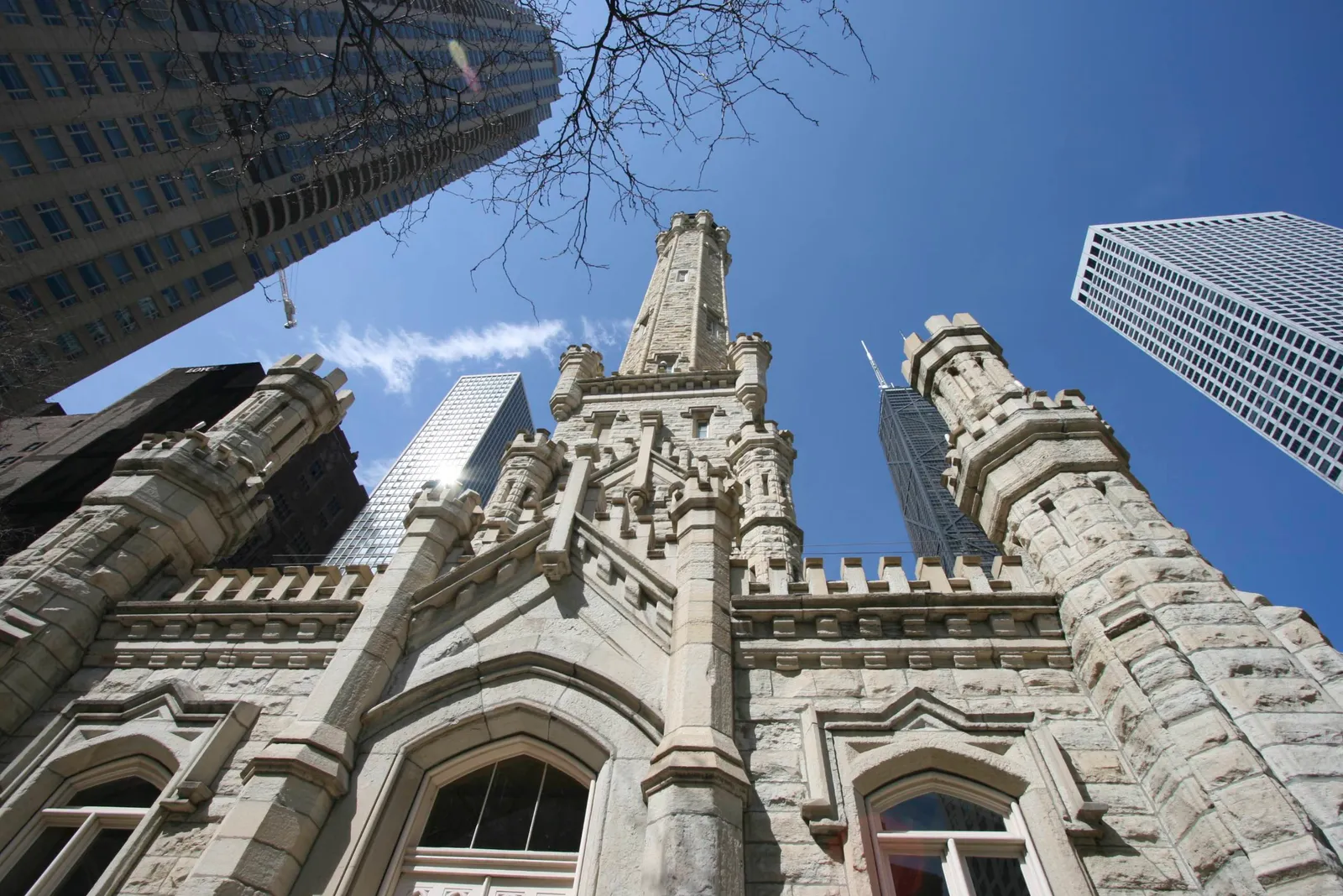
The 1869 Water Tower, which the Great Fire went around
William Boyington built the Water Tower in 1869 to hide a standpipe, and gave a piece of municipal plumbing 154 feet of castellated yellow limestone with turrets on it. Two years later the Great Fire went through this part of town and left the tower and its pumping station across the street more or less alone, mostly because there was almost no wood in either: between them they were the only public buildings in the burned district still standing afterwards. The tower is at 806 North Michigan with glass towers on every side now, which is most of why people photograph it.
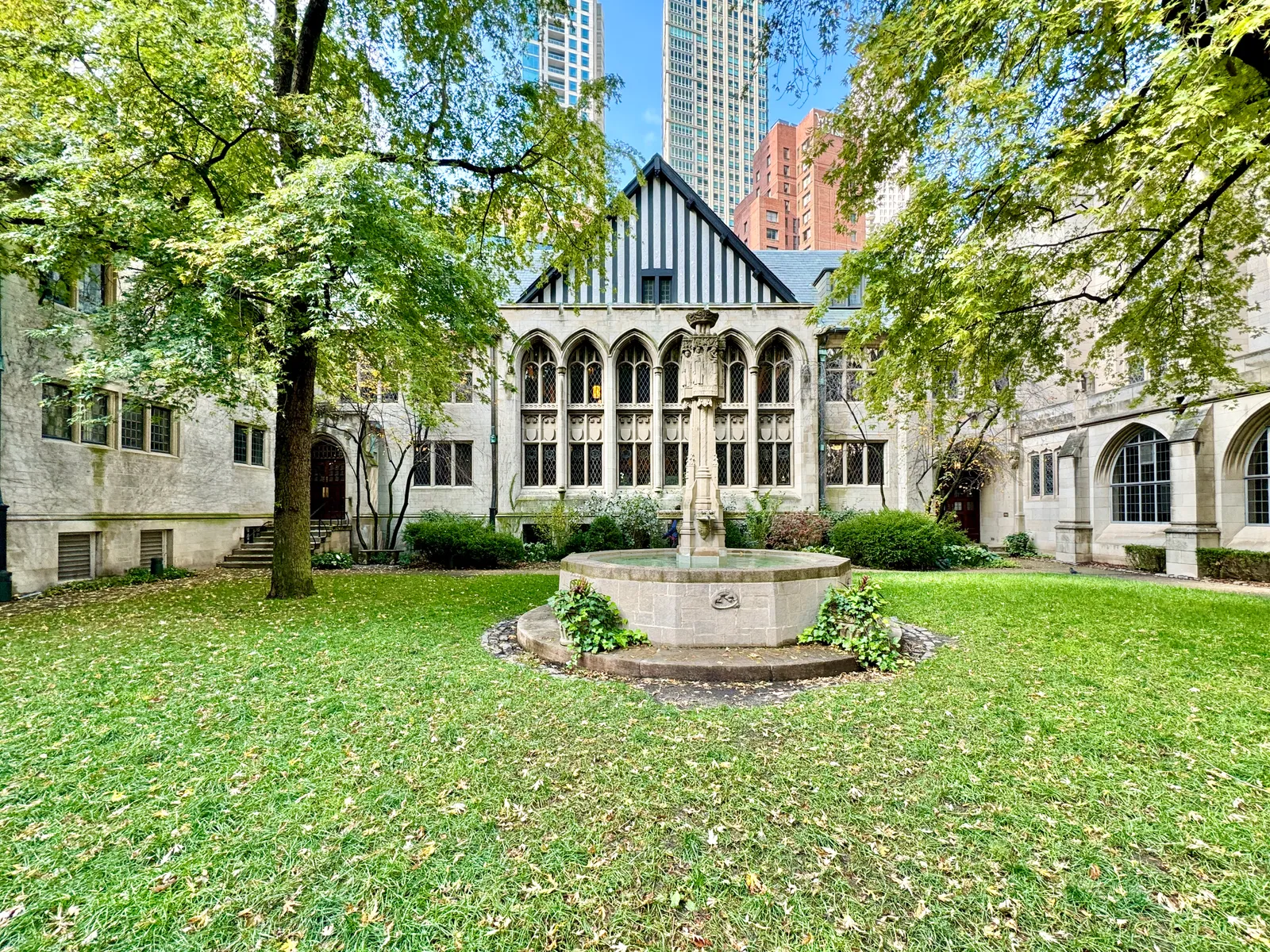
A block north at 866 North Michigan, Fourth Presbyterian Church keeps the quietest ground on the street behind it. Ralph Adams Cram’s Gothic church was dedicated in 1914, and Howard Van Doren Shaw laid out the cloister, parish house and garth beside it: a covered arcade running back from the avenue into a walled lawn with a stone fountain in the middle. The traffic noise stops at the arcade. It is open to the public daily and nobody asks why you came in.
With more time than a mile of storefronts needs, the free circuit around Millennium Park and the Riverwalk picks up fifteen minutes south of the bridge, and the Skydeck and the LaSalle Street canyon are the same idea over on the west side of the Loop if one high deck is enough for a day.
No train station on Michigan Avenue
Buses run the length of the avenue, but the nearest trains are three blocks west on State Street, at Chicago or Grand on the Red Line. From either, it is a short ride south to Jackson and then a 465-foot pedestrian tunnel across to the Blue Line platform, which runs out to O’Hare in roughly 45 minutes. Both lines run around the clock, the fare boarding downtown is the standard $2.50, and the $5 surcharge only ever applies to trips that start at the airport. An hour and a half from the Water Tower to the terminal door is a realistic figure.
The mile itself is flat, straight and about twenty minutes end to end if you do not stop, which nobody does. What makes it awkward with a bag is the two ticketed stops at either end of it, both of which have something to say about luggage before you get in.
Frequently asked questions
What should I do during a layover on Chicago's Magnificent Mile?
Three to five hours covers the whole mile at a browsing pace. The observation deck at 875 North Michigan is the one big ticket, open until 11pm, and the Museum of Contemporary Art a block east is the other. Everything else costs nothing: the roughly 150 fragments of foreign landmarks set into Tribune Tower's wall, the Wrigley Building's clock tower at the river end, the 1869 Water Tower, and the walled garden behind Fourth Presbyterian Church. Book the deck ahead if you want the tilting platform, and skip the museum entirely on a Monday, when it is shut.
Is the tilting platform worth paying extra for at 875 North Michigan?
It depends on how you feel about the lean. TILT holds up to eight people at a time, runs about two minutes, and takes you from the standard $30-ish adult deck ticket up to around $45. Riders have to be at least 42 inches tall, and the slots sell out on busy evenings, so it is a decision to make when you buy rather than at the counter. The view from the deck itself is identical either way.
What is open on the Magnificent Mile after dark?
More than you would expect. The observation deck runs until 11pm with last entry at 10pm, the Wrigley Building's white terracotta is floodlit and has been since it opened, and the stones in Tribune Tower's wall are lit by the lanterns along the facade. The Museum of Contemporary Art stays open until 9pm on Tuesdays and closes at 5pm the rest of the week, and the free gallery inside the Water Tower shuts at 7pm on weekdays and 5pm at weekends.
Can you go inside Tribune Tower?
Not as a visitor. The building was converted into 162 private condominiums in 2021 and the interior is residential now. The part worth coming for was always outside anyway: the fragments are embedded in the exterior walls at the base, at eye level, each with its origin engraved beside it, and they are there at any hour with no ticket.
How do I get from the Magnificent Mile out to O'Hare?
There is no train station on Michigan Avenue itself. Walk three blocks west to State Street for the Red Line at Chicago or Grand, ride south to Jackson, then use the 465-foot pedestrian tunnel across to the Blue Line platform for the run out to O'Hare, roughly 45 minutes from there. Both lines run 24 hours and the fare downtown is the standard $2.50, since the $5 surcharge applies only to trips starting at O'Hare. Budget an hour and a half to the terminal door.