Msheireb Layover: Doha's Clock Tower
Part of the full Doha in One Day: The Souq Waqif Market
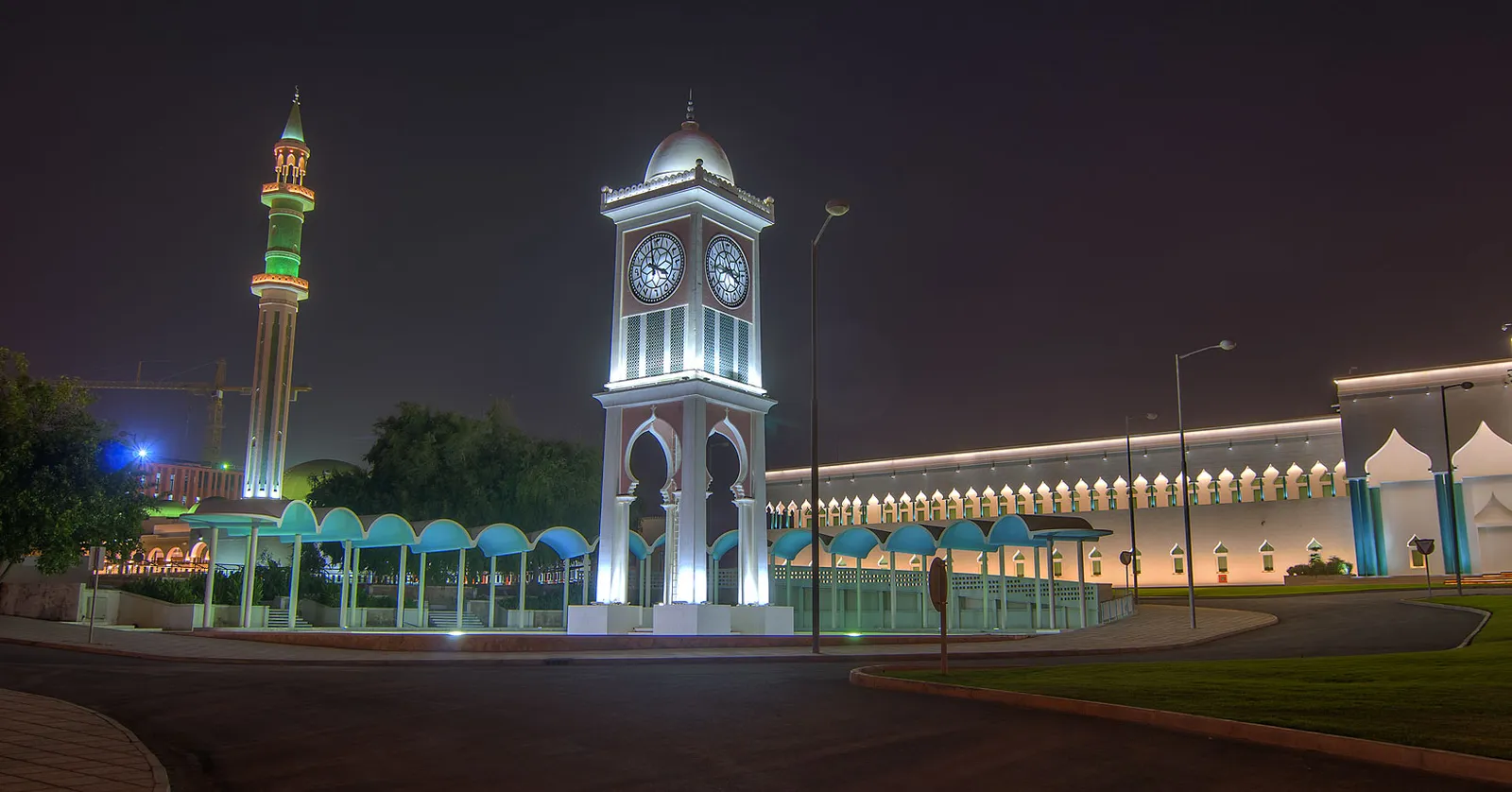
Msheireb is the station in central Doha where all three metro lines meet, and within a ten-minute walk of it are the 1956 clock tower in front of the Amiri Diwan, Al Koot Fort’s white walls at the edge of the old market, and a free tram that loops the surrounding district every six minutes.
A 1956 clock tower stands in front of the Amiri Diwan
The clock tower on Al Rayyan Road is white, arched at each stage and capped with a small dome, and it went up in 1956, which in a city that rebuilt itself twice over in the decades after makes it something close to an antique. Behind it sits the Amiri Diwan, the seat of government, on ground that has been fortified since the 18th century: Al Bidda Fort stood here first, the Ottomans ran it as a garrison, it became the ruler’s office after they left, and the name changed to Amiri Diwan in 1971 when Qatar took independence and its rulers took the title of Emir. The green-capped minaret next to it belongs to Al Shioukh Mosque.
You can get inside the compound, but only on a Saturday and only with a booking. The Qasr Al Hukum Visitor Centre in Msheireb runs two 45-minute tours a day, at 10am and 4pm, covering the mosque, the old fort, the clock tower and the palace, and the centre itself is open daily from 8am to 8pm, or from 1pm on Fridays, with a café in it. On every other day of the week the tower and the minaret are still there from the road, floodlit after dark, and that is what most people on a short stop actually come for.
A free tram loops Msheireb every six minutes
The Msheireb tram runs a single closed loop of two kilometres with nine stops, it ties into the metro at the Wadi Msheireb stop, a car comes past about every six minutes, and there is no fare and no card to tap. It is a genuinely useful piece of infrastructure in the middle of the afternoon rather than a novelty ride.
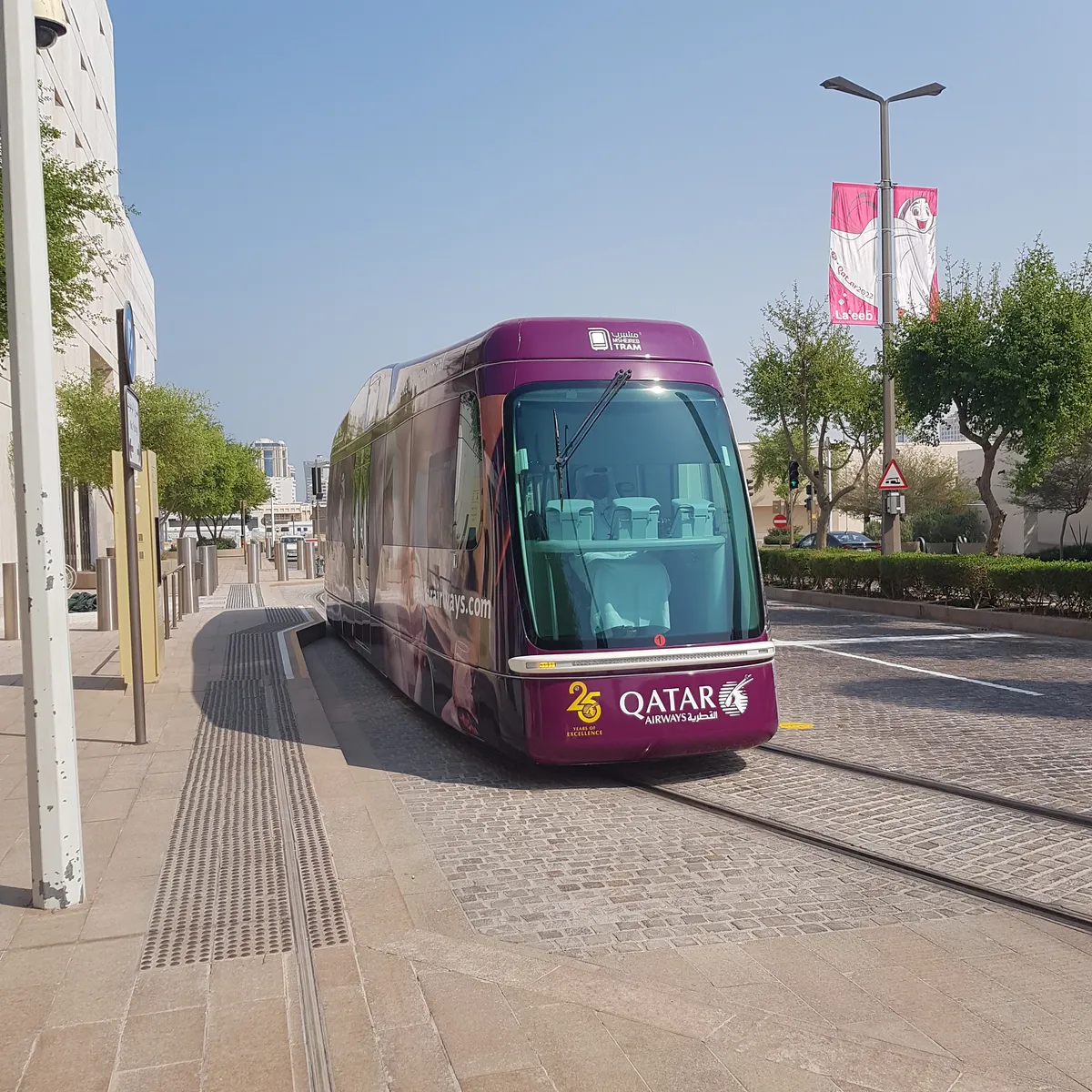
What it loops is 31 hectares of city that did not exist in this form fifteen years ago. Msheireb Downtown Doha was built between 2010 and 2022 on the old commercial quarter, and the brief was to work out what a Qatari street should look like when it is designed for the climate rather than against it: narrow shaded alleys running between blocks, streets angled to pull the Gulf breeze through, 6,400 solar panels on the roofs, pale surfaces throughout. The centrepiece is Barahat Msheireb, an open square of nearly 7,000 square metres with a canopy that unrolls across it on motorised arms and tension cables rigged from the buildings on either side, worked from a control room inside one of them. If you would rather have the whole city handed to you than work out the connections, a half-day tour taking in the market, the cultural village and the museums can be booked through a tours and activities platform and starts from this part of town.
Msheireb is where all three metro lines arrive, which means every transfer in the city funnels through the same set of gates, and the escalators between the platform levels get tight at the ends of the working day with anything bigger than a daypack.
Al Koot Fort’s turrets stand over a camel pen
Al Koot Fort is a square of white wall with round turrets at the corners, on Jassim bin Mohammed Street where Msheireb runs into the old market, and the Ottomans put the first version of it here in 1880 as a police post to keep thieves out of the traders’ stalls. They abandoned it in 1915. Sheikh Abdullah bin Jassim Al Thani rebuilt it in 1927, and what is inside now is Qatari handicraft: wooden and gypsum ornaments, fishing equipment, boats, and photographs of the city before the oil.
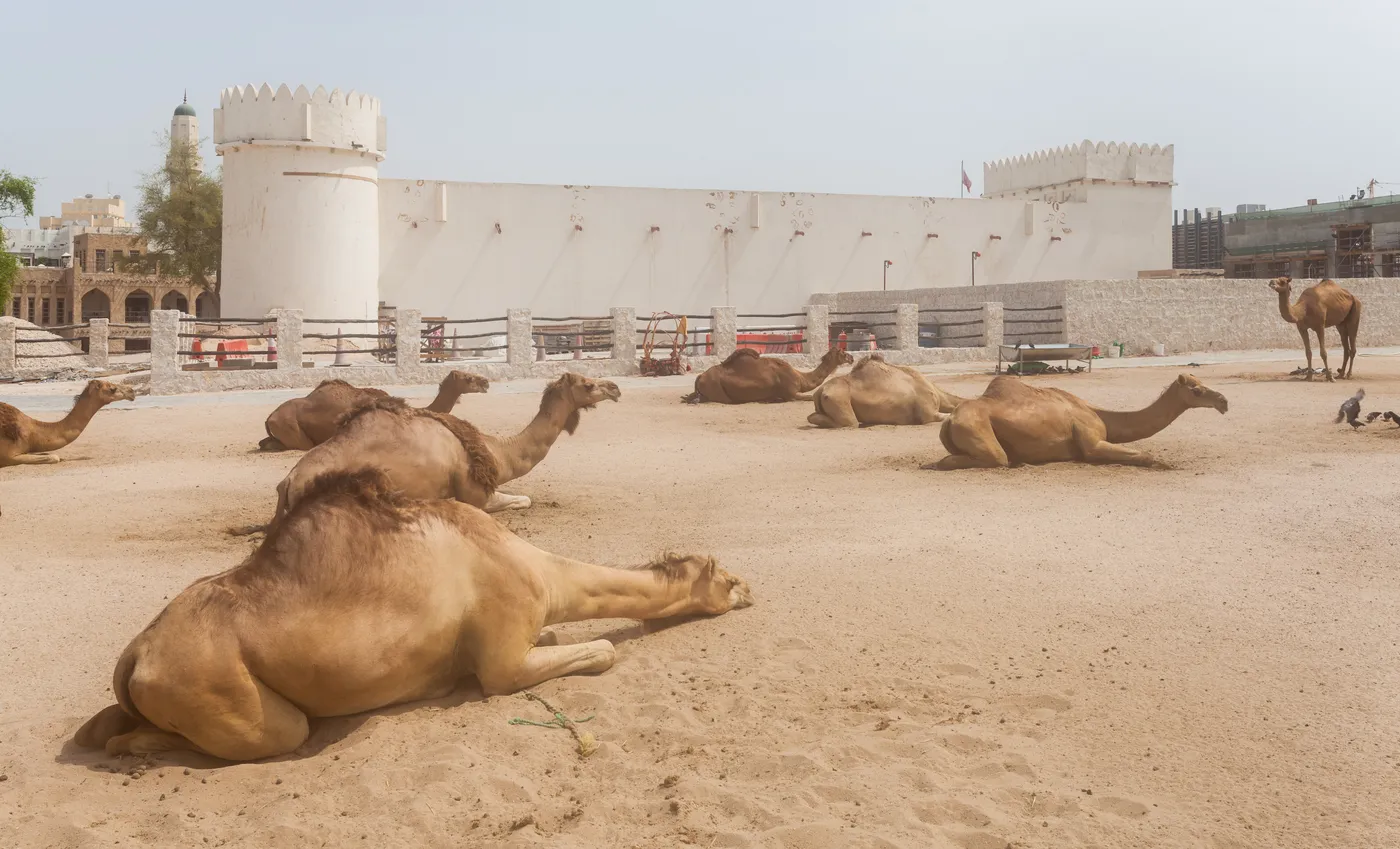
Getting in takes a phone call in advance, on +974 6699 5477, which is more organisation than a layover usually justifies. The outside is free and open to anyone at any hour, and the sand yard in front of it holds a working camel pen, so the animals sitting under those walls are not a display put on for visitors.
Three metro lines meet under Msheireb on four levels
Msheireb station goes four levels down, with the Red and Green lines sharing island platforms at one level and the Gold line crossing underneath them on side platforms, and it took the Prix Versailles world interior prize in 2020 for the vaulted concrete it is lined with. The Red Line is the one that matters on a flight day: it runs from here to the Hamad International Airport Terminal 1 station in about twenty minutes, five stops, for QAR 2 in standard class, and trains come every three to five minutes.
Allow another five minutes at the far end, because that station sits by the West short-term car park rather than inside the terminal. Service runs 5am to 1am Saturday through Thursday and starts at 9am on Fridays, which is the one gap worth checking against an early departure; a metered taxi from here is roughly QAR 40 to 60 and runs at all hours. If the gap turns out to be longer than this station’s own catchment needs, the wider Doha route picks up one stop east and one stop west of here and wants about five hours.
Collect the stored bag on the way to the platform rather than after you have gone through the gates, since the drop-off points in this part of town sit on the street rather than inside the station.
Frequently asked questions
What should I do during a layover near Msheireb in Doha?
Everything worth doing here is inside a ten-minute walk of the station. The clock tower of 1956 stands in front of the Amiri Diwan on Al Rayyan Road, with the Al Shioukh Mosque's minaret beside it. Al Koot Fort's white walls and corner turrets sit at the edge of the old market on Jassim bin Mohammed Street, with a camel pen in the sand out front. A free tram loops the Msheireb district every six minutes and costs nothing to ride. Three hours is enough for all of it; the fort's interior is the one thing that needs arranging in advance, and skipping it changes nothing about the walk.
Can you go inside Al Koot Fort?
Only by appointment. The fort was raised in 1880 as an Ottoman police post to guard the market, abandoned in 1915 and rebuilt in 1927 by Sheikh Abdullah bin Jassim Al Thani, and it now holds Qatari handicrafts, fishing gear and boats, gypsum and wooden ornaments, and historical photographs. Visits inside are arranged by calling ahead on +974 6699 5477. Standing in front of it costs nothing and needs no arrangement at all, which is how most people see it.
Is the Msheireb tram free, and where does it go?
It is free, with no ticket and no card to tap. The loop is a single two-kilometre track with nine stops around Msheireb Downtown Doha, and a car comes past about every six minutes, so a full circuit is a short ride rather than a commitment. It connects to the metro at the Wadi Msheireb stop. In practice it is most useful in the middle of the day, when walking the district in full sun is the part people underestimate.
Can you tour the Amiri Diwan in Doha?
Yes, on Saturdays and only with a booking made ahead. Tours run from the Qasr Al Hukum Visitor Centre in Msheireb, twice a day at 10am and 4pm, and last about 45 minutes, taking in Al Shioukh Mosque, Al Bidda Fort, the clock tower and the palace itself. The visitor centre is open daily from 8am to 8pm, and from 1pm on Fridays, with a café and a shop in it. If your layover falls on any other day, the clock tower and the mosque's minaret are still there to look at from the road.