Batu Caves Layover: Kuala Lumpur's Cave Temple
Part of the full Kuala Lumpur in One Day: The Twin Towers
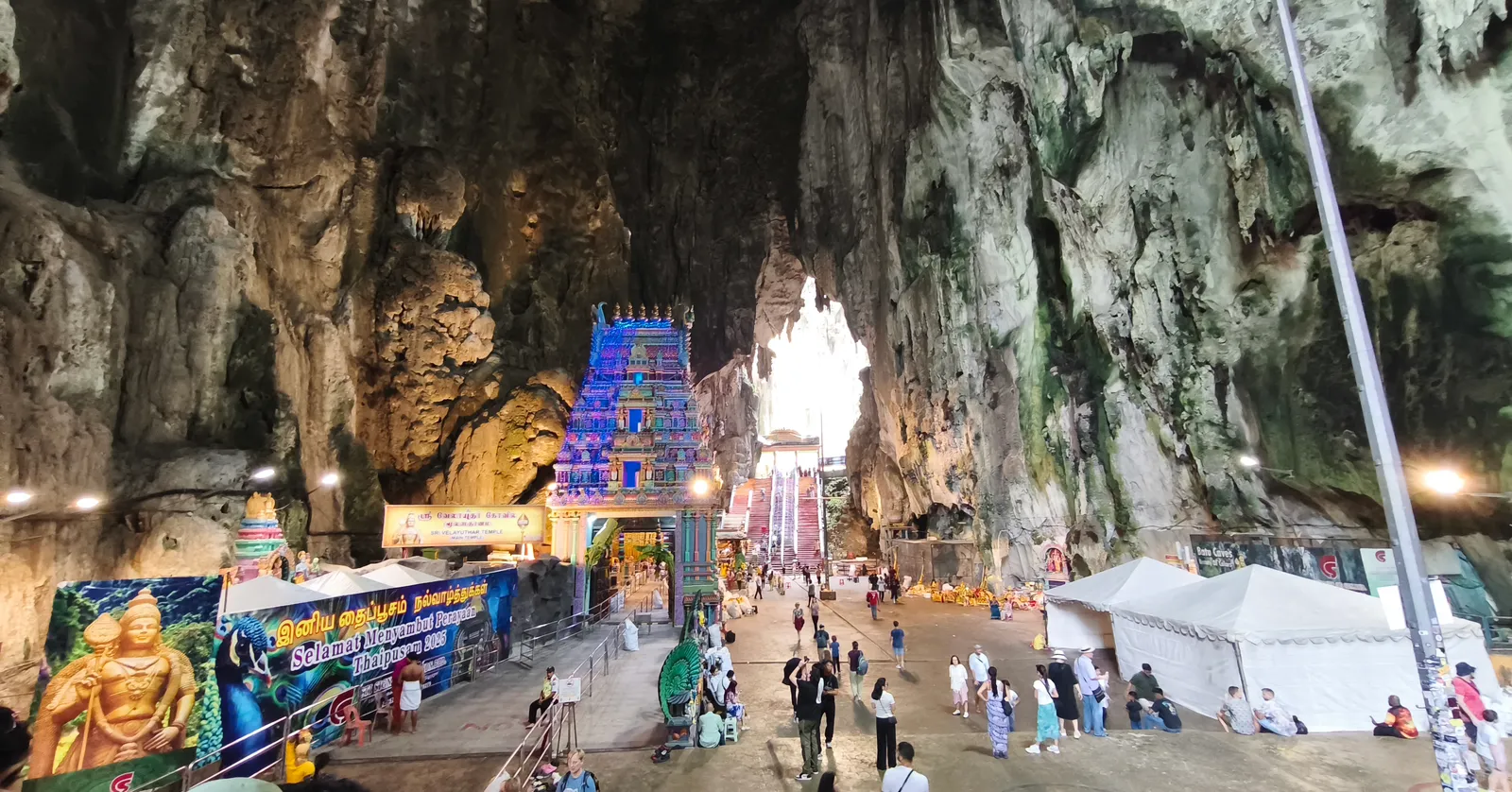
Batu Caves, thirteen kilometres north of central Kuala Lumpur, runs 272 painted steps up a limestone cliff into a cavern big enough to hold a temple, free to walk into and open from six in the morning.
The Temple Cave has a hole in its roof
The chamber at the top of the staircase is the reason the whole complex exists: a cave hollowed out of the limestone hill, with ribbed and dripping walls going up out of easy sight and a gap in the rock overhead that drops a shaft of daylight and a curtain of hanging greenery into the middle of it. Shrines stand on the cave floor under all of that, and the rock is loud with swiftlets. A gilded statue of Murugan 42.7 metres high was put up beside the staircase in January 2006 and is the first thing anyone sees from the station.
The complex is free and the doors are open from 6am to 9pm, which is why the honest advice is to arrive early: by ten the steps carry a continuous double file in both directions. A half-day guided visit sold through a tours and activities platform covers the caves and the road transport without anyone having to work out the commuter timetable, which is worth something when a flight is waiting at the other end.
The climb is 272 concrete steps laid in 1940 and repainted in blocks of colour in August 2018, with no lift and no other route up. Nobody gets a wheeled bag past the first landing.
Ramayana Cave paints the epic along its walls
Ramayana Cave sits at the left-hand end of the Batu Caves cliff, charges RM5, and runs the Ramayana around its interior as painted figures and dioramas, scene by scene, from Rama’s exile to the burning of Lanka. A standing Hanuman 15 metres high marks the entrance from the forecourt, and the temple inside opened in November 2001.
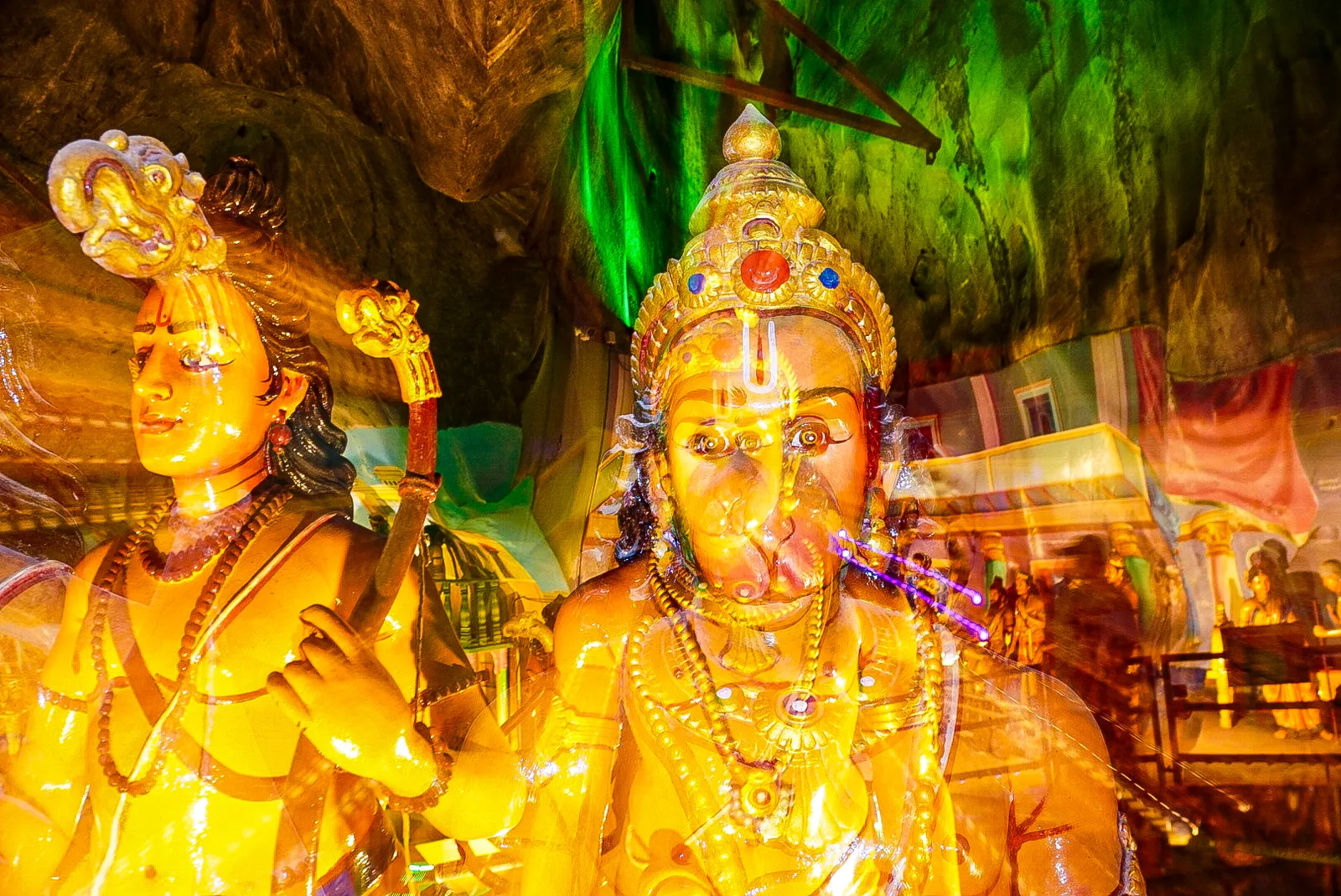
It is lit in greens and golds rather than daylight, the path through is short, and it takes about twenty minutes. The Dark Cave, the conservation tour through the unlit galleries further up the cliff, has not reopened to visitors since 2020, so anyone arriving with that on a list should plan around its absence.
Thaipusam fills this hill on the full moon of the Tamil month Thai
Once a year, in January or February, Sri Subramaniar Swamy Temple at the foot of Batu Caves becomes the end point of a procession that starts in the city centre and walks through the night, and the crowd at Batu Caves runs past a million people. Devotees carry kavadi, wooden and steel frames borne on the shoulders, some of them pierced through the skin, up the same 272 steps.
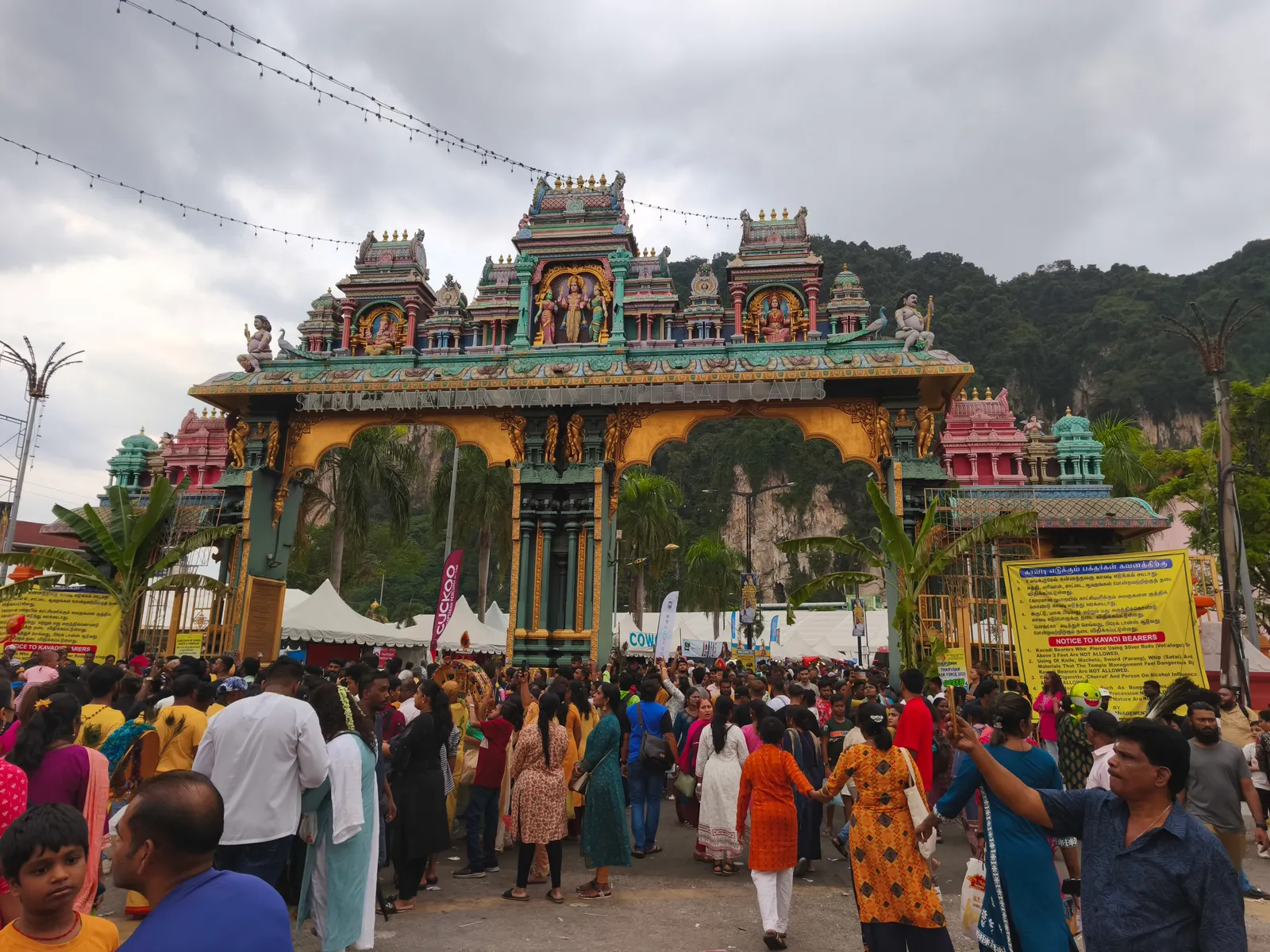
The rest of the year that temple, Sri Subramaniar Swamy, is a quiet ground-level building with a painted gateway tower. K. Thamboosamy Pillai, a Tamil trader in colonial Kuala Lumpur, promoted the caves as a place of worship and the temple was finished in 1891, which is the whole reason a limestone outcrop in a quarry district ended up as the most visited Hindu site in the country.
The commuter line ends at the temple gate
Trains from KL Sentral terminate at Batu Caves station, which lets out facing the temple entrance, in about 30 minutes for RM2.60. They run roughly every half hour at the morning and evening peaks and about hourly between 10am and 4pm, and that midday hour is the number that decides whether this trip fits, not the ride time. Getting back to the airport means retracing that leg to KL Sentral and changing to the KLIA Ekspres, which is 28 minutes non-stop to Terminal 1 of Kuala Lumpur International Airport (KUL) for RM55, every 20 minutes until midnight.
Budget three and a half hours from the top of the steps to the departure gate and none of it is tight. If that maths does not work, the central Kuala Lumpur route keeps everything inside a two-kilometre walk of one line and gets you back to the platform in a quarter of the time.
Leave the suitcase in the city rather than dragging it to the foot of the stairs. The drop-off points cluster around KL Sentral, which is where this trip starts and where it comes back to anyway.
Frequently asked questions
What should I do during a layover near Batu Caves in Kuala Lumpur?
Climb the 272 steps into the Temple Cave, which is a limestone chamber tall enough to hold shrines with daylight dropping in through a gap in its roof, and which costs nothing. On the way back down, the Ramayana Cave at the left-hand end of the cliff charges RM5 and lines its walls with painted scenes from the epic behind a 15-metre Hanuman at the door. The temple at the foot of the stairs, finished in 1891, is free and needs no climbing at all. Five hours is the sensible minimum because the commuter train takes half an hour each way and runs about hourly in the middle of the day; the Ramayana Cave is the part to drop if you are short.
How do I get to Batu Caves from central Kuala Lumpur?
A commuter train from KL Sentral runs the whole way and terminates at the foot of the hill, about 30 minutes for RM2.60 with no changes. It goes roughly every half hour during the morning and evening peaks and about hourly between 10am and 4pm, so check the return time before you start the climb rather than after. The station exit faces the temple gate directly, so there is no walk at the far end.
Are the 272 steps manageable with elderly parents or a bad knee?
The staircase itself is not, and there is no lift or alternative route up. It is one unbroken flight of open concrete steps in the heat, with handrails and a few landings but no shade, and the rock floor inside the cave at the top is uneven. Everything at the base is a different matter: the 1891 temple, the forecourt, the shops and the Ramayana Cave are all on the flat and step-free, so a slower group can spend an hour there quite happily while someone else does the climb.
What do the monkeys at Batu Caves actually do?
Long-tailed macaques live on the staircase and along the cliff, and they take things: open drinks, food in plastic bags, sunglasses, loose phones. Signboards at the base say as much. Nothing edible should be visible on the climb and nothing should be carried loose in a hand. They are wild animals rather than a photo opportunity, and a bite is a reason to get medical attention rather than to shrug it off.
Is there a dress code at Batu Caves?
Shoulders and knees have to be covered to go up into the Temple Cave, and it is checked at the base of the staircase rather than ignored. Sarongs are sold and rented for a few ringgit at the foot of the steps if you turn up in shorts, which is what most people arriving straight off a flight end up doing. Shoes stay on for the climb and come off at the shrines inside.