Frankfurt Layover From FRA: Skyline, Old Town
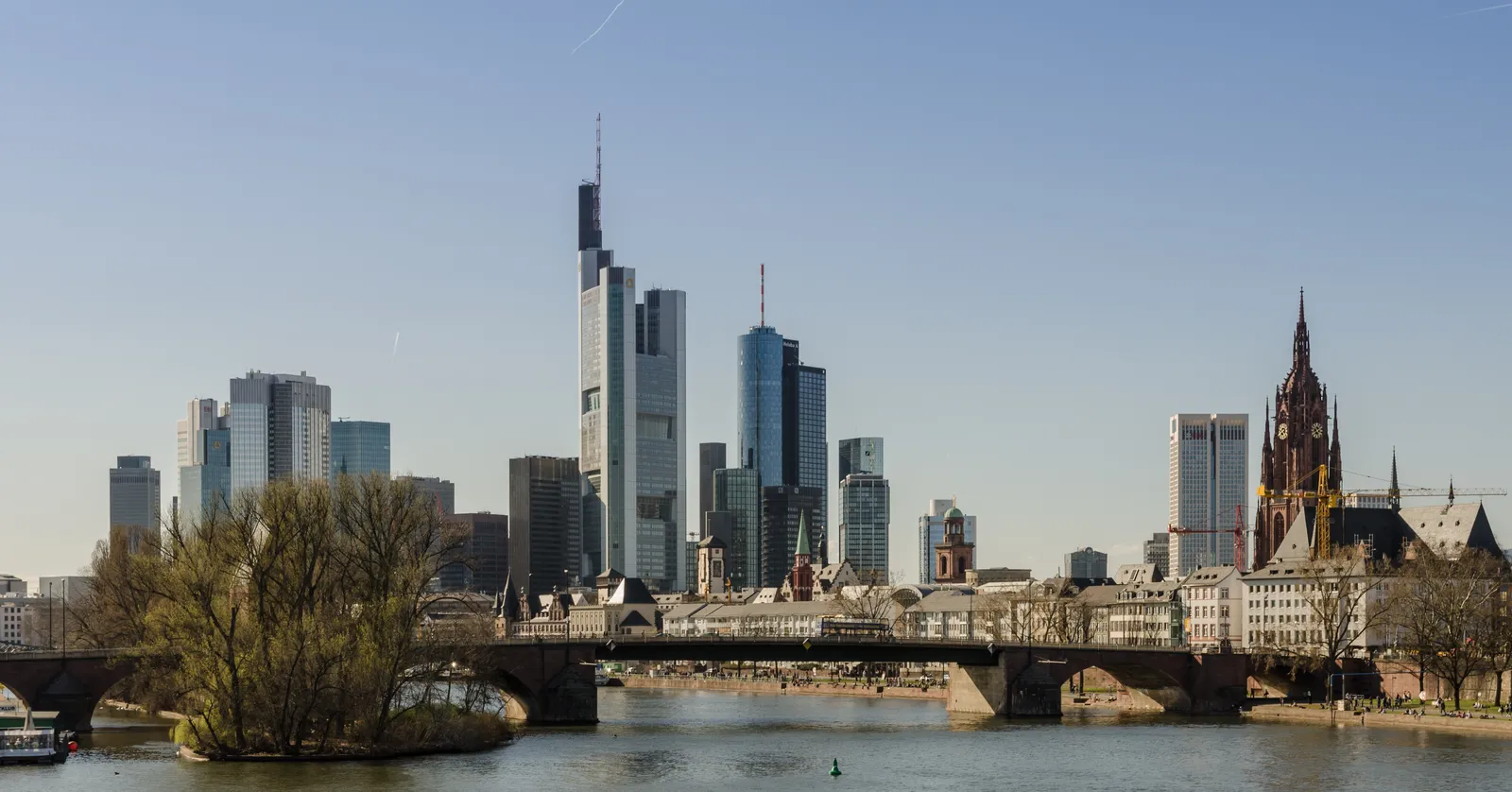
The Main Tower’s terrace sits 187 metres above Frankfurt, the cathedral tower is a 328-step climb from the old town at its foot, and the Römerberg between the two costs nothing to walk into.
The Main Tower is the only Frankfurt skyscraper you can go up
Frankfurt’s banks built the one high-rise cluster in the country, and the tallest of them, the Commerzbank Tower, is 259 metres to the roof and the tallest building in Germany. Munich went the other way and voted in 2004 to keep anything new below its cathedral towers. Only one tower in the Frankfurt cluster sells tickets to the public: the Main Tower, 200 metres to its roof, 240 with the antenna, and an open terrace at 187 metres.
Entry is 9 euros, 6 reduced, and 4 on days when the weather shuts part of the platform. It opens at 10am every day, running to 9pm Sunday to Thursday and 11pm Friday and Saturday in summer, two hours earlier in each case through the winter, and the last lift up leaves 45 minutes before closing. A one-day city card starts at 13 euros, covers travel across the city and the airport zone, and cuts what you pay at the door here.
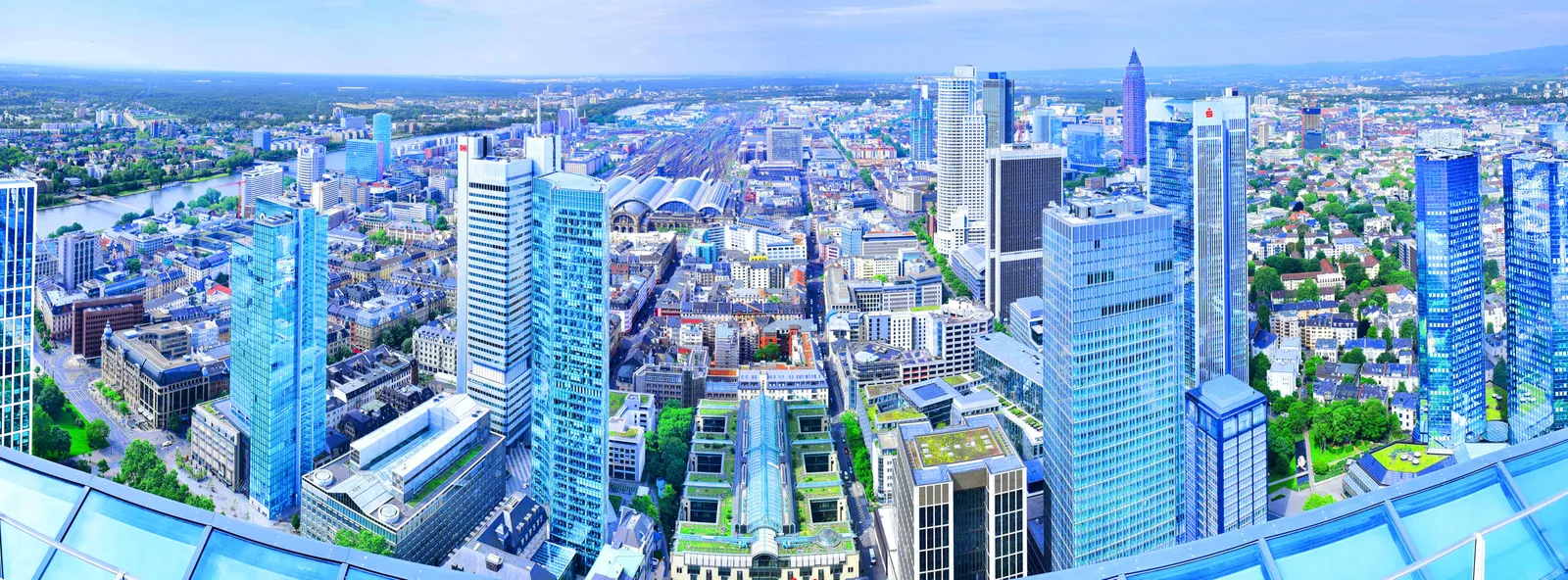
What you get for the 9 euros is the only view in the city that shows you the whole of it at once: the Main and its line of bridges to the south, the red sandstone cathedral tower standing on its own east of the glass, and the Taunus hills closing the horizon to the north. Large luggage, rucksacks and bags are not allowed on the platform, and there is a metal detector at the lift.
Ten Holy Roman emperors were crowned in Frankfurt’s cathedral
St. Bartholomew’s stands on Domplatz at the eastern edge of the old town, red sandstone, 95 metres to the tip of its tower and visible from most of the river. The Golden Bull of 1356 made it the church where the Holy Roman Empire elected its kings, in a chapel built off the choir for that purpose in 1425. From 1562 until 1792, ten emperors-elect were crowned in front of the altar here as well, which is why Germans call it the Kaiserdom, the emperors’ cathedral.
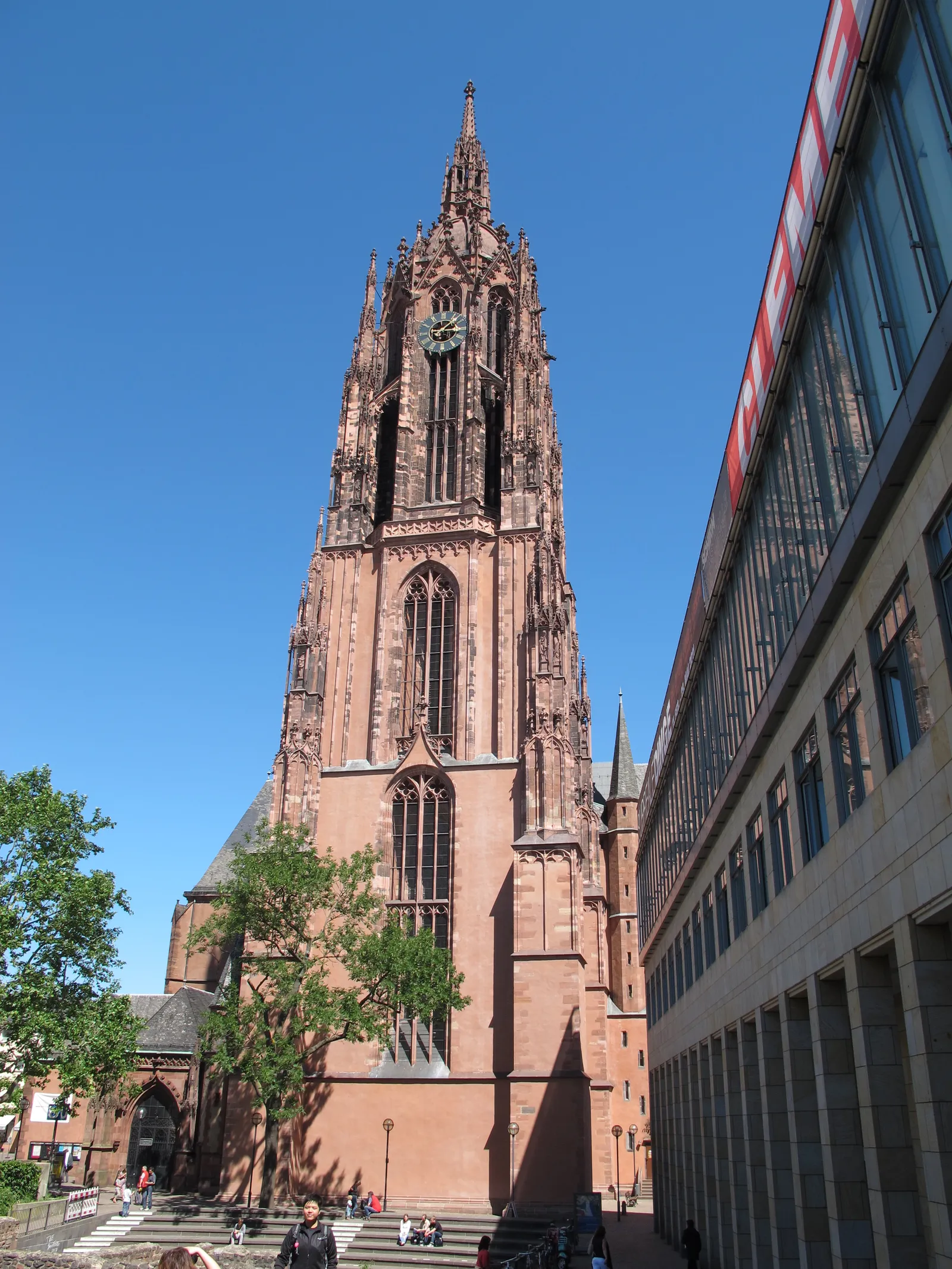
Walking in costs nothing. The tower is 3 euros, or 5 with the Türmerstube exhibition at the top, and it is 328 steps with no lift to a platform 66 metres up. Only a set number of people go up at a time, so a queue at the door on a Saturday is normal rather than a sign something has gone wrong. It opens Tuesday to Saturday from 10am and Sundays from 11am, until 6pm from April to October and 5pm from November to March, with Monday afternoons added in summer and Mondays shut in winter.
The Römer has been Frankfurt’s city hall since 1405
Three stepped gables face the Römerberg from its western side, and the middle one is the Römer, which the city bought in 1405 and has used as its town hall ever since. The Kaisersaal on the first floor is hung with 52 portraits of every king and emperor from Charlemagne to Francis II, painted between 1838 and 1853. It is free to look into, roughly 10am to 5pm, on any day when nothing has been booked in it, which is the usual reason to find the door shut.
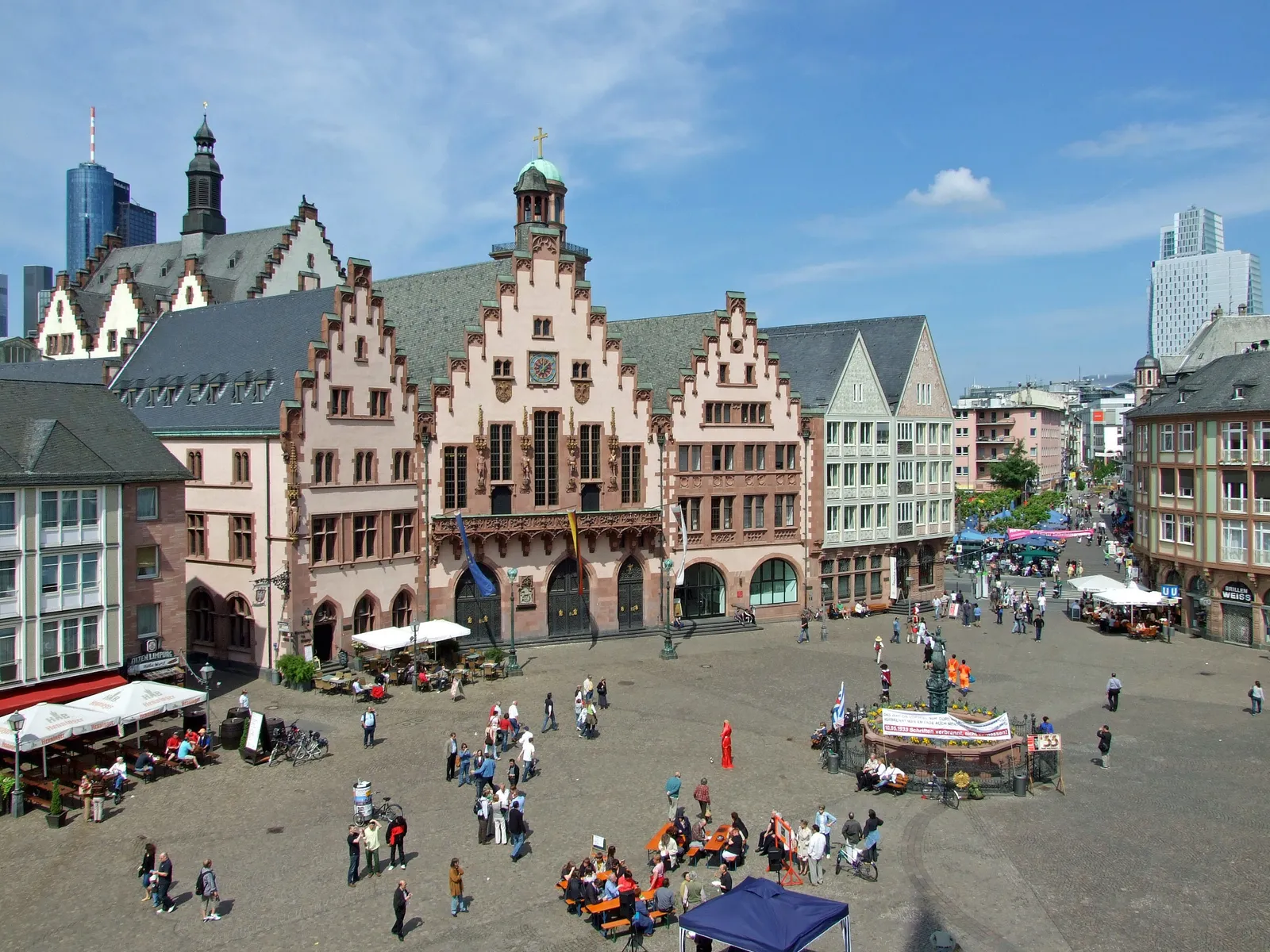
The fountain in the middle of the square dates from 1543, and its Justitia holds the sword and scales without a blindfold. At imperial coronations the city filled it with wine instead of water and let it run for whoever was standing there; it did that for Matthias in 1612.
The six half-timbered houses along the east side look older than they are. Bombing in March 1944 took the entire district, which had held something like 1,250 mostly medieval and Renaissance timber-framed houses. The row was rebuilt from the original plans between 1981 and 1983, and the 35 buildings of the quarter running from here to the cathedral, 15 of them reconstructions of specific lost houses, only opened in May 2018.
About 150 stalls trade inside the Kleinmarkthalle market hall
Hasengasse runs north from the old town towards the Zeil, and a plain post-war hall halfway along it holds Frankfurt’s daily food market. The Kleinmarkthalle has around 150 stalls in it: butchers, bakers, fishmongers, spice sellers, Italian and Turkish and Spanish counters, and a wine bar up on the gallery that opens in the afternoons.
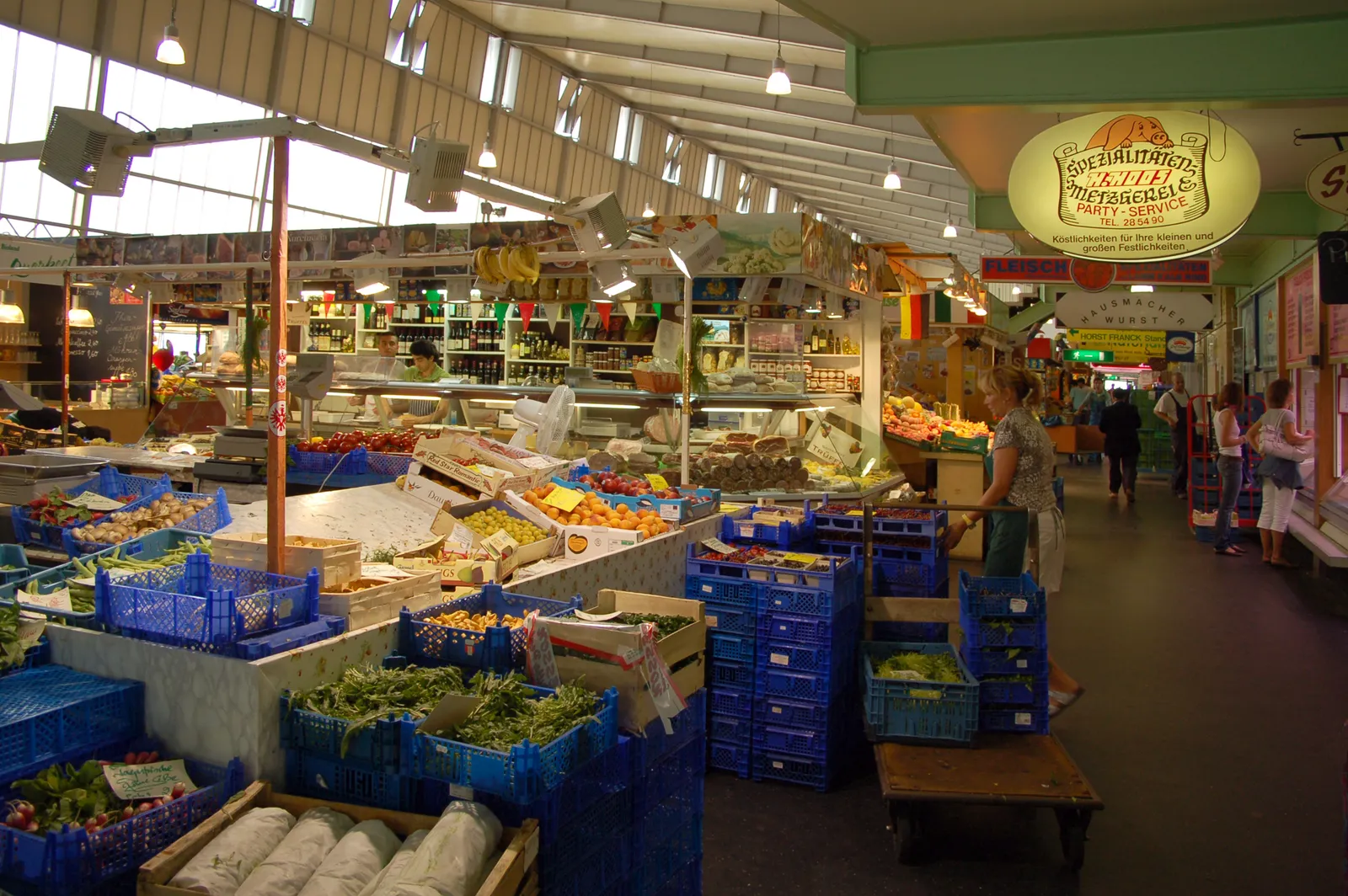
The hours are the thing to know: 8am to 6pm Monday to Friday, 8am to 4pm on Saturday, and closed all day Sunday. Turn up on a Sunday and Hasengasse is a shuttered wall.
A line from the Odyssey runs along the Eiserner Steg footbridge
The Eiserner Steg carries nothing but people across the Main, 170 metres of iron lattice between the Mainkai and the south bank. The first version went up in 1868, the Wehrmacht blew it up in the closing days of the war, and it was back in service by 1946.
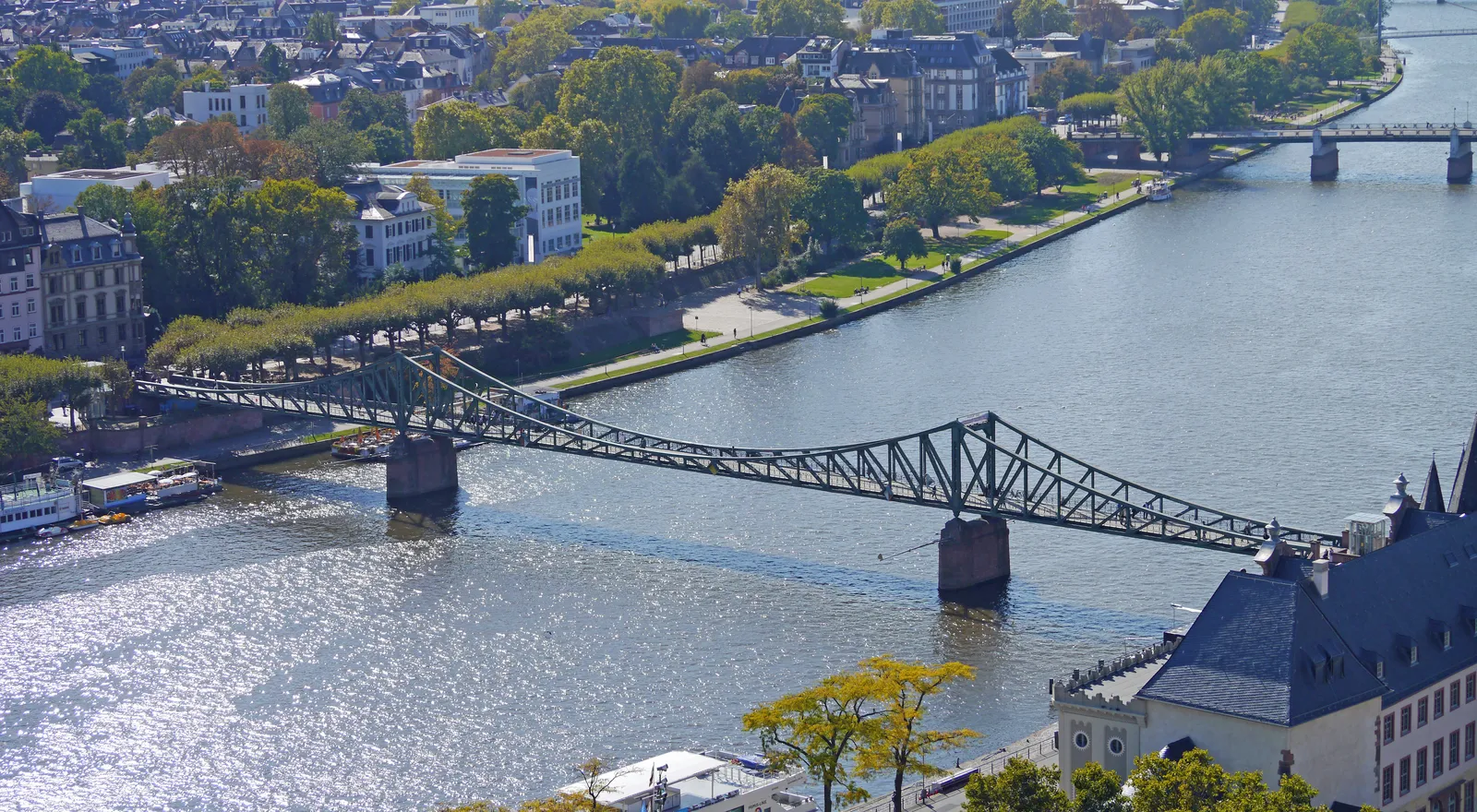
Above the walkway there is a line of Greek: ΠΛΕΩΝ ΕΠΙ ΟΙΝΟΠΑ ΠΟΝΤΟΝ ΕΠ ΑΛΛΟΘΡΟΟΥΣ ΑΝΘΡΩΠΟΥΣ, out of the first book of the Odyssey, sailing over the wine-dark sea to men of other tongues. Nothing up there translates it or explains why a Frankfurt footbridge is quoting Homer.
The far bank is the Museumsufer, a run of museums along Schaumainkai. The Städel is the one to pick if there is only time for one: seven centuries of European art, 19 euros, open Tuesday to Sunday 10am to 6pm and until 9pm on Thursdays, closed Mondays, and 10 euros for the last three hours of a Tuesday.
The Palmengarten has grown palms under glass since 1871
Bockenheim, northwest of the banking district, has 22 hectares of botanical garden in it, laid out in 1871 around a glass Palmenhaus that is still what everyone comes for. Around and inside it are a rainforest house, a subantarctic house, a flower and butterfly house, rose beds, a rock garden and a boating pond.
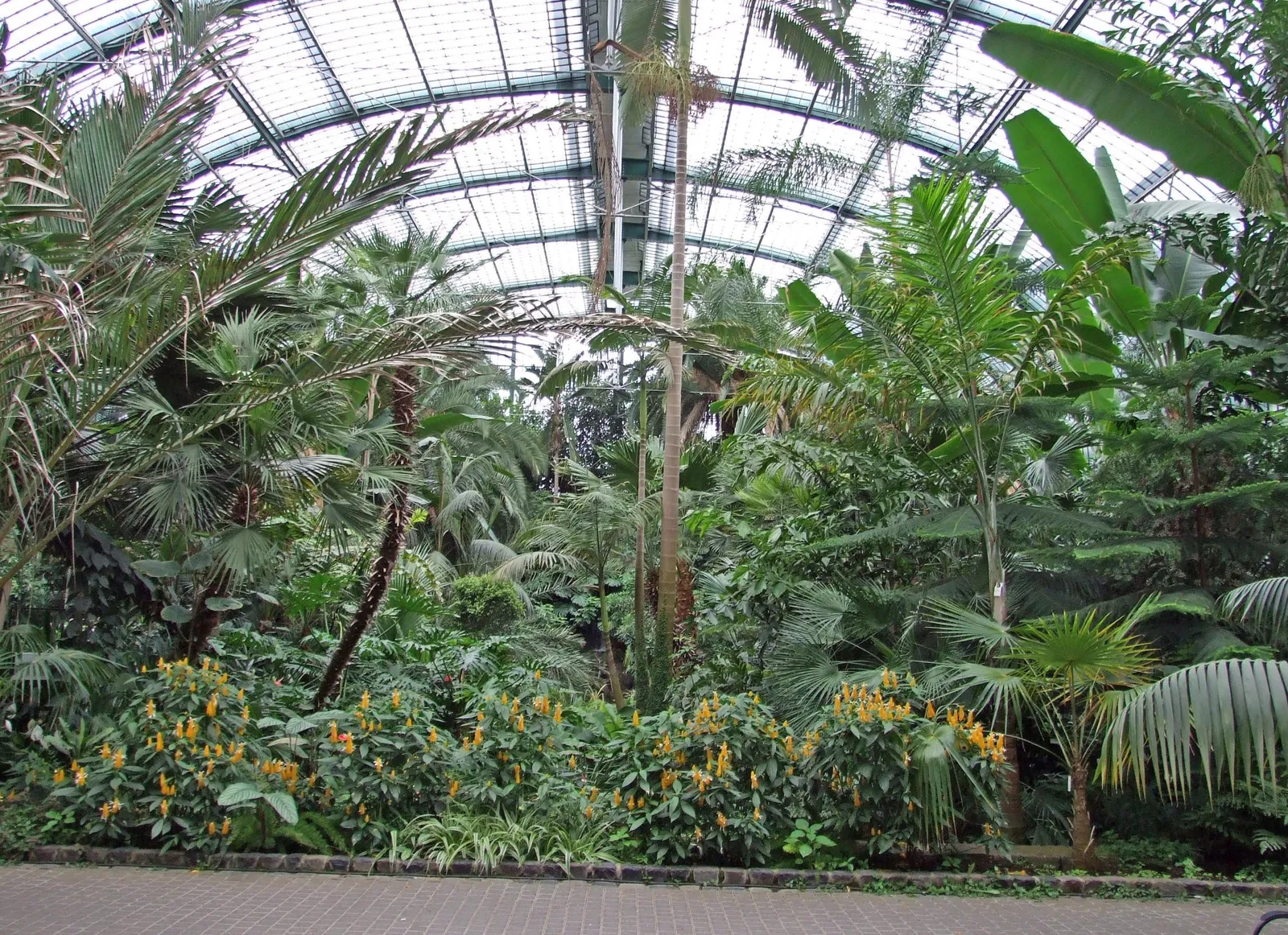
Adults pay 9 euros, 5 reduced, and anyone under 18 gets in free, so a parent with two children pays 9 euros between them. The gates open at 9am daily and close at 7pm from March to October and 4pm from November to February. On a wet afternoon this is the one stop here that works entirely under a roof.
The airport’s regional station is under Terminal 1, not Terminal 3
The S8 and S9 run from Konstablerwache and Hauptwache in the middle of the city, through Hauptbahnhof and out to Frankfurt Airport, with something leaving roughly every ten to fifteen minutes around the clock. Hauptbahnhof to the airport’s regional station is about 12 minutes on the train; from Hauptwache, two stops deeper into town, budget closer to 20. A single from the city into the airport zone is 6.90 euros for an adult and 4.10 for a child, so a day card at 13 euros roughly pays for itself on the return trip alone.
Which terminal you are flying from now changes that arithmetic, because Terminal 2 closed to passengers on 9 June 2026 for a refurbishment running into the mid-2030s, and every airline that used it moved to the new Terminal 3. Terminal 3 sits on the far side of the runways, about eight minutes from Terminal 1 on the Sky Line people mover. So the door-to-door figure depends on your boarding pass: Terminal 1 is the ride plus a walk up from the platforms, Terminal 3 is the ride plus eight minutes plus a walk at both ends.
Work backwards from that. Twelve to twenty minutes on the train, the Sky Line if you are on Terminal 3, then check-in and security at Germany’s busiest airport: leaving the centre two and a half hours before departure is comfortable, three if you are flying long-haul. Nothing in the old centre is more than about fifteen minutes’ walk from anything else in it, so the walking is not what a suitcase spoils. What it spoils is the 328 steps at the cathedral, and the Main Tower, which will not let a bag through the door at all.
Frequently asked questions
What should I do during a layover in Frankfurt?
With five hours or so, the Main Tower is the one bank tower open to visitors: 9 euros for a terrace 187 metres up, with the last lift 45 minutes before closing. From there the old town is a short walk, where St. Bartholomew's is free to walk into and its tower is 3 euros for 328 steps, and the Römerberg and the Römer city hall cost nothing at all. The Kleinmarkthalle is the sensible stop for food, though it shuts at 6pm on weekdays, 4pm on Saturdays and all day Sunday. If you have longer, cross the Eiserner Steg to the museums on the south bank, or head out to the Palmengarten.
Can I climb the cathedral tower the day I turn up?
Usually, but check the day of the week first. The tower at St. Bartholomew's opens Tuesday to Saturday from 10am and Sundays from 11am, running to 6pm from April to October and 5pm from November to March, with Monday afternoons added in the summer half of the year and Mondays closed entirely in winter. It is 3 euros, or 5 with the Türmerstube exhibition at the top, and the last ascent is 30 minutes before closing. Only a limited number of people are allowed up at once, so there is often a queue at the door on weekends. It is 328 steps with no lift.
Is the Römerberg actually medieval?
The site is; almost none of the fabric is. Bombing in March 1944 destroyed the whole district, which had held around 1,250 mostly medieval and Renaissance timber-framed houses. The Römer itself was reconstructed soon after the war and has served as the city hall since 1405. The six half-timbered houses on the east side of the square were rebuilt from the original plans between 1981 and 1983, and the 35-building quarter between the square and the cathedral, 15 of them reconstructions of specific lost houses, only opened in May 2018.
Is the Palmengarten worth it with children?
It is the easiest stop in the city with them. Entry is 9 euros for adults and free for anyone under 18, so a parent and two children pay 9 euros in total. The gates open at 9am daily and close at 7pm from March to October, 4pm from November to February. Inside there are 22 hectares to run around, a boating pond, and glasshouses including a rainforest house and a flower and butterfly house, which matters on a wet day when the rest of a Frankfurt itinerary is outdoors.
Which terminal do I go back to at Frankfurt Airport?
Check your boarding pass before you leave the city, because the answer changed in 2026. Terminal 2 closed to passengers on 9 June 2026 for a refurbishment running into the mid-2030s, and every airline that used it moved to the new Terminal 3. The S8 and S9 put you at the airport's regional station, which sits underneath Terminal 1. If you are flying from Terminal 3 you then need the Sky Line people mover, which takes about eight minutes from Terminal 1, so add that to your timings rather than discovering it at the platform.