Bruges Layover Near the Kruisvest Windmills
Part of the full Bruges Layover: The Belfry and Canals, BRU
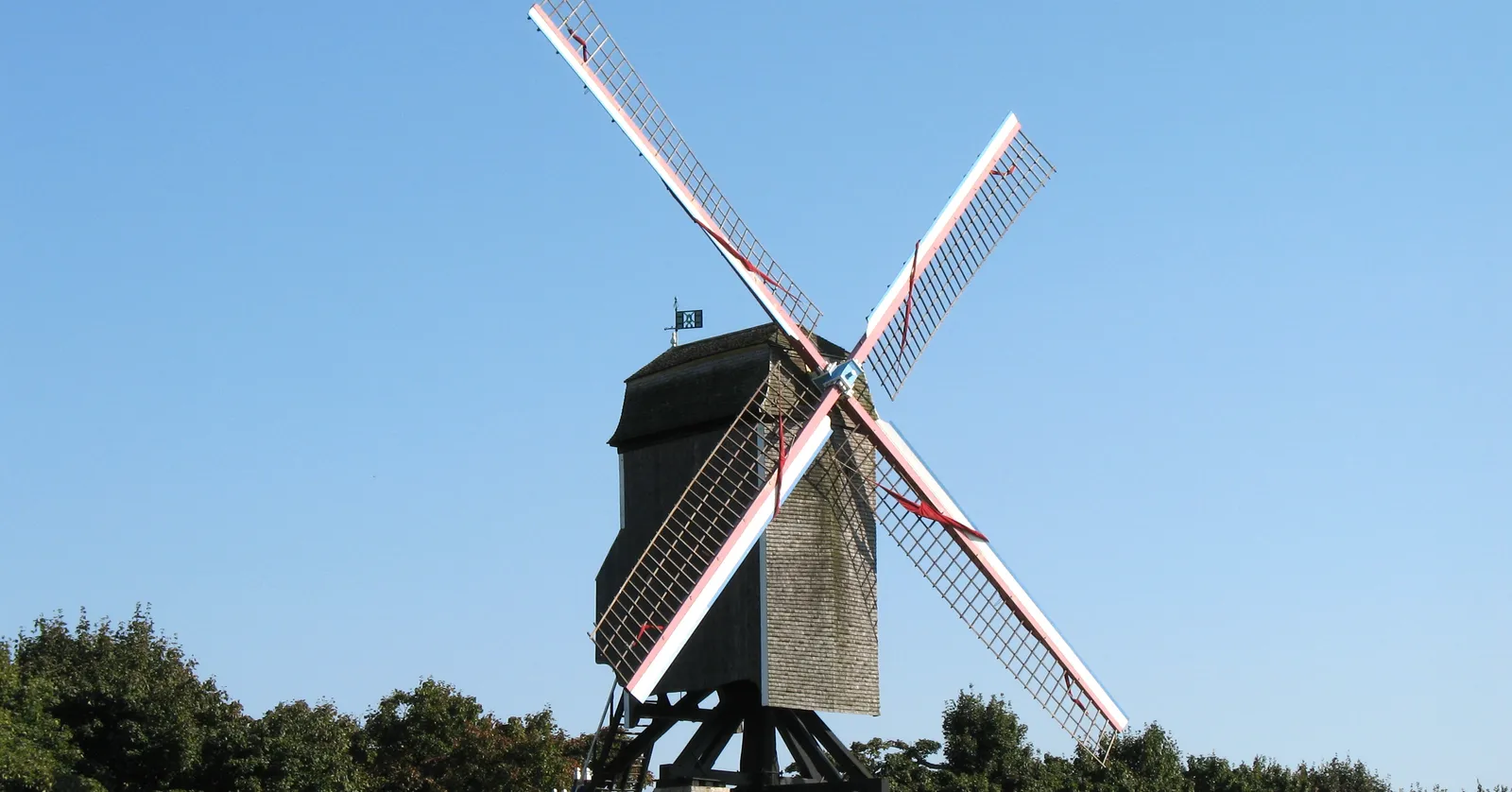
Four windmills stand on the earth ramparts along the eastern edge of Bruges, and the one built in 1770 still grinds grain, for 4 euros. The Kruispoort gate anchors the southern end of the same bank, and the Jerusalem Chapel with its octagonal lantern tower is two streets in from the water.
Sint-Janshuismolen, the 1770 mill that still grinds grain
Wind still turns the stones in this one, which separates it from most surviving Flemish mills and from the other three along the same bank. It has also never moved: it was built here in 1770 and it has stood on this spot ever since, on the earth rampart the city threw up when the walls came down.
Four euros gets you up the steep wooden stairs into the body of the mill, where the gearing and the millstones are, and a miller works it when there is enough wind. It opens 1 April to 2 November, half nine to half twelve and half one to five, shut on Mondays, and then closes for the winter apart from the second Sunday of each month from December onward.
The Jerusalem Chapel on the Adornes estate
Anselm Adornes’ family came from Genoa and settled in Bruges at the end of the 13th century, and what they built on Peperstraat in the 1400s is not a parish church at all: it is a private family chapel modelled on the Church of the Holy Sepulchre in Jerusalem, complete with the founder’s tomb inside and an octagonal wooden lantern tower carrying a gilded globe on top.
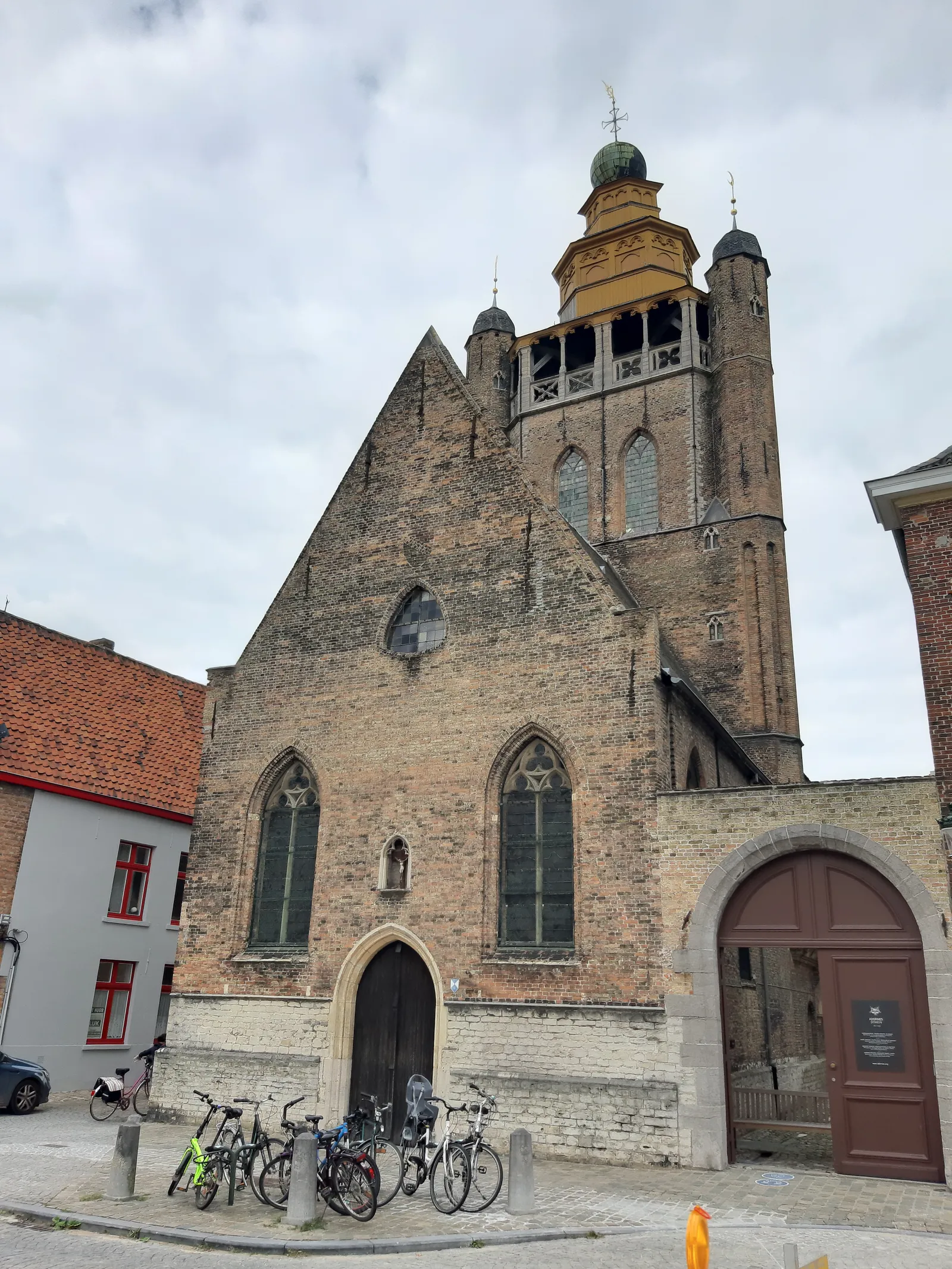
Eleven euros gets you the chapel and the almshouses beside it, now a museum of the family who paid for all of it, with stained glass from around 1560 still in place. The estate is still in the hands of the founding family’s descendants, which is a strange thing to be walking around in.
The other three windmills on the Kruisvest bank
Koelewei, Bonne Chière and De Nieuwe Papegaai all arrived in Bruges the same way: dismantled somewhere else in Flanders during the last century and rebuilt on this bank, which is why the line of four reads as a set even though only one of them has always been here.
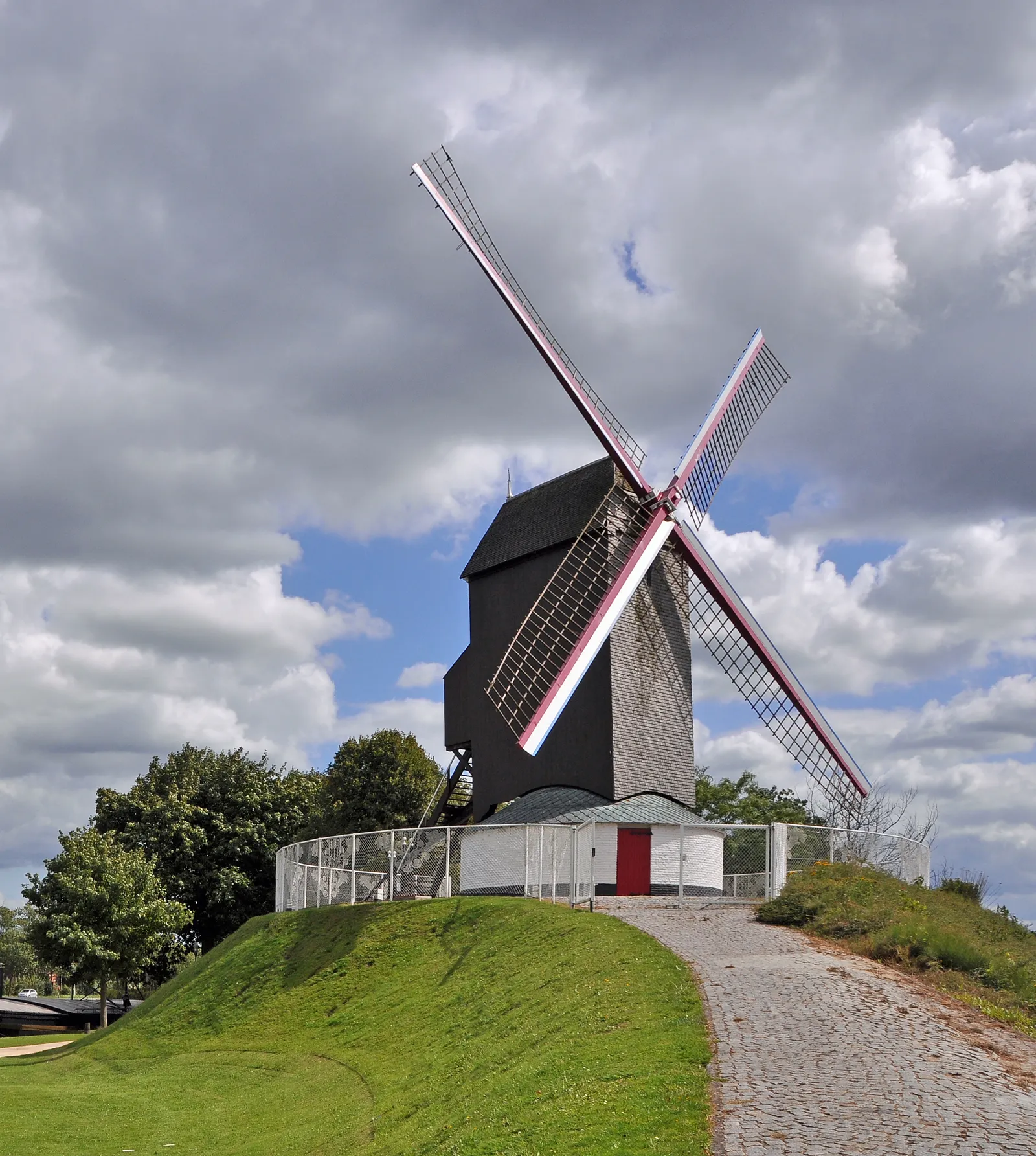
None of the three takes visitors inside. What they are for is the walk: a grass and gravel path along the top of the bank with the canal below on one side, allotments and back gardens on the other, and a mill roughly every few hundred metres. It is the flattest, emptiest stretch of the old city, and after an afternoon in the main Bruges itinerary that is most of the appeal.
The bank is open ground from one gate to the next, with no arcades, no awnings and very little tree cover, so anything you are carrying is out in the weather for the whole length of it.
The Kruispoort, a 1402 gate with two round towers
Nine gates once controlled the way into Bruges and four are left; this is the one in the best condition, rebuilt in 1402 with two heavy round towers and a gatehouse slung between them over the road. The canal runs right up to its foot, so the approach is over a bridge, which is close to how it would have worked when the towers were still doing a job.
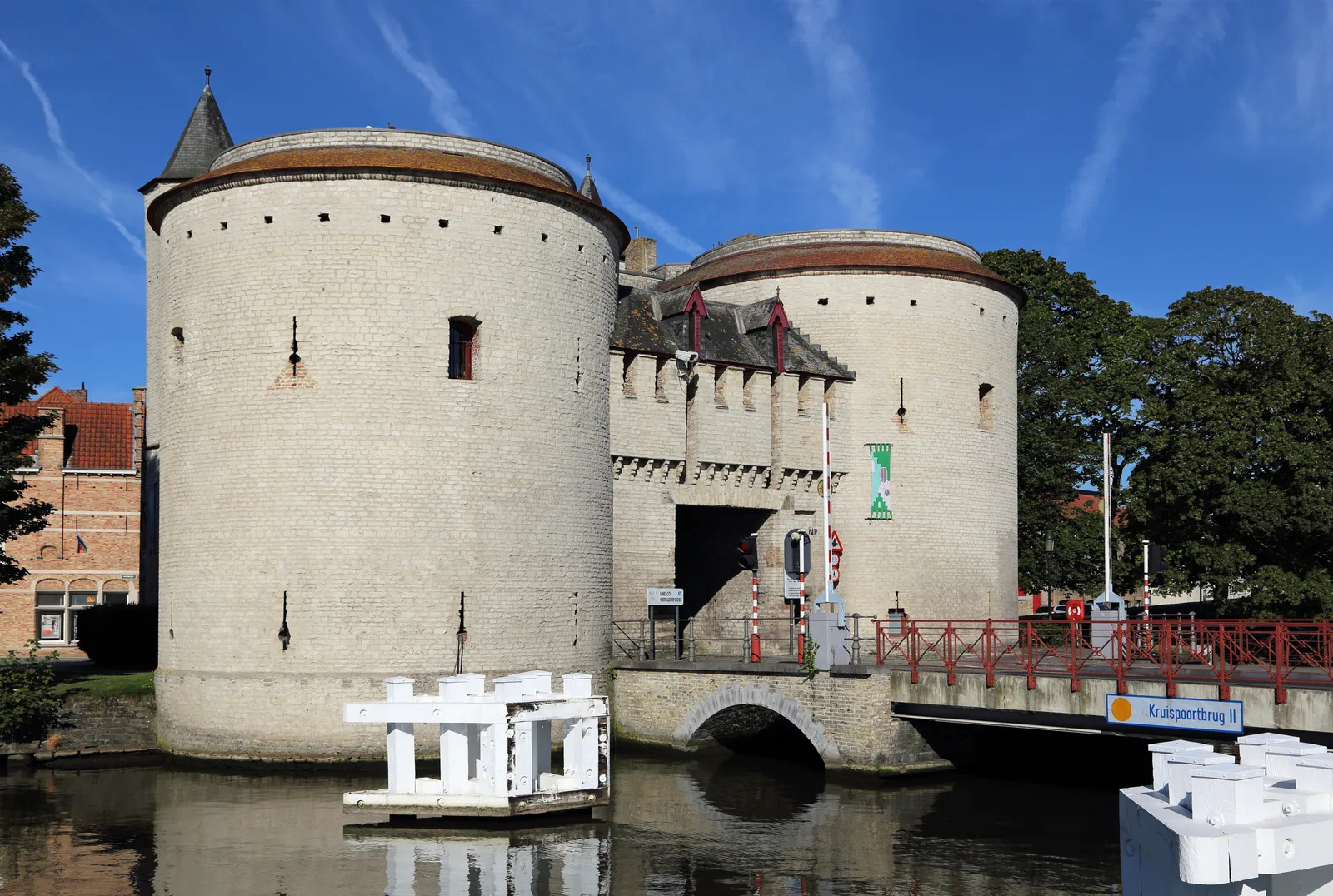
Traffic still goes through the arch, so this is not a quiet monument to stand in front of, and there is nothing to pay or queue for. West of it, the lanes of the Sint-Anna quarter run back towards the centre: brick terraces, a baroque parish church and almost no shops, which is the closest Bruges gets to an ordinary neighbourhood.
Roughly 23 direct trains a day, fewer at weekends
That is the whole timetable for getting from Bruges to Brussels Airport-Zaventem, on Intercity lines 23 and 23A, running without a change in a little under an hour and a half. They all leave from Bruges station, which is the far side of the old town from the ramparts, about half an hour on foot or a bus ride from the Kruispoort.
This corner of the city is the furthest thing in Bruges from a platform, which is the one practical argument against the rampart walk. Everywhere else in the old town, a missed train costs you twenty minutes and a fast walk; from the Kruispoort it costs you the better part of an hour, so treat the departure time as a hard edge rather than a target.
Frequently asked questions
What should I do during a layover near the Kruisvest Windmills in Bruges?
Sint-Janshuismolen is the one mill worth paying for: 4 euros, still grinding, and the only one you can climb into. Two streets in from the bank, the Jerusalem Chapel and the almshouse museum around it make up the Adornes estate at 11 euros. The rest of it is free walking: three more mills along the earth bank and the Kruispoort gate at the end of it. Two to three hours is plenty, and none of it is worth doing in heavy rain.
Can you go inside the windmills in Bruges?
Only Sint-Janshuismolen. It opens 1 April to 2 November, half past nine to half past twelve and half past one to five, closed Mondays, for 4 euros, and from December it opens on the second Sunday of the month. The other three on the bank are landmarks rather than museums, with no public access at all.
How far are the Kruisvest windmills from the centre of Bruges?
About fifteen minutes on foot east of the market square, and the ground is flat the whole way apart from the short climb up the earth bank itself. Compared with anywhere in the centre, the ramparts are quiet: this is a residential edge of the city with a canal on one side and back gardens on the other, and most days you will pass more dog walkers than visitors.
Is the rampart walk in Bruges worth doing in the rain?
Not really. The bank is open ground from one gate to the next with no arcades, no awnings and very little tree cover, and the mill interiors are one room wide with nowhere to wait out a shower. If the weather turns, the Adornes estate and the baroque interior of the Sint-Anna church a few streets in are the indoor options in this quarter.