Bruges Layover: 't Zand and the Concert Hall
Part of the full Bruges Layover: The Belfry and Canals, BRU
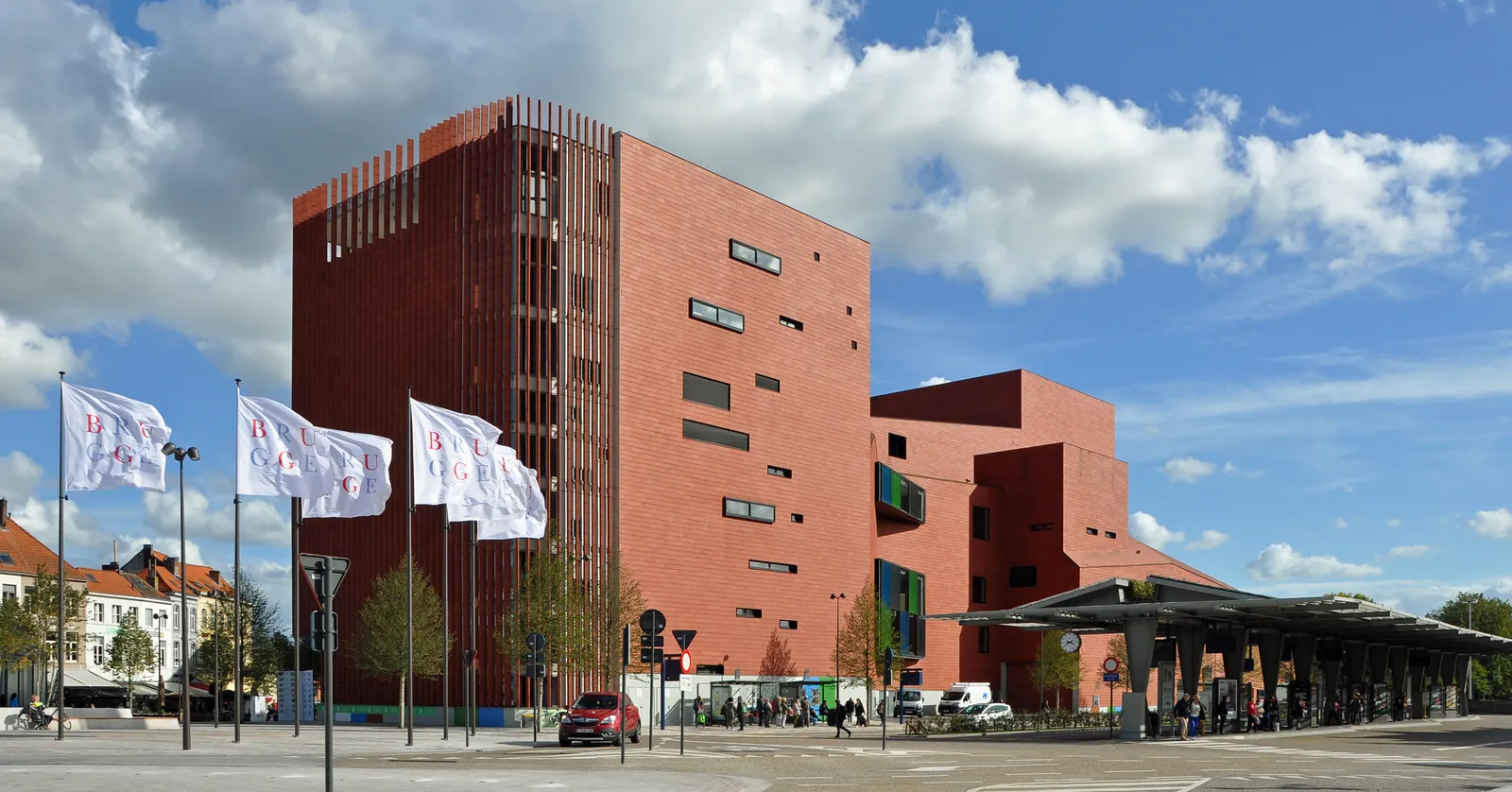
‘t Zand sits at the western edge of Bruges’ old town, with a terracotta concert hall on one side and a food market across it every Saturday morning. The Smedenpoort, one of four medieval city gates still standing, is five minutes west of the square, and the medieval core with its market square and canals is eight minutes east.
The terracotta concert hall on ‘t Zand
Sixty-eight thousand tiles, fired at Saint-Omer just over the French border, cover the outside of this building from the ground to the top of the fly tower, which is why it reads as one solid block of dark red against a city otherwise built of small brick and pale stone. Robbrecht en Daem designed it, and it opened in 2002, the year Bruges held the European Capital of Culture title. There are 1,290 seats in the main hall and 320 in the chamber hall.
You do not need a concert ticket to get in. A self-guided route through the building costs 12 euros, 6 under 26 with ID, and takes in the sound-art collection, a set of installations you play yourself, and a roof terrace on the seventh floor with the belfry, the cathedral tower and, on a clear day, the line of the coast laid out from it. The catch is that it is open on some days and not others, so check before building an afternoon around it.
The Saturday market across ‘t Zand and Koning Albert I Park
Stalls go up from eight in the morning and come down around half past one, and they do not stop at the edge of the square: the market runs off ‘t Zand into Beursplein and along the paths of Koning Albert I Park behind it. Food is most of it, cheese and fish and fruit, with clothing and household stalls filling the rest.
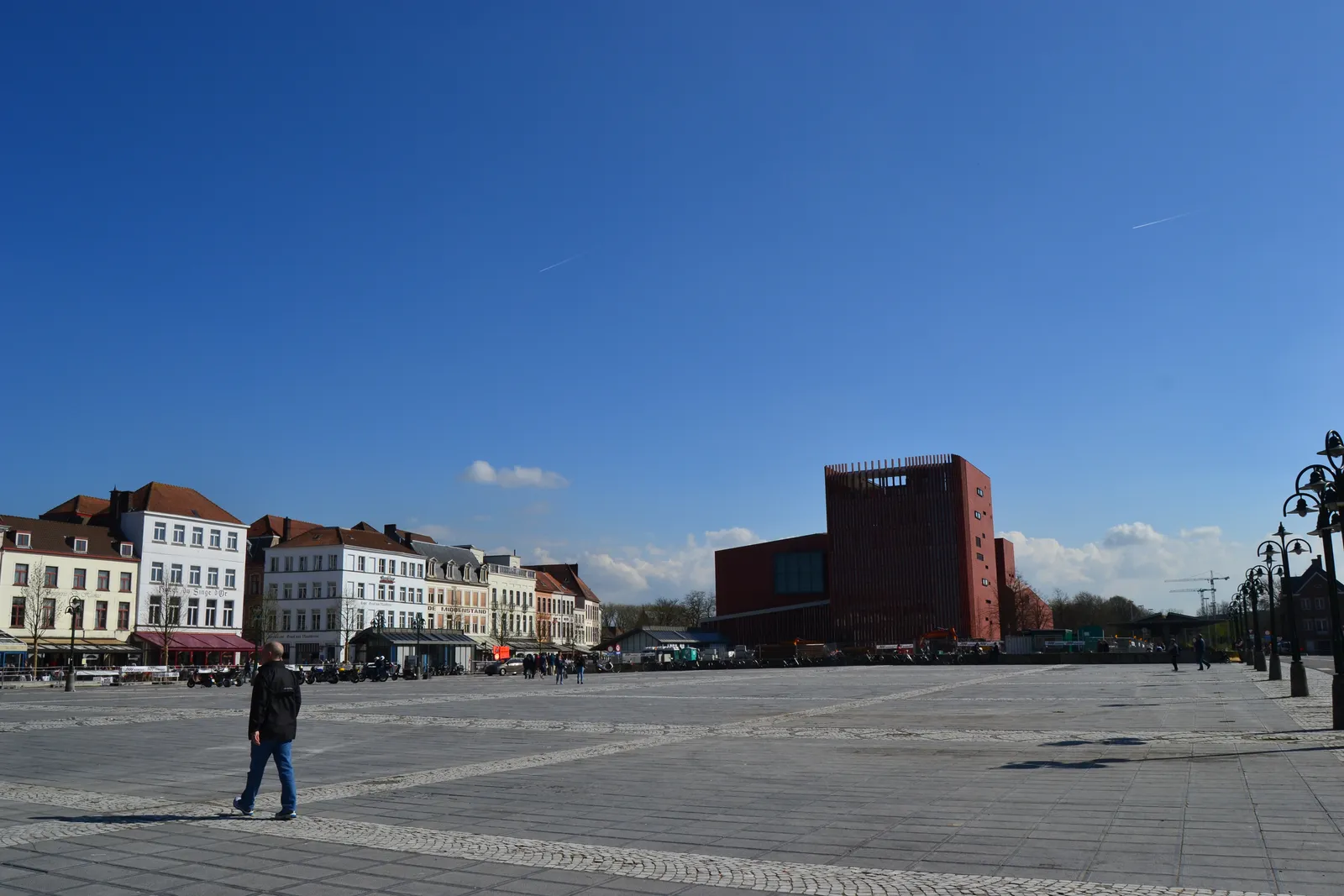
The other six days it reverts to open paving, a ring of cafés along the north side and the concert hall closing the far end. That emptiness is what makes it useful as a transit hub: the city buses converge here, and coaches put down day visitors who have not come in by train.
Which is also the practical wrinkle: the square has no left-luggage counter the way the railway station does, so anyone arriving on a coach is carrying whatever they brought.
The bronze skull on the Smedenpoort
A man called François van der Straeten was hanged in Bruges in June 1691 for agreeing to let French troops into the city through this gate. His head was dipped in bronze and hung from an iron pin on the brickwork as a warning; it went missing during the French Revolution, turned up again in 1876, and what is bolted there now is a replica, with what is left of the original in a museum elsewhere in the city.
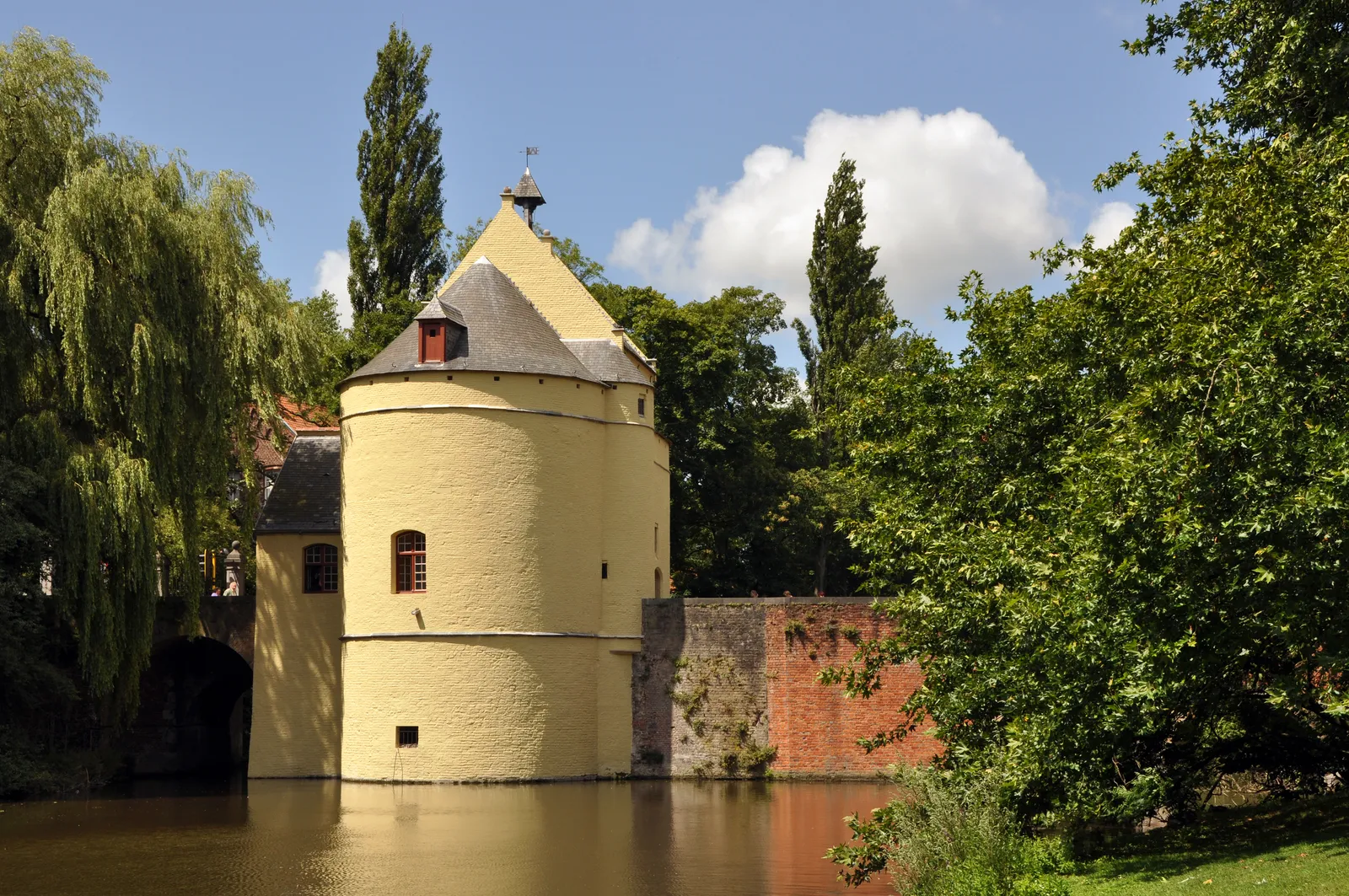
The gate underneath the skull is worth the five minutes on its own. It was first built in the 1290s and rebuilt in 1367 and 1368, and it stands over the water of the old moat with willows on both banks, which is about as far from the coach traffic on ‘t Zand as you can get in that time. Four of these gates survive out of the nine the city once had.
Going the other way, Zuidzandstraat and Steenstraat run east into the old town in under ten minutes and put you at the market square, which is where the full Bruges walk starts and where most of the ticketed sights are.
The train is the only direct link to the airport
Nothing goes from ‘t Zand to Brussels Airport-Zaventem in one hop. The connection is by rail from Bruges station, ten minutes’ walk south of the square or a few minutes on a city bus, and Intercity lines 23 and 23A run from there to the airport without a change in a little under an hour and a half.
The bus is the unpredictable leg, not the train. Services from ‘t Zand to the station are frequent but not clockwork, so if the connection is tight the walk is the version of the trip you can actually put a number on.
Frequently asked questions
What should I do during a layover near 't Zand in Bruges?
On a Saturday morning, the market that covers the square is the answer on its own, and it costs nothing. Otherwise the concert hall on the south side runs a self-guided route through the building for 12 euros that ends on a roof terrace, and the Smedenpoort gate with its bronze skull is five minutes west along the old moat. Two to four hours covers all of it comfortably. The concert hall route is the one part that depends on the day, since it only opens on some of them.
Can you go inside the Bruges concert hall when there is no concert on?
Yes, on the days the building runs its self-guided circuit: weekends year-round, plus Wednesday to Friday in school holidays, and Wednesday to Sunday through July and August. It is 12 euros for adults and 6 for anyone under 26 with ID, and it takes in the sound-art collection, several interactive installations and a seventh-floor roof terrace that looks over the old town and out towards the coast.
Is 't Zand worth a stop if it isn't a Saturday?
The square itself is open paving on the other six days, so on its own, not especially. What makes it worth the stop is what sits around it: the concert hall on the south side, the Smedenpoort five minutes west, and the medieval core eight minutes east along Zuidzandstraat and Steenstraat. Treat 't Zand as a starting point on those days rather than a destination.
How long is the walk from 't Zand to the Markt in Bruges?
Eight to ten minutes, straight through on Zuidzandstraat and then Steenstraat, which is the main shopping street and the flattest way in. Saint Saviour's Cathedral is about halfway along it, a few metres off to the right. There are no steps on the route, but the last stretch is cobbled.