Pike Place Market on a Seattle Layover
Part of the full Seattle Layover: Downtown and the Piers, SEA
Seattle’s Pike Place Market costs nothing to walk through, and the parts worth the time sit below and behind the stalls: the DownUnder shops under the Main Arcade, the gum wall along Post Alley, and the MarketFront terrace looking out over Elliott Bay.
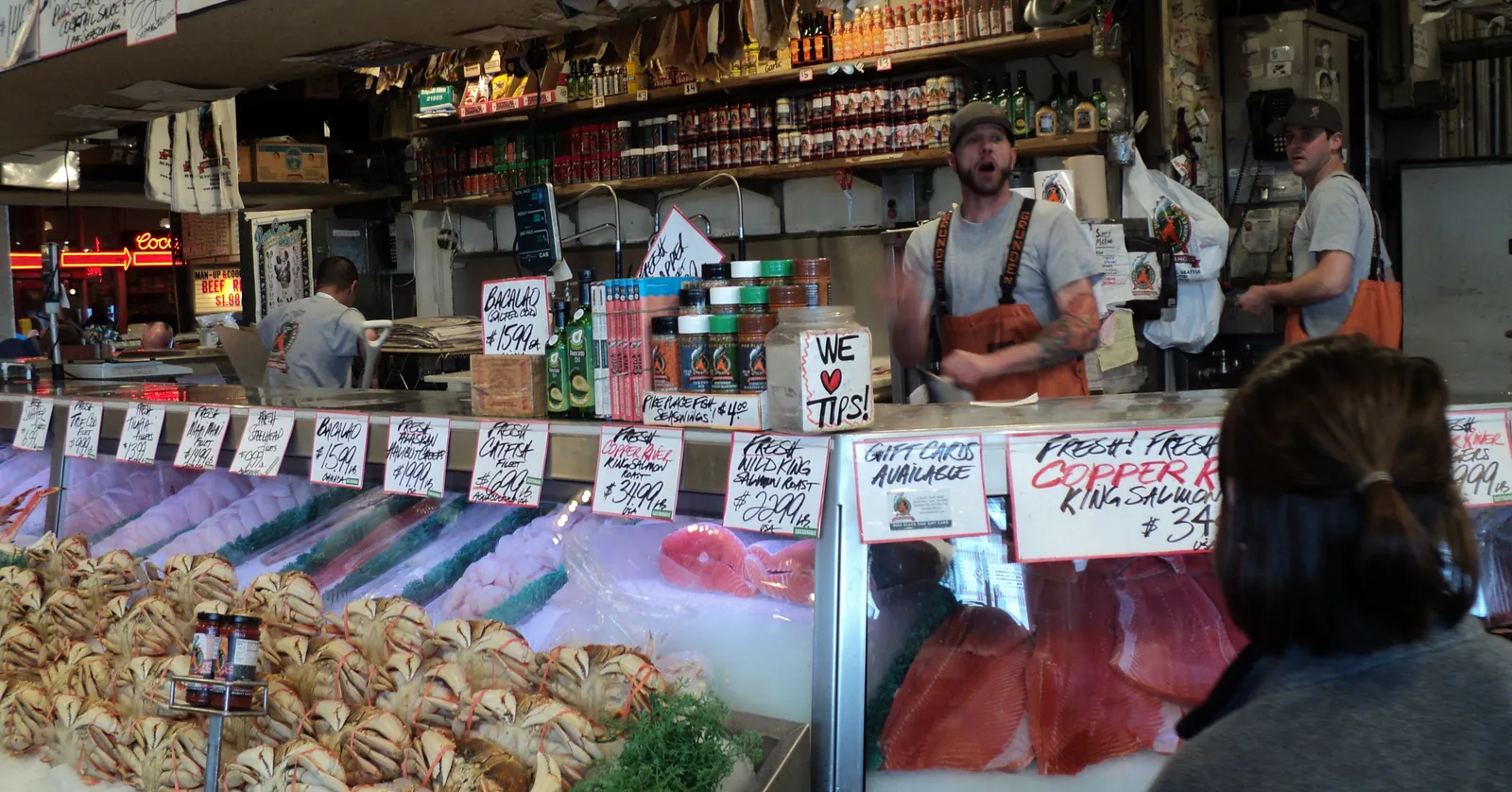
The salmon toss at the Pike Place Fish Market counter
The fish stall at the Pike Street corner, directly under the brass clock, has been throwing whole salmon over the ice since the 1980s, and it still does it every time somebody buys one. The counter itself is worth the stop regardless: Dungeness crab stacked in pyramids, halibut and king salmon laid out under hand-lettered cardboard prices, and staff who will happily explain the difference between the five Pacific salmon species to someone with no intention of buying any. Nothing about watching costs anything.
The bronze pig at the same entrance is Rachel, a working piggy bank installed in 1986. She and a second pig at the north end take in around $20,000 a year in coins from visitors, which funds the market’s own food bank, senior center, preschool and medical clinic. If you would rather eat here than watch other people buy fish, a tours and activities platform sells a small-group tasting walk led by a chef, which is the version of this that comes with a table booked at the end of it.
The DownUnder shops below the Main Arcade
Below Pike Place Market’s fruit and flower stalls, the building keeps going down through several more floors of shops cut into the hillside, signed as the DownUnder. The tenants are the opposite of the produce above: a magic supplier, a comics dealer, secondhand maps and vintage magazines, an Indian spice counter, a shop selling nothing but bags. Almost nobody upstairs comes down here, so this is the part of the market you can actually stand still in.
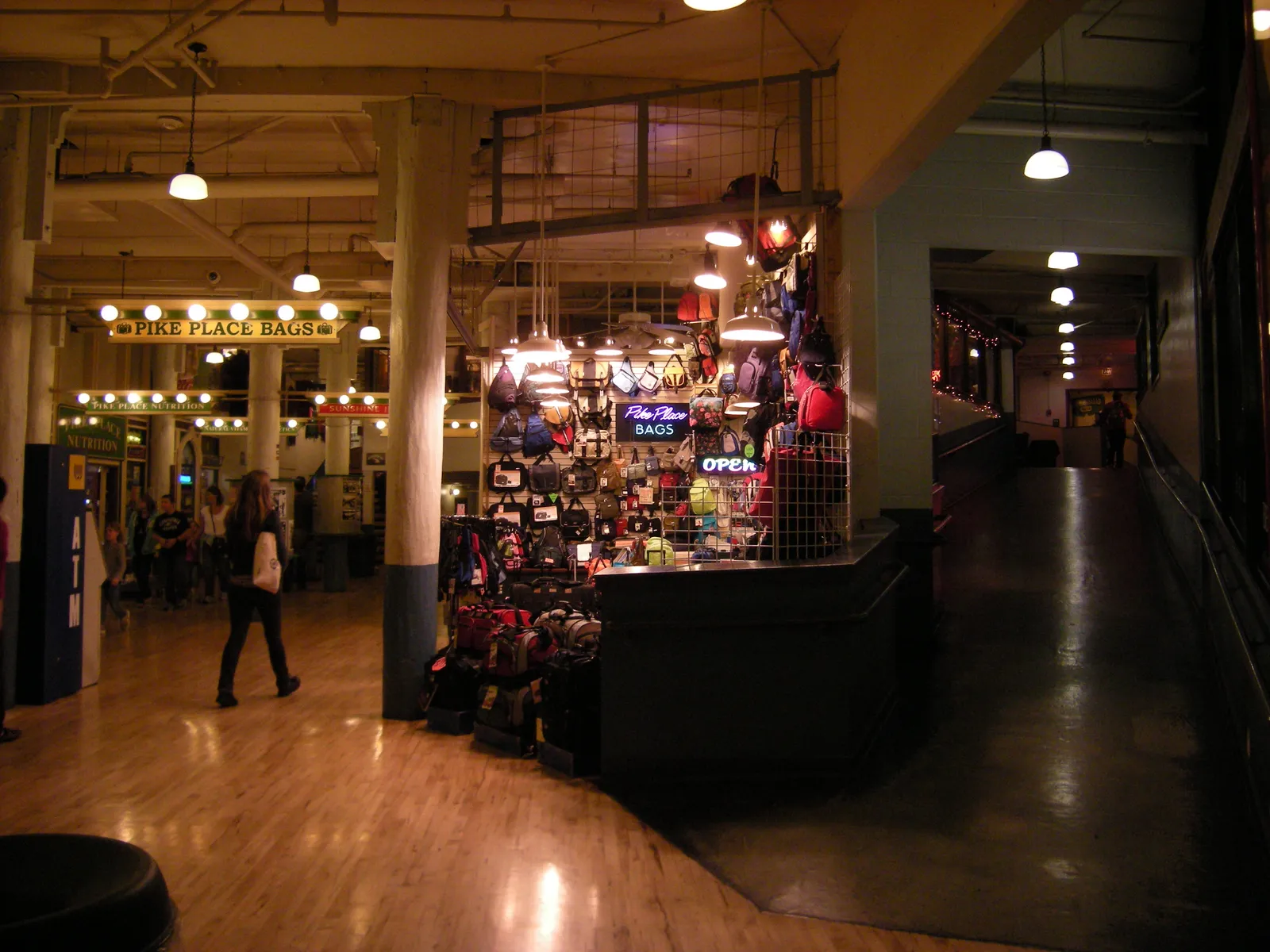
Getting between the levels means stairs and a couple of narrow ramps, and the Main Arcade above narrows to single file when a tour group comes through at midday.
The gum wall in Post Alley
Post Alley runs under Pike Place Market on its west side, and the stretch outside the Market Theater is coated on both walls in chewed gum, several inches deep in places, going up as high as anyone can reach. It started around 1991 with people queuing for improv shows sticking gum to the brick with a penny pressed in, and it has been left alone ever since apart from one full strip-back in November 2015, when crews spent three days steaming off 2,300 pounds of it. The brick was visible for a few weeks. It has been solid gum again for years.
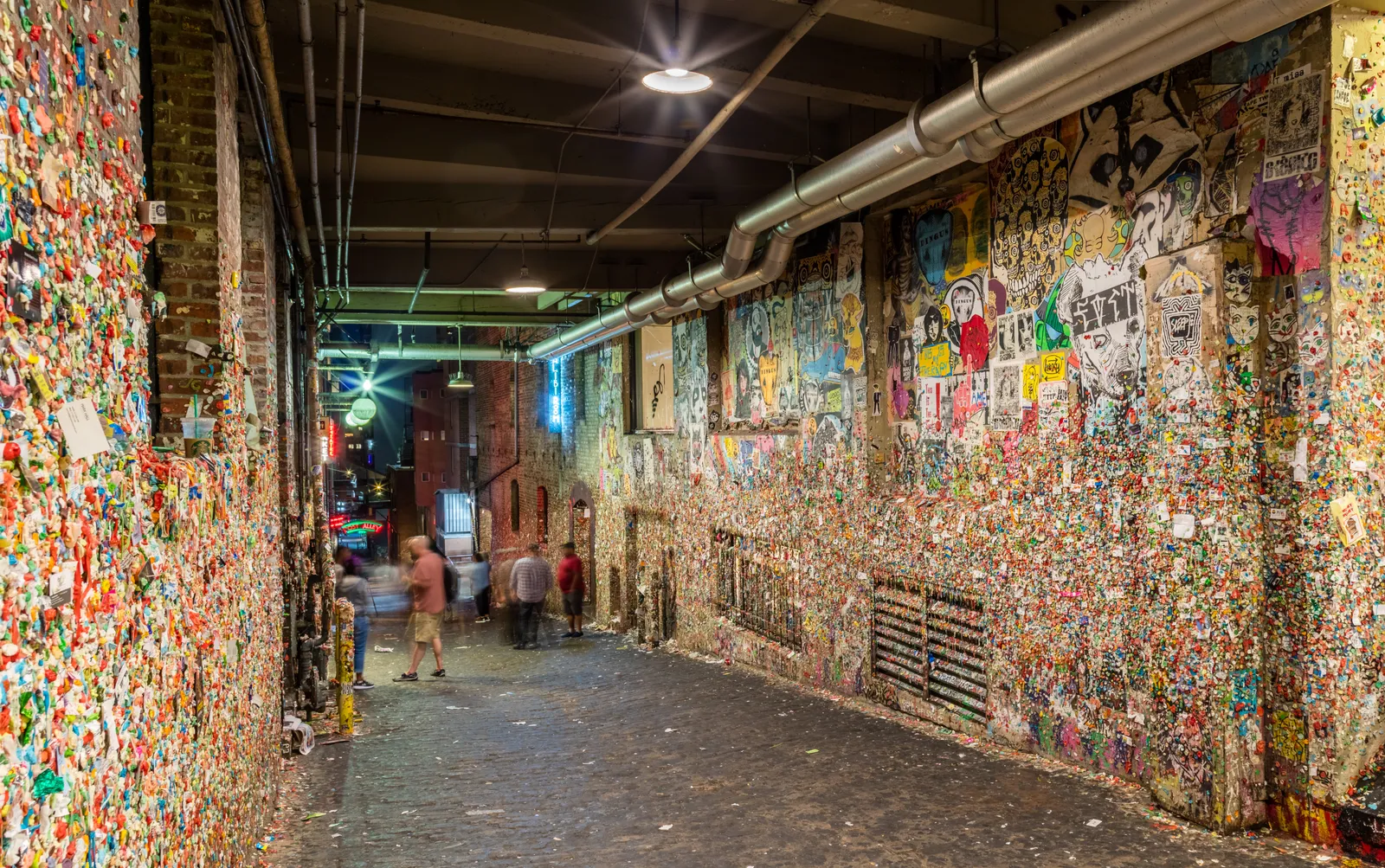
The alley is open air and unlit at the north end, which makes it one of the few parts of the market that works after the stalls close.
The MarketFront terrace over Elliott Bay
At 1901 Western Avenue, the north end of Pike Place Market opens onto a covered pavilion and an outdoor terrace built in 2017, on what had been a parking lot for decades. It is the first extension the market had in forty years, and the reason to walk up to it is the view: an unbroken line of Elliott Bay, the container cranes at Harbor Island, and the Olympic range behind them on a clear day. It costs nothing and nobody checks why you are there.
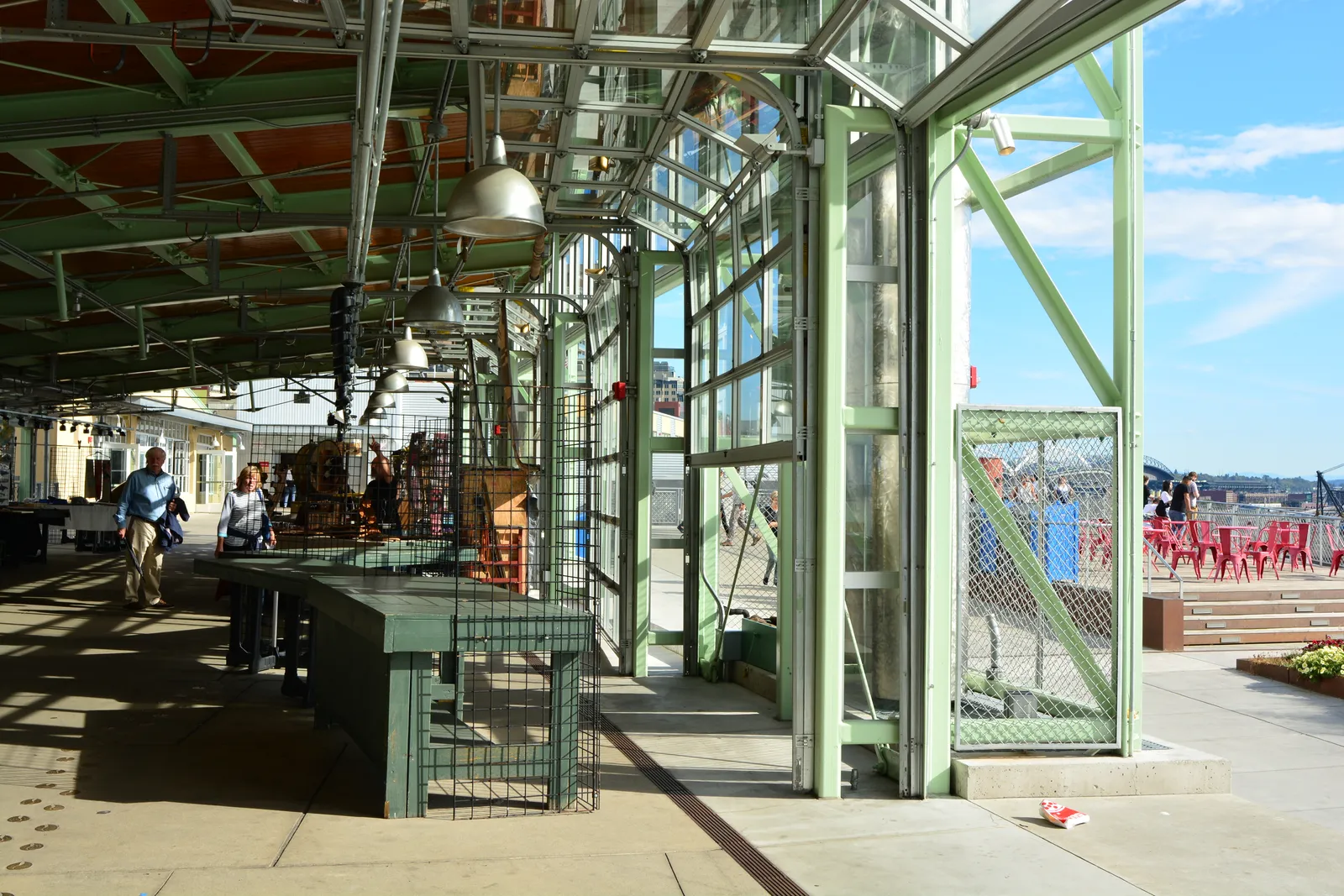
The waterfront the terrace looks down on is five minutes away on foot, and the aquarium there sells timed entry tickets if you have longer than the market alone needs. With four hours or more free, the market becomes one stop on the wider downtown Seattle route, which adds the Central Library and Pioneer Square.
The airport train boards under Pine Street at Westlake
The 1 Line covers the run out to SeaTac/Airport Station in 38 minutes at a flat $3 for an adult, and Westlake, the closest station it stops at, is about ten minutes’ walk uphill from Pike Place Market. Trains come every 8 to 10 minutes through the day and serve the airport station from 5am to 1am Monday to Saturday, 6am to midnight on Sunday. At the far end the platform is not attached to the terminal: about 1,200 feet of covered walkway crosses the parking garage and comes out at Skybridge 6, by baggage carousel 16, so an hour door to door is the honest figure rather than 38 minutes.
Coming back for a stored bag on your way to Westlake costs a few minutes. Carrying one down two flights into the DownUnder and back up again costs rather more.
Frequently asked questions
What should I do during a layover near Pike Place Market in Seattle?
Give the fish counter at the Pike Street corner ten minutes, then go down rather than along: the DownUnder levels under the Main Arcade hold several floors of small shops that most visitors never reach. Post Alley below that has the gum wall, and the MarketFront terrace at the north end is a free overlook onto Elliott Bay and the Olympics. Two hours covers all four comfortably. If you want to eat properly rather than graze, a guided tasting is worth booking ahead, since walk-up spots are limited.
Is Pike Place Market worth visiting in the evening?
The stalls shut at 6pm Monday to Saturday and 5pm on Sunday, so an evening visit is not the market itself. What stays open is Post Alley, where the restaurants and bars run late, and the outdoor parts: the gum wall is in a lit passage with no gate on it, and the MarketFront terrace is public until late. If your free hours are all after six, the covered arcades will be dark and mostly shuttered.
Is the Starbucks at Pike Place really the first one?
Not quite. The company's first shop opened in 1971 at 2000 Western Avenue, and moved to 1912 Pike Place in 1976 when its original building was pulled down. The Pike Place store keeps the older logo and sells store-specific merchandise, which is what the queue outside is generally for; the coffee is the same as any other branch, and there are several less busy ones within two blocks.
How long does it take to reach the airport from Pike Place Market?
Westlake is the nearest station with an airport service, roughly a ten-minute walk uphill from the market, and the 1 Line takes 38 minutes from there out to SeaTac/Airport Station for a flat $3 adult fare. Add the 1,200-foot covered walkway between that station and the terminal and it is closer to an hour door to door. Trains serve the airport station from 5am to 1am Monday to Saturday and 6am to midnight on Sunday.