Marrakech Layover: Medina Palaces From RAK
Marrakech’s walled medina has its two finest interiors, the Bahia Palace’s marble courtyards and the Ben Youssef Madrasa’s carved stucco, about a kilometre either side of Jemaa el-Fnaa, with the covered souks and the Koutoubia minaret free to walk past in between.
The Bahia Palace’s Grand Courtyard is fifty metres of Carrara marble
The Bahia Palace stands on the southern side of Marrakech’s medina, where the old Jewish quarter, the Mellah, begins. Si Musa, grand vizier to Sultan Muhammad ibn Abd al-Rahman, started it in the 1860s, and his son Ba Ahmed, who ran the country as regent in the 1890s, pushed it north between 1894 and 1900 until it covered almost two hectares and about 150 rooms. What that money bought is the reason to come: painted cedar ceilings, zellige tilework to shoulder height, and the Grand Courtyard, 50 by 30 metres of Italian Carrara marble ringed by a painted wooden gallery.
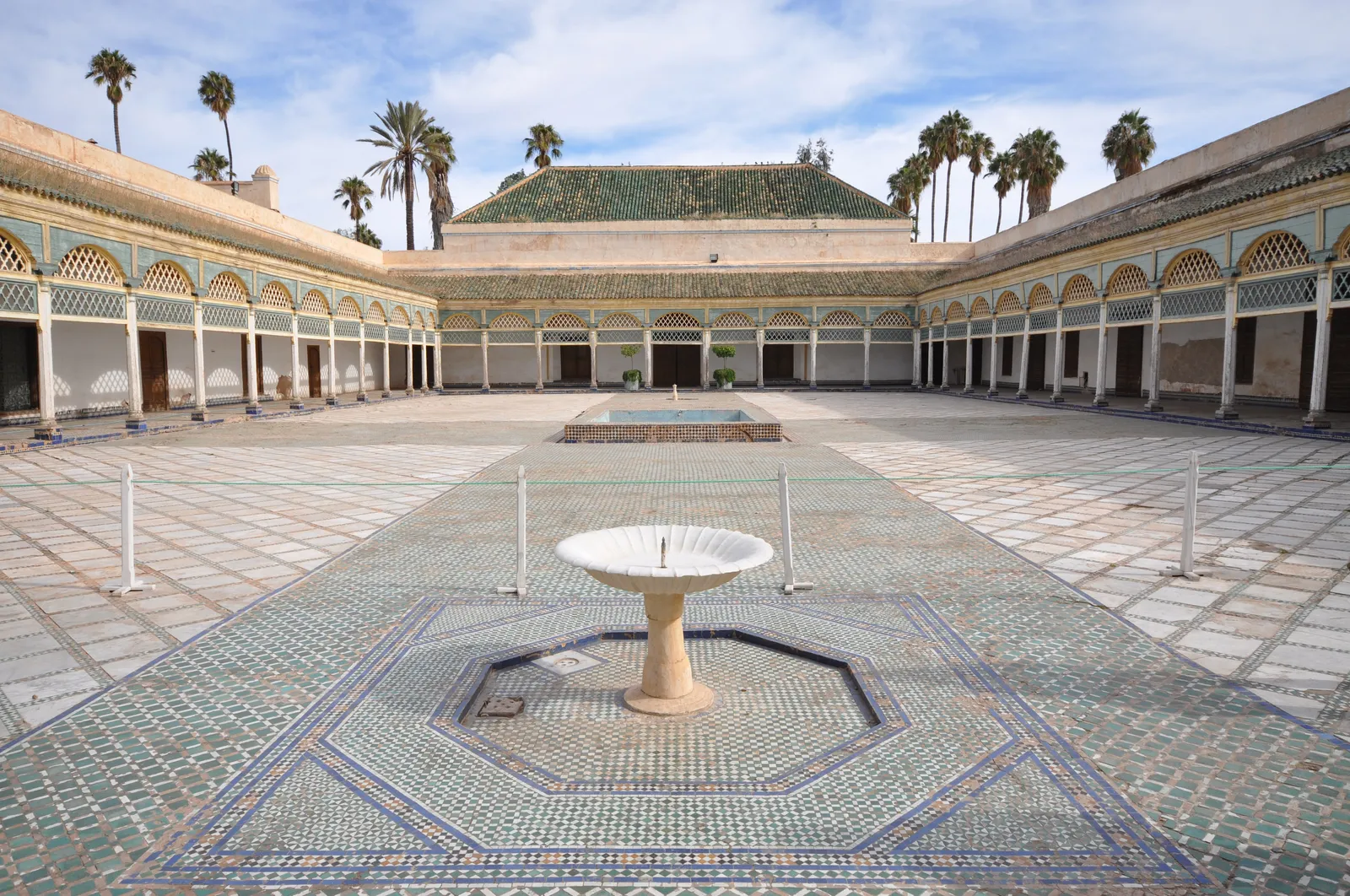
Entry is 100 dirhams, it opens from 9:00 to 17:00 with last admission around 16:30, and the oldest part of the palace, the Grand Riad, still has its garden of 19th-century trees between two reception halls. The ticket window is known for a mid-morning queue in full sun and for wanting cash, so if you would rather arrive with it sorted, a guided tour with the entry ticket included can be booked ahead.
Ben Youssef Madrasa, where 800 students once lived
The Ben Youssef Madrasa sits at the northern end of the souks, beside the mosque it was built to serve. The Saadian sultan Abdallah al-Ghalib commissioned it in 1564, and at its height its 130 small rooms housed up to 800 students, which made it the largest madrasa in Morocco. The rooms are tiny and bare and open for you to walk through, and they are the contrast that makes the courtyard below them land: a shallow reflecting pool about seven metres long, framed by zellige-tiled pillars, carved stucco and a cornice of cedar.
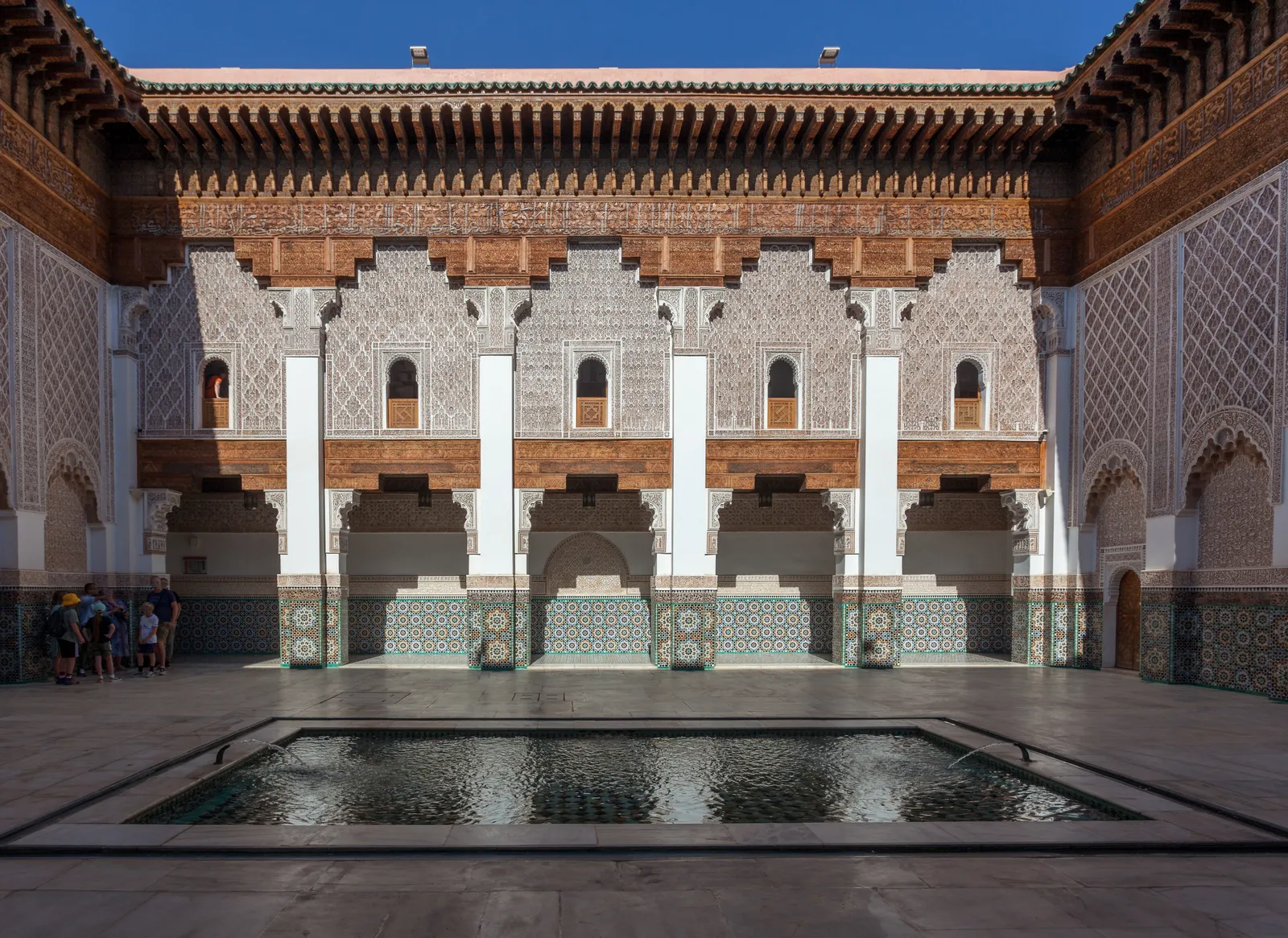
It reopened in April 2022 after a restoration that closed it for more than three years. Entry is 50 dirhams, and the doors stay open until 19:00, later than anything else on this walk. A guided walk that pairs the madrasa with Dar El Bacha and the medina is an option if you want someone to read the inscriptions for you. About forty metres south of the mosque, the Almoravid Koubba, a small domed ablutions pavilion from the early 12th century, is the only Almoravid building left standing in the city; more than half of it lay under metres of rubble until French archaeologists dug it out in the years after 1947, and it is ticketed separately.
Le Jardin Secret’s two gardens and the tower above them
Le Jardin Secret occupies a walled plot in the Mouassine quarter, on the western side of the souks, where a Saadian sultan began building in the 16th century. The palace there now dates from the mid-19th century, when a local kaid rebuilt on the old layout, and a chamberlain to Sultan Moulay Abd al-Hafiz bought it in 1912 and added the tower. Restoration started in 2008 and it opened to the public in 2016.
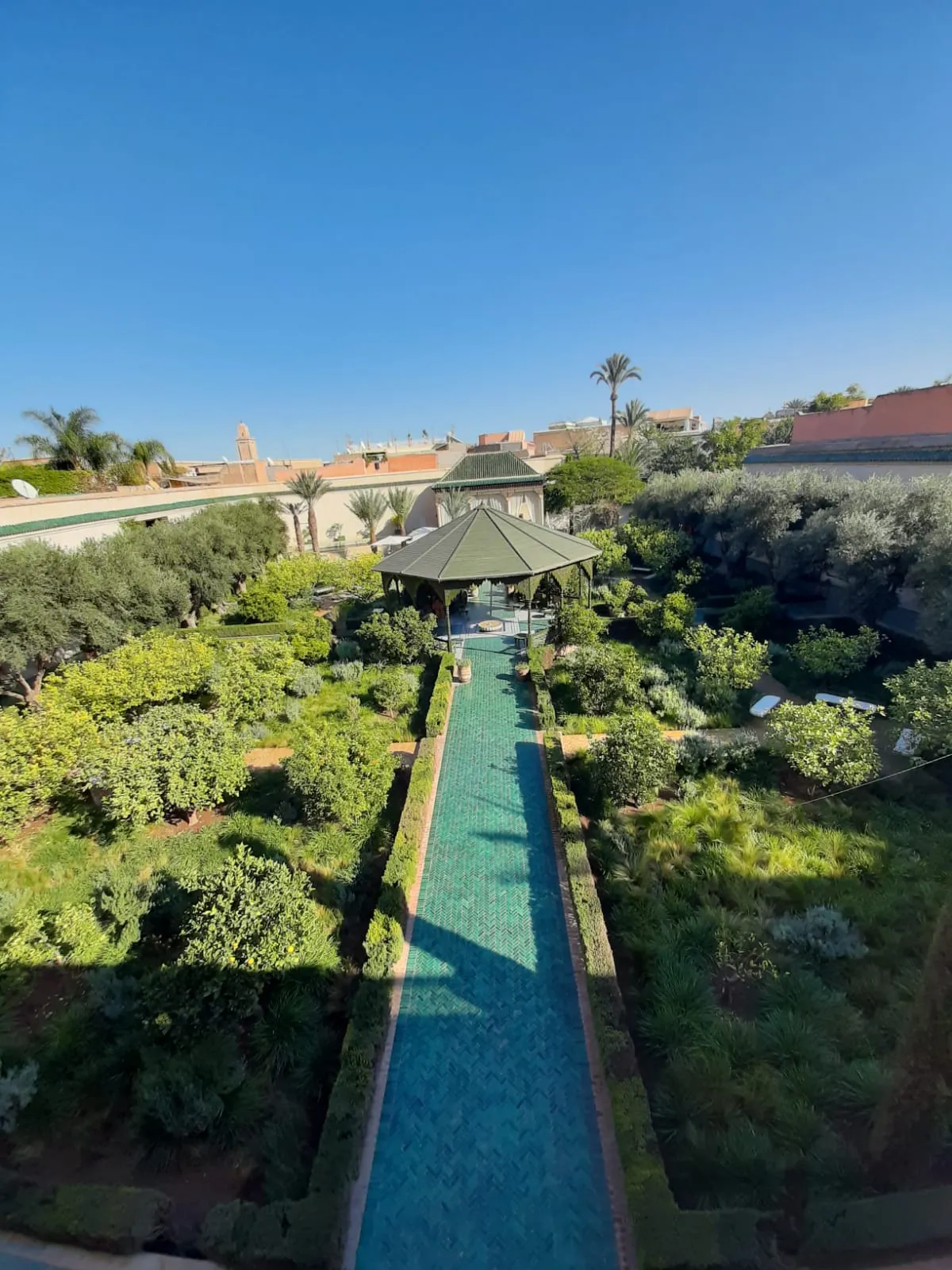
There are two gardens, a formal Islamic one quartered by tiled water channels and an exotic one planted from other continents, both fed by the old khettara, the underground channels that brought water into the medina. Entry is 100 dirhams, the tower is 40 more, and hours run 9:30 to 19:30 from March to September and shorter in winter. The garden also features on a half-day heritage tour that also takes in Ben Youssef, which suits you if you would rather not navigate the souks between them yourself.
Souk Semmarine and the spice stalls of Rahba Kedima
Souk Semmarine is the medina’s main market street, entered through an arch on the northern side of Jemaa el-Fnaa and running north toward the Ben Youssef Mosque under a slatted canopy of reed and wood. Fabrics, lamps, leather slippers and brass hang off both sides, and the smaller specialist souks branch away from it: woodworkers, ironworkers, basket makers. Just before the street forks, a narrow lane to the right opens onto Rahba Kedima, a small square where the stalls sell spices, dried herbs and apothecary jars. Walking through costs nothing.
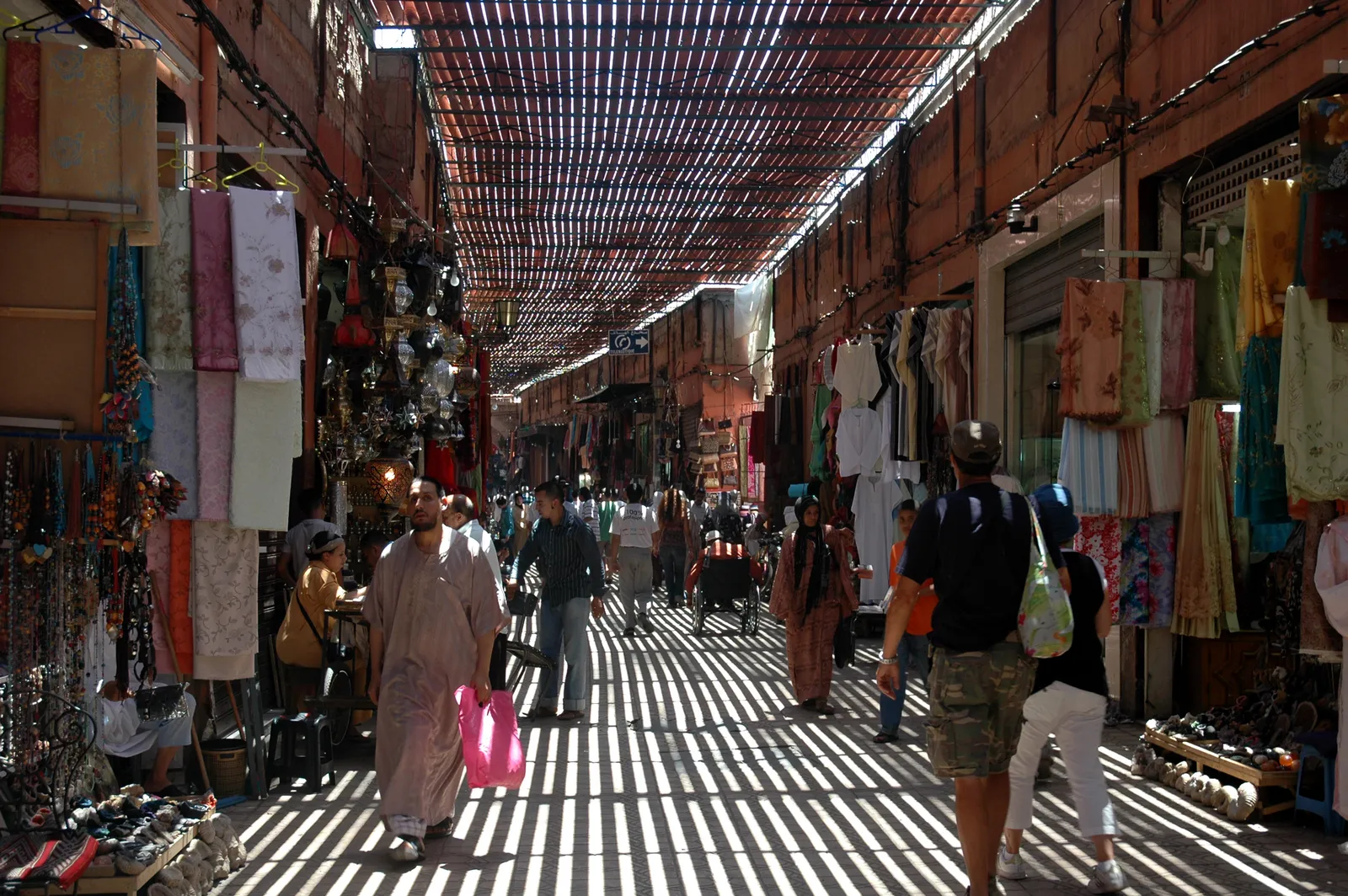
Marrakech allows motorbikes in its medina, and scooters push through the souk lanes among the shoppers, so when you hear “balak!” behind you, step to the side: that is simpler to do without a suitcase.
Jemaa el-Fnaa’s food stalls go up at dusk
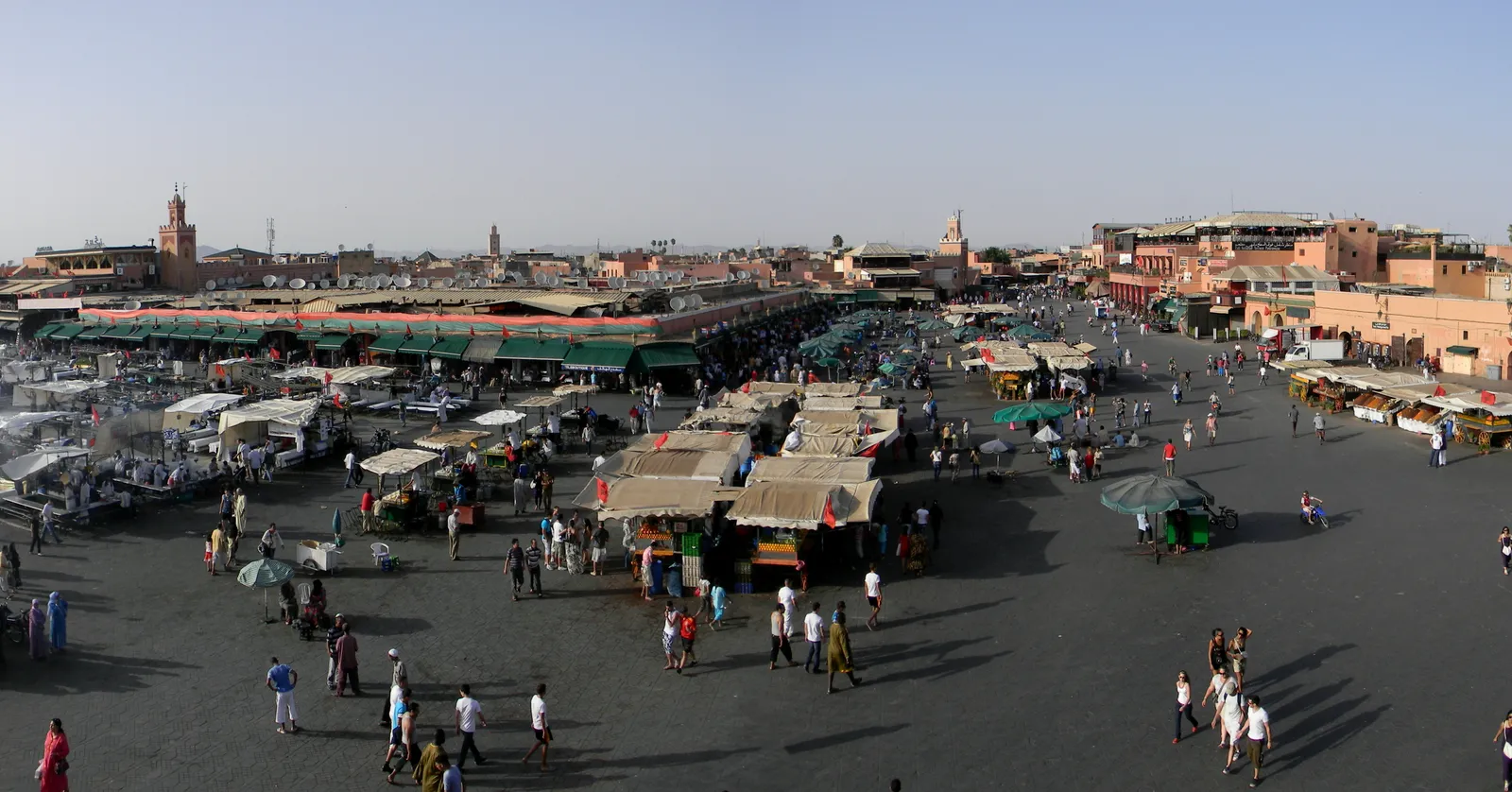
Jemaa el-Fnaa is the open square at the centre of Marrakech’s medina, and it changes character with the light. By day it belongs to fresh orange juice sellers, traditional water sellers and snake charmers; toward evening come the storytellers, musicians and dancers; after dark, dozens of food stalls set up in the middle and fill the square with smoke from their grills. UNESCO proclaimed it a masterpiece of oral heritage in 2001, specifically to protect the performers from being pushed out by development.
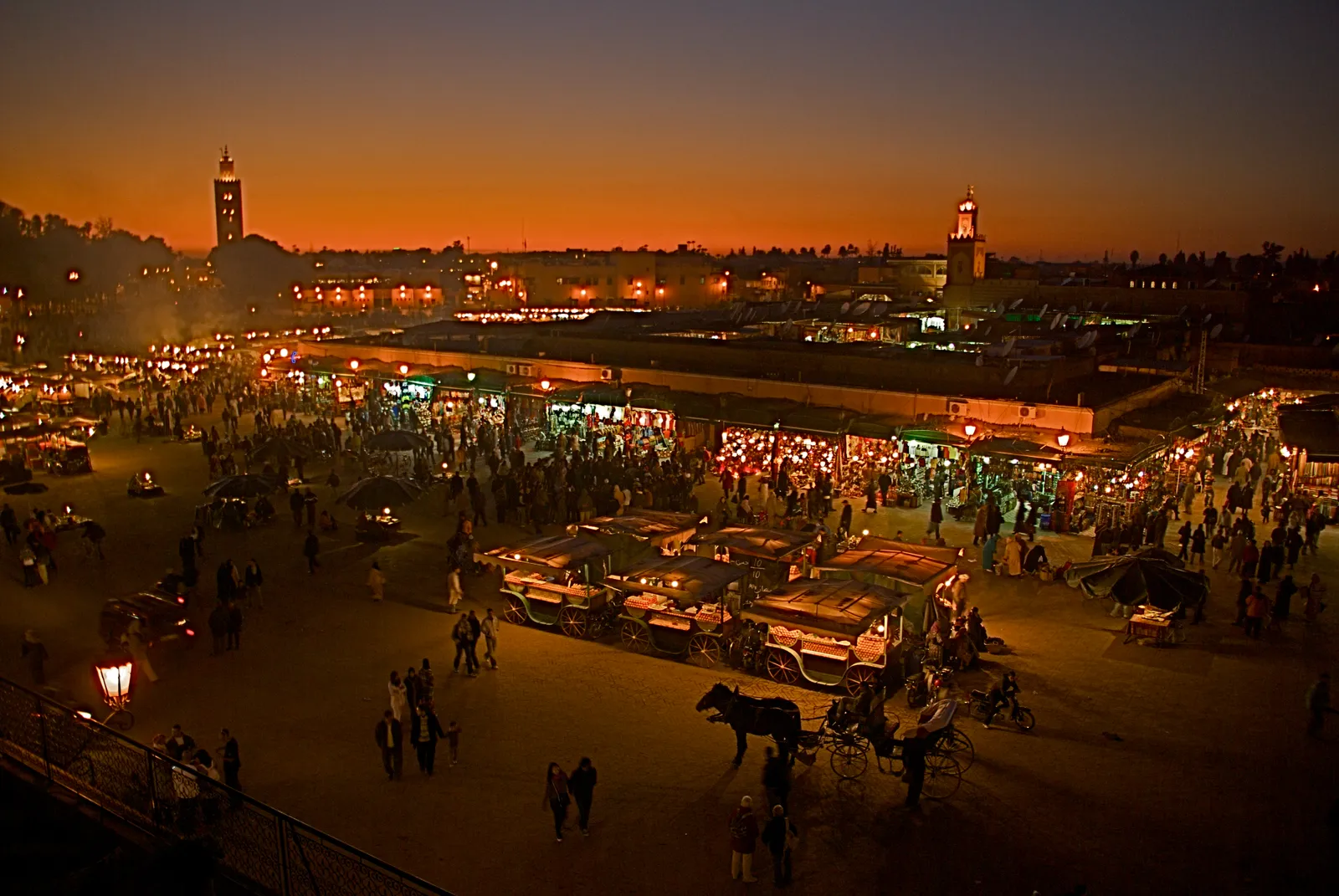
The name is usually read as “mosque of ruins,” after a Friday mosque that the Saadian sultan Ahmad al-Mansur began here in the late 16th century and abandoned when plague struck. The rooftop cafés on the square’s edges are the way to see it from above; a drink is the usual price of a seat.
The Koutoubia minaret, model for Seville’s Giralda
The Koutoubia Mosque stands just west of Jemaa el-Fnaa, and its minaret, 77 metres of square stone tower topped by three copper spheres, can be seen from much of the medina. The Almohad caliph Abd al-Mu’min founded the mosque in 1147, the minaret was probably finished around 1195, and its design was copied for the Giralda in Seville and the Hassan Tower in Rabat. The name comes from the booksellers, the kutubiyyin, whose market once stood around it.
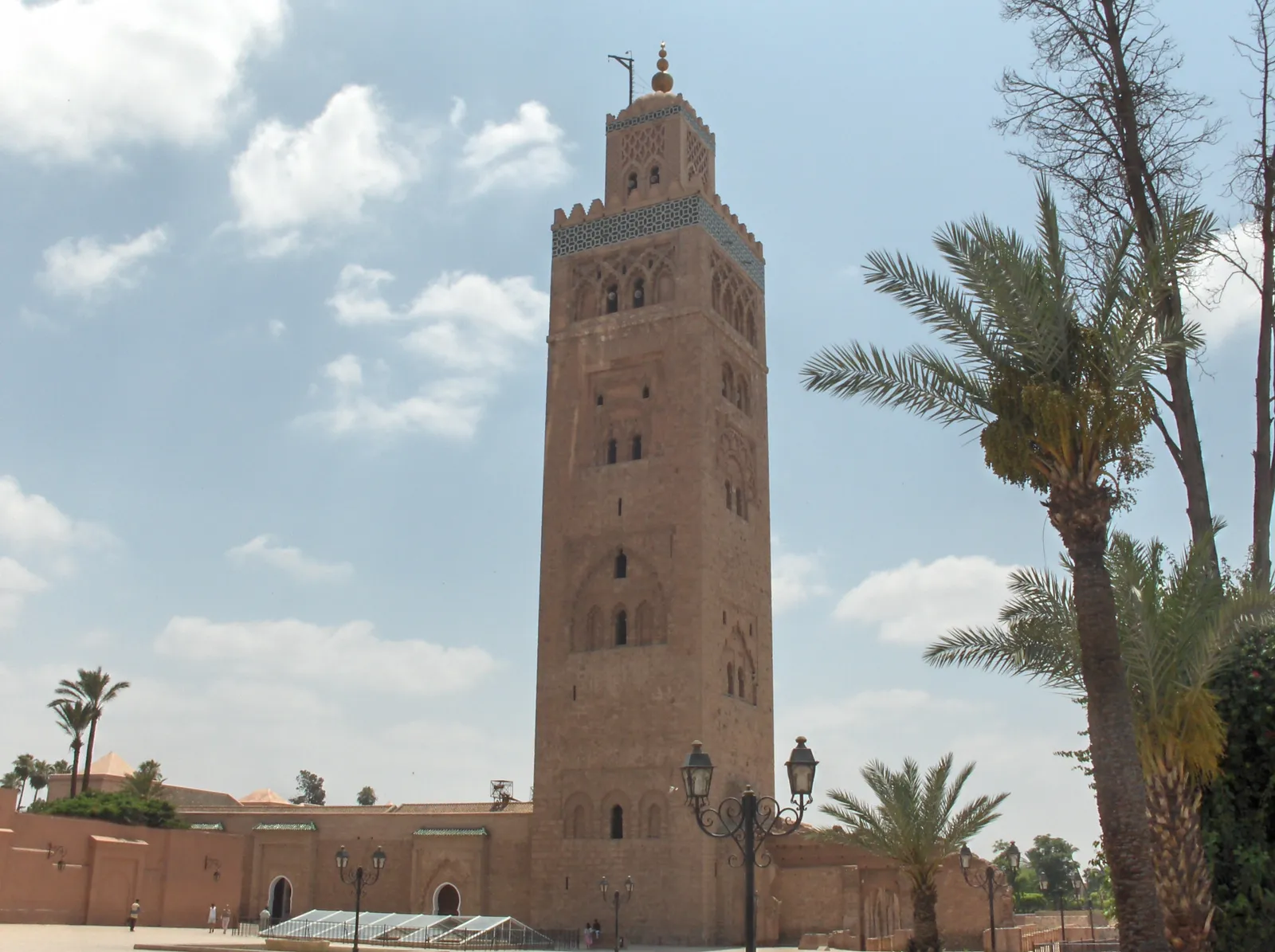
Only Muslims may go inside, but the rest is open around the clock: the gardens on either side, and on the esplanade, the excavated foundations of the first mosque, torn down and rebuilt a few years after it went up.
A 30-dirham bus to Menara Airport leaves from beside the Koutoubia
Bus 19, the airport line run by ALSA, stops by the Koutoubia on the edge of Jemaa el-Fnaa and runs to Marrakesh Menara Airport (RAK), six kilometres south-west, roughly every half hour from about 06:00 to 21:00. A single is 30 dirhams, paid in cash to the driver, and a 50-dirham return is the better buy if you rode it in. The ride itself is about 20 to 30 minutes, but allow closer to an hour door to door from the Ben Youssef end of the medina once the walk to the stop and a wait for the next bus are added. A petit taxi does the same run in 15 to 30 minutes on no timetable; taxis cannot enter the medina lanes, so you board at a gate, and the fare should be agreed or the meter switched on before you set off.
Aim to be at the terminal about three hours before an international flight. Departing passengers are screened at the terminal door before check-in, then again at security, and passport control comes after that. If your flight actually leaves from Casablanca instead, that is a different day: direct trains from Marrakech’s station take about two hours and forty minutes.
Three hours on foot between a marble palace, a madrasa’s student rooms and a lane where scooters have right of way goes further with nothing to carry, and a bag left at a storage point in the medina is one less thing to steer through the souks on the way back to the bus.
Frequently asked questions
What should I do during a layover in Marrakech?
Spend it inside the medina walls. The Bahia Palace (100 dirhams) and the Ben Youssef Madrasa (50 dirhams) are the two interiors worth paying for, about a kilometre either side of Jemaa el-Fnaa, and the covered souks run between the square and the madrasa at no cost. The Koutoubia minaret stands just west of the square and is seen from outside only. Allow about three hours on foot; Le Jardin Secret, a restored riad garden in the souks, is the stop to drop if you are short on time.
Can I see the Bahia Palace and the Ben Youssef Madrasa on the same afternoon?
Yes, but do the palace first. The Bahia Palace closes at 17:00 and stops admitting visitors around 16:30, while the Ben Youssef Madrasa stays open until 19:00, so a late start can still fit both only in that order. The walk between them, straight through the souks, is about two kilometres.
Can non-Muslims go inside the Koutoubia Mosque?
No. The Koutoubia is a working mosque and only Muslims may enter. The minaret, the gardens on either side of it and the excavated foundations of the first 12th-century mosque on the esplanade beside it are all open to look at from outside, at any hour and at no charge.
Is Marrakech too hot for a layover in summer?
It is hot enough to change the order you do things in. July and August average daily highs of about 37 degrees Celsius, and the Bahia Palace's Grand Courtyard is fifty metres of open marble with shade only under the gallery around its edge, where the ticket queue can stand in full sun by mid-morning. Go to the palace when it opens at 9:00, keep the covered souks and the madrasa's shaded galleries for the middle of the day, and leave Jemaa el-Fnaa for the evening, when the food stalls go up.
How do I get back to Marrakesh Menara Airport, and how early should I leave?
Bus 19, the airport line run by ALSA, stops by the Koutoubia on the edge of Jemaa el-Fnaa and leaves roughly every half hour between about 06:00 and 21:00. A single is 30 dirhams, paid in cash to the driver, and the ride takes about 20 to 30 minutes. A petit taxi covers the six kilometres in 15 to 30 minutes; agree the fare or ask for the meter before you set off. Aim to reach the terminal about three hours before an international departure, because bags are screened at the terminal door before check-in as well as at security after it.