Marrakech Layover Near the Saadian Tombs
Part of the full Marrakech Layover: Medina Palaces From RAK
Marrakech’s Saadian Tombs, the ruined El Badi Palace and the 12th-century Bab Agnaou gate stand a few minutes’ walk apart in the Kasbah, the walled royal quarter at the southern end of the medina.
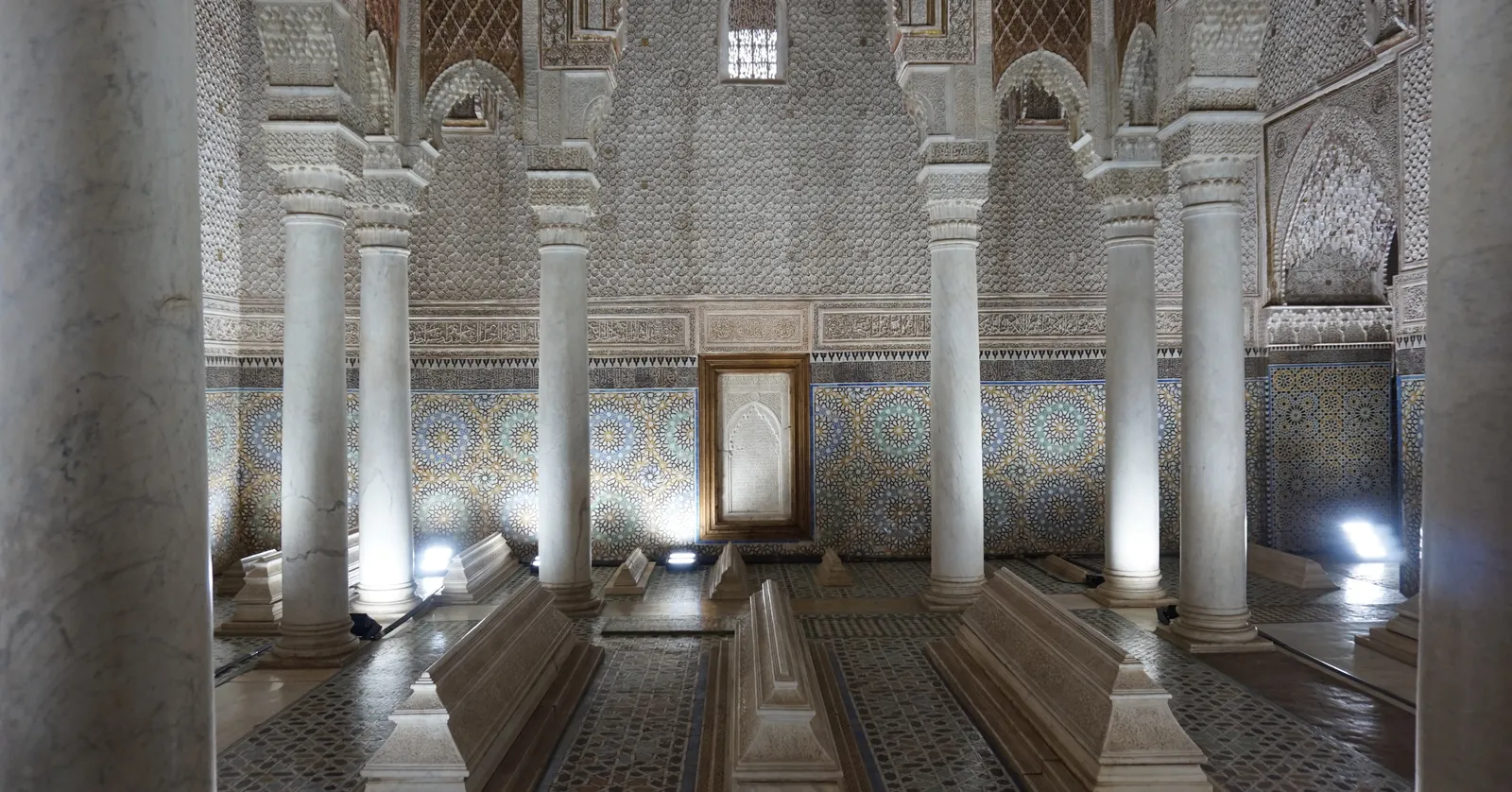
The Hall of Twelve Columns inside the Saadian Tombs
The Saadian Tombs stand against the south wall of the Kasbah Mosque, the Almohad mosque of Marrakech’s royal quarter, and they are entered from the west down a single narrow passage. The Saadian sultans buried their dead here through the 16th century, and Ahmad al-Mansur, who ruled from 1578 to 1603, built the western mausoleum that holds the best of it: the Hall of Twelve Columns, where twelve columns of Carrara marble stand in groups of three around his tomb and his family’s, under a ceiling of carved and painted cedar, with zellige and carved stucco climbing every wall. More than a hundred graves fill the halls and the garden around them. The complex was later sealed off, and it stayed out of sight until the colonial heritage service found and restored it in 1917.
You see the Hall of Twelve Columns from its doorway, a couple of people at a time, which is why the queue forms where it does; at busy times that wait alone can run 20 to 30 minutes. Recent listings put entry at 70 to 100 dirhams, cash at the gate, and it opens at 9:00 with last entry around 16:15. A guided tour of the tombs with the Bahia and El Badi palaces handles the tickets for all three if you would rather not queue for each.
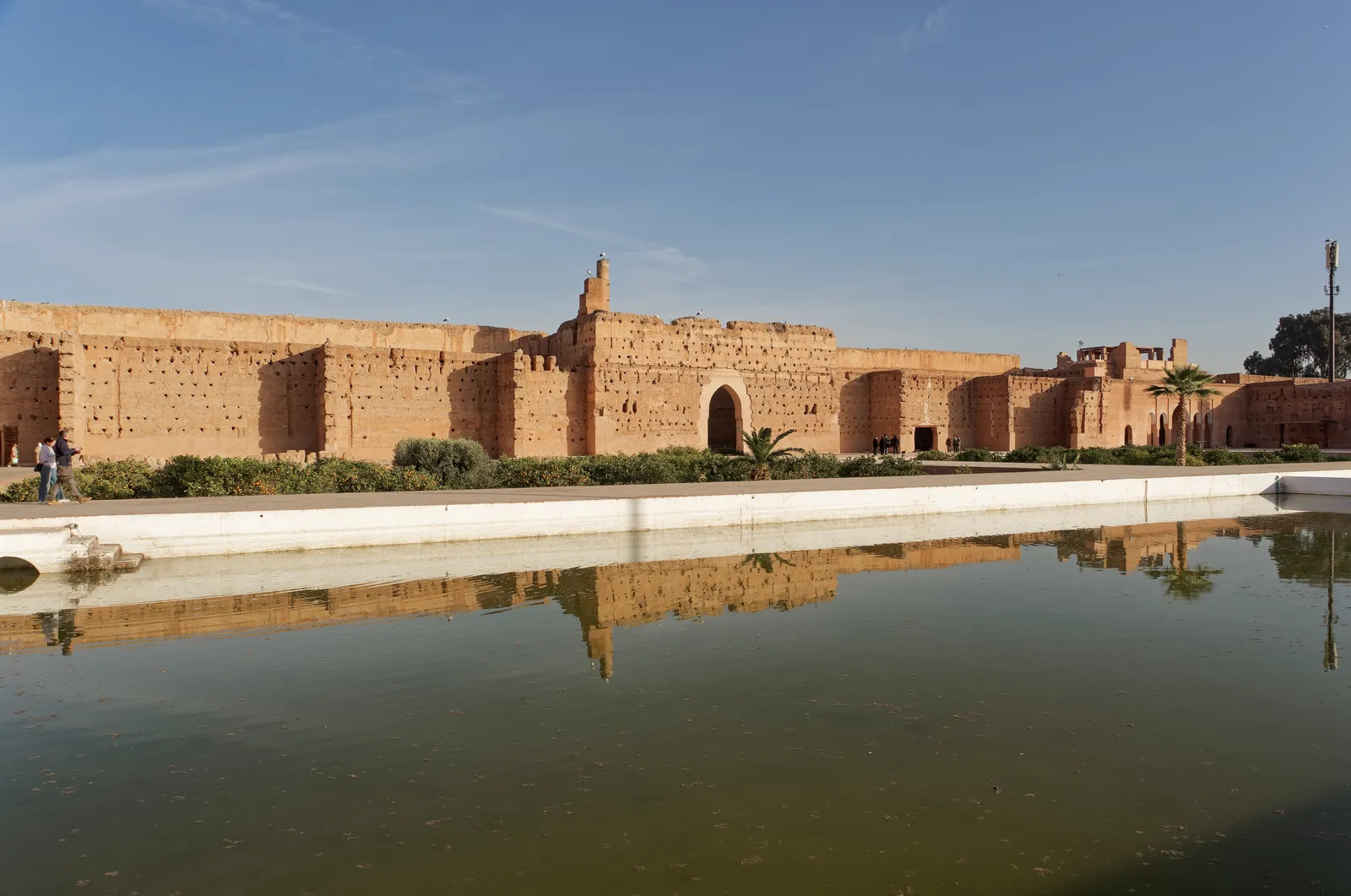
El Badi Palace, Ahmad al-Mansur’s courtyard of sunken gardens
The El Badi Palace fills a walled block on the eastern side of the Kasbah. Ahmad al-Mansur started it a few months after he took the throne in 1578 and kept building until about 1593, and at full size it was a courtyard 135 by 110 metres around a pool 90 metres long, with four sunken gardens set symmetrically around it. In 1707 and 1708 Moulay Ismail had it stripped of its marble, tiles and timber for his new capital at Meknes, and what is left is the shell: the pool, the sunken garden beds and pink earthen walls with the pavilions reduced to their footings.
Entry is 100 dirhams for a foreign adult, from 9:00 to 17:00 with last admission at 16:30, and a pavilion inside holds the minbar made in Córdoba in 1137 for the Almoravid mosque that came before the Koutoubia. A guided tour of El Badi with admission included gets you someone to explain which footing was which room.
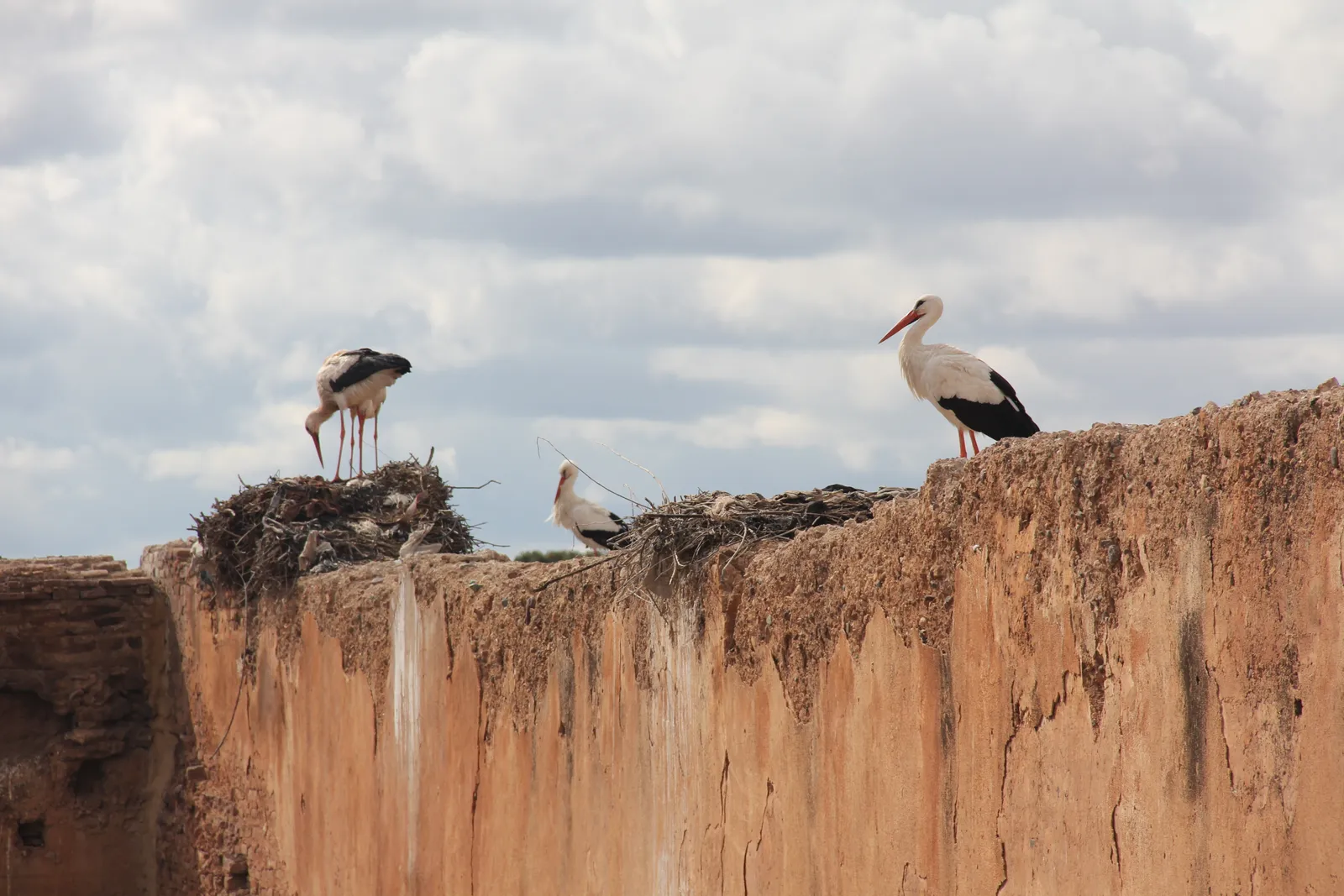
Stairs lead up onto the walls, where the terraces look across the ruin toward the Koutoubia minaret, and where white storks have nested for generations, their stick nests built along the tops of the earthen battlements.
Between the broken paving, the garden beds set several steps below the walkways and the stairs up to those terraces, El Badi is the part of the medina where wheels stop being useful, and a suitcase would spend most of the visit being carried.
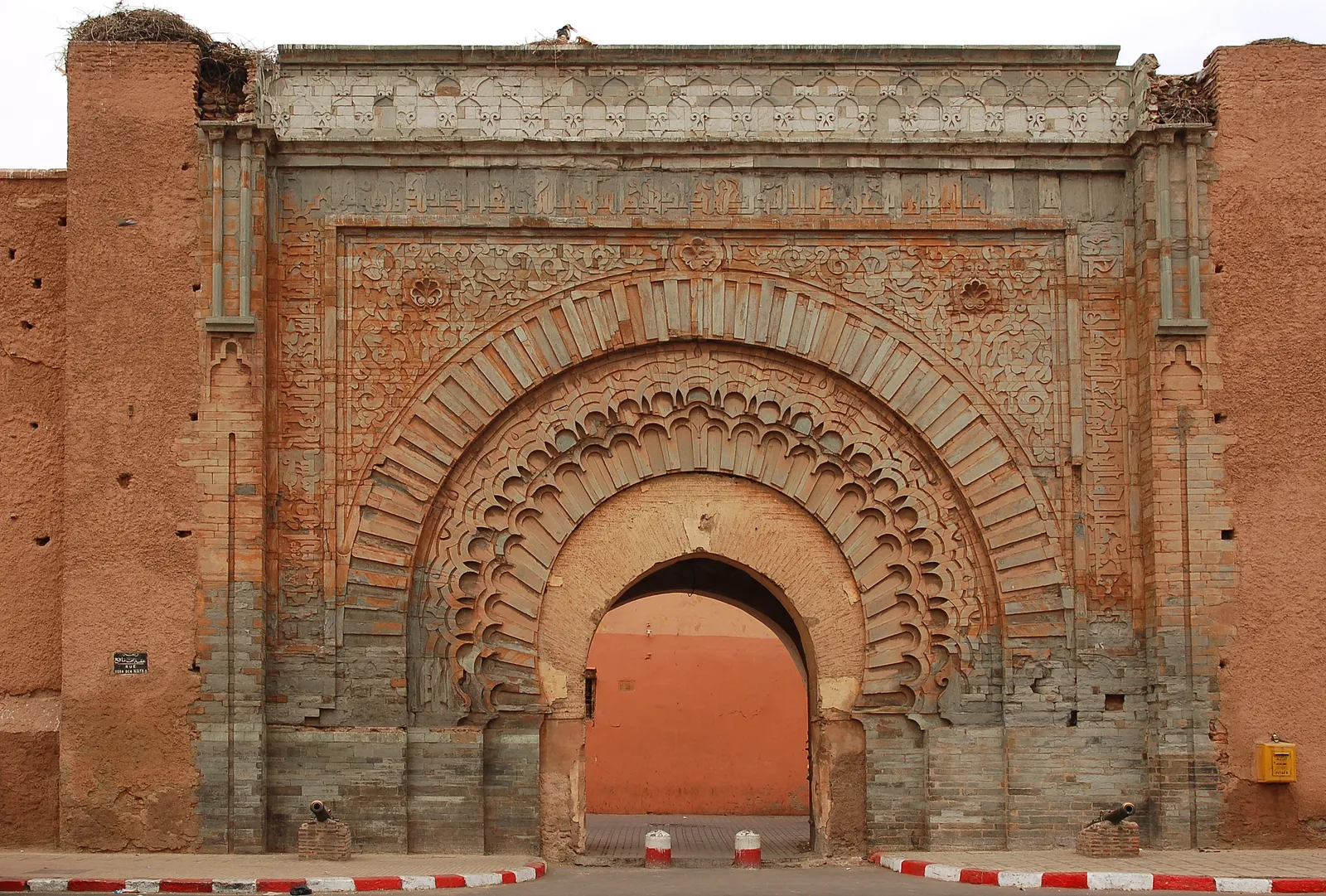
Bab Agnaou, the 12th-century gate to the royal kasbah
Bab Agnaou stands on the northern edge of the Kasbah, just inside the city walls near Bab er-Robb, and it was built as the main public entrance to the Almohad royal citadel. It was finished around 1188 to 1190 under the caliph Ya’qub al-Mansur, the same ruler who is thought to have completed the Koutoubia’s minaret. The gate is cut from sandstone, and its horseshoe arch sits inside concentric carved bands, with a long frieze of Quranic verse in foliated Kufic script running across the top and carved shells and arabesques in the corners.
It costs nothing to see from the street. Jemaa el-Fnaa is about a kilometre north, fifteen minutes on foot past the Koutoubia, which is where the main Marrakech medina walk picks up with the souks, the Ben Youssef Madrasa and the Bahia Palace.
Menara Airport is a short taxi ride south-west of the Kasbah
A petit taxi from outside the walls at Bab er-Robb makes the run to Marrakesh Menara Airport (RAK) in about 15 to 20 minutes; agree the fare or ask for the meter first. Bus 19, the airport line run by ALSA, costs 30 dirhams in cash and runs roughly every half hour between about 06:00 and 21:00 from its stop by the Koutoubia, a ten-minute walk north of Bab Agnaou. The drive is the easy part; the three-hour margin before an international flight is for the terminal itself, where bags go through a scanner at the door and again at security.
Two paid sites that close their gates in the late afternoon, one of them a ruin you climb over, fit a short morning in the Kasbah best when nothing needs to be wheeled behind you.
Frequently asked questions
What should I do during a layover near the Saadian Tombs in Marrakech?
See the Hall of Twelve Columns in the Saadian Tombs first, then walk a few minutes to the El Badi Palace, the ruin of Ahmad al-Mansur's 16th-century palace, for its sunken gardens, its storks and the 12th-century minbar kept there. Bab Agnaou, the Almohad gate to the royal kasbah, is free to look at on the way in or out. Two to three hours covers all three; both paid sites stop letting people in during the late afternoon, and the tombs are the one worth reaching early.
Why is there a queue at the Saadian Tombs?
The whole complex is entered through one narrow passage beside the Kasbah Mosque, and the best room, the Hall of Twelve Columns, is seen from its doorway rather than walked into, only a couple of people at a time. At busy times the wait for that doorway alone runs 20 to 30 minutes. At opening, 9:00, the passage is usually clear, and entry is paid in cash at the gate.
Where is the Koutoubia's minbar now?
In a pavilion inside the El Badi Palace. The minbar, the stepped pulpit from which the Friday sermon was given, was made in Córdoba in 1137 for the Almoravid mosque that preceded the Koutoubia, carved in cedar and inlaid, and it is one of the finest surviving pieces of Islamic woodwork from that period. It stays under cover in its own room, out of the sun that bakes the rest of the ruin.
Is the Kasbah quarter step-free?
The streets around Bab Agnaou and the Kasbah Mosque are flat, but the two paid sites are not. The Saadian Tombs sit at the end of a narrow passage, and the El Badi Palace is a ruin: broken paving, sunken garden beds several steps below the walkways, underground passages, and stairs up to the terraces on the walls. A wheelchair or a wheeled bag gets round the edges of the main courtyard and not much further.