Kuala Lumpur Railway Station Layover Guide
Part of the full Kuala Lumpur in One Day: The Twin Towers
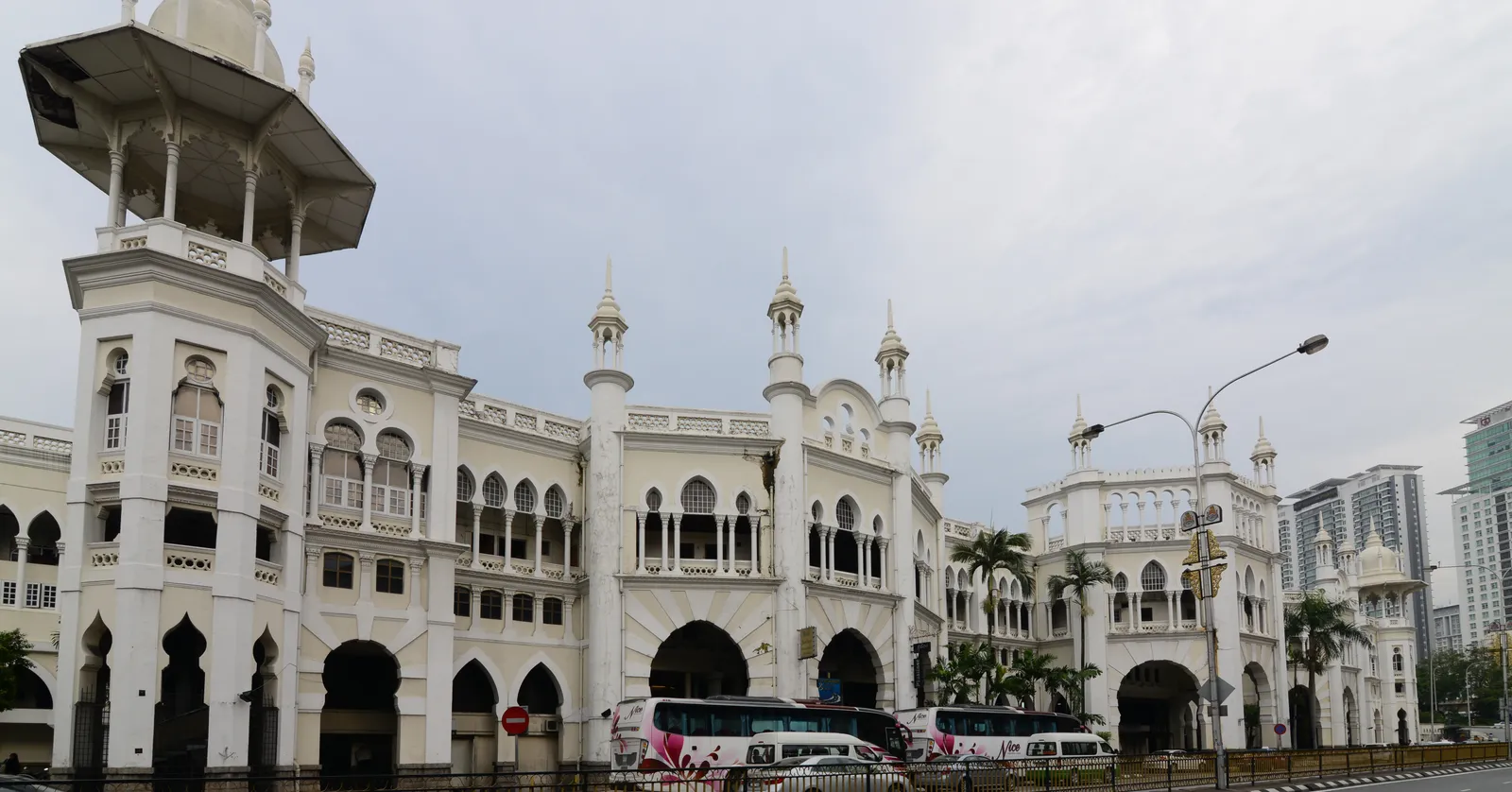
Kuala Lumpur’s 1910 railway station carries horseshoe arches and minarets over four working commuter tracks, with the railway’s own headquarters in matching style opposite and the National Mosque’s star-shaped roof a few minutes’ walk south.
Hubback put minarets on a railway station in 1910
The station opened on 1 August 1910 on Jalan Sultan Hishamuddin, and Arthur Benison Hubback drew it in the Indo-Saracenic manner the British used across Malaya: a long white frontage of horseshoe and ogee arches, small domed pavilions along the roofline, and slender minarets at the corners, none of which has anything to do with moving trains. Behind all that are three platforms serving four tracks, still in daily use.
For ninety-one years this was the city’s main station. On 15 April 2001 the newer hub opened one stop south and took the intercity services, and the facilities here were shut down one at a time after that, the Heritage Station Hotel lasting until 2011. Commuter trains still call, plus a few longer-distance services restored in 2009, and platforms 2 and 3 were raised the same year. What it is now is a very grand shelter over an ordinary local stop.
Directly across Jalan Sultan Hishamuddin, the Railway Administration Building does the same job in a different register: heavier, greyer, arcaded along its upper floors, with corner turrets and a dome over the centre. It was built as the offices of the railway whose trains ran under the white arches over the road, and it is still railway property rather than a museum, so nothing inside is open and it is a photograph from the pavement.
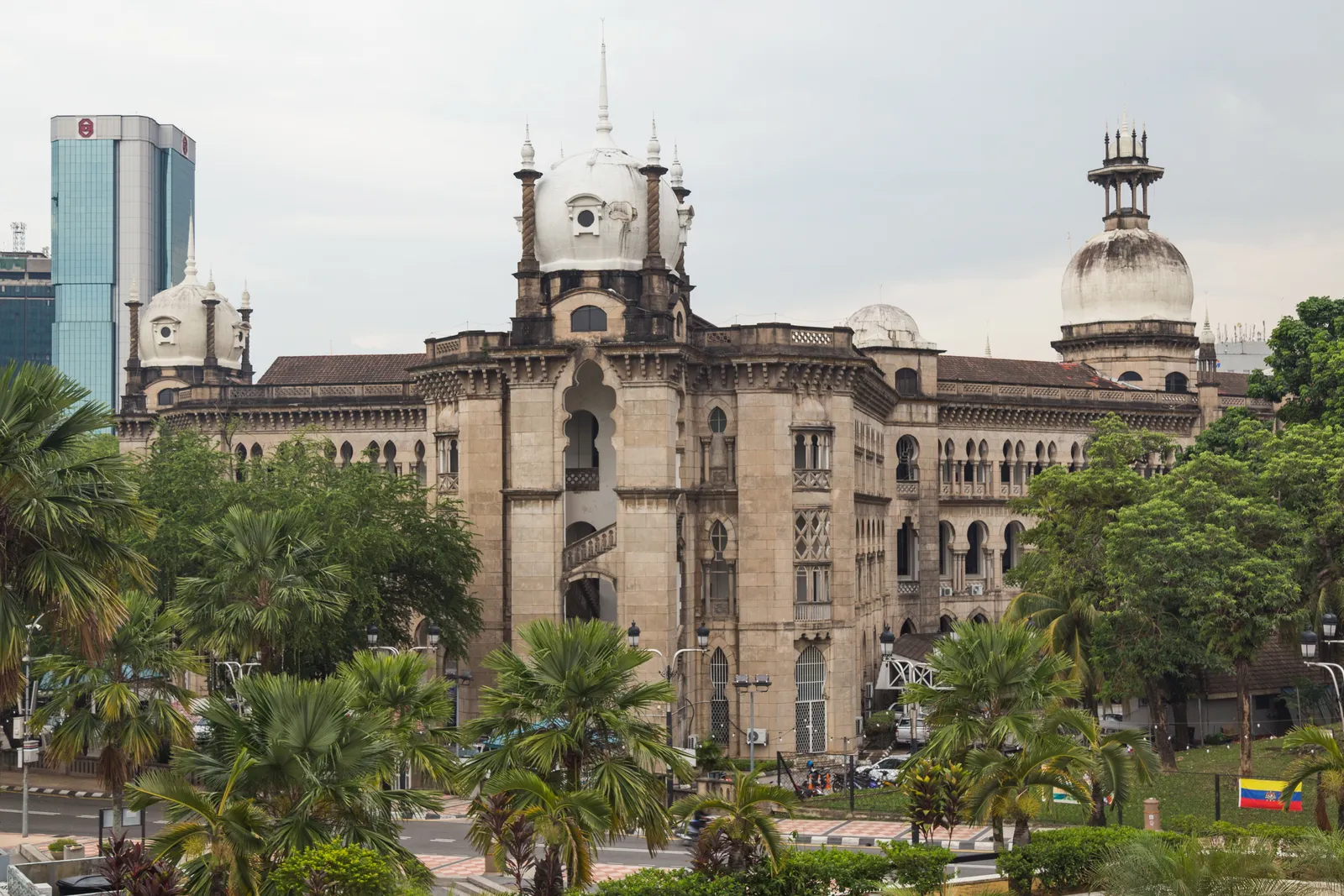
The pair together, facing off across a road, is the clearest surviving picture of what the colonial administration thought a railway ought to look like.
The National Mosque’s roof is a folded concrete star
The National Mosque stands on Jalan Perdana on the slope below the botanical garden, and it was finished on 27 August 1965 in reinforced concrete, which makes it look nothing like the two railway buildings a few minutes north of it. Its main roof is a sixteen-pointed star, folded so it sits like an open umbrella over the prayer hall, and the 73-metre minaret beside it is capped like a folded one. It holds 15,000 people and stands in thirteen acres of gardens, pools and long colonnades.
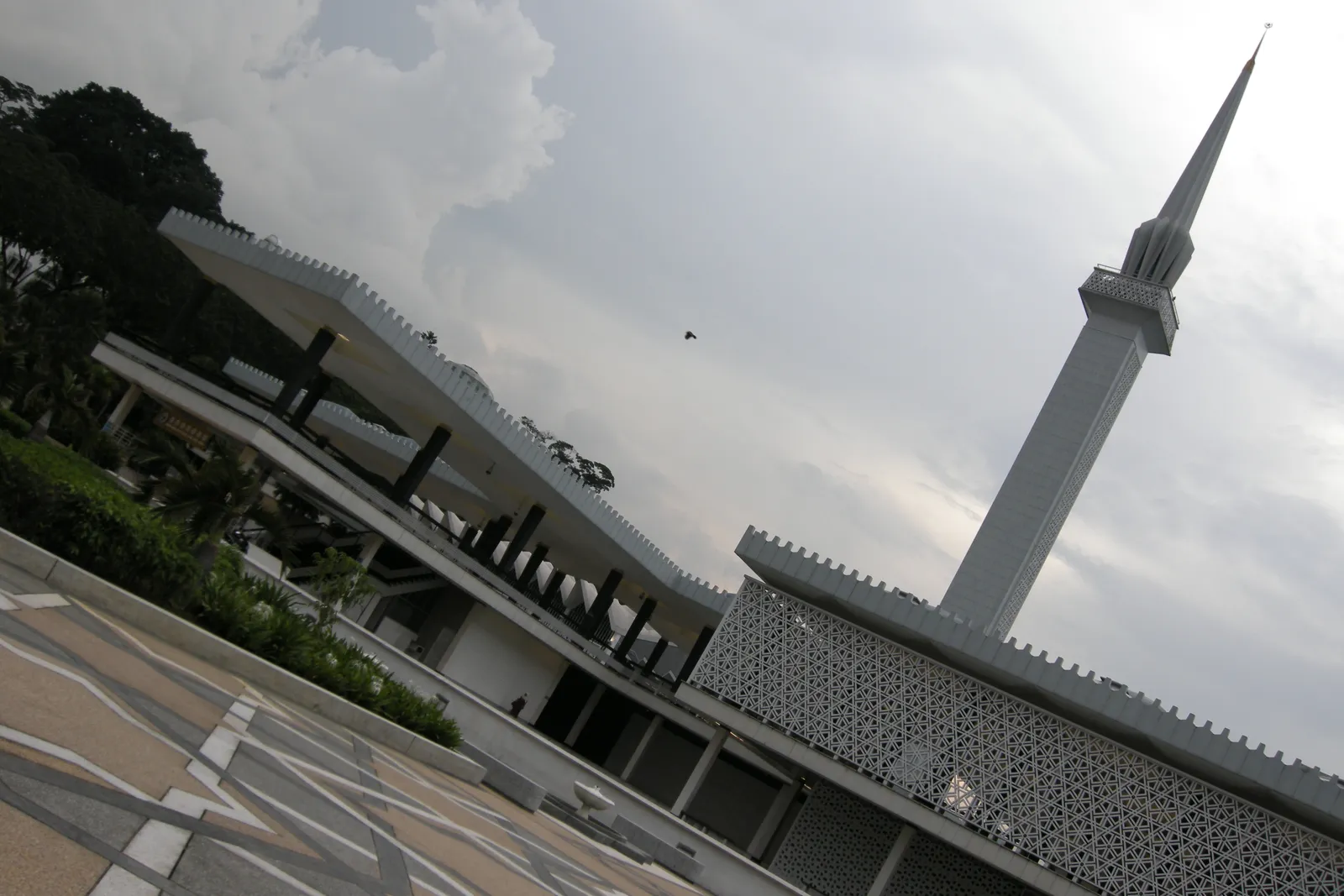
Non-Muslim visitors are welcome outside prayer times, admission is free, and volunteers run guided tours at no charge. Robes and headscarves are handed out at the entrance, so turning up dressed for the heat is expected rather than a problem, and shoes come off before the hall. The colonnades and reflecting pools around the edges take as long as the interior.
Everything the old station once offered a traveller left with the intercity trains in 2001, the hotel included, so there is no counter here to hand a bag across. That decision has to be made before you arrive rather than on the platform.
The airport train leaves from KL Sentral, not from here
Commuter trains from here reach KL Sentral in a few minutes, and KL Sentral is where the KLIA Ekspres runs from: 28 minutes non-stop to Terminal 1 of Kuala Lumpur International Airport (KUL), RM55 for an adult, every 20 minutes from 5am until midnight. Walking is also realistic, about fifteen minutes south along Jalan Tun Sambanthan, though it is uncovered the whole way.
Reckon on ninety minutes from the mosque steps to the terminal door. If the gap is longer than this walk needs, the full Kuala Lumpur route heads the other way, east across the centre to the market halls and the twin towers, which wants most of a day rather than an afternoon.
Frequently asked questions
What should I do during a layover near Kuala Lumpur railway station?
Three buildings sit within about 600 metres of the platforms and none of them charges anything. The station itself, finished on 1 August 1910 to Arthur Benison Hubback's design, runs a long white arcade of horseshoe arches under domed pavilions and minarets. Directly opposite, the Railway Administration Building answers it in heavier stone with corner turrets and a central dome. A few minutes south, the National Mosque's roof is a folded concrete star with a 73-metre minaret beside it, and non-Muslim visitors are welcome outside prayer times with robes lent at the door. Three hours is comfortable; the mosque is the one with fixed visiting windows, so check the time before you set out.
Is this the same as KL Sentral?
No, and mixing them up is the common mistake. Kuala Lumpur railway station is the 1910 building on Jalan Sultan Hishamuddin; KL Sentral is the modern hub that replaced it on 15 April 2001, one stop south. Intercity trains and the airport trains all use KL Sentral now, and the old station is served by commuter trains, with a handful of longer-distance services added back in 2009. If your ticket says KL Sentral, this is not your platform.
Can I leave luggage at the old station?
Not in any useful way. When the newer hub took over in 2001, the old station's traveller facilities were wound down one by one, including the Heritage Station Hotel, which closed in 2011. What is left is a working commuter stop with ticket gates and platforms rather than a terminus with services around it. Anything you want to leave behind has to be left elsewhere before you get here.
Can I walk around the station without a train ticket?
Yes, for the part worth seeing. The arcade along the front, the booking hall and the concourse are public, so the arches, the tiling and the domed pavilions can all be looked at without buying anything. The platforms sit behind fare gates, which is where a ticket starts to matter; the view down the length of the train shed is the one thing you give up by not having one. Ten minutes covers the outside, and it is the outside the building was designed for.