Ramses Station Layover: Downtown Cairo
Part of the full Giza and Downtown Cairo on a CAI Layover
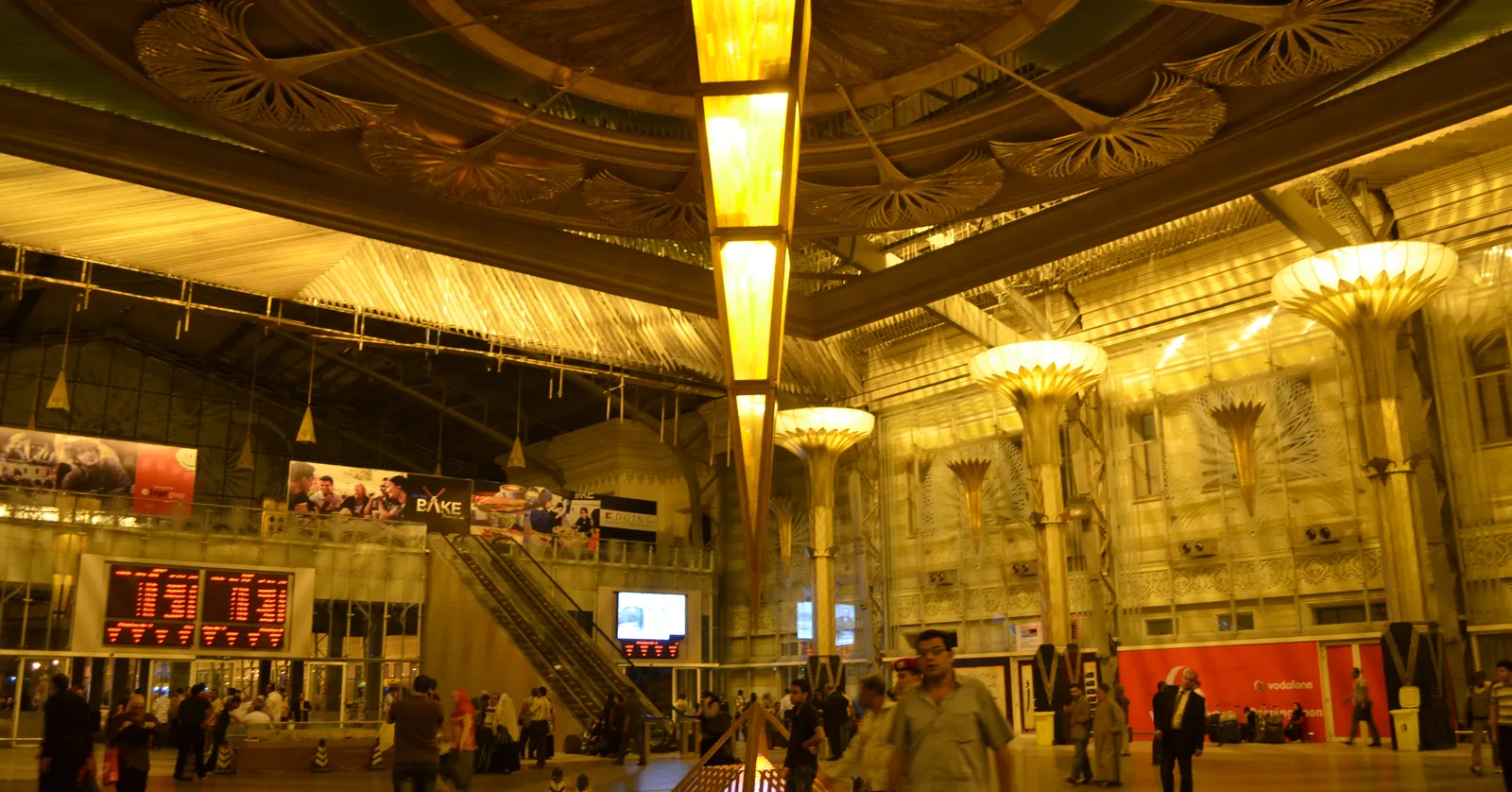
Ramses Station in Cairo has been the country’s main rail terminus since 1856, with a railway museum at its eastern end, Al-Fath Mosque’s minaret standing over the square outside, and the rococo Sakakini Palace on a traffic circle a kilometre east.
Ramses Station has been Cairo’s rail terminus since 1856
The Cairo to Alexandria line, the first railway built anywhere in Africa, reached this site in 1856, and the building standing over it now went up in 1892 and was worked over again in 1955 and 2011. Inside, the concourse is a single wide hall under a fan-patterned ceiling, with lamp standards flaring open at the top like capitals, and enough floor space that the crowd reads as busy rather than impassable.
The railway museum occupies two storeys at the eastern end of the station, reopened after a renovation, and holds more than 700 locomotives, royal carriages, scale models, maps and archive documents. It opened in January 1933, timed to an international railway conference held in Cairo that month. The hours are the thing to check: it shuts in the early afternoon, earlier than almost anything else in the city. If the day is shaped around a guided run instead, half-days covering the Egyptian Museum, the bazaar and Old Cairo start from downtown, which is the same twenty-minute radius as the station.
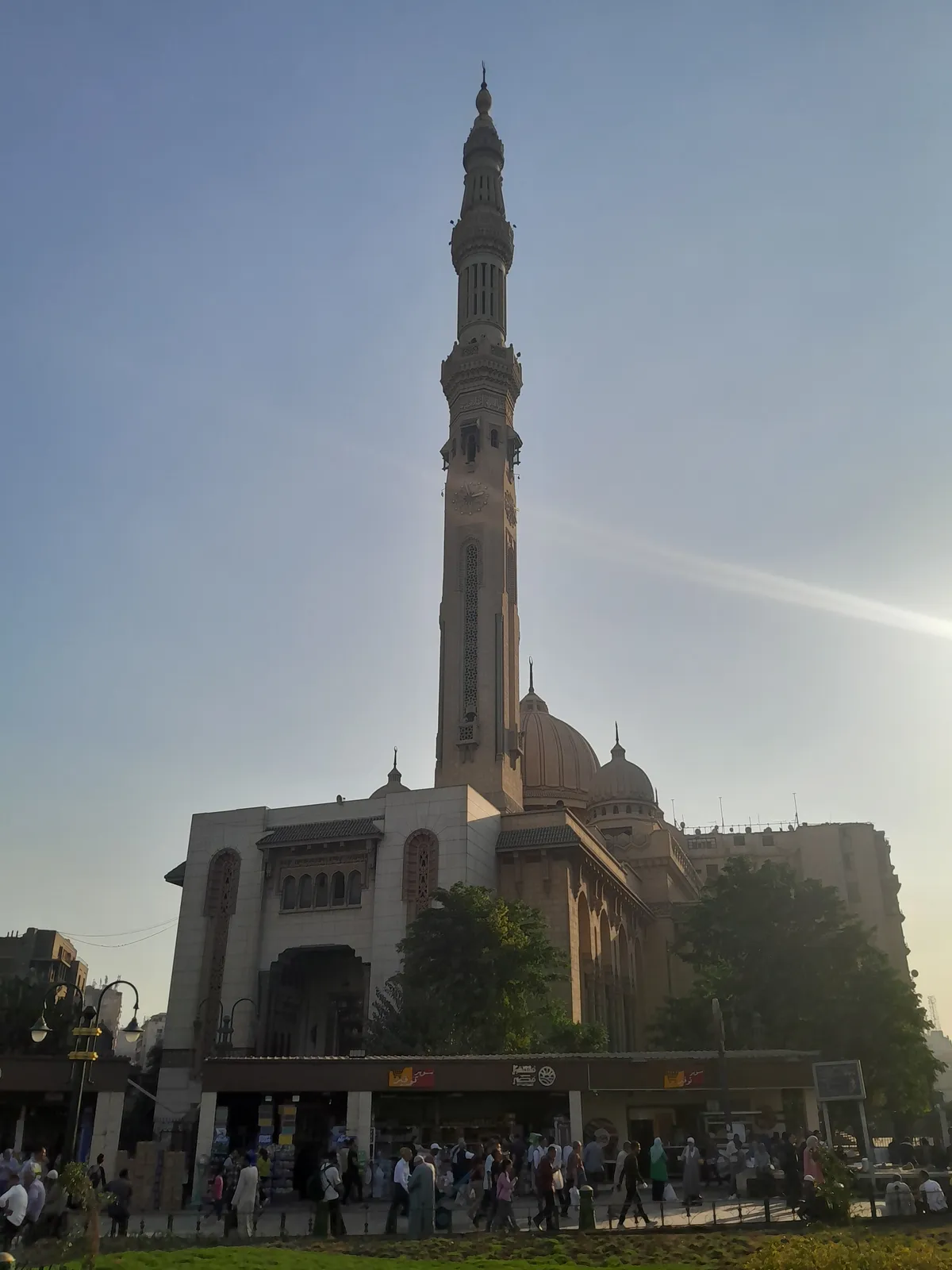
Al-Fath Mosque’s minaret stands over Ramses Square
The mosque on the eastern side of the square was inaugurated in 1990, designed by Hussein Bikri with five domes and room for 5,000 worshippers, and its minaret runs to 130 metres, the tallest in Cairo. From the pavement it reads less as a mosque than as a single vertical line going up out of a block of shopfronts, which is how most people first notice it.
The square itself is named for a statue that is no longer here. A colossus of Ramses II was brought from Mit Rahina in 1954 and set up in front of the station, then taken away again in 2006 because traffic fumes and the vibration from the road and the metro underneath were damaging it. It now stands in the entrance atrium of the Grand Egyptian Museum out at Giza. The square kept the name and lost the reason for it. Long-distance trains, the metro beneath the station and a large share of Cairo’s bus routes all meet on this one square, so the pavements around it are tight to cross with a suitcase in tow.
Sakakini Palace sits on a circle where eight streets meet
Habib Sakakini Pasha arrived in Egypt from Syria at sixteen, worked on the digging of the Suez Canal, became the wealthiest contractor in the country, and in 1897 built himself a French rococo palace in Daher, a kilometre or so east of the station, modelled on one he had seen in Europe. Every surface of it carries something: statues in niches, carved balustrades, turrets at the corners and a domed tower in the middle.
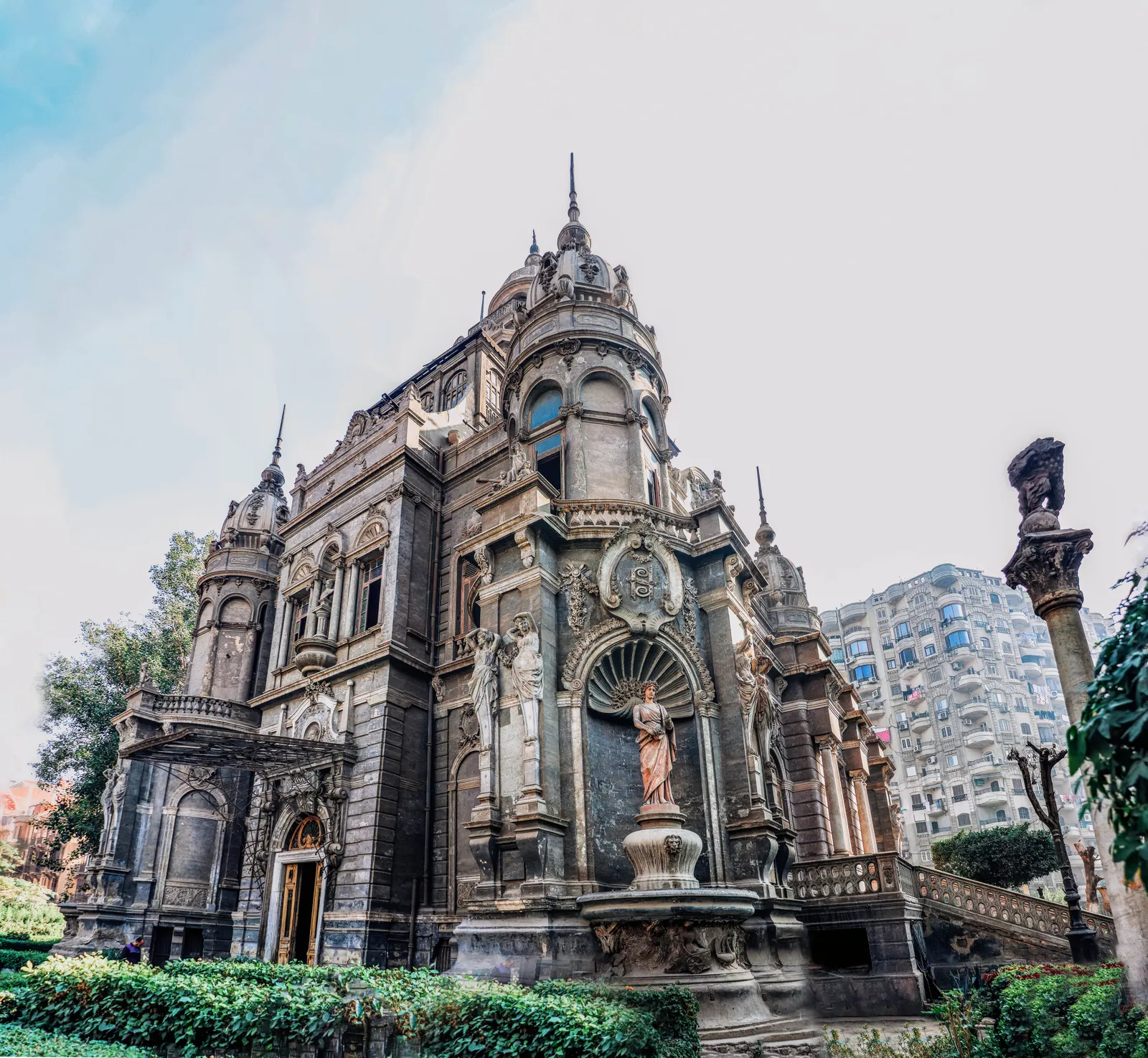
It stands alone on a roundabout where eight roads converge, which means you can walk the full circuit and see all four sides, something the dense blocks around it would never allow. Restoration work has been under way for years with a plan to reopen it as a cultural centre, and no confirmed public opening has followed, so plan on the outside.
One bus route links Ramses Square to the airport, and no train does
Cairo International Airport has no rail connection of any kind, which is the one thing that catches people out at a station this size. The 356 bus runs between the airport bus station and Midan Tahrir by way of Ramses, roughly every half hour, taking 60 to 120 minutes depending on traffic, and the 111 covers the same stretch heading towards Shubra. Fares are a few pounds in cash. A taxi or a ride-hailing car is 30 to 60 minutes when the roads are clear and much longer when they are not, which is why two hours is the sensible allowance from here.
A day that starts at this station is a downtown day by default: the museum, the square, the palace, and the bazaar two kilometres east through the Mousky if the hours stretch. Giza sits on the far side of the city, and the full Cairo itinerary is the one sized for a gap long enough to include it.
Frequently asked questions
What should I do during a layover near Ramses Station in Cairo?
Start inside the building. The railway museum at the station's eastern end holds more than 700 locomotives, royal carriages, models and maps, and it keeps short hours, so it is the piece that has to come first or not at all. Outside, Al-Fath Mosque's 130-metre minaret is the thing you cannot miss on the square, and Sakakini Palace is a kilometre or so east, a rococo mansion on a traffic circle that is worth the walk for the outside alone. With four hours or more, the bazaar is a further two kilometres east through the Mousky.
Is the railway museum at Ramses Station open, and what does it cost?
It reopened after a renovation and is back in normal operation, on the eastern side of the station rather than through the main concourse. Entry for foreign visitors runs somewhere in the 50 to 100 EGP range and photography is charged separately, a nominal amount on top. The catch is the hours: it shuts in the early afternoon rather than at five like most Cairo museums, so an afternoon arrival at the station will find it closed.
Can I get inside Sakakini Palace?
Not reliably. The building has been under restoration for years with a plan to reopen it as a cultural centre, and no confirmed public opening date has followed, so treat the interior as shut unless you find otherwise on the day. The exterior is the reason to go anyway: it sits alone on a circle where eight streets converge, so you can walk the whole way round it and see every facade, which is not true of most buildings in this part of Cairo.
Can I walk from Ramses Station to Khan el-Khalili?
You can, at about two kilometres, but it is a walk rather than a stroll. The route runs south-east to Ataba and then east along the Mousky, a continuous commercial street of shopfronts and pavement stalls that is busy at almost any hour and uneven underfoot, so allow half an hour and expect to be weaving. A taxi covers it in ten minutes when the traffic allows. The bazaar quarter at the far end is worth the effort either way.