Trogir, a Walled Island Town Near Split
Part of the full Diocletian's Palace on a Split Layover (SPU)
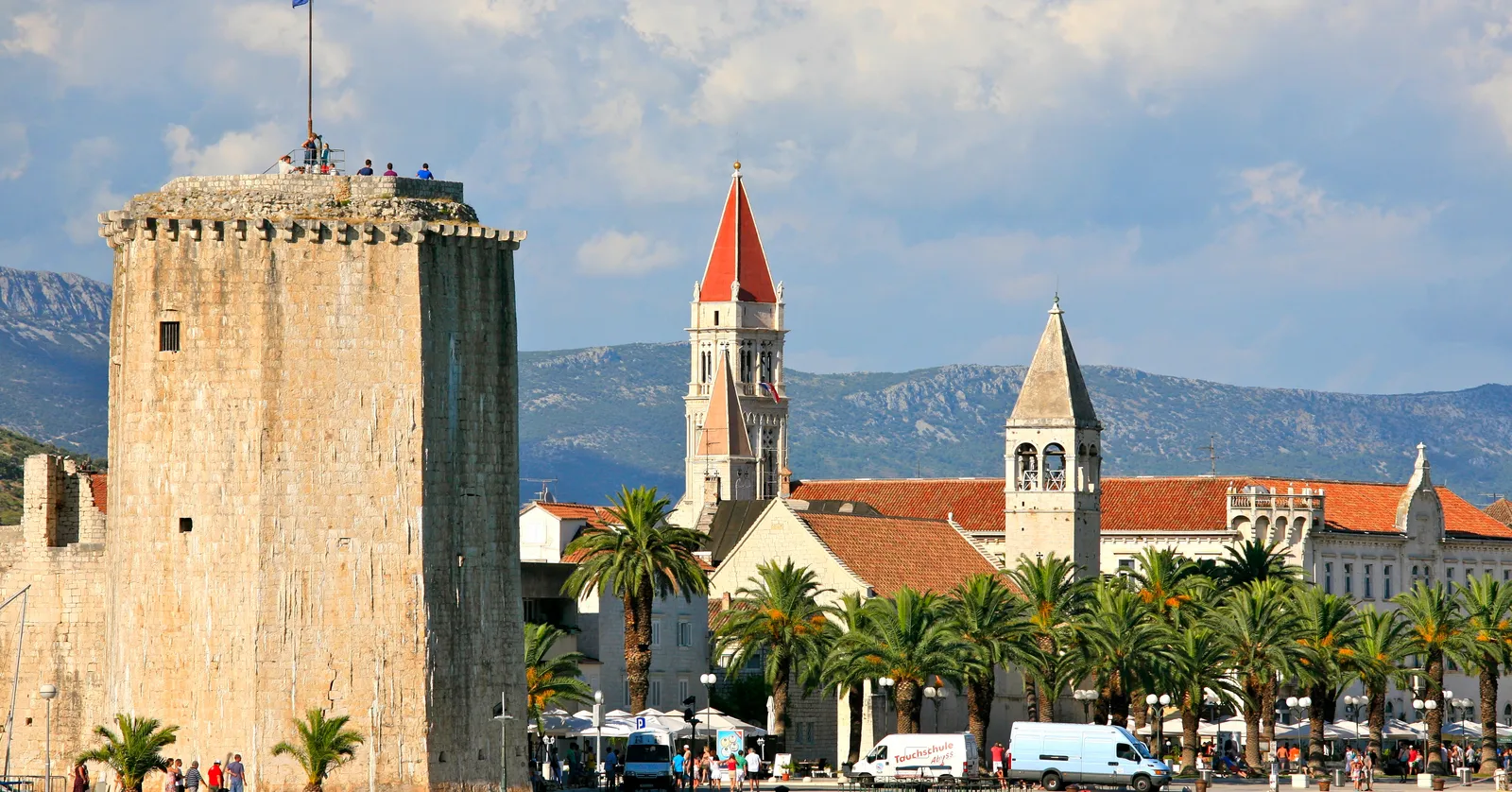
Trogir is a walled old town on a small island off the coast west of Split, and its cathedral portal, its town loggia and the Kamerlengo fortress at the far end of the island all sit within about six hectares of stone streets.
Trogir’s old town, six hectares on an island
Greek colonists from Vis founded the place in the 3rd century BC and called it Tragurion. What stands now is mostly medieval and Venetian, packed onto an island barely larger than a few city blocks, with the mainland on one side and the island of Čiovo on the other, and a bridge to each. UNESCO listed the historic centre in 1997. The practical consequence of all that history landing on such a small footprint is that nothing here is more than ten minutes’ walk from anything else, and a guided round covering the cathedral, the palaces and the fortress runs about half a day with transport from the city included if you would rather not work out the bus.
One building on the main square belongs to the Cipiko family, the Trogir nobles who also put up the fortified villa on the reef at Kaštel Stari a few kilometres back east. Their palace here is the Renaissance version of the same wealth.
The carved portal of Trogir cathedral
The west door of the cathedral of St Lawrence is the thing people come for, and it is outside, so there is no ticket to look at it. A sculptor named Radovan signed and dated it 1240, and filled the arch with concentric bands of small figures: months of the year, hunting scenes, animals, apostles, Adam and Eve on the flanking columns standing on lions.
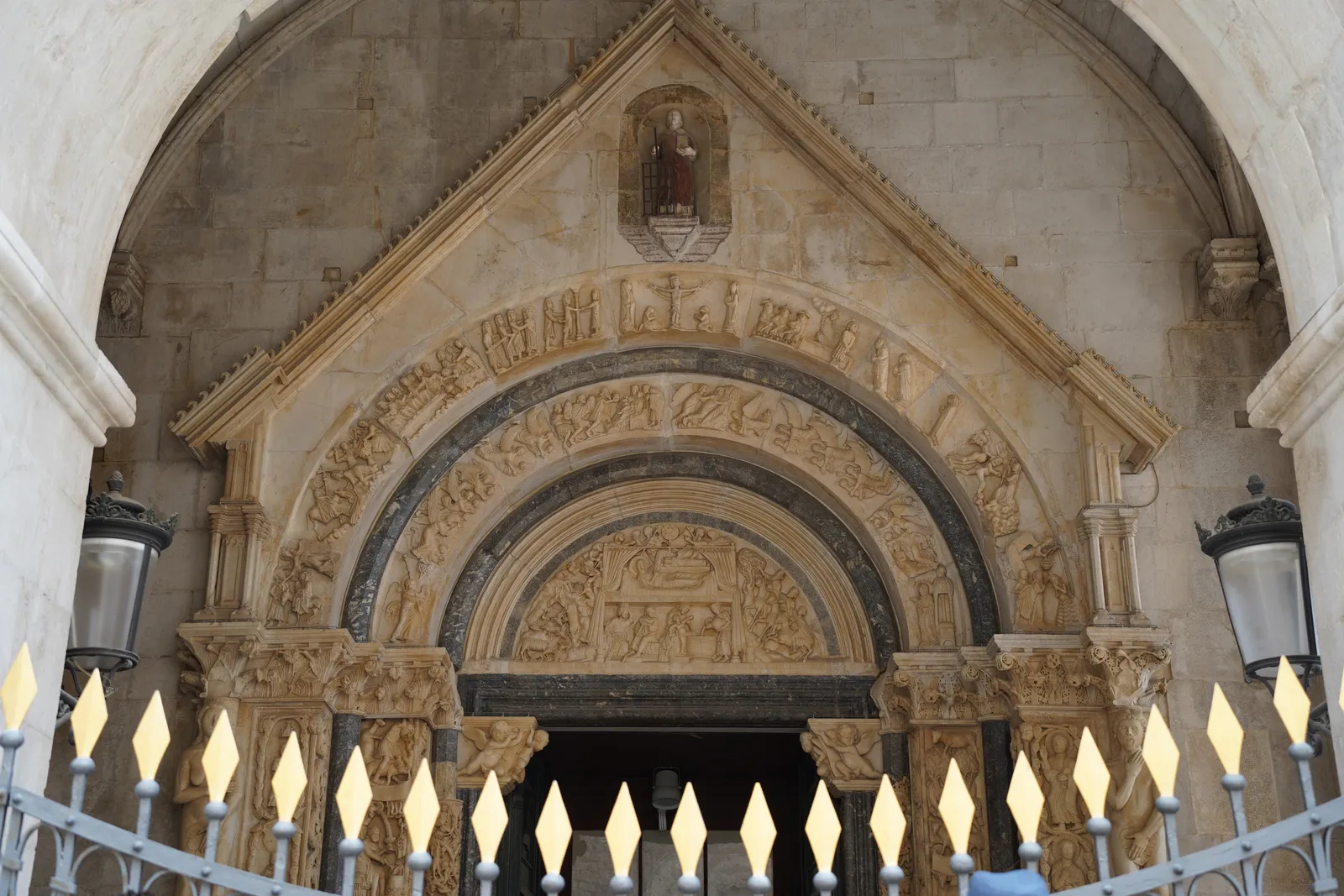
Inside is a separate ticket, and so is the bell tower, which went up over roughly two centuries and shows it: the lowest stage is Gothic, the top is Renaissance, and the styles change as you climb.
The town loggia on Trogir’s main square
Facing the cathedral across the square is a hall with no walls: a tiled roof on plain stone columns, open on every side, first built in the 13th century and rebuilt in the 15th. This was the public end of the legal system. Judgments were read out here in the open, and the stone table under the roof is where they were handed down, which is why the building has no door to shut.
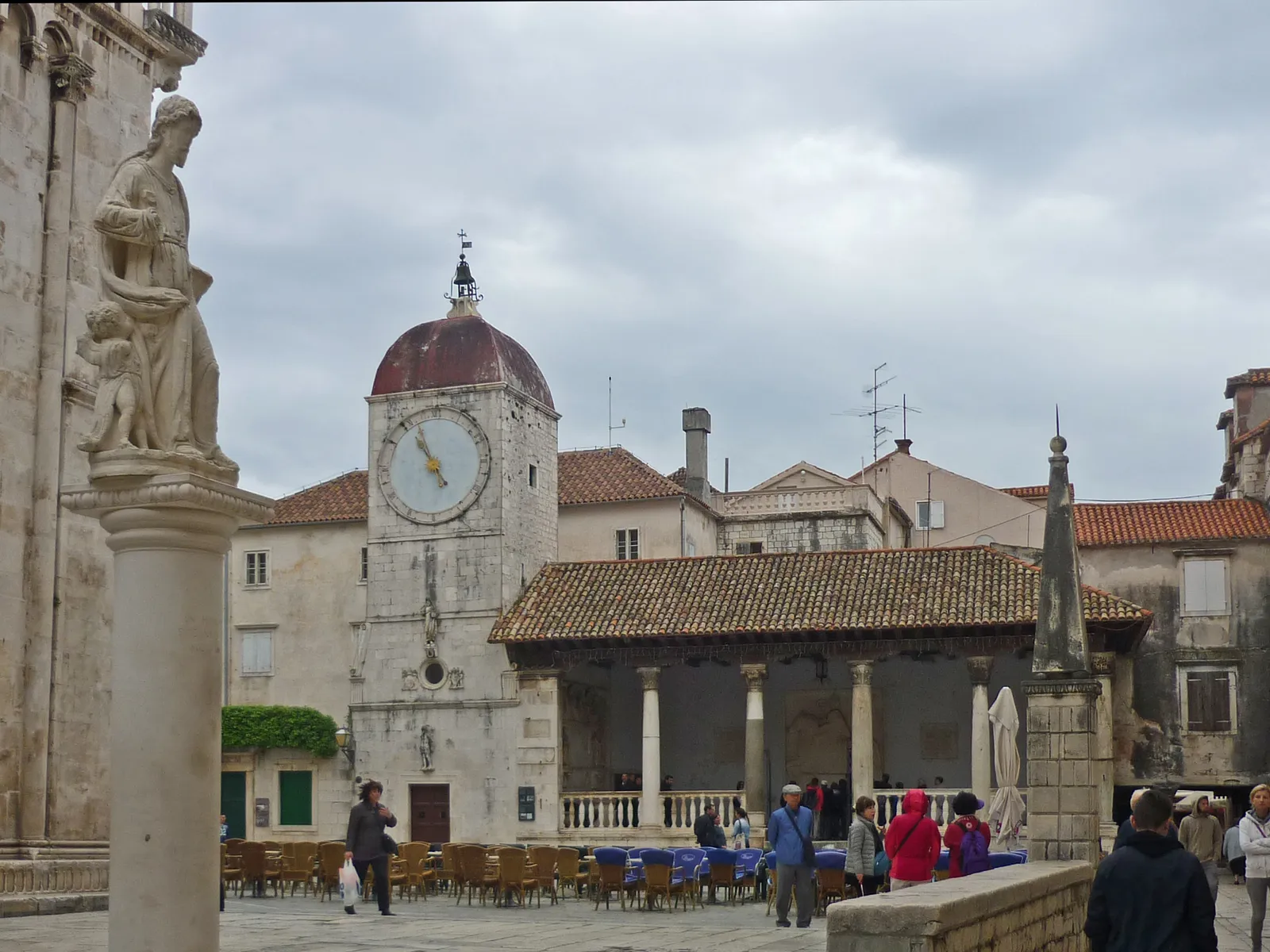
A carved relief was added to it in the 15th century, and nobody charges to stand under any of it. The clock tower next door, with its red dome, is part of the same run of civic building along that side of the square.
Kamerlengo, the Venetian fortress at the island’s west end
Kamerlengo occupies the western tip of the island, a 15th-century tower and curtain wall the Venetians built to watch the channel. The inside is essentially an empty stone shell now, which is why the town uses it for concerts and film screenings through the summer, and why the point of buying a ticket is the rampart walk rather than anything under a roof.
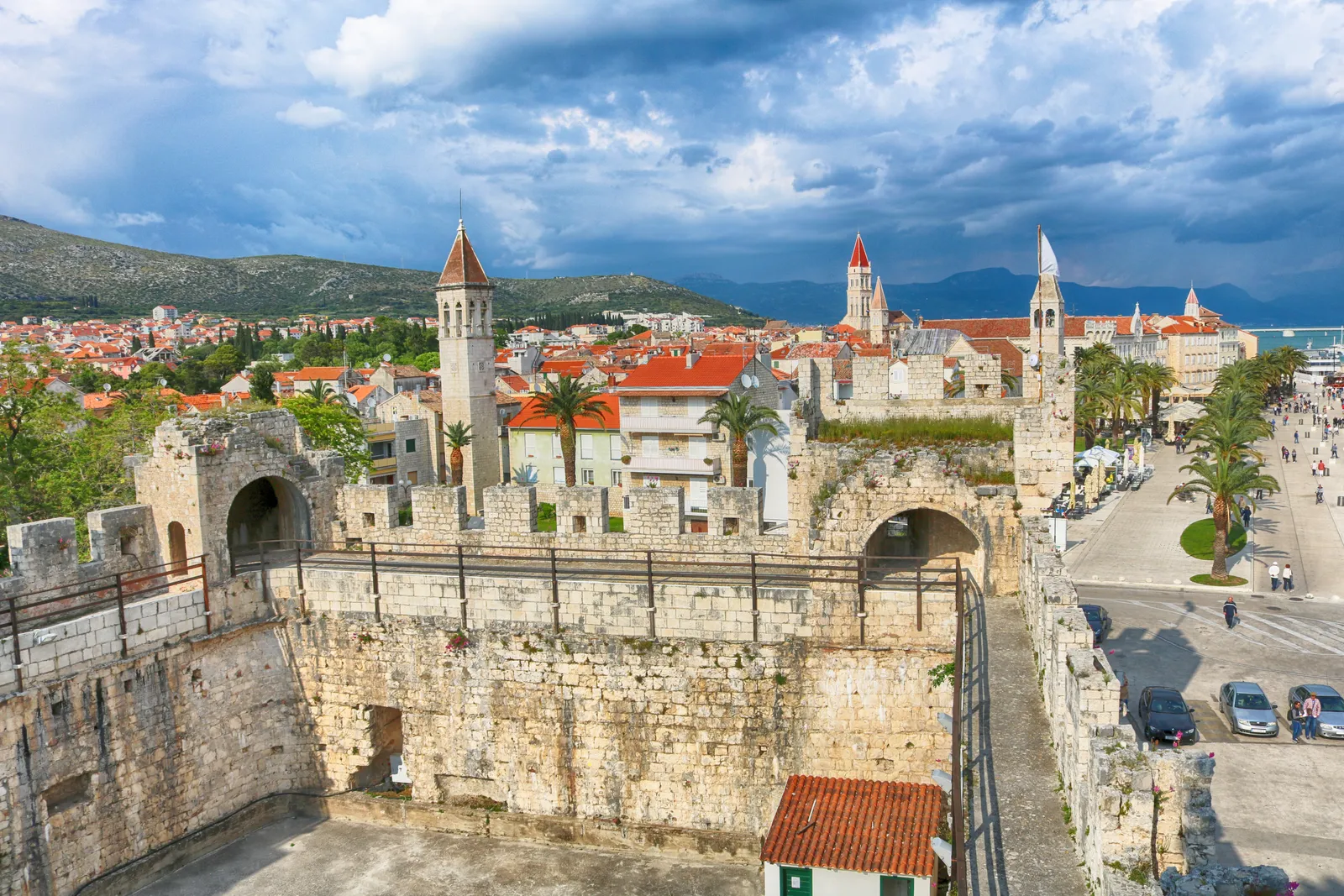
From up there the whole island reads at once: the grid of roofs, the two bell towers, the promenade along the southern edge and the boats tied along it. The waterfront below runs the length of that southern side and costs nothing to sit on.
Closer to the airport than the city is
Trogir is the stop for people who never need to reach Split at all. The airport sits between the two, closer to this end, so a connection that would not justify the run into the city and back can still cover this: everything you carry stays with you the whole time, because there is no base at either end of the trip to leave it in. That is a different calculation from the itinerary through Split’s Roman core, which assumes you have already put your suitcase down somewhere.
Promet’s line 37 is the connection, running between Trogir and Split along the Kaštela coast and passing Split Airport roughly ten minutes out from the Trogir end. It costs around 3 euros to the driver, the stop is on the main road rather than at the terminal building, and the timetable thins out on Sundays and public holidays. Allow 90 minutes at the airport after that, and treat the bus frequency rather than the walking as the thing that decides how long you can stay.
Frequently asked questions
What should I do during a layover near Trogir in Split?
Cross the bridge and walk the island. The whole old town is about six hectares, so an hour gets you round it without hurrying: the cathedral of St Lawrence with the carved doorway a sculptor named Radovan signed and dated 1240, the 15th-century town loggia on the main square, and Kamerlengo fortress at the western tip, whose walls you can climb for the view back over the roofs. Three to four hours is comfortable including the bus at each end. The streets and the waterfront cost nothing; only the bell tower and the fortress sell tickets.
Can I reach Split Airport straight from Trogir?
Yes, and this is the reason to come here rather than into the city. Promet's line 37 between Trogir and Split passes Split Airport on the way, about ten minutes from the Trogir end, and the stop is on the main road outside the airport grounds rather than at the terminal door. Tickets are around 3 euros paid to the driver, and the service thins out noticeably on Sundays and public holidays. The airport shuttle, by contrast, only runs from Split's main bus station, which is the wrong direction from here.
What costs money in Trogir's old town?
Very little of it. The streets, the squares, the waterfront promenade and the outside of the cathedral, including the carved portal, are all free and open at any hour. The cathedral interior and its bell tower are ticketed, and so is Kamerlengo fortress. The town loggia is an open structure on the square with nobody at a desk. On a tight budget, the free half is genuinely most of what there is to see.
Where does the bus stop in Trogir?
On the mainland side, at the bus station just short of the bridge, which puts the old town about five minutes' walk away across the water. The island is small enough that nowhere in it is more than ten minutes from that bridge. The streets inside are stone, flat and narrow, with no vehicles, which makes them easy on foot and awkward on wheels of any kind.