Split Ferry Port Layover: Riva and Matejuška
Part of the full Diocletian's Palace on a Split Layover (SPU)
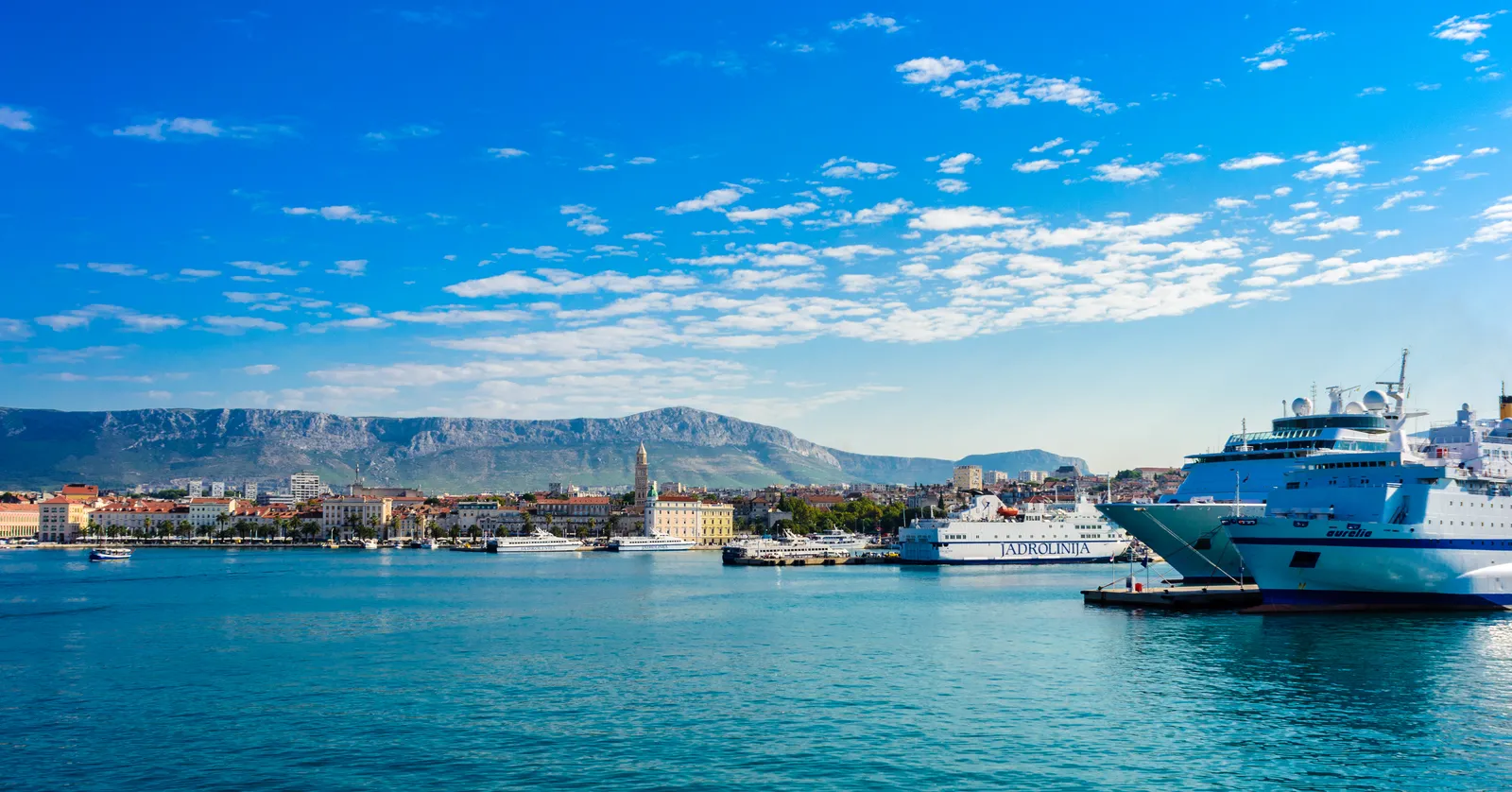
Split’s ferry port sits at the eastern end of the city’s waterfront, and the arcaded square at Prokurative, the fishing boats at Matejuška and Marko Marulić’s tomb all fall inside a fifteen-minute walk west of the berths, none of them ticketed.
Not every ferry from Split leaves from the same pier
The port spreads along several piers, and which one a boat uses depends on where it is going. International sailings, the overnight crossing to Italy among them, generally load at Gat sv. Duje, the pier the ticket office stands on. Most of the car ferries out to Brač, Hvar, Vis and Korčula go from Gat sv. Petra instead. Gat is simply the Croatian word for pier, and the departures board on the quay is the thing to read, since the berth for a given route is not fixed from one sailing to the next.
The same water carries a second kind of boat entirely. Excursion craft leave from the harbour through the day for the Blue Lagoon off Drvenik and the bays on Šolta, and a half-day speedboat run out to three islands is the version that fits a long gap rather than a whole day. It wants booking ahead, though; these are not boats you walk onto.
One practical thing about this stretch of quay: the ferry berths, the coach bays and the terminal doors all share a single narrow strip of pavement, and it fills solid in the half hour either side of a departure.
Prokurative, the arcaded square open to the harbour
Prokurative is properly Trg Republike, Republic Square, though almost nobody calls it that. Antonio Bajamonti, who ran the city for most of the second half of the 19th century, had it built as a deliberate piece of Venetian-looking townscape: three sides of two-storey neo-Renaissance arcades, the fourth left open to the sea. The central range went up in 1859, the western in the mid-1860s, and the eastern side was not finished until 1928. Bajamonti’s theatre stood here too until it burned.
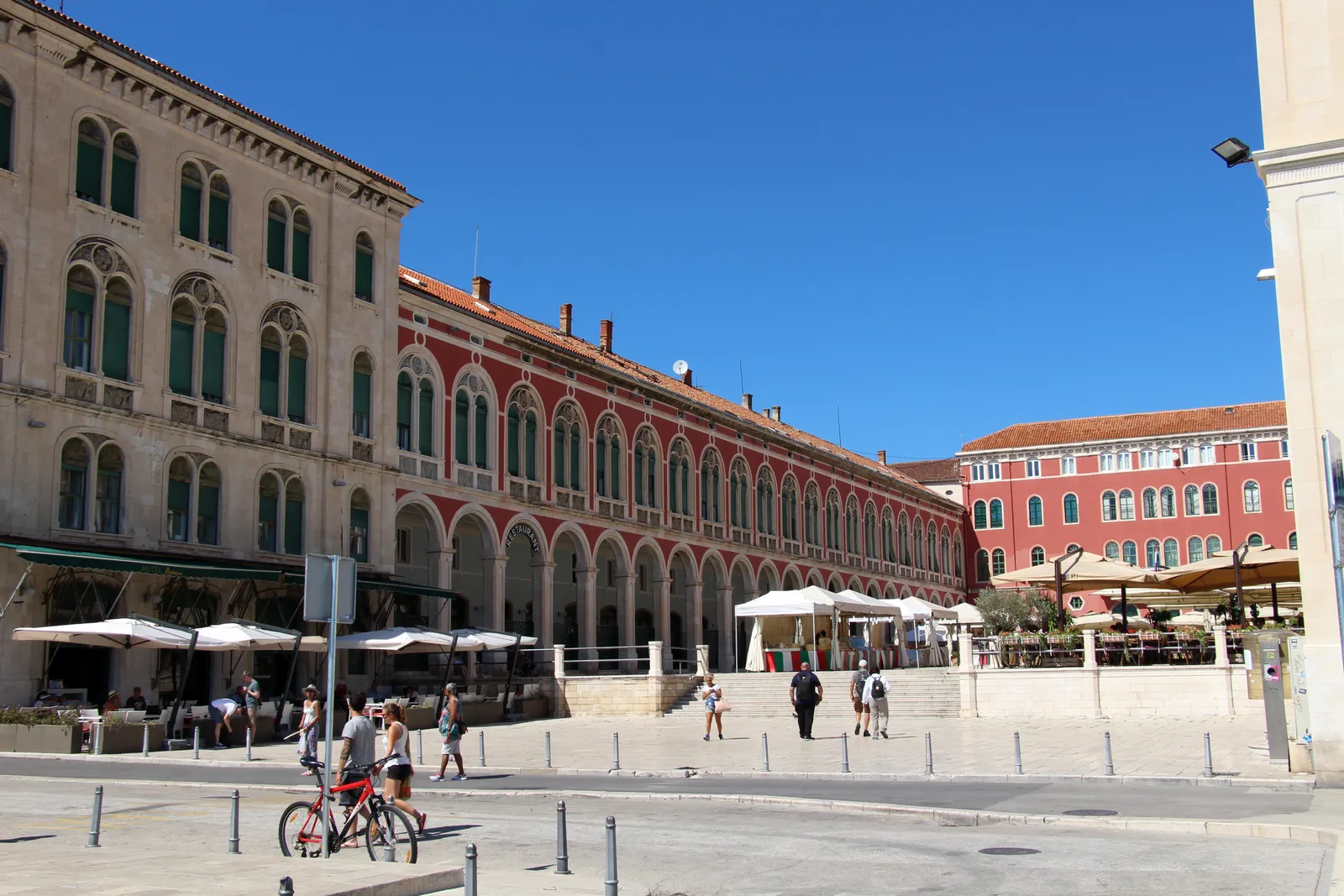
The square works as a stop mainly because it is empty in the way the Roman streets never are. The walk through Diocletian’s Palace starts a few streets east of here and is shoulder to shoulder by mid-morning in season; Prokurative, which is bigger and has nothing ticketed on it, tends not to be. It also has a summer use: the city’s song festival has been staged on this square since 1960, with the open side facing the water as the backdrop.
Matejuška, where Split’s fishing boats still moor
Matejuška is the small working harbour at the far western end of the promenade, and the boats tied up in it belong to Veli Varoš, the old stone quarter immediately behind it. Fishermen from those houses have used this inlet for centuries. It was rebuilt and tidied in the 2000s without being turned into a marina, so what is moored there is still mostly open wooden boats with outboards rather than yachts.
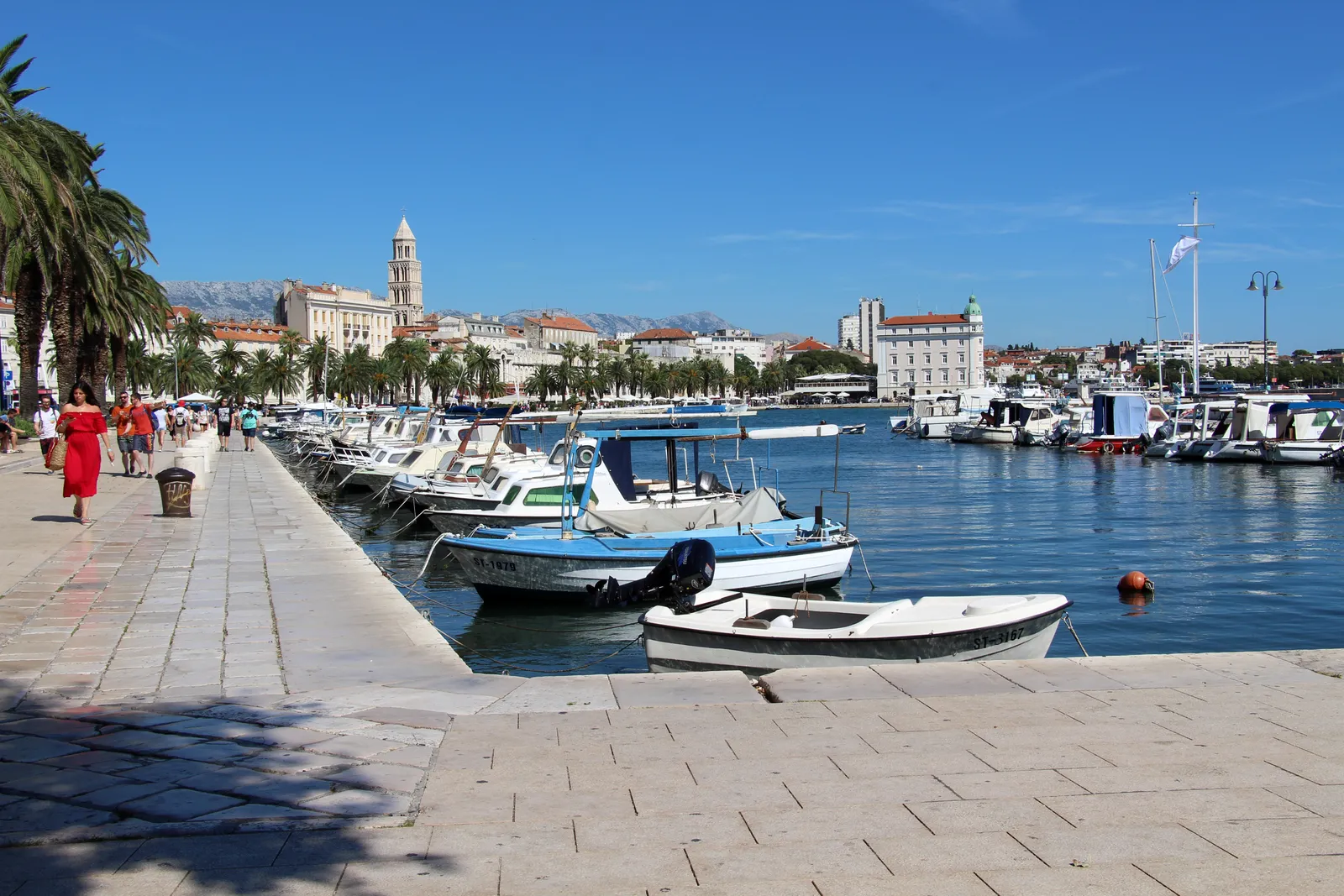
The stone steps running down to the water are the actual attraction, and they are not marked as one. In the evening they fill with people from the neighbourhood, often with a grill going and the day’s catch on it, and the city’s own tourist board describes the place in those terms rather than as a sight. Sitting on them costs nothing and nobody moves you along. It is a five-minute walk from Prokurative and about fifteen from the berths.
Marko Marulić’s tomb in the church of St Francis
The Franciscans built at the western edge of the medieval town, on ground that already held an early Christian grave, and the church that stands there now faces straight onto the waterfront. Inside it is the tomb of Marko Marulić, who died in 1524 and whose Judita was the first work of literature written in Croatian. The composer Ivan Lukačić and the poet Jeronim Kavanjin are buried here too, and Ante Trumbić’s sarcophagus in the same church was carved by Ivan Meštrović.
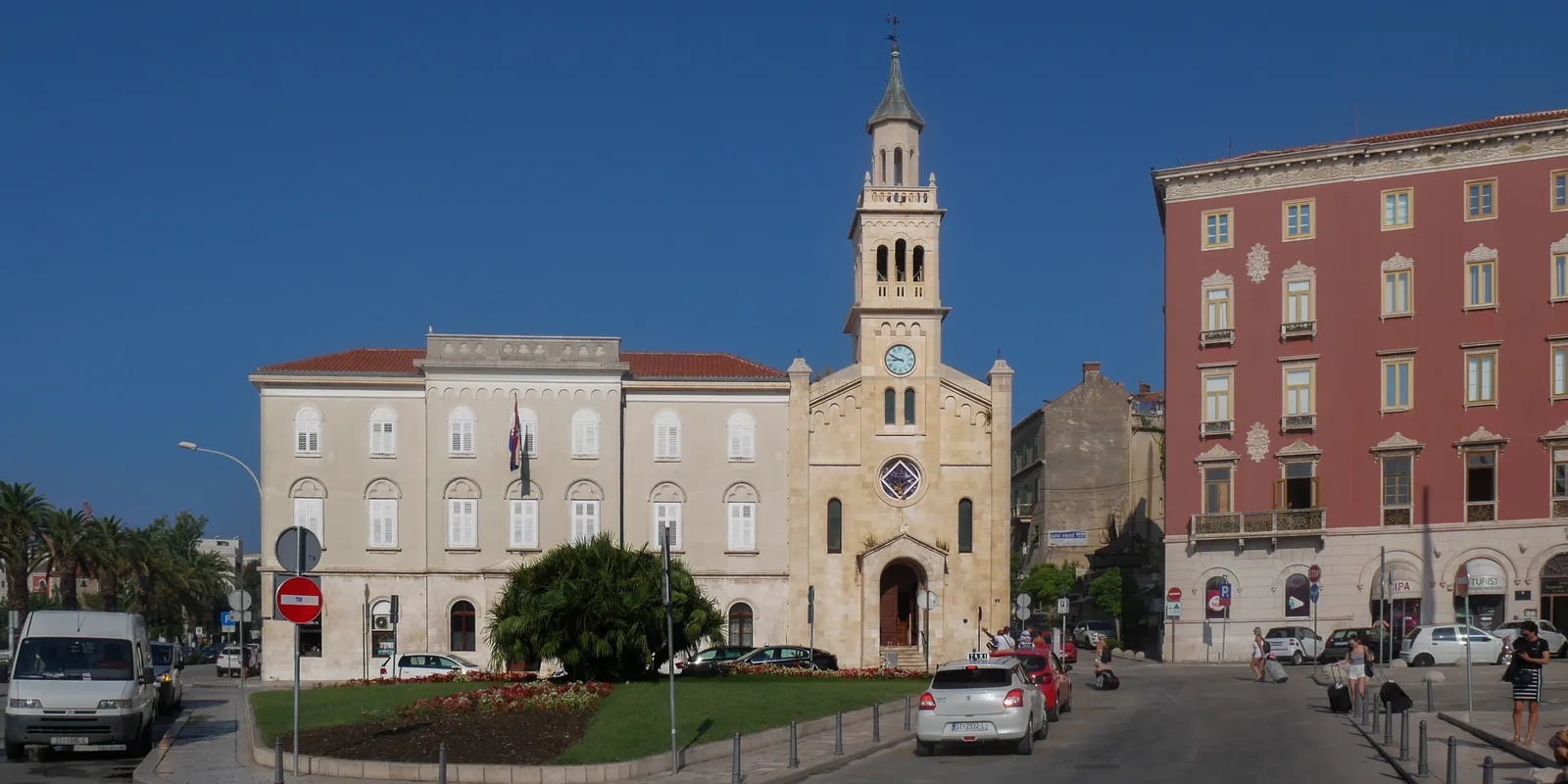
The cloister behind the church dates from the 13th century and is the quietest enclosed space at this end of town, a square of arcades around a small garden, with a monastery library of more than three thousand volumes off it. Entry is free, hours follow the working day rather than the tourist one, and it takes ten minutes to see properly.
The airport shuttle leaves from the bay behind the berths
Split Airport is about 19 kilometres west at Kaštela, and the direct shuttle to it starts from platform 1 at the main bus station, which is the building immediately behind the ferry berths. The ride is about 30 minutes with no stops, 10 euros one way and 15 for an open return, and departures are set against the flight schedule rather than a clock. Promet’s line 37, the local Split to Trogir service, costs around 3 euros paid to the driver but takes an hour or more along the coast and picks up out on the main road.
Allow about 90 minutes from collecting your luggage to standing in the check-in hall, and more in July and August. If you came in by sea and are leaving by air, this is the one spot where both happen within the same two hundred metres of quay, which makes it the sensible place to leave a suitcase while you walk west and the only place you have to come back to.
Frequently asked questions
What should I do during a layover near Split Ferry Port in Split?
Walk west along the waterfront. Prokurative, the square with neo-Renaissance arcades on three sides and the harbour open on the fourth, is about ten minutes from the berths and costs nothing to sit in. Another five minutes on, Matejuška is where Split's small fishing boats still moor, on a stone quay with steps down to the water. Between the two, the church of St Francis holds the tomb of Marko Marulić, who wrote the first literary work in Croatian. With two hours or less, that whole line of stops fits comfortably; with more, the excursion boats leaving from the same harbour run half-day trips out to the islands, though those need booking rather than turning up.
Which pier does my ferry leave from in Split?
Not all of them use the same one. The international sailings, including the overnight crossing to Italy, generally go from Gat sv. Duje, the pier where the ticket office sits, while most of the local car ferries out to the islands load from Gat sv. Petra further along. Pier is written as gat on the signs. Check the departures board on the quay rather than assuming, because the berth can move between sailings of the same route.
How far is Split's old town from the ferry port?
About five to seven minutes on foot, all of it flat. The berths sit at the eastern end of the waterfront and the Roman walls begin where the promenade does, so the palace is the first thing you reach walking west. The main bus station and the train platforms are on the same stretch of quay, within a couple of minutes of each other, which is why this end of the waterfront is the busiest part of it.
Is there anything to do near the port after dark?
This is the part of Split that stays awake. The waterfront promenade is lit and busy well past midnight in summer, the cafés along it run late, and Matejuška is where people actually gather after hours, sitting on the stone steps above the fishing boats. None of it costs anything and none of it closes. The churches and the market run the other way round: both are morning propositions, so an evening gap is better spent outdoors than trying to get inside anything.