Bogotá's Museo del Oro Station: Two Churches
Part of the full Bogotá Layover: La Candelaria From BOG
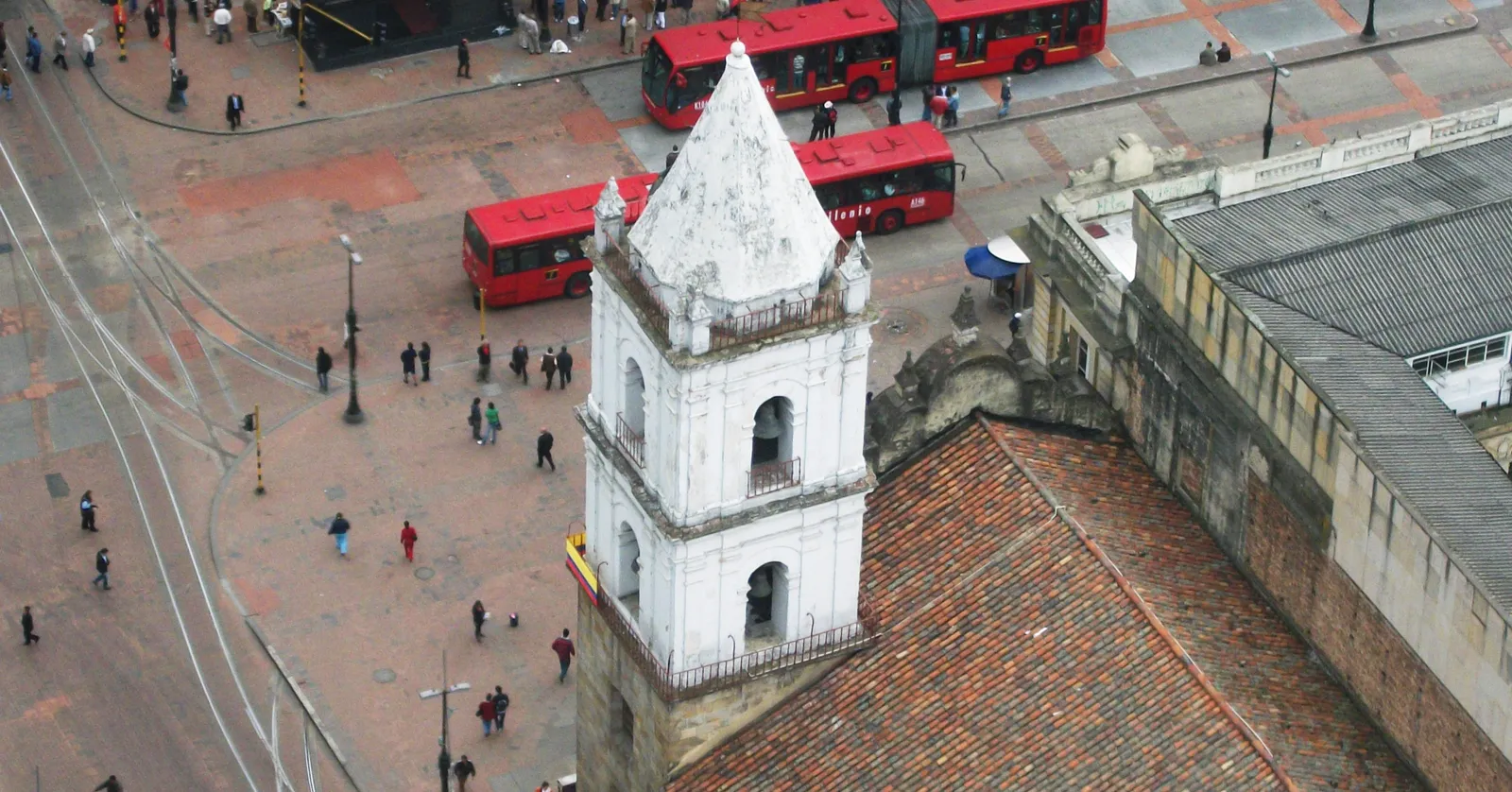
Bogotá’s Museo del Oro station stands where Avenida Jiménez meets Carrera Séptima, with the city’s oldest surviving church on one corner and the church that holds its independence dead a block north, and a channel of water running down the avenue between them.
The gold-leaf altarpiece in the Iglesia de San Francisco
Construction on the Iglesia de San Francisco started in 1557, twenty years after the Spanish founded the city, and dragged on until 1621, which makes it the oldest church still standing in the city. It occupies the corner of Avenida Jiménez and Carrera Séptima, across from Parque Santander, and from outside it is a plain white block with a squat bell tower, easy to walk past.
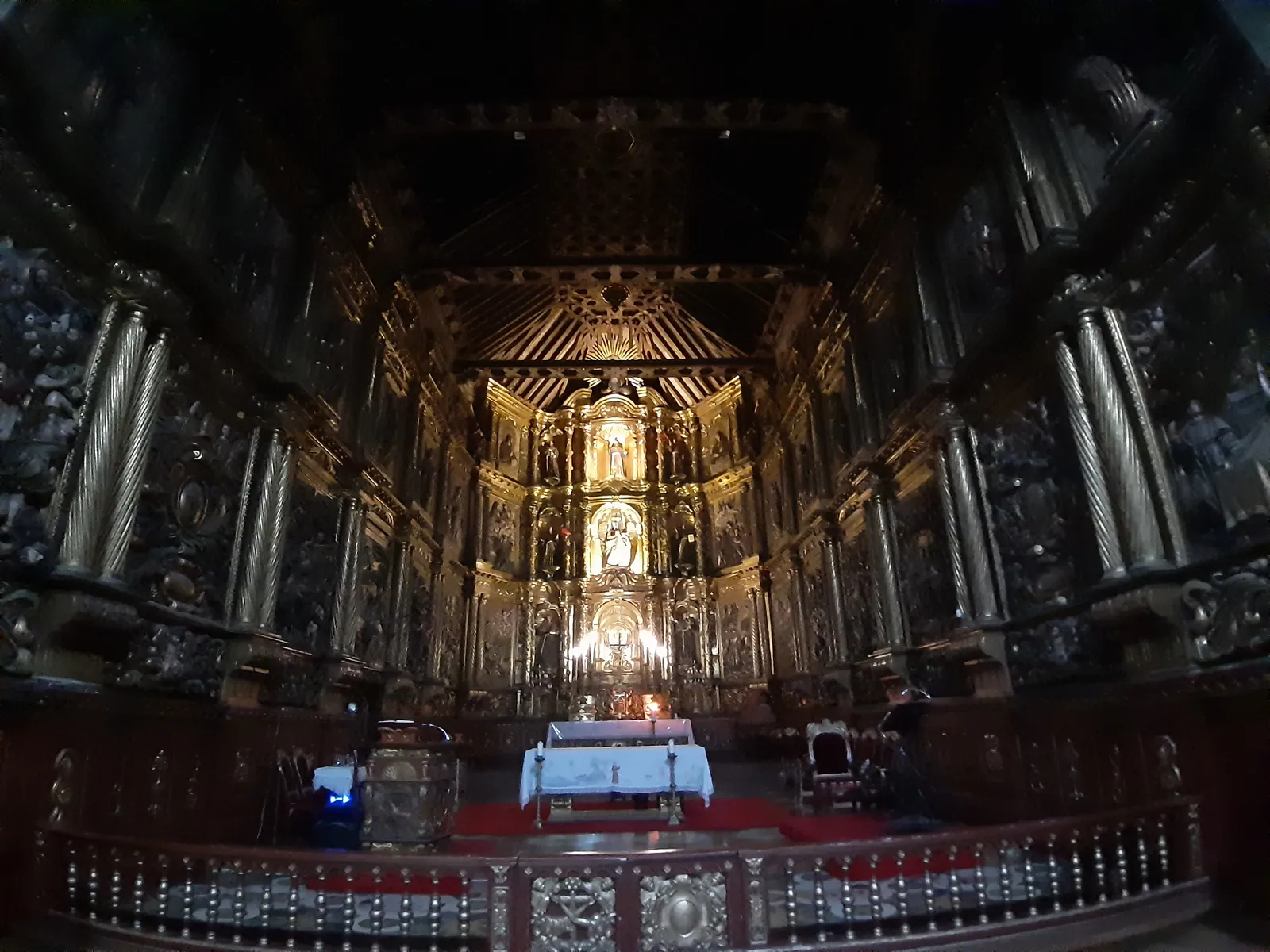
Inside is the opposite. The presbytery is filled end to end with a carved wooden altarpiece from 1623, gold-leafed over every surface, wrapping around three sides with God the Father at the top and ranks of apostles and saints below. The interior is kept dark, which does the gold no harm at all. It is a working parish church rather than a monument with a ticket desk, so services take priority over sightseeing and the quiet hours are mid-morning and mid-afternoon. If you would rather cover more of the city than one corner of it, a hop-on hop-off bus ticket picks up in this part of the centre.
Eighty independence leaders are buried under La Veracruz
La Veracruz sits on Carrera Séptima at Calle 16, a few minutes north. A plaque on its north face gives 1546 as the year the first chapel here opened, which would make it almost as old as the Spanish settlement itself.
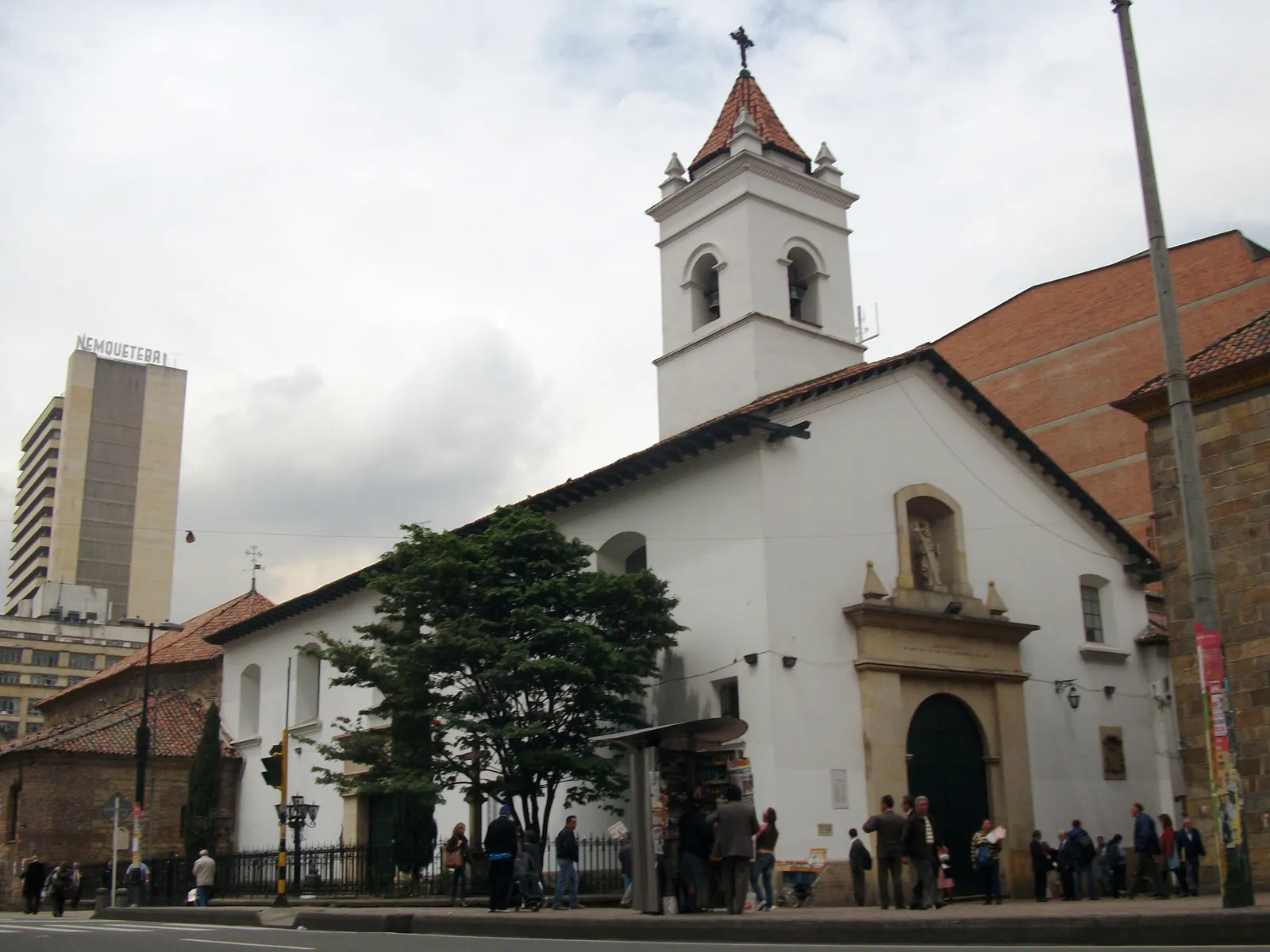
Between June and November 1816, during the Spanish reconquest, around eighty leaders of the independence movement were executed in Bogotá, and the brotherhood attached to this church took the bodies and buried them in its grave. Francisco José de Caldas, the astronomer, is among them, along with Antonio Villavicencio, Jorge Tadeo Lozano and José María Carbonell. Colombia declared the parish its national pantheon in 1910, on the centenary of independence, and a French-styled rebuilding at the same time stripped much of the original character out; a further restoration from 1959 put it back.
A river runs under Avenida Jiménez, and some of it is back on the surface
Avenida Jiménez bends where nothing else in central Bogotá does, because it follows the bed of the Río San Francisco, which the city canalised and roofed over in the 1930s. The Muisca called that river Vicachá. Rogelio Salmona’s redesign of the avenue, built under mayor Enrique Peñalosa and opened around 2000, put water back on the surface as a shallow stepped channel down the middle, with wax palms planted along it and the traffic reduced to buses.
The corner with Carrera Séptima carries ten plaques marking the spot where Jorge Eliécer Gaitán was shot on 9 April 1948; the riots that followed took out a good part of the surrounding blocks, which is why so much of what stands here now is mid-century rather than colonial. The whole corridor is open to the sky with no arcades to duck under, and Bogotá’s rain comes in the afternoon from April to May and again from October, so this is a morning walk in those months.
The airport bus does not stop on this avenue
No trunk service runs from Avenida Jiménez to El Dorado. The K86, which is the one bus that reaches the airport without a change, boards at Museo Nacional station on Carrera Séptima, about two kilometres north of here and a half-hour walk up the pedestrianised stretch of the same street. The alternative is a transfer onto the Calle 26 corridor, which is free within 110 minutes of tapping in, at 3,550 pesos for the journey on a TuLlave card.
The Museo del Oro’s own entrance is on Parque Santander, a minute from the platform, and the main Bogotá itinerary deals with the Muisca raft and the rest of that collection in detail. Leaving a bag in the centre first is worth the detour either way, because the avenue’s water channel is stepped rather than ramped along much of its length.
Frequently asked questions
What should I do during a layover near Museo del Oro station in Bogotá?
Start with the Iglesia de San Francisco on the corner of Avenida Jiménez and Carrera Séptima, the oldest surviving church in the city, for the gilded seventeenth-century altarpiece that fills the whole presbytery. La Veracruz, a block north at Calle 16, is where around eighty independence leaders executed in 1816 were buried, and has been the national pantheon since 1910. In between, the avenue itself is worth the slow walk, with a water channel running down the middle of it where a river used to. Three hours covers all of it without hurrying; anything longer and you would want to push uphill instead.
Why is there a water channel running down the middle of Avenida Jiménez?
Because a river runs underneath it. The Río San Francisco, called Vicachá by the Muisca, was canalised and covered over in the 1930s, and the avenue follows its old course, which is why it bends where the rest of the grid does not. Rogelio Salmona's redesign, built under mayor Enrique Peñalosa and opened around 2000, put a shallow stepped channel of water back along the surface and planted wax palms beside it. The result is a pedestrian and bus corridor rather than a road.
What is the memorial at Carrera Séptima and Avenida Jiménez?
Jorge Eliécer Gaitán, the Liberal presidential frontrunner, was shot on that pavement on 9 April 1948 as he left his office. The mob that formed killed his assassin within minutes, and the rioting that followed, the Bogotazo, gutted a large part of the centre and opened the decade of civil conflict known as La Violencia. Ten plaques mark the spot now, set into the ground and the wall at the corner, and most people walk over them without looking down.
Does the rain here ruin the walk?
It can, because this stretch is open ground with almost no shelter: the avenue is a bus corridor and a promenade, not a street of arcades. Bogotá's wetter months run roughly April to May and again October to November, and showers tend to arrive in the afternoon, so a morning start is the lever you have. Both churches are indoors and warm, and the Museo del Oro a minute away is the obvious place to sit out an hour of it.