Union Passenger Terminal, New Orleans Layover
Part of the full New Orleans Layover: French Quarter From MSY
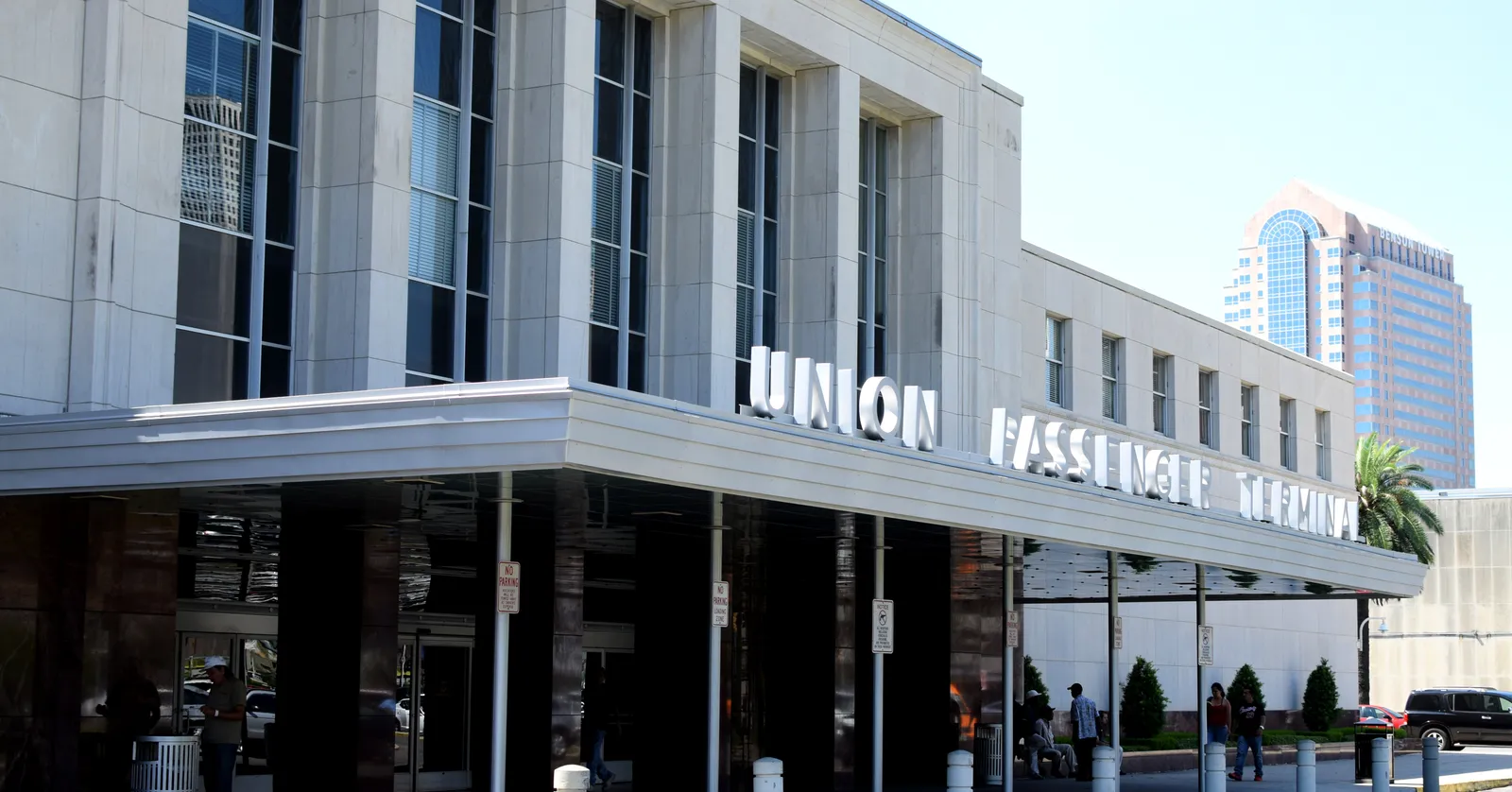
New Orleans Union Passenger Terminal carries four painted panels of Louisiana history across its waiting hall, and the streets east of it hold Gallier Hall’s marble front on Lafayette Square and a neon-lit postmodern piazza mid-block off Poydras, none of them ticketed.
The 1954 waiting hall at Union Passenger Terminal
Five separate railway stations served New Orleans before this building opened, one for each company that reached the city, and consolidating them into a single terminal at 1001 Loyola Avenue took from the design work of 1949 to the opening in 1954. Wogan and Bernard drew it with Jules K. de la Vergne and August Perez and Associates, in the flat, low, aluminium-lettered idiom of the moment, and it arrived just as the passenger trains it was built for began to disappear. Greyhound moved in during the 1970s, shortening two platforms to fit, so trains and intercity coaches now share one concourse.
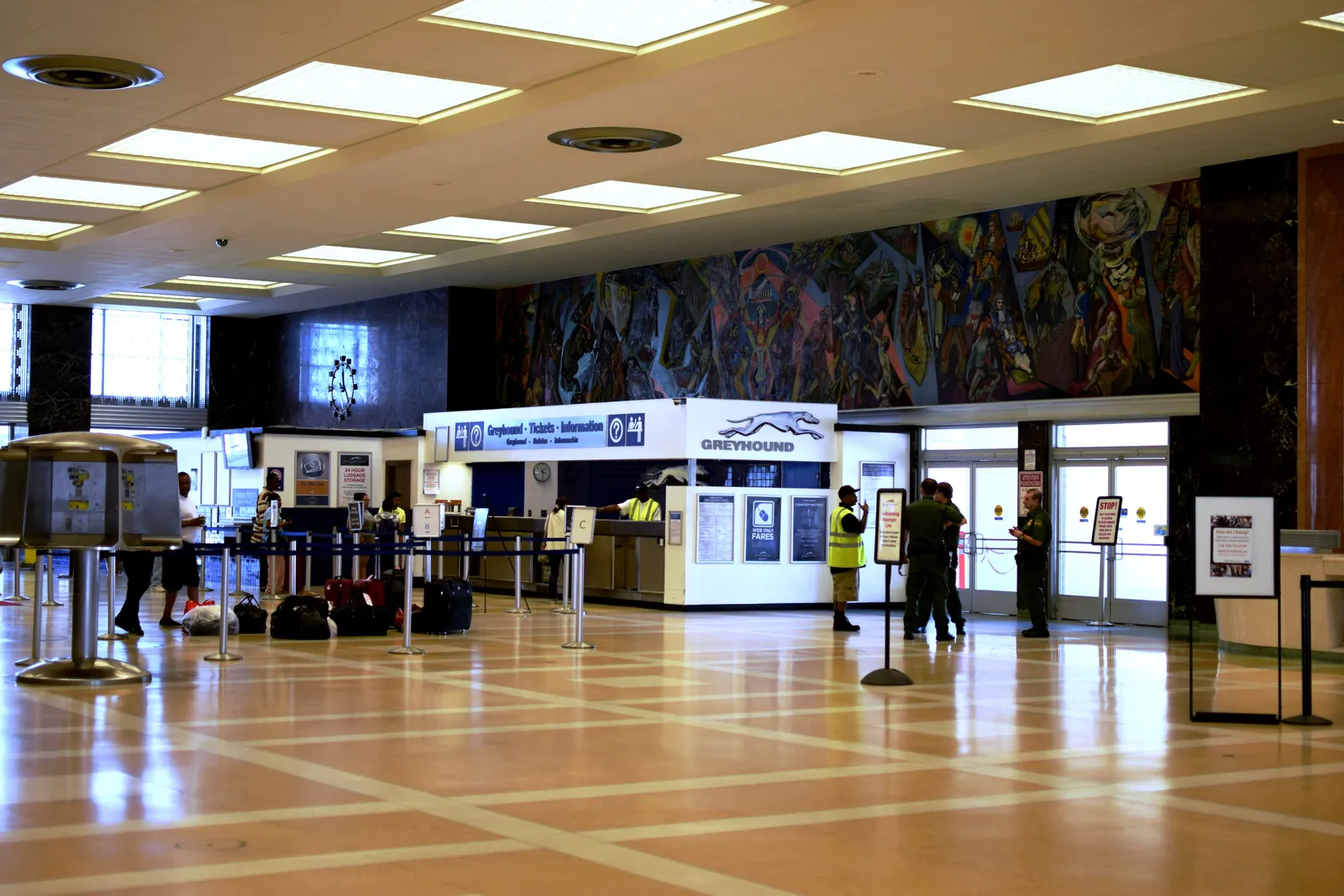
What is worth a few minutes before you leave is the painting. Conrad Albrizio, who taught the first painting classes at Louisiana State University, took the commission in 1951 and worked with James Fisher on four fresco panels, each over sixty feet long, running the walls of the hall: exploration, colonisation, conflict, and the modern age, in angular blocks of colour with dying soldiers, enslaved workers and nuclear scientists all in the same frame. It was his last fresco, and it was restored after Hurricane Katrina. If walking is not what you want out of the next few hours, a hop-on hop-off sightseeing bus can be booked in advance through a tours and activities platform and covers the same downtown ground sitting down.
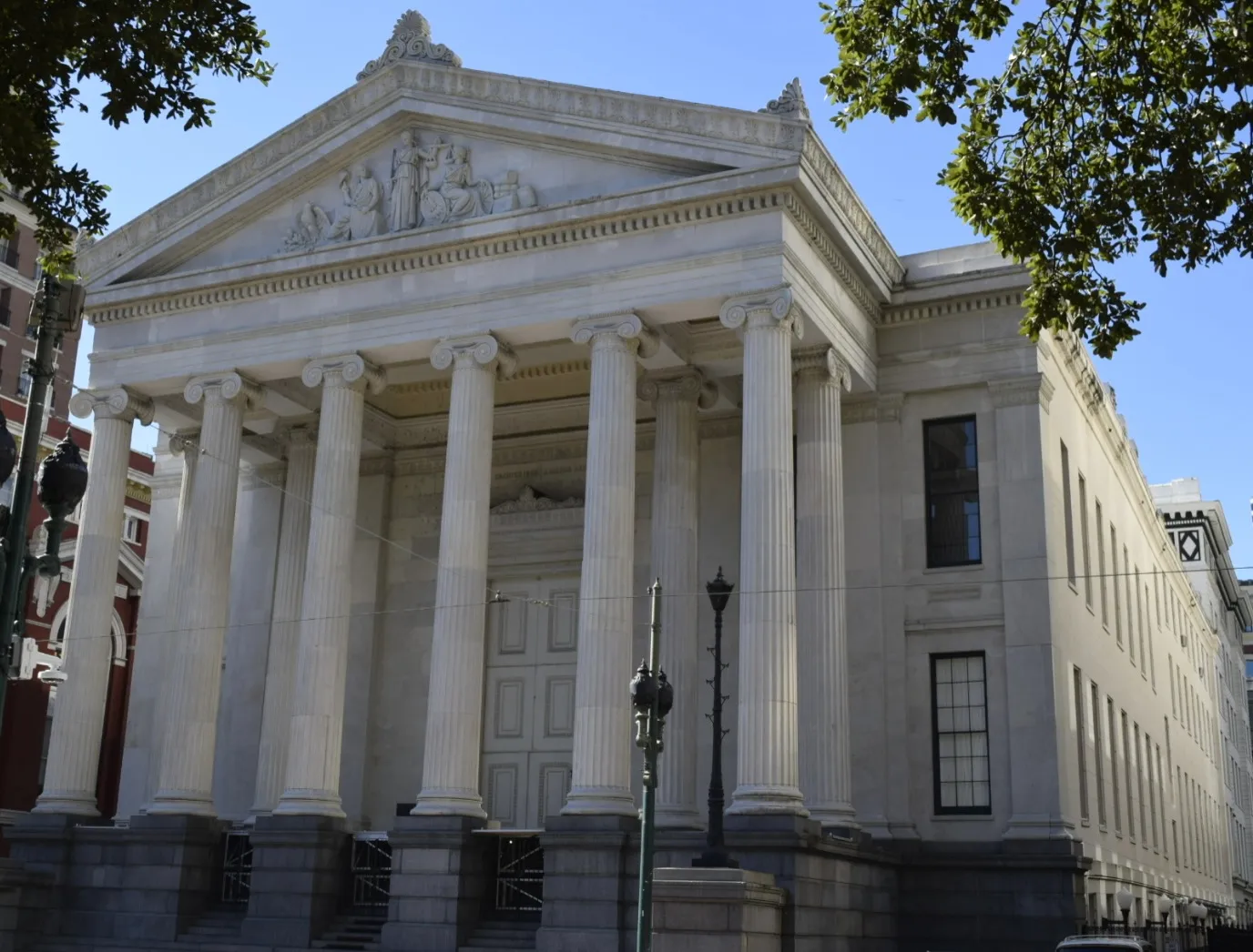
Gallier Hall’s marble portico on St. Charles Avenue
Gallier Hall stands at 545 St. Charles Avenue, a white marble Greek Revival block that James Gallier Sr. completed in 1853 and that housed New Orleans city government until 1957. Ten Ionic columns carry a sculpted pediment across the front, and the building still does ceremonial duty: lyings-in-state, Carnival reviewing stands, city events that need a portico. The interior opens only for those, so what you get on an ordinary weekday is the front, which is the part worth the walk anyway.
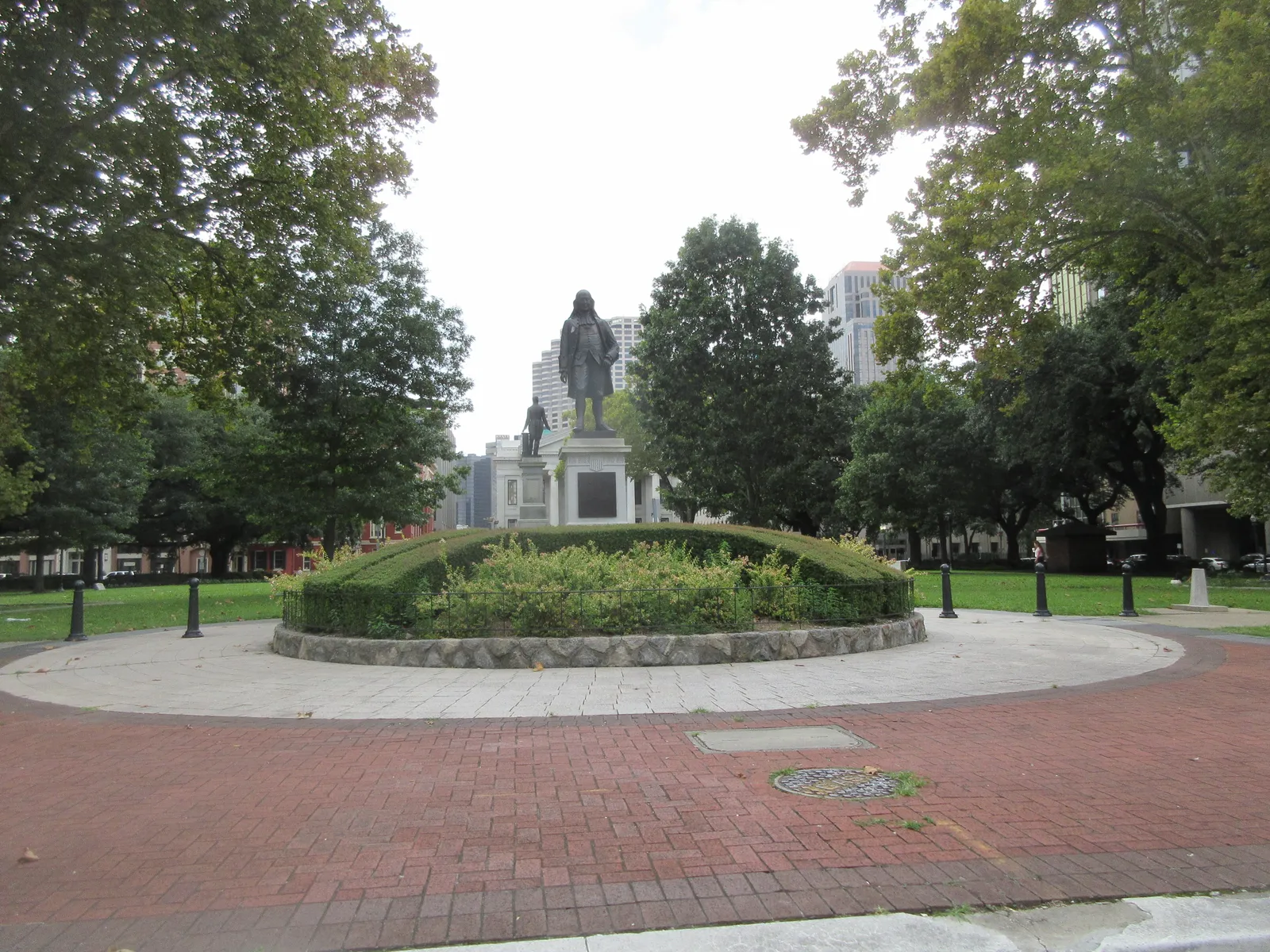
Directly opposite is Lafayette Square, laid out in 1788 by Charles Laveau Trudeau, the Spanish colonial government’s surveyor general, which makes it the second-oldest park in the city. Three bronzes stand under its trees, Henry Clay, Benjamin Franklin and John McDonogh, each in its own bed, and the square filled up with banks and hotels in the 1850s once the city government moved in across the street. It is now the lunchtime green of the Central Business District, with office towers on three sides and a good deal of shade.
Anyone arriving on a long-distance train or coach steps off with checked-size luggage rather than a cabin bag, which is a different proposition for a twenty-minute walk through the business district than a carry-on would be.
The Piazza d’Italia, a postmodern fountain square from 1978
Charles Moore built the Piazza d’Italia into the middle of a block between Poydras and Lafayette Streets, a gift to the city’s Italian community and, as it turned out, one of the buildings that defined postmodern architecture for everyone else. The fountain is cut in the outline of the Italian peninsula, stepped so that water runs down the length of the country, with Sicily set where the centre of the plaza would be. Around it stand hemicycles of columns in red, orange and yellow, each colonnade in a different classical order, several of them outlined in neon.
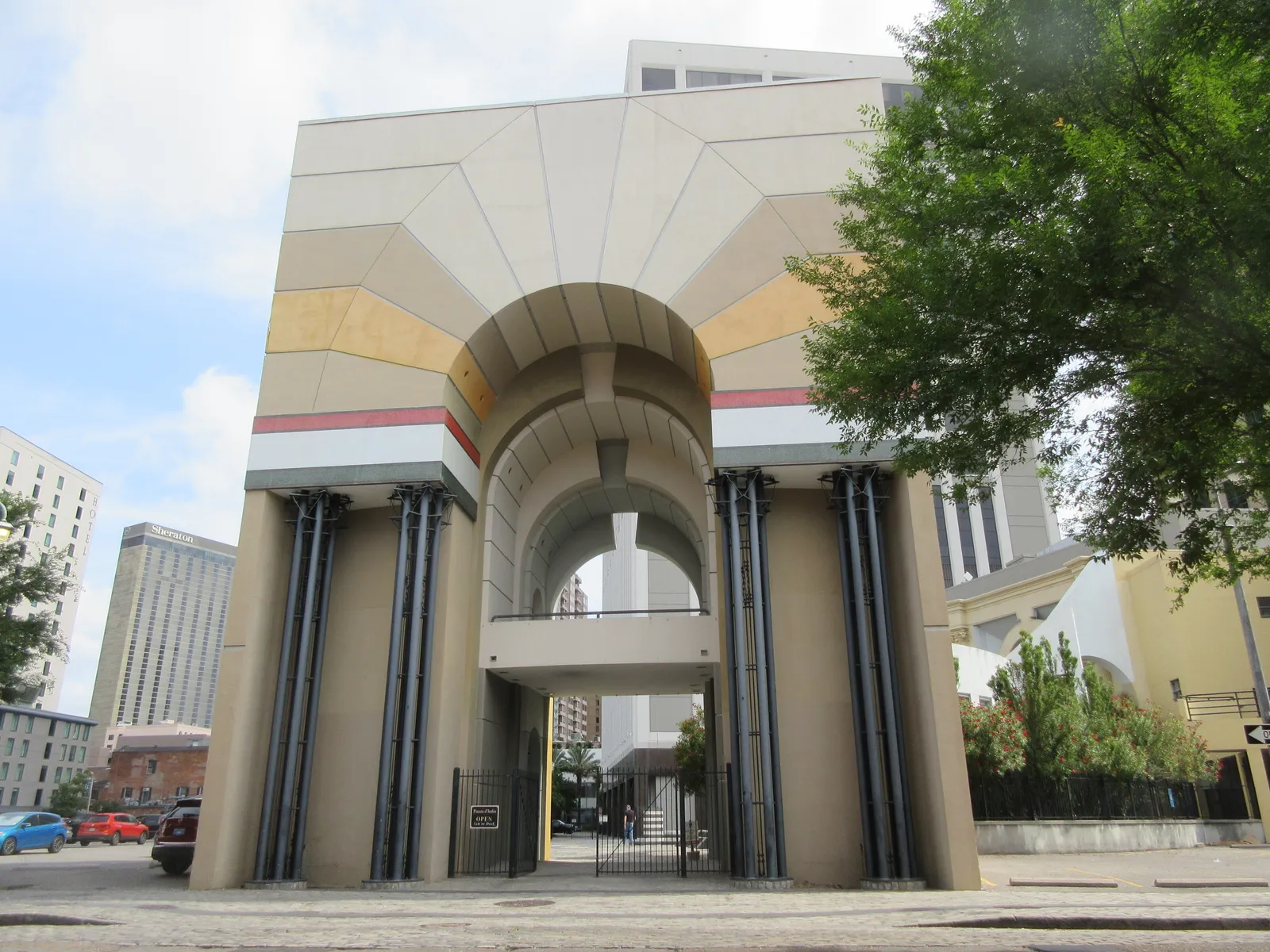
Two ways in: a tapering passage off Poydras Street, or the clock-tower arch where Commerce Street stops at Lafayette Street. The piazza fell into disrepair through the 1980s and 1990s and was fully restored by 2004 alongside the hotel conversion next door, so what stands there now is the thing as drawn rather than the ruin that got photographed for years. There is no gate, no admission and no posted hours.
The airport bus leaves from this terminal’s own bus bays
Bus Bay 2 at Union Passenger Terminal is one end of the 202 Airport Express, which is the only public transit between downtown and Louis Armstrong New Orleans International Airport (MSY). The fare is $1.25, the same as a streetcar, and the run out along Interstate 10 takes about 40 minutes. Departures come every 70 to 90 minutes, which is the number that actually governs the day: a bus missed here is more than an hour of standing around, and the taxi rank outside charges a flat $36 into or out of the Central Business District for one or two people, fixed by city ordinance.
Three hours is enough for all of the above with time to sit down. If the gap before the flight is nearer six, the French Quarter itinerary is the better use of it, and collecting a stored bag on the way back here costs a few minutes rather than shaping the whole afternoon around where the suitcase is.
Frequently asked questions
What should I do during a layover near Union Passenger Terminal in New Orleans?
Look at the mural wall inside the terminal first, four painted panels of Louisiana history finished in 1954, then walk east. Gallier Hall's marble portico is about ten minutes away on St. Charles Avenue, facing Lafayette Square, which has been a public park since 1788 and has three bronzes under its oaks. A few blocks further toward the river, the Piazza d'Italia is a 1978 fountain square in stepped colonnades that most visitors never find. None of the three charges anything, so three hours covers all of it without a ticket.
Is there anything free to do near Union Passenger Terminal?
Almost everything within walking distance of it is. The terminal's own mural panels cost nothing to stand and look at. Lafayette Square is an open public park, Gallier Hall's exterior is on a public street and the interior opens only for city events, and the Piazza d'Italia is a public plaza with no gate and no hours posted. The one thing you will spend money on in this part of town is the museums in the Warehouse District, which all charge admission.
Can you walk to the French Quarter from Union Passenger Terminal?
Yes, it is about a mile to the edge of it, roughly twenty minutes on flat pavement, and a streetcar runs from outside the terminal door if you would rather not. If the Quarter is what you came for, the Jackson Square and Royal Street walk is the better plan and this itinerary is the wrong one: the point of staying in the Central Business District is that it is quieter, closer, and empty of the crowds that fill Decatur Street by lunchtime.
How do you get from Union Passenger Terminal to Louis Armstrong airport?
The 202 Airport Express uses Bus Bay 2 at this terminal, which makes this one of the two easiest places downtown to start the trip. The fare is $1.25 and the ride is about 40 minutes along Interstate 10, but departures are only every 70 to 90 minutes, so check the time before committing to a last stop in town. A taxi from the rank outside is $36 flat to or from the Central Business District for one or two passengers, set by city ordinance.