Abu Dhabi's Grand Mosque on an AUH Layover
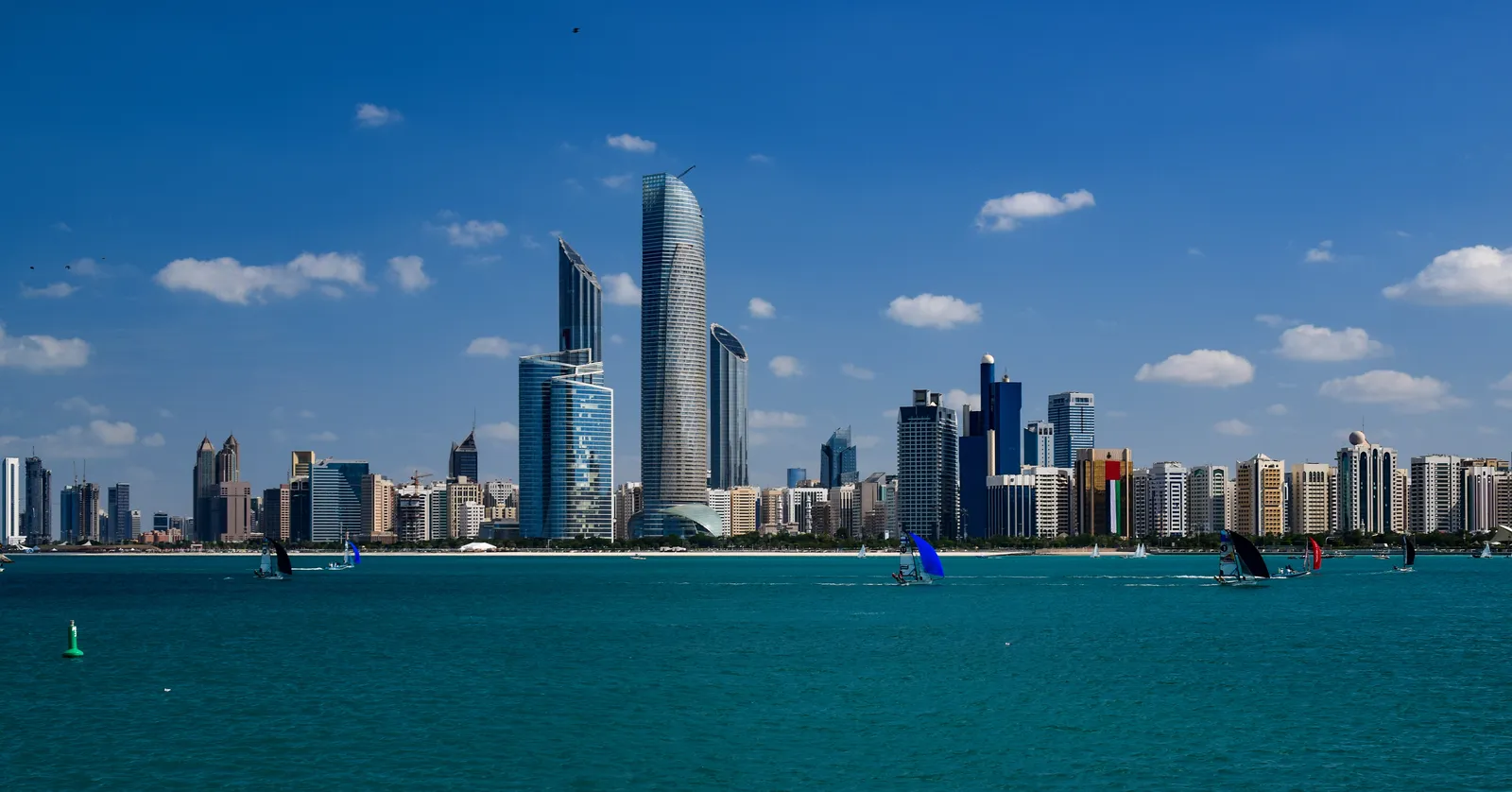
Abu Dhabi’s Grand Mosque costs nothing to walk into and runs guided tours right through the night, while the perforated dome over Louvre Abu Dhabi, out on Saadiyat Island, costs AED 70 to stand under.
The star-cut canopy over Louvre Abu Dhabi
Louvre Abu Dhabi opened in November 2017 on Saadiyat Island, north-west of the city across a short causeway, and it is laid out as a low grid of white blocks rather than one building, with a single canopy 180 metres across resting over the lot. Jean Nouvel’s office built that canopy as eight stacked layers of steel and aluminium with 7,850 star-shaped openings cut through them. Sunlight works its way through all eight and lands on the paving and the seawater channels below as scattered, shifting points, which the museum calls the rain of light.
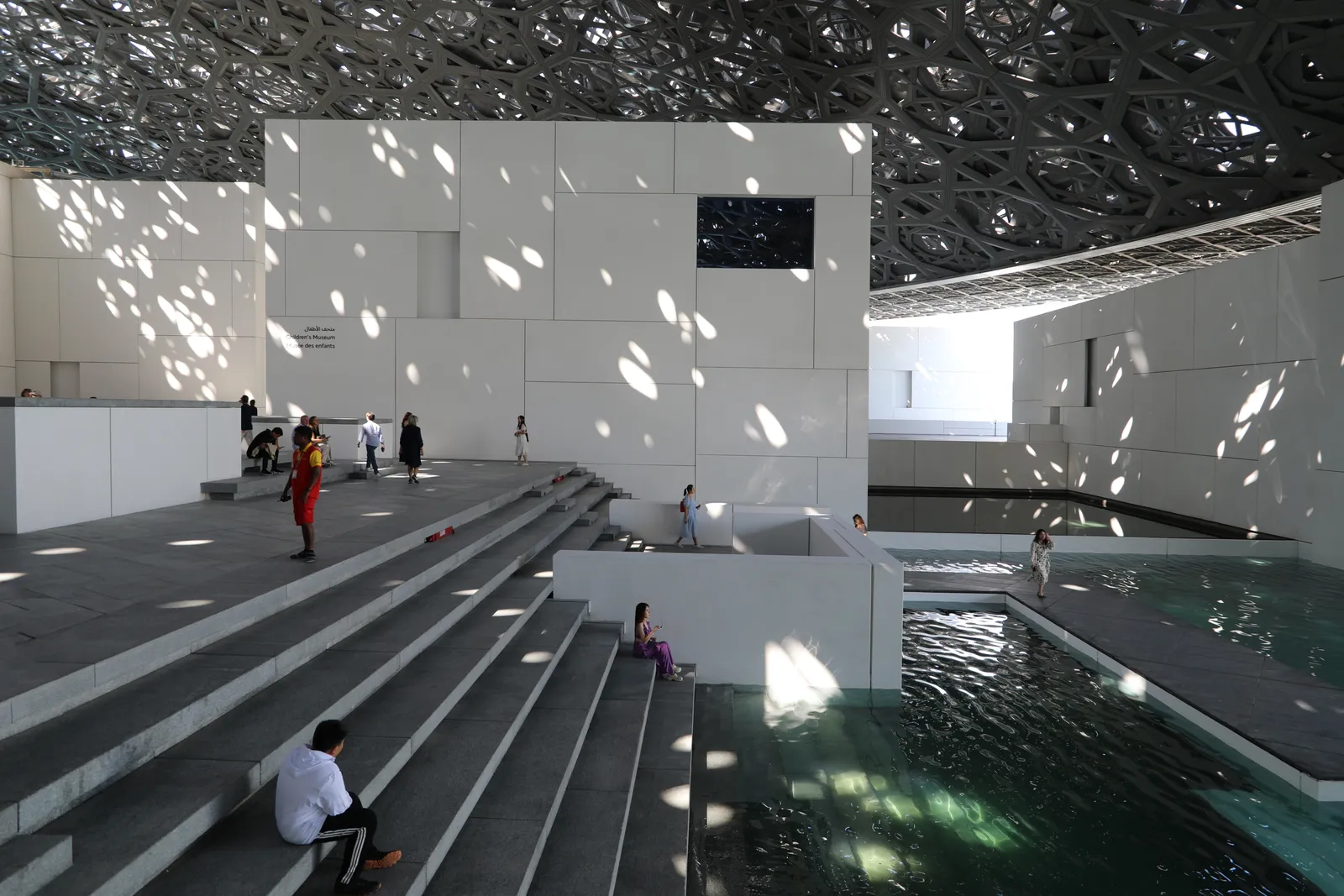
Adult admission is AED 70 and anyone under 18 goes in free. The galleries run 10am to 6.30pm Tuesday to Thursday and 10am to 8.30pm Friday to Sunday, and the whole place shuts on Mondays, which is the single fact most likely to waste a layover here. The outdoor areas under the dome stay open until midnight with last entry at 11pm, so a late flight can still get the canopy even after the art has closed, and a ticket bought ahead skips the counter on the way in.
One thing to sort out before you get here: the museum asks visitors not to bring large luggage, and its cloakroom is sized for daypacks rather than suitcases.
Qasr Al Watan, the presidential palace open to the public
The United Arab Emirates runs its head of state’s business out of a working palace on the Ras Al Akhdar headland at the western end of Abu Dhabi island, and on 11 March 2019 it began selling tickets to part of it. The Great Hall is the room people come for, a square chamber under a dome 37 metres in diameter, with a chandelier of 350,000 pieces of crystal hanging in a separate hall nearby and a library of more than 50,000 books on Arab scholarship in the wing called the House of Knowledge.
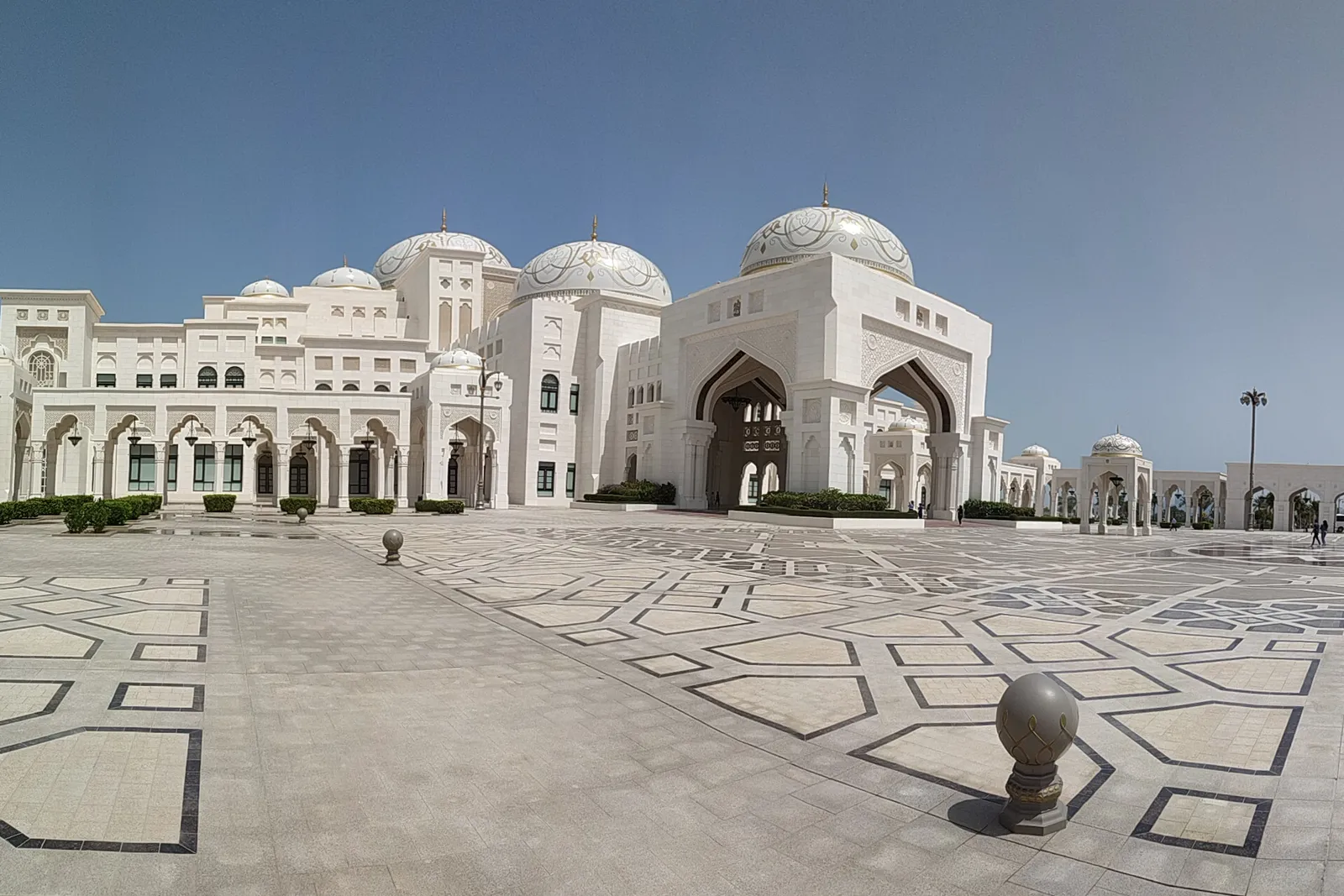
Admission is AED 65 for adults and AED 30 for children, and tickets are sold in advance as well as at the gate. The building being a functioning palace is not a marketing line: opening hours shift, and the whole site closes at short notice when a state event is on. Check the day you are travelling rather than the week before, and if it is shut, the Emirates Palace hotel and the Etihad Towers stand within about a kilometre of the same headland.
Qasr Al Hosn, the coral-stone fort among the towers
A round watchtower went up on Abu Dhabi island in the 1700s to guard the only freshwater well on it, and everything that followed grew outward from that tower: a small fort for the ruling family, then a palace, then a late-1930s extension paid for out of the first oil licence money, which is roughly the shape you see today. It was the seat of government until 1966 and the national archive after that, and it reopened in 2018 as a museum following more than a decade of restoration.
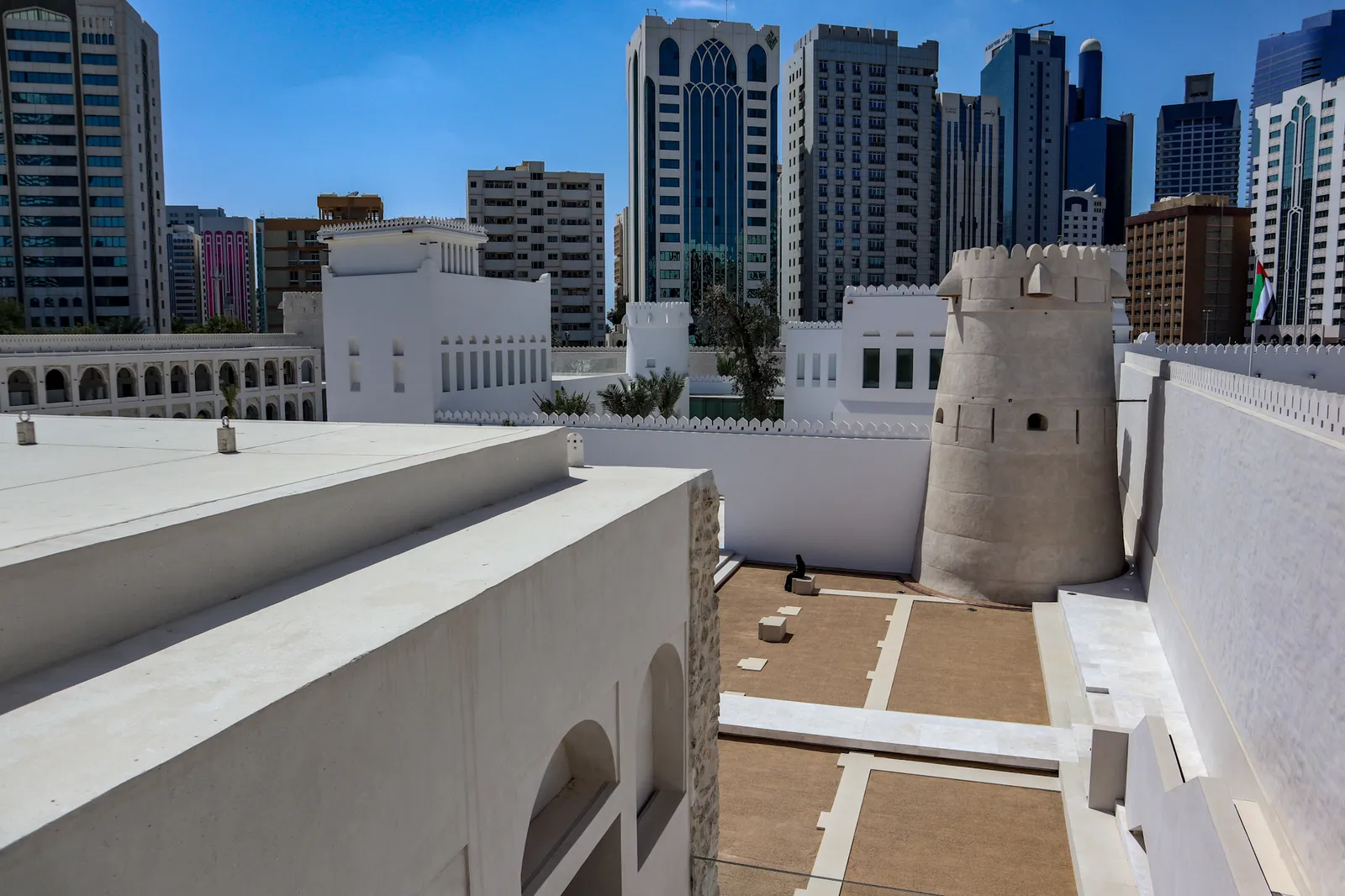
It sits on Sheikh Rashid Bin Saeed Street in the middle of downtown, which is why the view most people take away from it is the wall of office towers rising directly over the watchtower. The fort itself is AED 30, free for under-18s, and that ticket also covers the Cultural Foundation, the House of Artisans and Bait Al Gahwa on the same grounds. The grounds and the House of Artisans are free to walk into on their own, which is worth knowing if the clock is tight. Opening is 9am to 8pm Saturday to Thursday, 2pm to 8pm on Friday.
Sheikh Zayed Grand Mosque stays open all night
Eighty-two white marble domes in seven different sizes stand over the courtyards and prayer halls, with four minarets of about 104 metres at the corners, all of it built between 1994 and 2007 and inaugurated that December. The main prayer hall holds a single carpet of 5,627 square metres, knotted by hand by somewhere around 1,200 weavers, designed by the Iranian artist Ali Khaliqi and woven in Mashhad from New Zealand and Iranian wool. Seven chandeliers hang over it, made by Faustig of Munich and set with Swarovski crystal; the largest is 10 metres across and 15 metres tall.
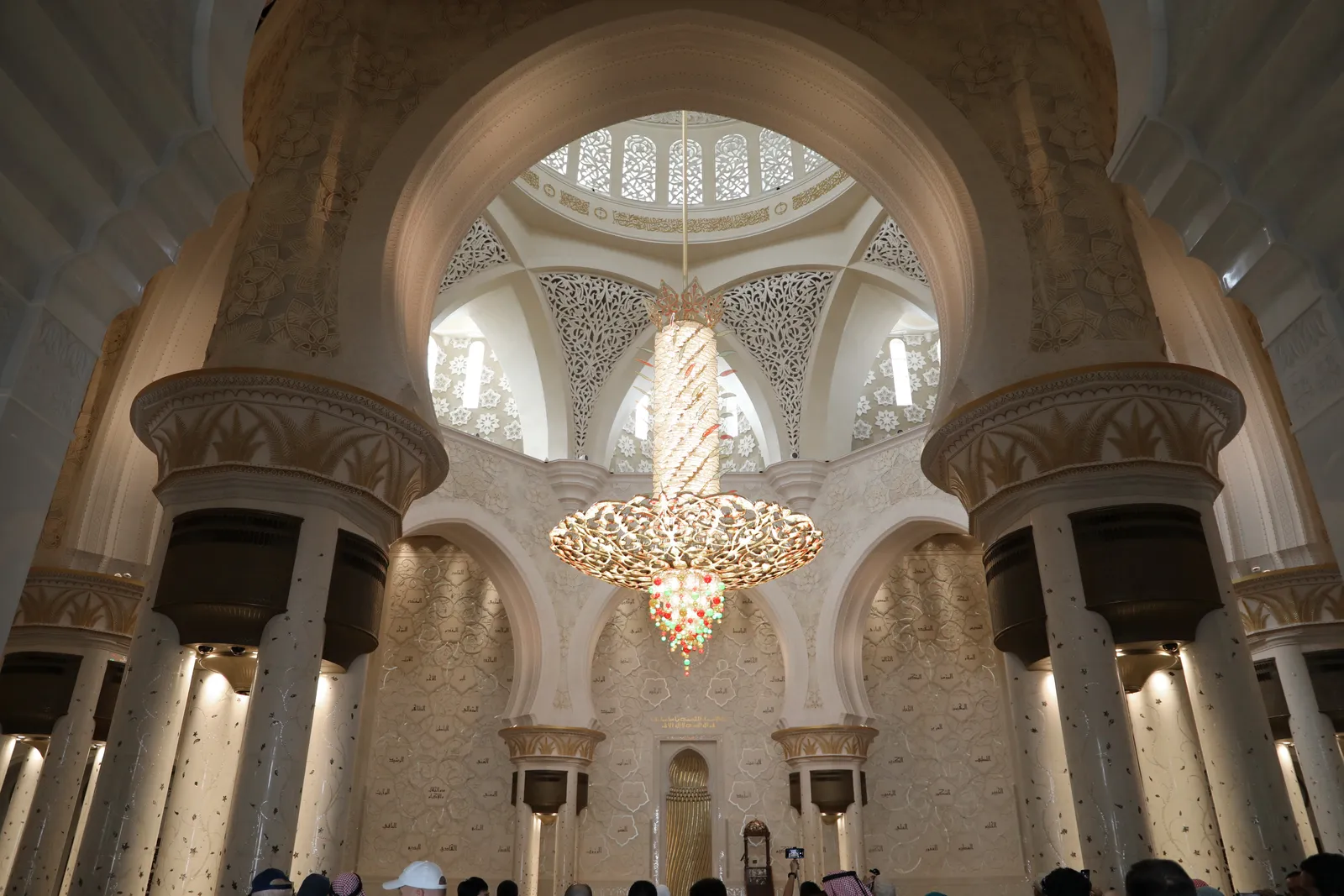
Entry costs nothing and free guided tours in Arabic and English run through the day, no booking needed, though the mosque does ask visitors to register for an access pass on its own site first. Ordinary visiting is 9am to 8.30pm Saturday to Thursday. What makes this the one stop on the list that suits an awkward flight time is the night service the mosque started in December 2023: guided evening tours that carry on through the small hours until nine the following morning, booked in advance on the mosque’s website. Dress is ankle-length and loose for everyone, with hair covered for women, and abayas and headscarves are lent at the entrance for nothing.
Across the road, and joined to the mosque by a footbridge, Wahat Al Karama is the memorial to the country’s war dead: 31 aluminium-clad slabs leaning against one another, free to walk around, and with no dress code or screening line to clear first. A free shuttle runs between the two every half hour from 10am to 7.15pm, so it costs you the shuttle wait and not much else.
A public beach and a free bike track on the Corniche
The Corniche runs eight kilometres along the north-west shore of Abu Dhabi island, with the pedestrian path and the cycle lane kept separate the whole way and a six-kilometre bike track that costs nothing to use. Corniche Beach holds Blue Flag certification and is lifeguarded; the open stretches of sand are free, while the gated family and singles section charges AED 10 for adults and AED 5 for children.
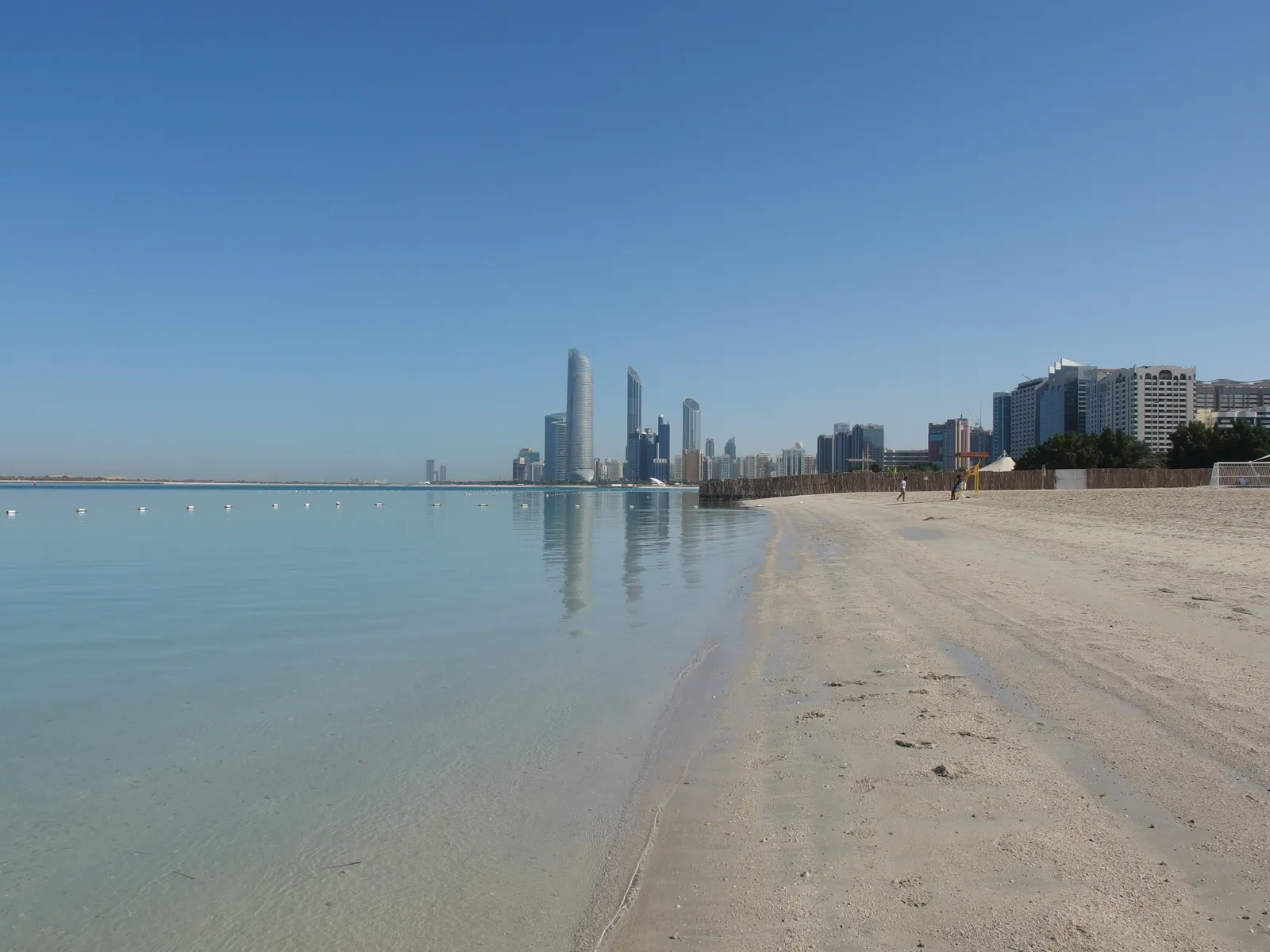
Time of year decides whether any of this is pleasant. July and August average 42 to 43°C in the daytime and the humidity off the Gulf pushes what it feels like higher again, so between roughly June and September this is something to do before nine in the morning or after sunset, and the air-conditioned half of the city is the better bet in between. From November to March it is simply a flat, shaded-in-places walk with the water on one side.
No metro in Abu Dhabi, and the buses take no cash
The A1 bus leaves Terminal A at Zayed International Airport (AUH) for Al Zahiyah in the city centre, and the A2 runs to Al Danah on Khalifa bin Zayed Street, both roughly every 40 minutes between six in the morning and eleven at night, both AED 4. A metro has been on the drawing board here for years but nothing is running yet, so those buses and the taxi rank are the whole menu. The bus takes 45 to 60 minutes depending on traffic; a metered taxi does the same trip in 30 to 40 for AED 60 to 70, and Al Ghazal’s airport cars charge a flat AED 75.
The fare rule is the part worth planning around. No Abu Dhabi public bus takes cash or a bank card. You need a Hafilat card, AED 10 for the card plus whatever you load onto it, sold at the counters and machines in Terminal A arrivals, and you tap it both boarding and getting off so the distance is charged correctly. If your flight goes in the middle of the night, the A1 and A2 stop around eleven and the N2 covers midnight to six every 20 minutes instead. If the rest of the trip runs on to Singapore, that airport sits on a branch of the metro rather than at the end of a bus route, which changes the arithmetic on how late you can leave town.
Whichever way you go back, the suitcase is the piece that decides your route, not the sights: leave it in the city and the mosque, the fort and the Corniche are all walk-in stops with nothing to check and nowhere to park a bag. Collect it on the way through and the last hour stays a straight run to the terminal.
Frequently asked questions
What should I do during a layover in Abu Dhabi?
Pick one ticketed building and pair it with the mosque. Sheikh Zayed Grand Mosque is free, has 82 domes and a 5,627-square-metre hand-knotted carpet in the main prayer hall, and is the closest of these to the terminal. From there the choice is Louvre Abu Dhabi on Saadiyat Island at AED 70, Qasr Al Watan at AED 65, or Qasr Al Hosn downtown at AED 30, and five to seven hours is enough for the mosque plus one of the three. The Corniche is free and needs no plan at all, so it is the first thing to drop if the traffic runs long, and the first thing to reach for if your flight leaves too early for anything ticketed to be open.
Do I need a visa to leave the airport and go into Abu Dhabi?
For most travellers on a Western passport, no. Passport holders from the United States, the United Kingdom, Australia, Canada, New Zealand, Japan and every EU member state are admitted without applying in advance, with the permitted stay running to 30 or 90 days depending on nationality. The one requirement that catches people out is passport validity: the UAE wants at least six months left on it from the date you arrive. Nationalities outside that group may need a visa on arrival or an approved application beforehand, and the Federal Authority for Identity, Citizenship, Customs and Port Security publishes the current list, which is worth checking rather than assuming.
Is the bus or a taxi better back to Zayed International Airport?
A taxi, unless you are counting every dirham. The A1 and A2 buses run from the city centre to Terminal A for AED 4, but they take 45 to 60 minutes depending on traffic and no Abu Dhabi bus accepts cash or a bank card, so you also need a Hafilat card at AED 10 before you board. A metered taxi covers the same trip in 30 to 40 minutes for AED 60 to 70, and Al Ghazal's airport cars charge a flat AED 75. If the flight is overnight, note that the A1 and A2 stop around eleven at night and the N2 covers midnight to six in the morning instead, every 20 minutes.
Is a summer layover in Abu Dhabi worth leaving the airport for?
Yes, but only for the indoor half of this list. July and August run to daytime averages of 42 to 43°C, and coastal humidity makes it feel hotter still, so the Corniche and the mosque's outdoor courtyards are an early-morning or after-dark proposition rather than an afternoon one. Louvre Abu Dhabi, Qasr Al Watan and Qasr Al Hosn are all air-conditioned end to end. The mosque itself is worth timing for the evening in summer for a second reason: its facade is lit after dark, and its guided night tours run long after the heat has dropped.
Can I visit Sheikh Zayed Grand Mosque on a Friday?
Yes, in two windows rather than one. Saturday to Thursday the mosque is open to visitors from 9am to 8.30pm, but on Friday it opens 9am to 11.30am, closes for Friday prayers, and reopens at 2.30pm until 8.30pm. The main prayer hall is shut to visitors between noon and three. Entry is free every day and the dress code does not relax for the weekend: ankle-length, loose clothing for everyone, hair covered for women, with abayas and headscarves lent at the entrance at no charge.