Warsaw Centralna Layover: Plac Konstytucji
Part of the full Warsaw Layover: A Rebuilt Old Town From WAW
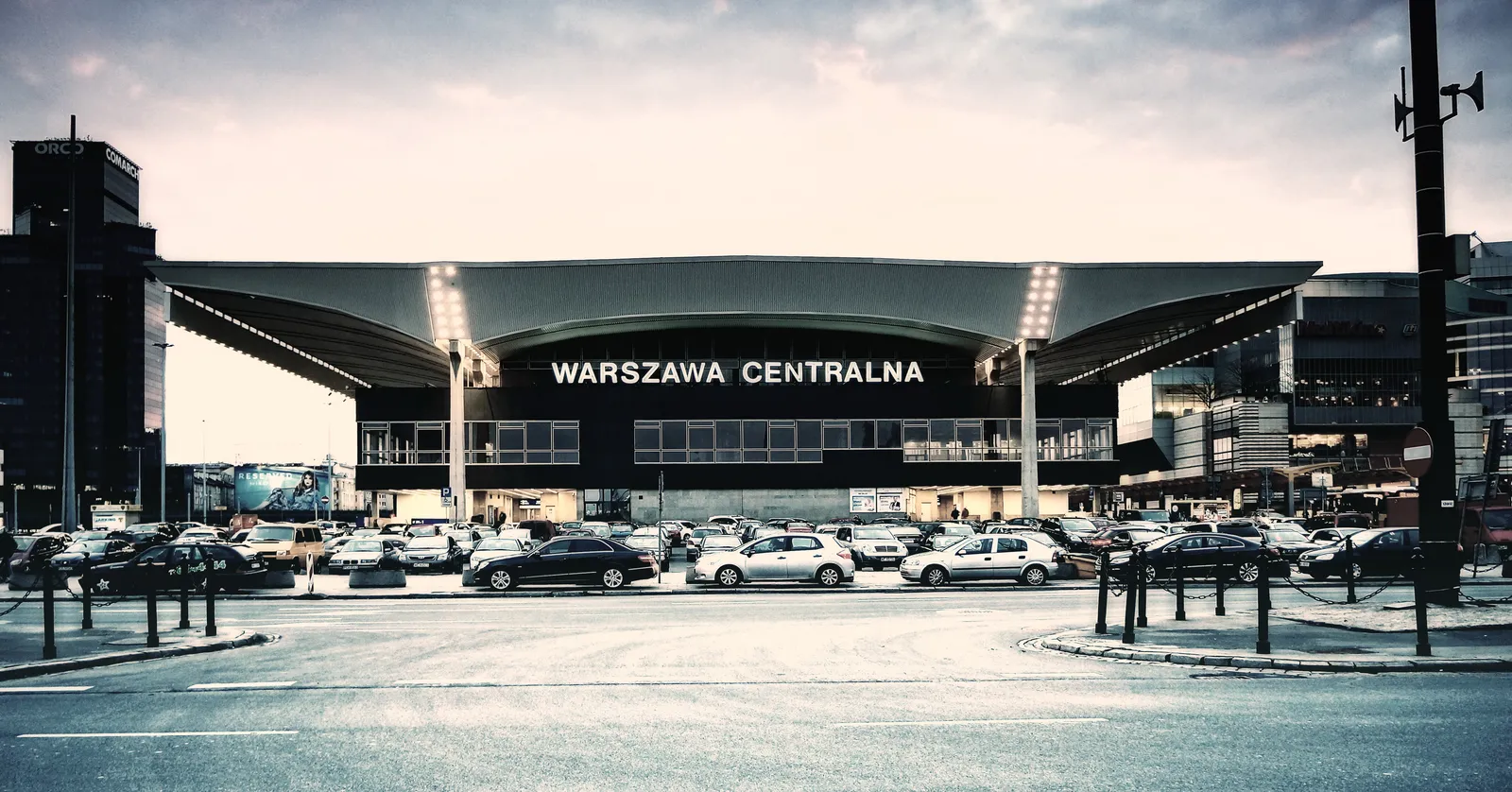
Warsaw’s Centralna station sits within twenty minutes’ walk of Plac Konstytucji, a square finished in 1952 as a showpiece of socialist realism, and of Hala Koszyki, a 1909 market hall now trading as a food hall, which puts both inside an ordinary gap between trains.
Warszawa Centralna is a listed piece of 1970s modernism
Arseniusz Romanowicz and Piotr Szymaniak designed the station, and it went up fast between 1972 and 1975, timed to be finished for a Brezhnev visit. What they built is a low, wide concourse under a cantilevered concrete canopy, with the trains themselves four island platforms and eight tracks below ground. It was the most advanced station in the country when it opened, automatic doors and air conditioning included, and it is now protected as an architectural monument in its own right. Worth two minutes above ground before you go anywhere: the roofline is the whole idea of the building, and you cannot see it from the platforms.
Buses looping the wider city leave from the centre too, and a seat booked in advance is the faster option if the gap is long enough to want the river and the Old Town in it. That northern half of the city, the Royal Route and the rebuilt Old Town, is the subject of the main Warsaw guide rather than this walk, which stays south of the station.
One thing to settle before you leave the building, because it is the single most common mistake made here: the trains out to Warsaw Chopin Airport do not go from Centralna. Warszawa Śródmieście, a few minutes east along the same underground passage, is where the S2 and S3 commuter services call. Between the two lines one leaves roughly every fifteen minutes, the ride is a little over twenty, and the fare is the ordinary 4.40 złoty 75-minute city ticket, because the airport counts as fare zone 1 like everything else here. Budget about thirty minutes in total once the wait and the walk into the terminal are counted. That passage between the two stations also runs right past where the drop-off points cluster, so collecting a bag is on the way rather than a detour back.
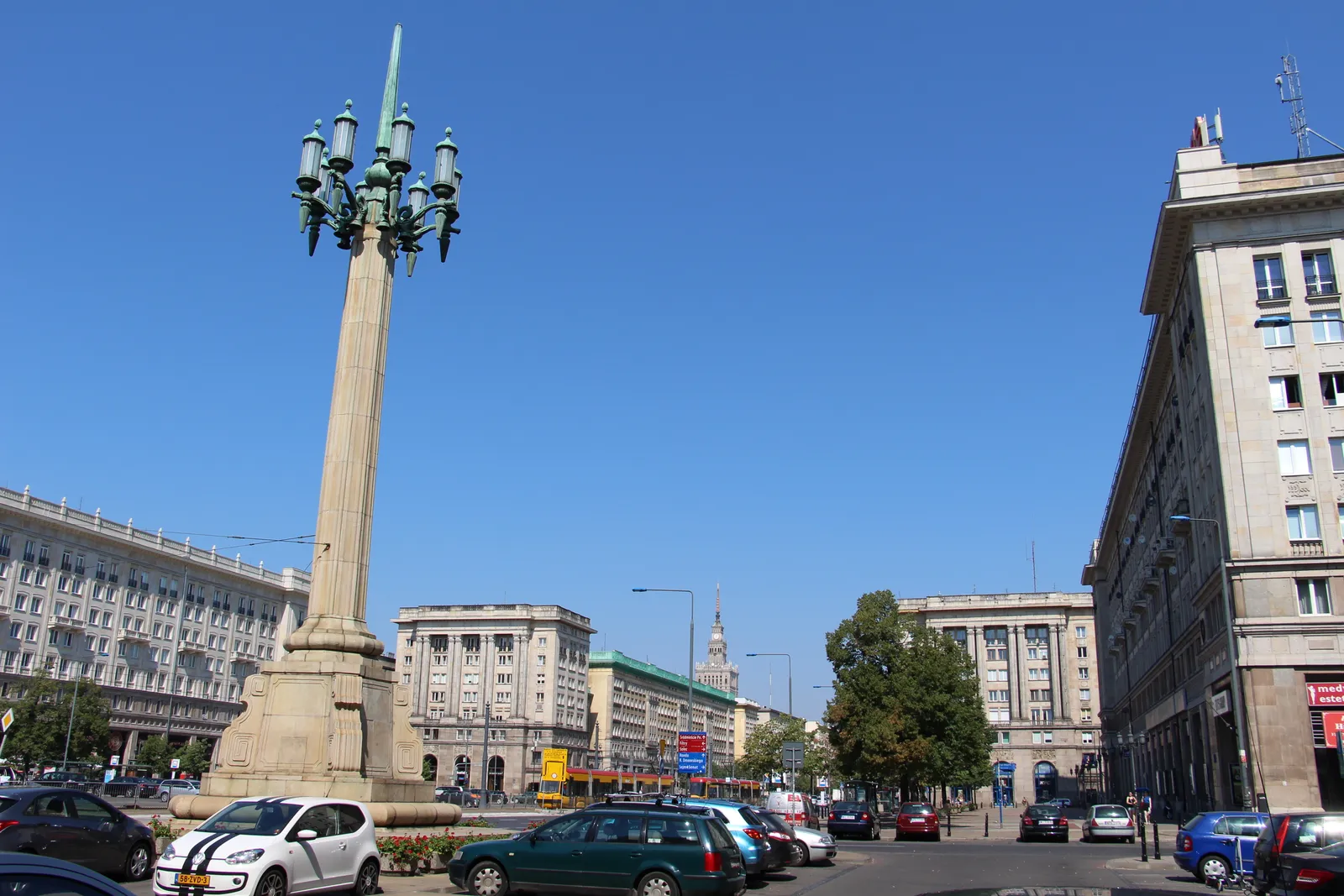
Worker reliefs and giant lamps on Plac Konstytucji
Plac Konstytucji was finished in 1952 as the centrepiece of the Marszałkowska housing district, a scheme by Józef Sigalin, Stanisław Jankowski, Jan Knothe and Zygmunt Stępiński built to house 45,000 people and intended, in the language of the time, as an expression of creative optimism under socialism. What survives of that intention is architectural: heroic worker reliefs carved into the facades, arcaded ground floors, and a pair of stone candelabra the height of a house standing at the southern end.
On the corner with ulica Piękna is the Siatkarka, an animated neon of a woman leaping to spike a volleyball, the ball then dropping in stages down the face of the building. Jan Mucharski designed it in 1961 to advertise the sports shop underneath. It went dark for decades, was restored in the mid-2000s by the artist Paulina Ołowska, who raised the money for it through a gallery show, and is now on the heritage register. It only does anything after dark.
The walk down Marszałkowska is flat, paved and about a kilometre and a half, twenty minutes at an unhurried pace. Getting out of the station is the part that is not flat: every arriving train empties into the same underground passages, and they get tight with luggage around the evening peak.
Hala Koszyki, a 1909 market hall rebuilt around its ironwork
Koszykowa street runs east from the bottom of Plac Konstytucji, and about 350 metres along it is Hala Koszyki, a market hall Juliusz Dzierżanowski built between 1906 and 1909 in the secessionist style. It traded as a market for most of the 20th century, was left to rot, and then came apart entirely: the restoration took five years, kept the original green iron frame and the brick pavilions at either end, and reopened in 2016 with food counters on two levels under the glass roof.
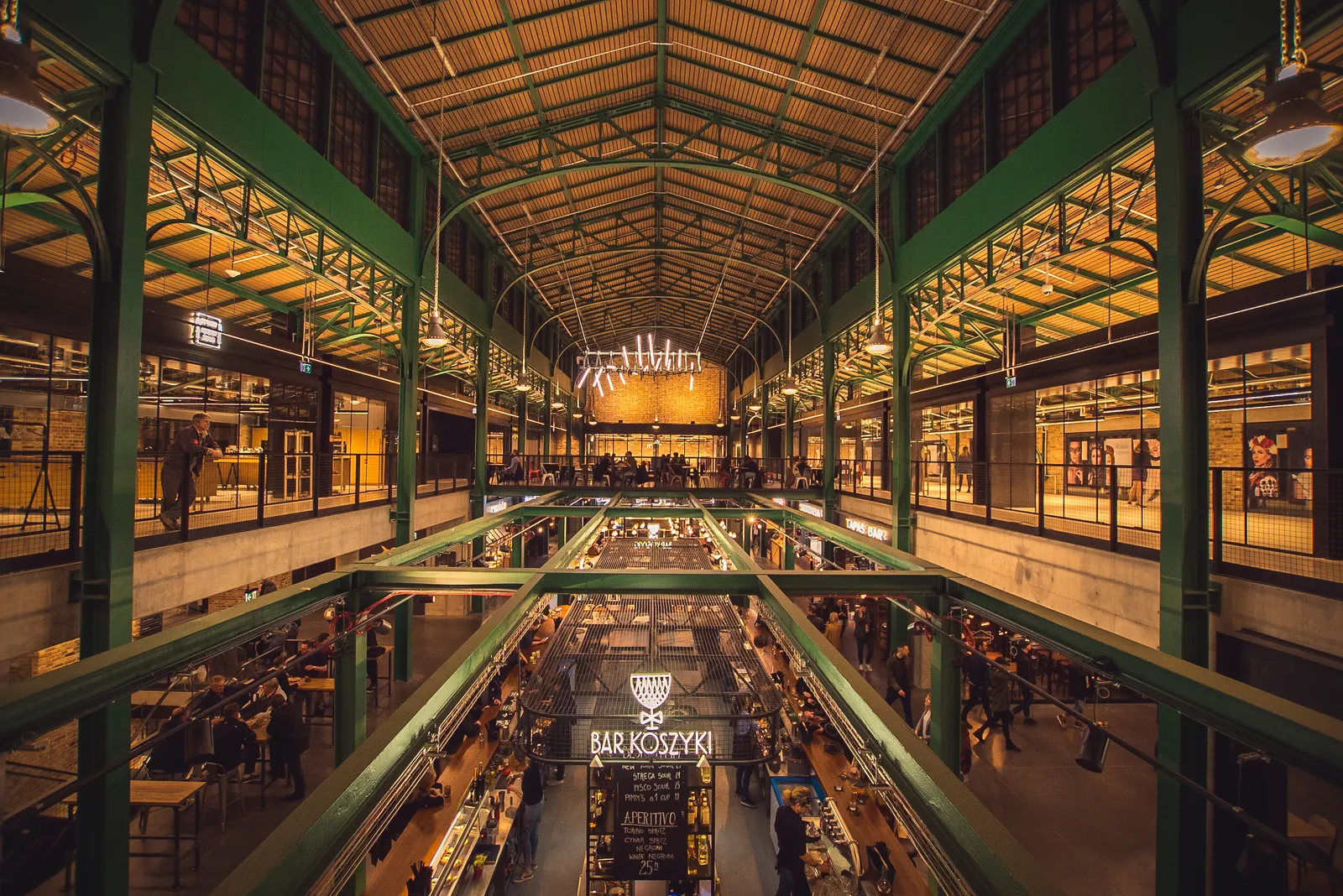
It opens at 8am Monday to Saturday, 9am on Sunday, and runs until 1am, though the counters fill up gradually through the morning and the real choice starts around midday. Nobody minds if you walk the gallery, look at the roof and leave without buying anything.
Frequently asked questions
What should I do during a layover near Warszawa Centralna in Warsaw?
Walk south to Plac Konstytucji, the square finished in 1952 at the centre of the Marszałkowska housing district, where the facades still carry their carved worker reliefs and a pair of stone candelabra stand at the far end. From there it is about 350 metres to Hala Koszyki, a 1909 market hall reopened in 2016 as a food hall under its original green ironwork. Two hours covers both comfortably with time to eat. Nothing on the walk needs a ticket, and both are open late enough to work around an evening train.
Should I use Warszawa Centralna or Warszawa Śródmieście?
They are different stations with an underground passage between them, and the distinction catches people out. Centralna handles intercity and long-distance services from four island platforms under the building. Śródmieście, a few minutes east along the same passage, is a smaller station used by regional and suburban trains, including the ones that run out to the airport. If your ticket names one of them, use that one; the walk between the two is signed and stays indoors, which matters in bad weather.
Is Hala Koszyki worth going to if I only have an hour?
Yes, if you want to eat. It opens at 8am on weekdays and 9am on Sundays and runs to 1am, but not every counter is trading first thing, so the choice is thinner before noon. The building is the draw as much as the food: a 1909 hall by Juliusz Dzierżanowski, taken apart and rebuilt around its restored iron frame over five years before reopening in 2016. Walking in and looking costs nothing.
Is a sightseeing bus worth it for a short gap between trains?
Only if the alternative is sitting in the concourse. The loop takes in the Old Town and the riverside, which a 90-minute walk from here will not reach, so it suits a gap of two to three hours better than a tight one. Buy a ticket ahead of time rather than at the stop if your connection is fixed, since the gap between departures is the part you cannot control.