POLIN and Muranów: A Warsaw Layover Walk
Part of the full Warsaw Layover: A Rebuilt Old Town From WAW
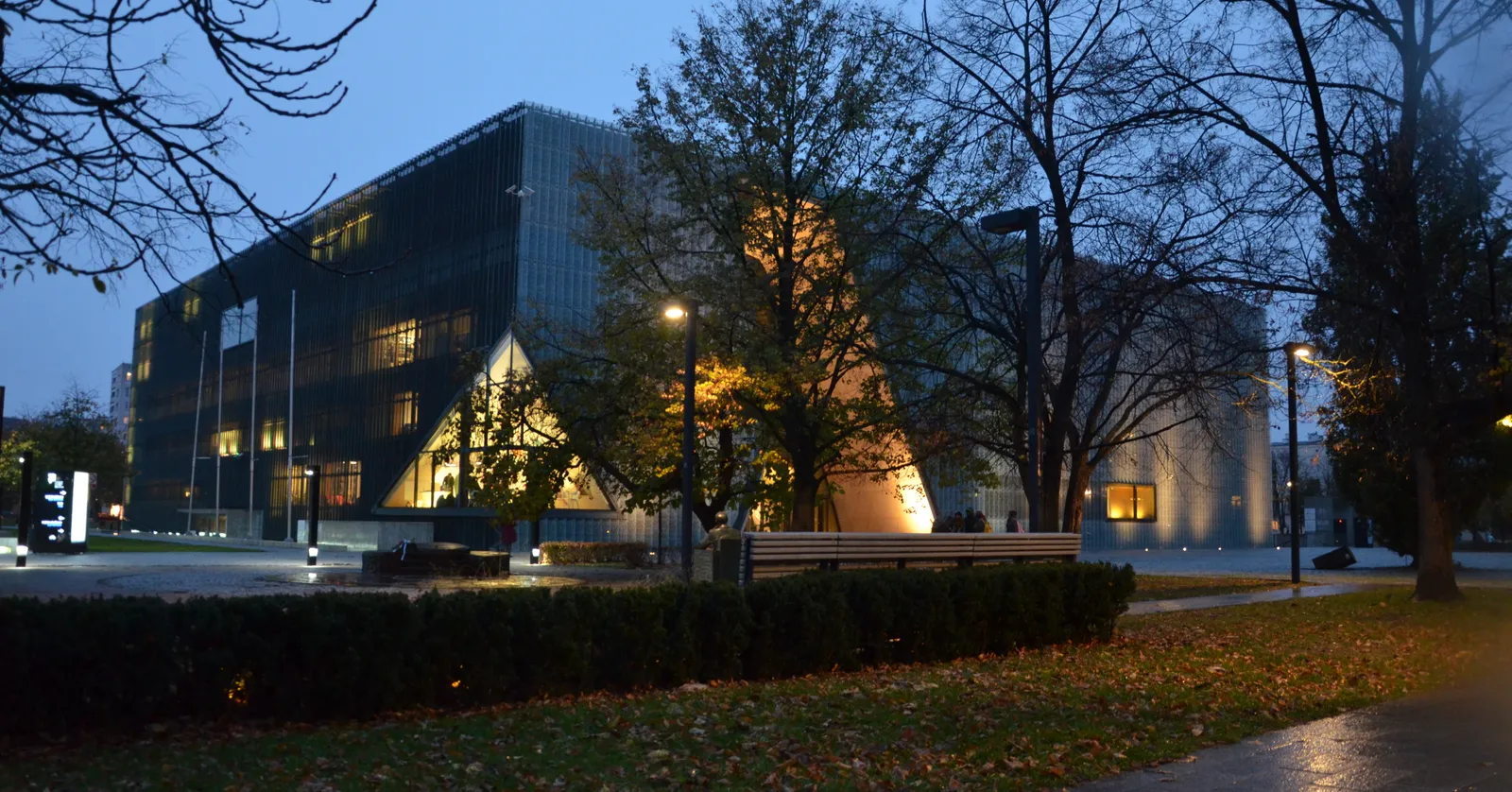
Warsaw’s POLIN museum stands on Anielewicza in Muranów, a district rebuilt from 1948 on the levelled rubble of the ghetto that had occupied the same ground, which makes the streets outside as much of the subject as the exhibition inside.
Muranów was rebuilt out of the rubble it stands on
The ghetto was razed after the 1943 uprising, and what was left was not cleared away so much as flattened and built over. Bohdan Lachert took the housing scheme on in 1948 and made a decision no other Warsaw district got: rather than cart the debris out, he had it graded into terraces and slopes and cast into rubble-concrete blocks, so the estate would be built from the thing it replaced. He intended it as a memorial you could live in. The ground under your feet here is several metres higher than the pre-war street level for the same reason.
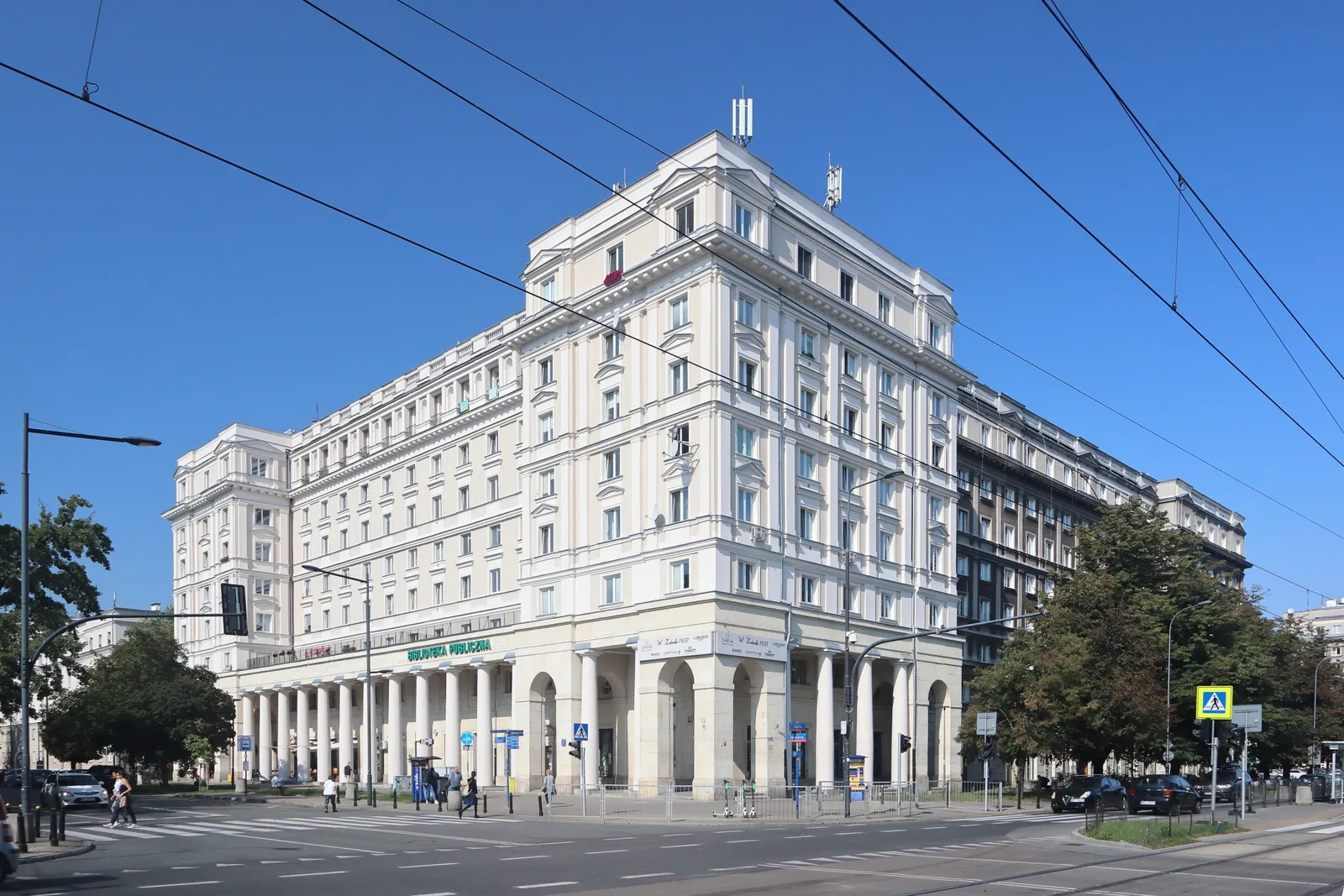
That intention did not survive the decade. After 1950 the raw blocks were rendered over in white stucco and given the pilasters, colonnades and painted ornament that socialist realism required, so what you see now reads as ordinary 1950s monumental housing unless you know what is inside the walls. Walking it costs nothing and takes as long as you give it; the streets are flat and wide and there is very little tourist traffic.
POLIN’s exhibition runs under a canyon cut through the building
The museum opened its core exhibition in 2014 in a building by the Finnish practice Lahdelma & Mahlamäki: a plain glass and copper box from outside, split down the middle by a curving cleft of pale plaster that you walk into rather than through. The break is the point. Eight galleries then run chronologically from the first Jewish settlements in Poland through the Paradisus Iudaeorum of the Commonwealth, the Jewish street of the 19th century, the Holocaust and the decades after it.
A regular ticket is 45 złoty and a reduced one 35, Thursdays are free, and it is closed on Tuesdays. Two hours gets you round; three is better, and the wartime gallery is the part nobody should be checking a watch in. On the open ground outside is the 1948 memorial to the ghetto’s fighters, the spot where the West German chancellor Willy Brandt knelt unannounced on a December morning in 1970, which remains the most quoted thing that has happened on this square.
One practical thing decides how the visit goes: rucksacks, bags, suitcases, umbrellas and coats all have to be left in the cloakroom, and whatever you carry is X-rayed at the door regardless of size, so arriving wheeled means queueing twice before you have seen anything.
The Nożyk Synagogue is the only pre-war one left standing
Twarda street, a bit under two kilometres south of the museum, holds the Nożyk Synagogue, built in the 1890s by Zalman and Rywka Nożyk and the single synagogue in Warsaw to come through the war as a building rather than a footprint. The Germans used it as a feed store, which is largely why it survived while everything around it did not.
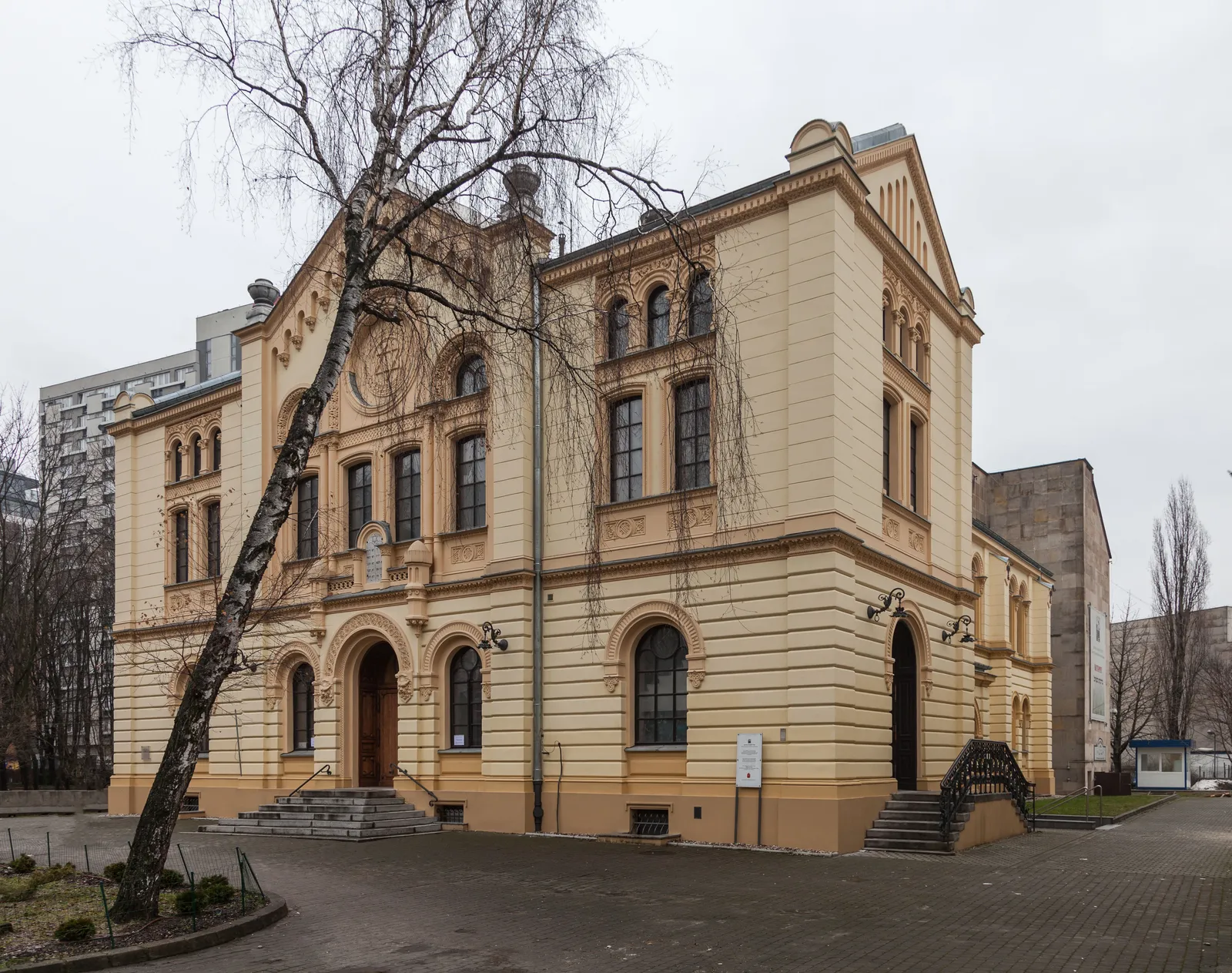
It is a working congregation rather than a museum, so visiting hours bend around services and a head covering is expected of men inside. It is also a useful counterweight to the morning: POLIN ends on the postwar decades, and this is the same story still going on in a building rather than behind glass.
The nearest airport trains leave from the middle of the city
Nothing on the commuter network comes out to Muranów, so getting to Warsaw Chopin Airport means a tram or the metro south into the centre first, ten minutes or so, and then the S2 or S3 from Warszawa Śródmieście or Warszawa Centralna out to the platform under the terminal. The train leg is a little over twenty minutes and runs roughly every fifteen; the whole thing from here is best budgeted at fifty minutes to an hour rather than the half hour the airport quotes from the city centre.
That routing is convenient in one way: it takes you back past the central stations where the drop-off points cluster, so a bag left there in the morning is on the way rather than a detour. If the day was always going to be about the rebuilt Old Town and the Royal Route instead, that is the walk the main Warsaw guide lays out, and it starts from the same two stations.
Frequently asked questions
What should I do during a layover near the POLIN Museum in Warsaw?
Give the museum two hours and the streets around it one. POLIN's core exhibition runs through eight galleries covering a thousand years of Jewish life in Poland, and a regular ticket is 45 złoty, 35 reduced, with Thursdays free. Outside, Muranów is the reason the museum is where it is: the district was rebuilt from 1948 on the levelled rubble of the ghetto, using concrete blocks cast from that rubble. If time is left, the Nożyk Synagogue, the only pre-war synagogue still standing in the city, is a bit under two kilometres south.
How long does POLIN's core exhibition take?
Two hours is brisk and three is comfortable. There are eight galleries running chronologically from the first Jewish settlement through to the postwar decades, and the second half, the wartime gallery in particular, is not something to rush past on the way to a train. The museum opens 10am to 6pm and is closed on Tuesdays, so a Tuesday layover needs a different plan entirely.
Can I take a suitcase into POLIN?
Not into the galleries. Rucksacks, bags, suitcases, umbrellas and coats all have to go in the cloakroom, and everything you carry is X-rayed at the entrance the way it would be at an airport, whatever its size. There is a self-service locker area by the entrance as well as a staffed desk, and some of the lockers want a coin. Nothing may be left standing unattended anywhere in the building.
Is there a free day at POLIN?
Thursday. Admission to the core exhibition and the temporary exhibitions is free that day, which on a flight-day schedule is worth knowing because free entry does not mean no queue. Every other day is 45 złoty regular and 35 reduced, and the museum is shut on Tuesdays.