Rothschild Boulevard Layover: Habima, Tel Aviv
Part of the full Tel Aviv Layover: Jaffa and Bauhaus From TLV
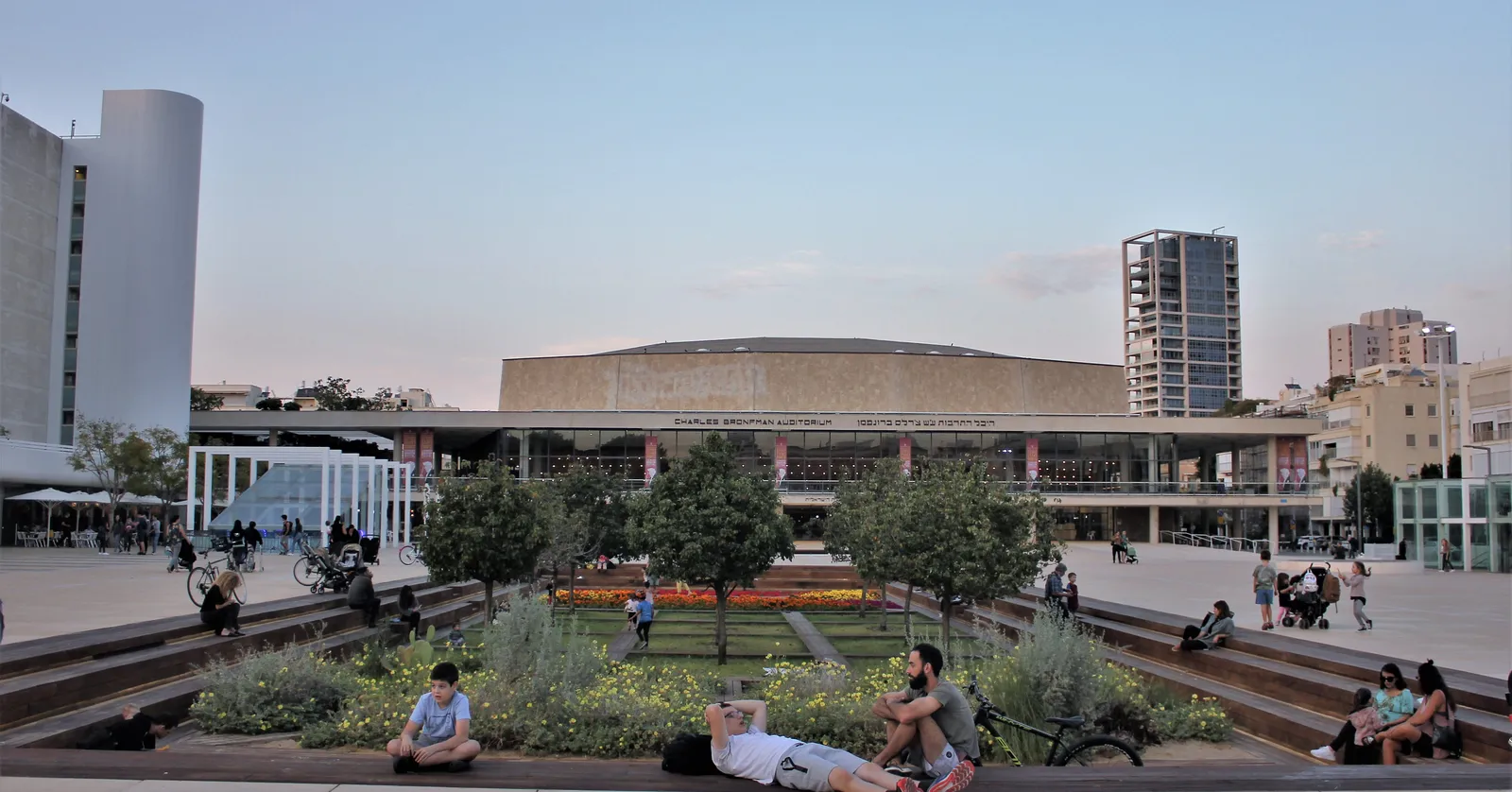
Rothschild Boulevard runs about a kilometre and a half through central Tel Aviv under a double row of trees, with a replica of the city’s first kiosk standing where it meets Herzl Street and Habima Square, the national theatre’s home, closing off the far end.
Habima Square closes the north end of the boulevard
Three cultural buildings face each other across this plaza. Habima, the company that began as an amateur troupe in Białystok in 1912 and settled in Palestine in 1931, built its theatre here in 1945 to a design by Oskar Kaufmann, has been the national theatre since 1958, and reopened in January 2012 after four and a half years and more than 100 million shekels of rebuilding by Ram Karmi. The Charles Bronfman Auditorium alongside it is where the Israel Philharmonic plays, and the Helena Rubinstein Pavilion on the third side shows contemporary art as an outpost of the city’s main art museum.
The square between them was rebuilt as a landscape rather than a paved plaza, with a garden sunk below street level and broad stone steps around its edge that people sit on all evening. It costs nothing, it is never closed, and it is the one place along this boulevard with somewhere to sit that is not a cafe table. A guided architecture walk is the way to have the 1930s facades explained rather than guessed at, since almost none of them carry a plaque.
The 1910 kiosk rebuilt at Rothschild and Herzl
Akiva Aryeh Weiss, one of the men who founded the city, asked permission in 1909 to put a refreshment stand on the boulevard for the workers building what was then called Ahuzat Bayit. What went up the following year was a small hexagonal pavilion selling gazoz, the fizzy fruit drink that was the standard thing to buy on a hot street here for the next half century. Some of the early residents objected that it would give the street a commercial character, which in hindsight was an accurate prediction.
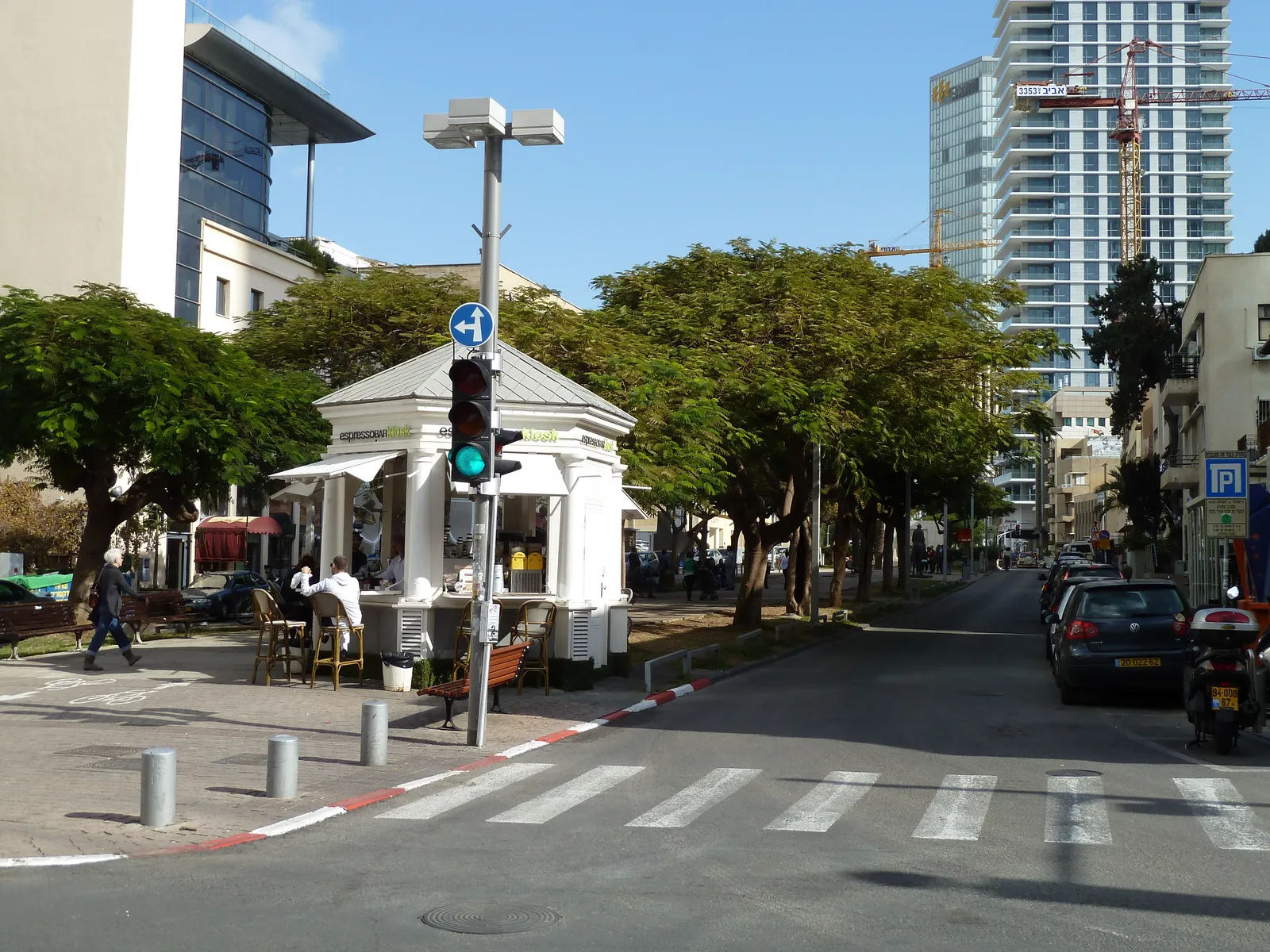
The original came down in the late 1980s and the replica standing on the corner now was put up in the 2000s, selling coffee instead. It is small, it is easy to walk past, and it is the oldest idea on the boulevard.
A cycle lane runs the length of the central strip
The middle of Rothschild is a linear park rather than a median: a walking path and a marked bike lane side by side, under two rows of broad flat-crowned trees that close overhead for most of the distance, with benches and kiosks spaced along it and traffic running one way on each side. It is the shadiest route through the centre of the city, which is why it is busy at two in the afternoon in August when the parallel streets are empty.
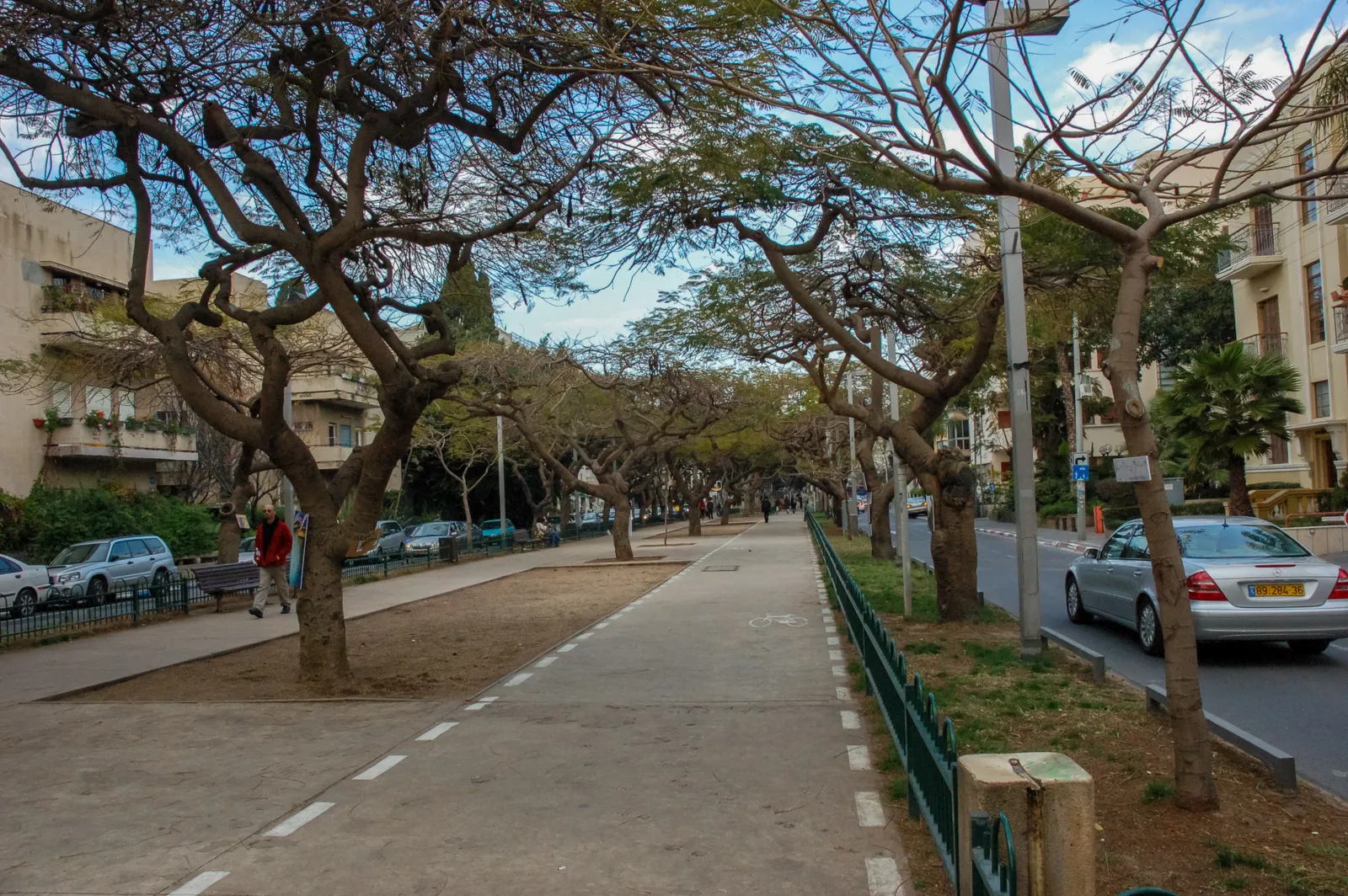
The cycle lane is the thing to be aware of if you are carrying anything: it runs the full length, the riders on it are commuting rather than sightseeing, and the walking path beside it narrows at the crossings where the two are squeezed together.
Number 16 is the address with the history on it, the house where independence was declared on 14 May 1948, though the building has been shut for restoration for years with the reopening pushed back more than once. The rest of the boulevard makes its case collectively instead: block after block of rounded corner balconies, ribbon windows and flat roofs, part of the area UNESCO listed in 2003.
No station stands on the boulevard itself
The nearest platforms are on the Ayalon corridor about two and a half kilometres east, and a direct train from any of them reaches Ben Gurion International Airport (TLV) in roughly 20 minutes for NIS 13.50. The light rail’s Carlebach stop is a few minutes from the middle of the boulevard and runs through to Savidor Center for NIS 8, which is the simplest way to cover the first leg; both it and the trains stop from Friday afternoon until Saturday after dark. With more than four or five hours free, the boulevard on its own is too small a target, and the seafront, Carmel Market and Old Jaffa are all within a couple of kilometres of its southern end.
Frequently asked questions
What should I do during a layover near Rothschild Boulevard in Tel Aviv?
Walk it end to end and stop at the two fixed points. Habima Square closes the northern end, with the national theatre, the Israel Philharmonic's concert hall and a contemporary art pavilion standing around a sunken garden that is free to sit in. At the southern end, the corner of Rothschild and Herzl Street holds a replica of the first kiosk Tel Aviv ever had, put up in 1910 to sell fizzy drinks to the men building the city. In between is roughly a kilometre and a half of tree-covered central strip lined with 1930s blocks. Two or three hours covers it comfortably and nothing on the route charges admission.
Can you walk the whole length of Rothschild Boulevard?
Yes, and the central strip runs almost the entire way without a break. It starts near Neve Tzedek in the south and finishes at Habima Square in the north, about a kilometre and a half, on a flat paved path under a continuous canopy of broad-crowned trees. Road crossings interrupt it every block or so and those are the only places you leave the strip. Walking one way and coming back along the pavement on either side gives you the building facades at close range, which the middle of the boulevard does not.
Is Rothschild Boulevard shaded enough for a hot afternoon?
More than anywhere else in central Tel Aviv, which is most of the reason locals use it as a route rather than the parallel streets. The two rows of trees down the central strip meet overhead for long stretches, so the path underneath stays in shade through the middle of the day while the roadway on either side does not. The kiosks along it sell cold drinks and have tables in that shade. In July and August this is the one walk in the city centre that works at two in the afternoon.
Which building on Rothschild is worth stopping at?
Number 16, the house where Israel's independence was declared on 14 May 1948, is the one with the history, though it has been shut for a long restoration whose completion date has moved more than once, so check before planning around it. Beyond that the boulevard is not about single buildings but about the run of them: rounded corner balconies, long horizontal window bands, flat roofs and narrow vertical strips of glass over the stairwells, repeated block after block. The stretch between Herzl Street and Sheinkin has the densest concentration of it.