Giza Layover: The Grand Egyptian Museum
Part of the full Giza and Downtown Cairo on a CAI Layover
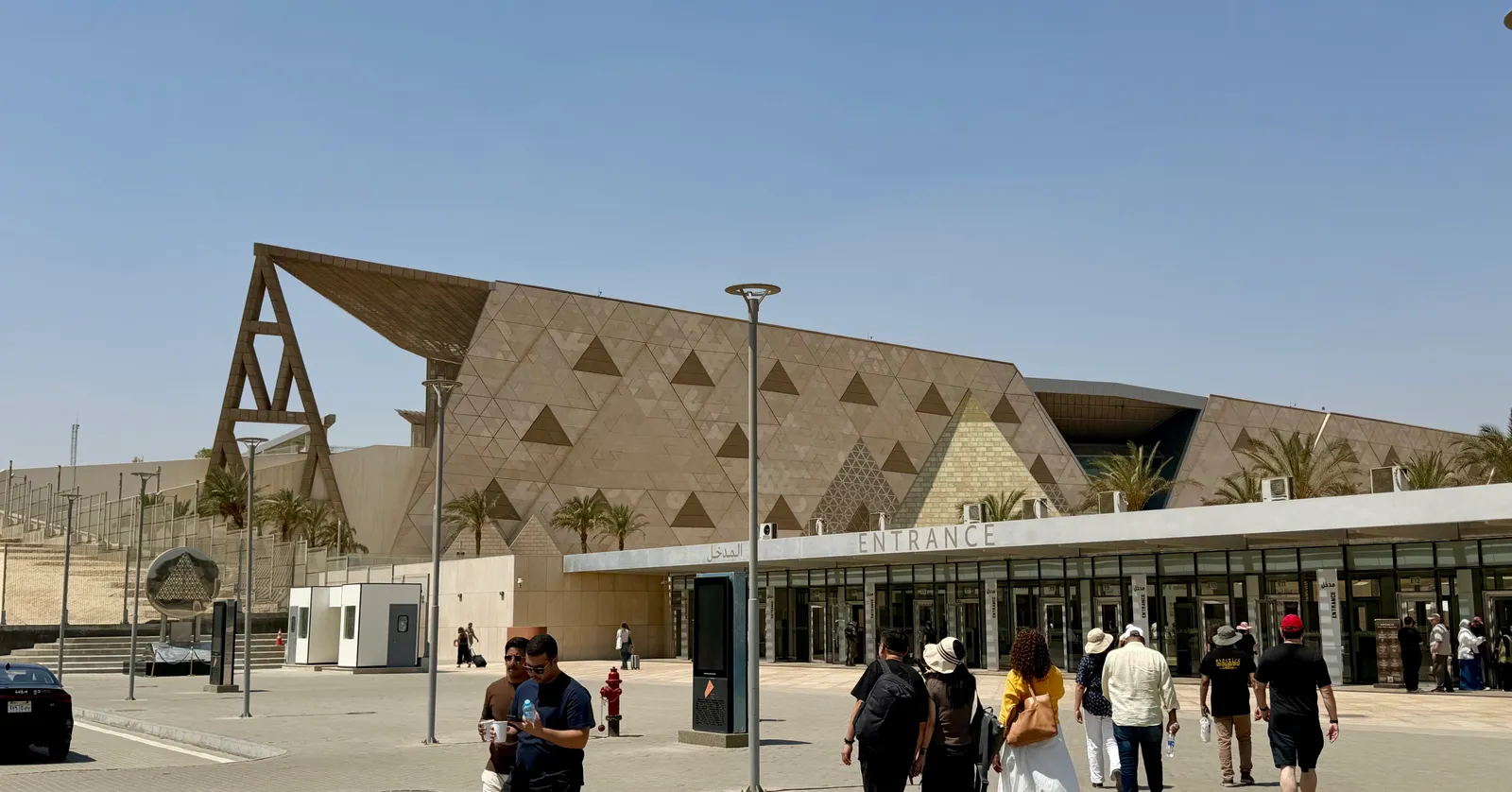
The Grand Egyptian Museum sits on the Fayoum road at Giza with an 87-tonne granite obelisk hanging on four columns outside its entrance, Khufu’s 43-metre cedar ship inside it, and a 1.27 km walkway running from its forecourt to the Sphinx and the pyramids.
An 87-tonne obelisk hangs on four columns in the entrance plaza
The obelisk standing in front of the museum came from Tanis in the Delta and carries the titles of Ramses II down its shaft. It is about 16 metres tall and weighs in the region of 87 tonnes, and instead of setting it on the ground the museum lifted it onto four columns, leaving the underside of its base open and a space beneath it where people can walk in and look straight up. Cut into that base is a cartouche of Ramses II that nobody had seen for more than three thousand years, because for all that time it was face down on a plinth.
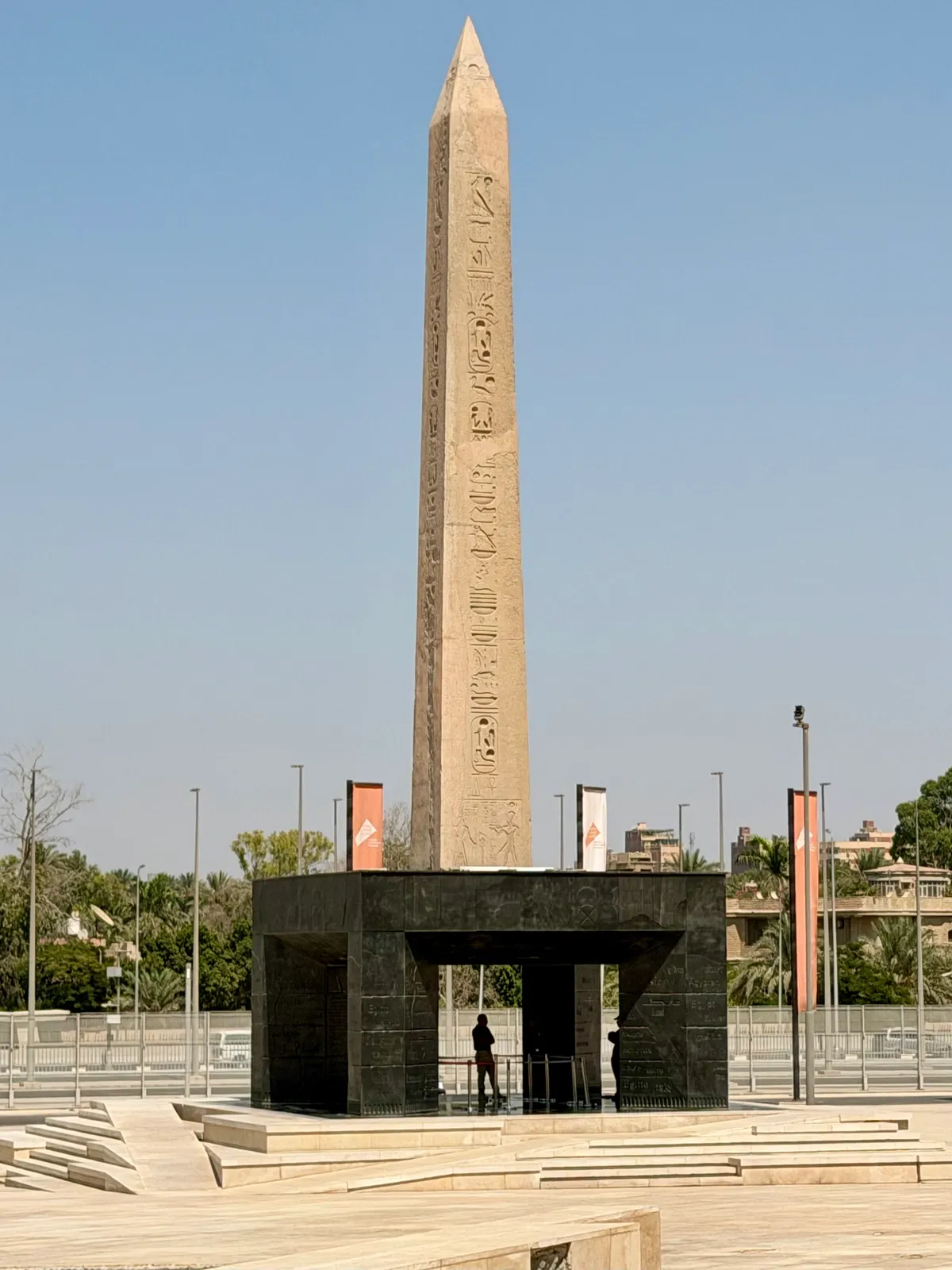
It sits outside the ticket line, in the open plaza, so it costs nothing to stand under. Inside, the collection runs to 81,000 square metres of floor, and a guided visit that takes in both the museum and the plateau is the version of this that does the timing for you when a flight is waiting at the other end.
Khufu’s cedar ship crossed 7.5 kilometres to get here in 2021
Workmen clearing rubble on the south side of the Great Pyramid in 1954 found a sealed pit holding 1,224 pieces of Lebanon cedar, which turned out to be a boat taken apart and buried in order. Reassembled, it runs 43 metres from stern to prow and is the oldest intact vessel that survives anywhere. It spent decades in a museum built directly over its own pit, and in August 2021 it was moved the 7.5 kilometres to the new galleries inside a sealed metal cage on a remote-controlled transporter brought in from Belgium, a journey that took 48 hours at walking pace.
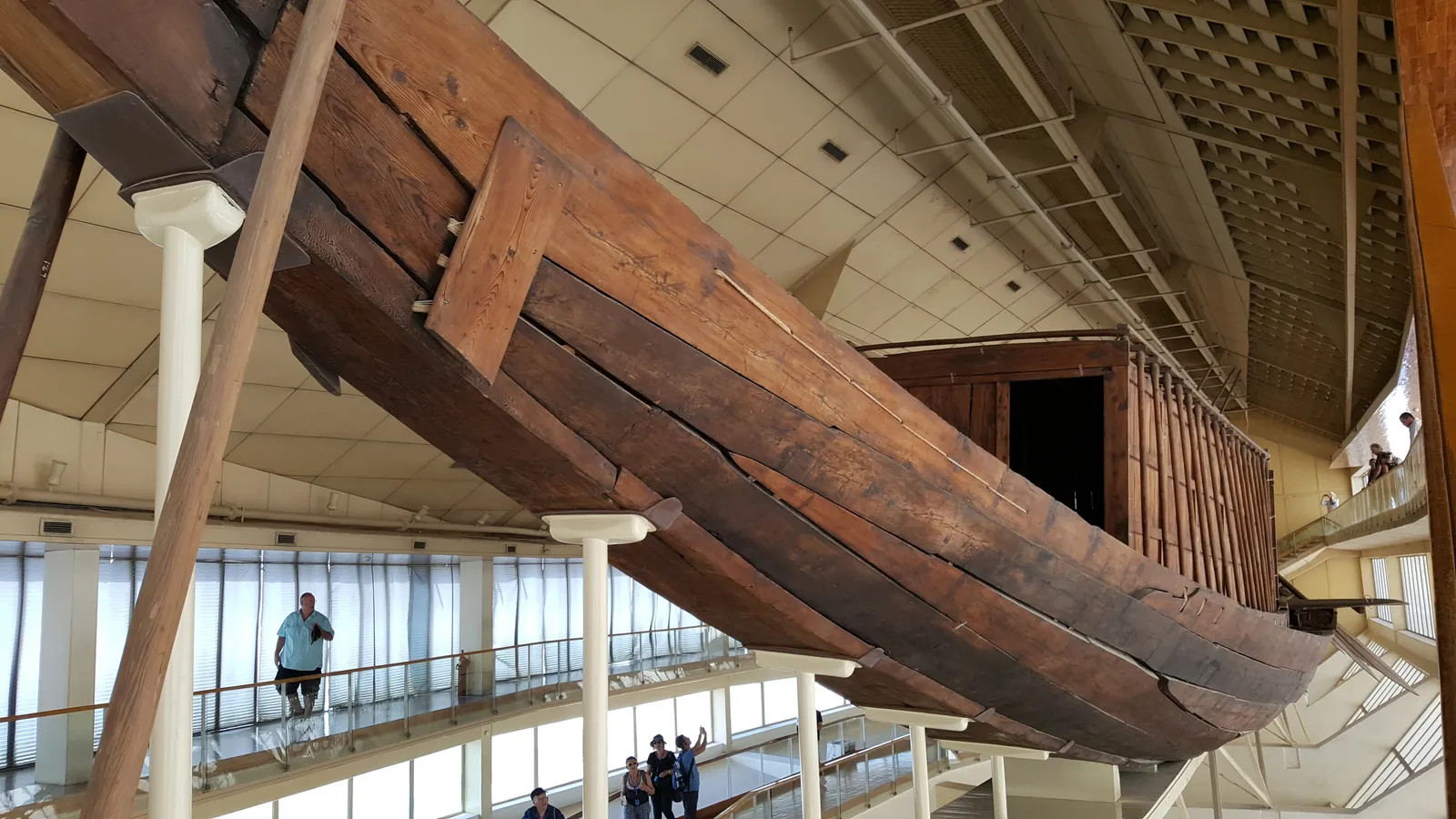
Nothing larger than 40 by 40 centimetres goes into the galleries here, so a suitcase means the cloakroom queue on the way in and again on the way out.
The Sphinx was cut down into the rock, not built up from it
Every other monument on the plateau was quarried, hauled and stacked. The Sphinx was made the opposite way: masons cut a horseshoe-shaped trench into a limestone knoll and left the lion in the middle of it, which is why it sits below the level of the ground you approach it across, roughly 73 metres long and 20 metres high with the pyramid of Khafre lined up behind its head. Khafre’s valley temple stands immediately to the south, built of granite blocks so large the roofing slabs had to be floated in from Aswan.
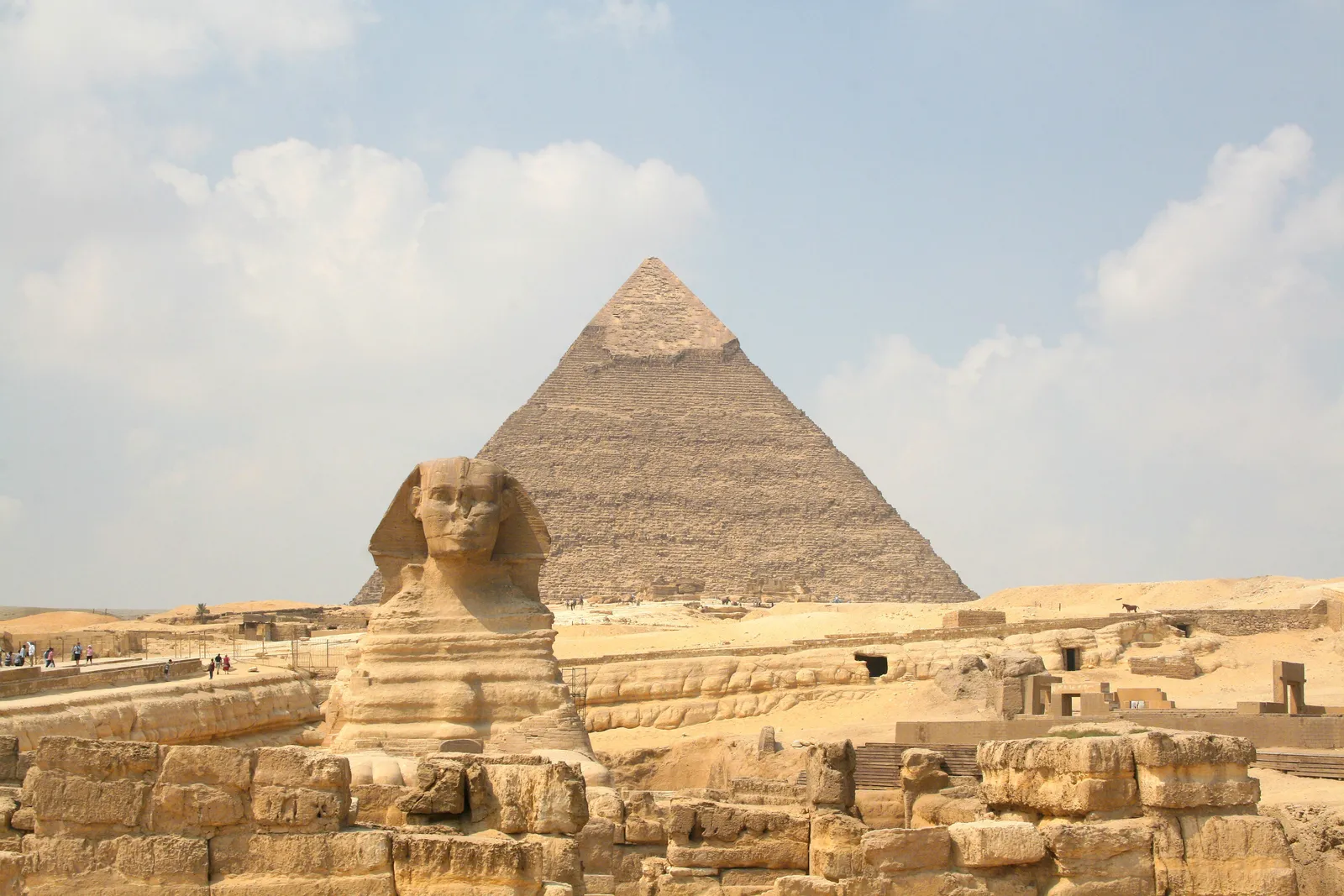
Between its paws is a granite slab set up by Thutmose IV, recording a dream in which the Sphinx promised him the throne if he cleared the sand that had buried it to the neck. It had to be dug out again more than once after that.
The pyramids line up in one frame from the desert south-west of Menkaure
The three large pyramids and the smaller satellite pyramids beside them only read as a single row from the open ground beyond the field, on the rise of sand south-west of Menkaure’s pyramid. From inside the complex they block each other; from out there, there is nothing but desert in front of them and the whole necropolis sits on one horizon.
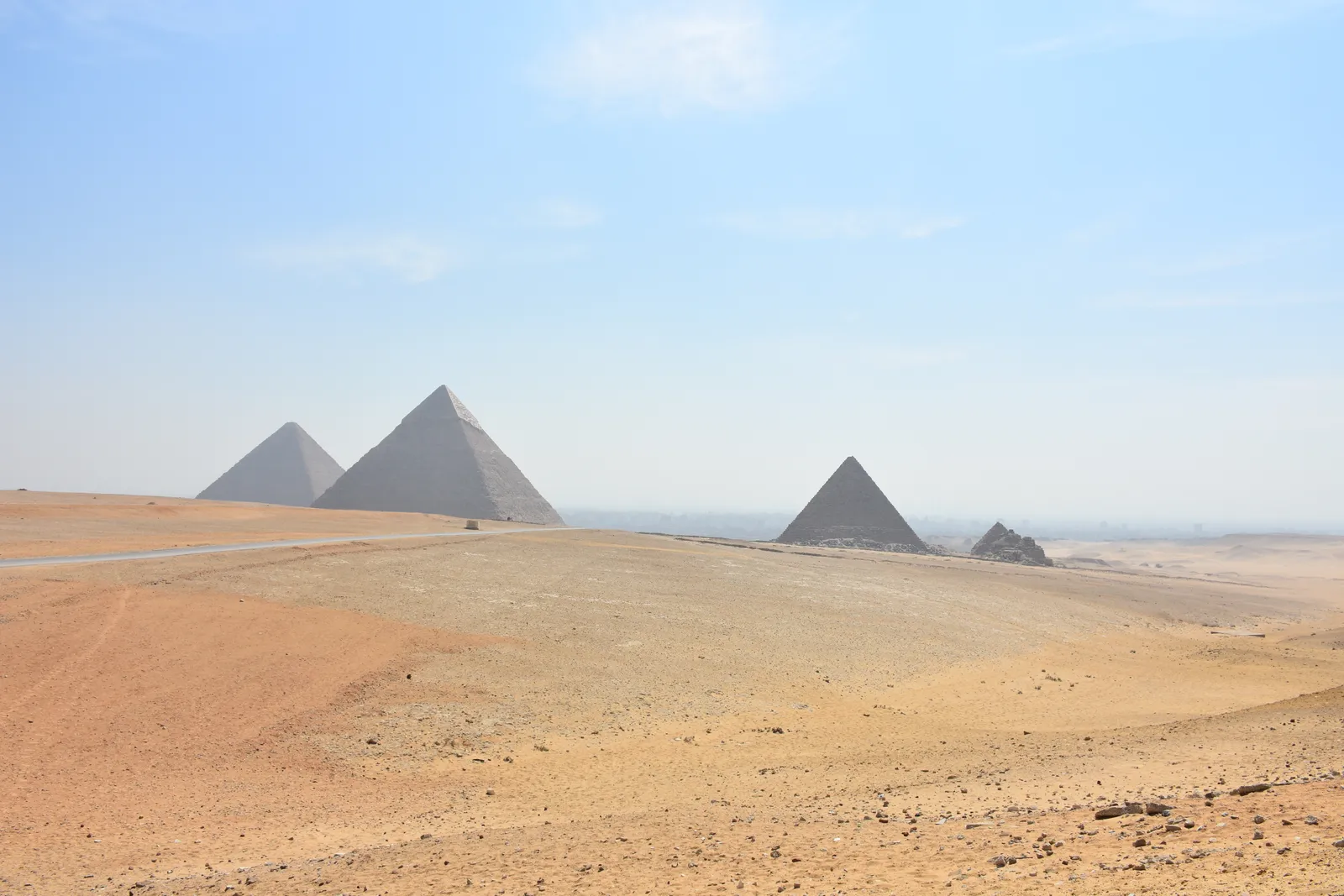
Reports differ on whether you can reach it on foot or whether a camel, a horse cart or a car is required, and the twenty-minute walk across open sand is not a summer proposition in any case, so settle it with your driver rather than at the gate.
The plateau gate shuts at 4pm and the museum at 5pm
Last entry to the Giza plateau is 4pm, with the gate opening at 7am, and the Grand Egyptian Museum takes its last visitors at 5pm on most days, staying open until 9pm on Wednesdays and Saturdays. Those two numbers are what decide the order you do this in, since the plateau closes first.
Getting back from here to Cairo International Airport is the long leg: about 45 kilometres, right across the width of the city, and no rail line covers any of it. A taxi or a ride-hailing car is the only sensible option and the standing advice is to allow three hours from Giza, against two from the centre. If the gap between flights is not long enough to absorb that, the downtown Cairo itinerary is the shorter trip to make instead.
Frequently asked questions
What should I do during a layover near the Grand Egyptian Museum in Cairo?
Treat the museum and the plateau as one stop, because the walkway between them makes that possible. Start at the suspended obelisk in the entrance plaza, which is free to stand under before any ticket is checked, then the Tutankhamun galleries and Khufu's cedar ship inside. Walk or ride the shuttle to the plateau for the Sphinx and the pyramids themselves, and if a car is taking you around, the open desert south-west of Menkaure's pyramid is where the whole line of them fits in one frame. Going inside the Great Pyramid is the piece to drop first: it is a separate ticket and a separate queue.
Does one ticket cover both the museum and the pyramids?
No, they are sold separately and priced very differently. The Grand Egyptian Museum is around 1,590 EGP for a foreign adult with a timed entry slot booked in advance; the Giza plateau is 700 EGP and covers the exteriors of all three pyramids and the Sphinx. The 1.27 km walkway between the two is the one thing that is included in either ticket, along with the electric shuttle that runs the same route, so you do not pay again to move between them.
Can I take a suitcase into the Grand Egyptian Museum?
Not into the galleries. Anything larger than 40 by 40 centimetres has to go into the cloakroom before security, which is free to use, and it has to be collected again before closing time on the same day. The practical effect on a flight day is two extra queues in a building this size, one on the way in and one on the way out, plus the walk back to wherever the cloakroom sits relative to the exit you use.
Is it worth going inside the Great Pyramid?
Only with time to spare and a tolerance for tight spaces. The interior is a separate ticket on top of the plateau fee, currently 1,500 EGP, the daily allocation is limited, and the climb up the Grand Gallery is a stooped one through a low, warm, unventilated passage with nothing decorated to look at when you get there. Private tours that include the interior bundle the extra ticket, which saves working out the queue on the day.