Cairo Airport Layover: The Baron's Palace
Part of the full Giza and Downtown Cairo on a CAI Layover
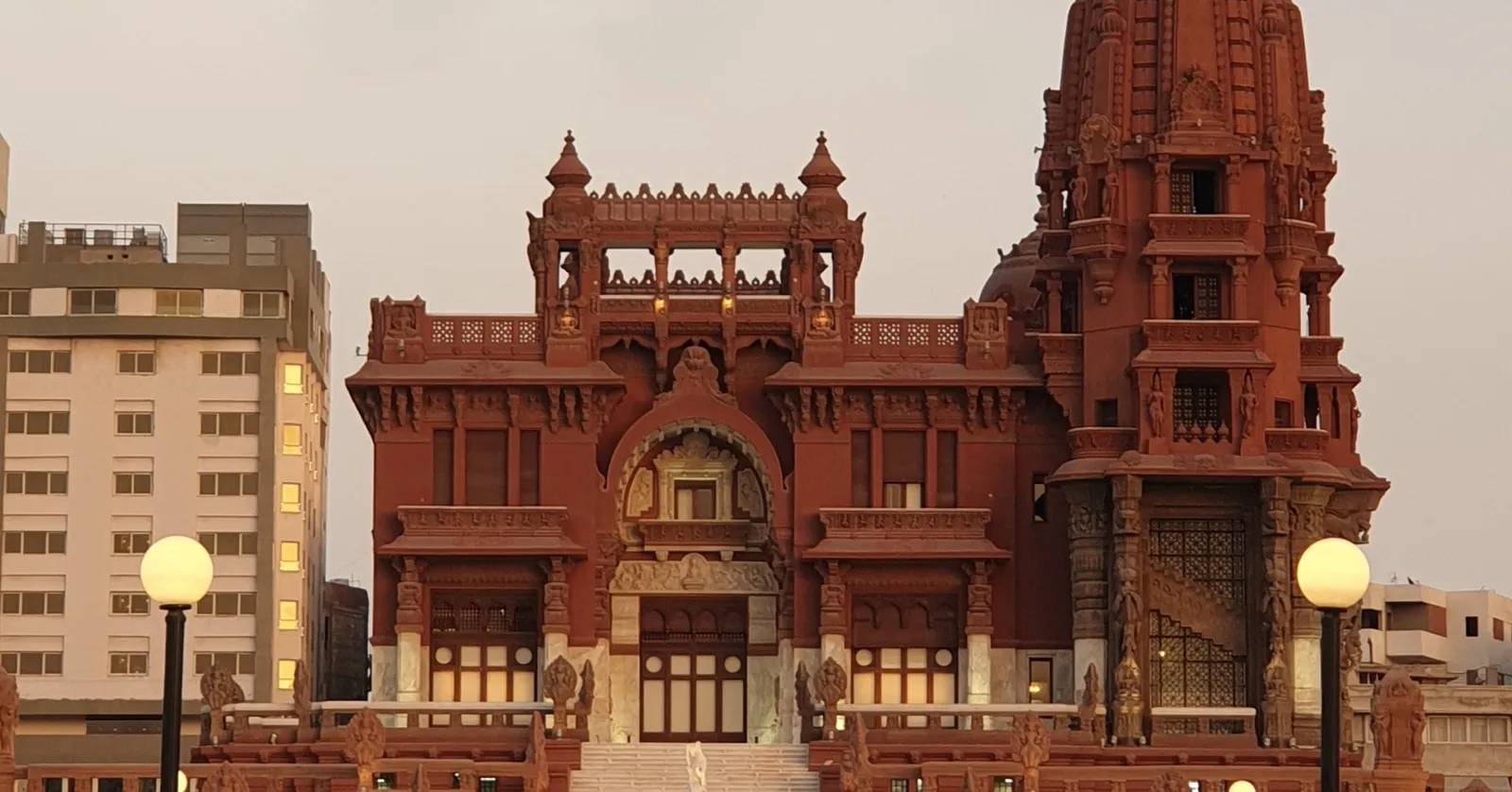
Fifteen minutes down Orouba Street from Cairo International Airport, the Baron Empain Palace stands in Heliopolis as a concrete copy of a Cambodian temple, with the suburb’s domed basilica and the arcaded shopfronts of Korba a few blocks beyond it.
The Baron Empain Palace copies a Cambodian temple in concrete
Orouba Street is the road between the airport and the city, and the palace sits directly on it, on the Heliopolis side. Édouard Empain, the Belgian industrialist who bought 25 square kilometres of desert here in 1906 and built a suburb on it, had the French architect Alexandre Marcel design him a house between 1907 and 1911, drawing on Angkor Wat and the Hindu temples of Orissa. It came out as a squat red tower block of galleries and turrets in reinforced concrete, with elephants, lions, snakes and figures of Buddha, Shiva and Krishna worked into the balustrades, standing on a corner in a Cairo suburb where nothing else looks remotely like it.
The palace was abandoned after 1929, bought by the Egyptian state in 2005, and opened to visitors on 30 June 2020 after a restoration that put the deep red back on the concrete. Entry is 100 EGP for foreign visitors and the roof terrace is a separate 50 EGP. Opening hours are 9am to 4pm, which is the constraint that decides whether this trip works at all: an overnight connection gets you nothing here.
A run out to Giza needs eight hours between flights
Forty-five kilometres of city separate the terminals from the pyramid plateau, and Cairo traffic is what makes that number unreliable rather than the distance itself. Half-day guided trips exist for exactly this gap, and tours with pickup included are the version that makes sense when there is a flight at the end of it, since the driver is the one watching the clock. A shorter alternative in the same direction is a half-day run to the Egyptian Museum and the Citadel, which stays inside the city rather than crossing to its western edge.
Below eight hours, none of that is worth starting, and the downtown-and-Giza itinerary is the one to save for a longer stop. Heliopolis is the version that fits a genuine connection.
The Heliopolis basilica is built on the plan of Hagia Sophia
Alexandre Marcel designed the church on Al-Ahram Square as well, and finished it in 1913 in a completely different register from the palace: a Byzantine Revival co-cathedral with a great recessed arch over the entrance and a dome on a drum behind it, worked out from the plan of Hagia Sophia. Empain is buried in the crypt underneath, along with members of his family, which is a plain enough arrangement for a man who owned the ground the church stands on.
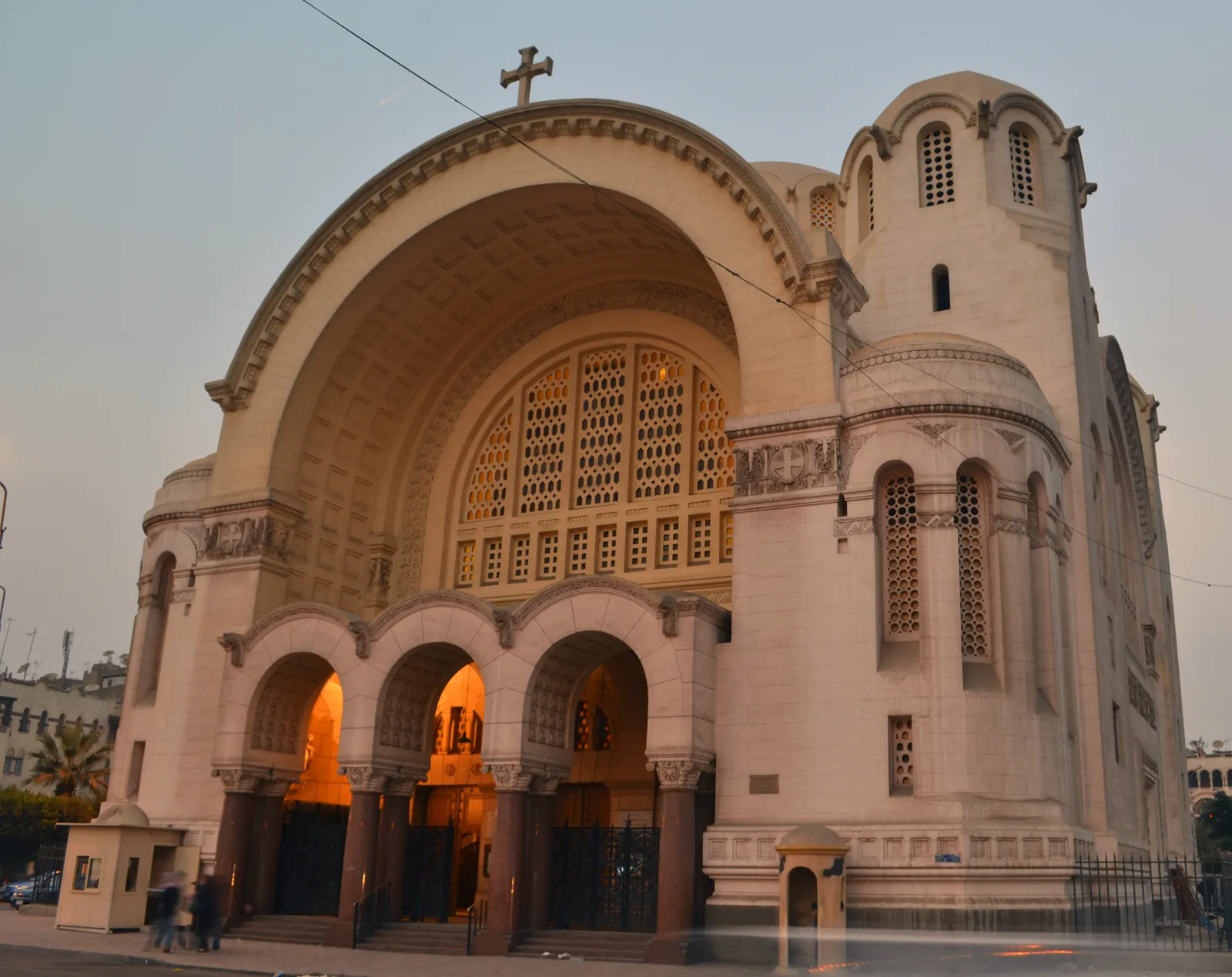
It costs nothing to walk into, and services aside it is usually quiet, which is not a common combination this close to a major airport.
Korba’s arcaded shopfronts along Baghdad Street
Korba is the original commercial centre of Empain’s suburb, and its signature is the arcade: ground floors set back behind continuous runs of horseshoe arches, so the pavement on Baghdad Street and Ibrahim al-Laqqani Street is covered for most of its length. The buildings above them mix Moorish arches and balconies with European apartment planning, which was the brief Empain gave his architects, and enough of the original fabric survives to make the walk worth the twenty minutes it takes.
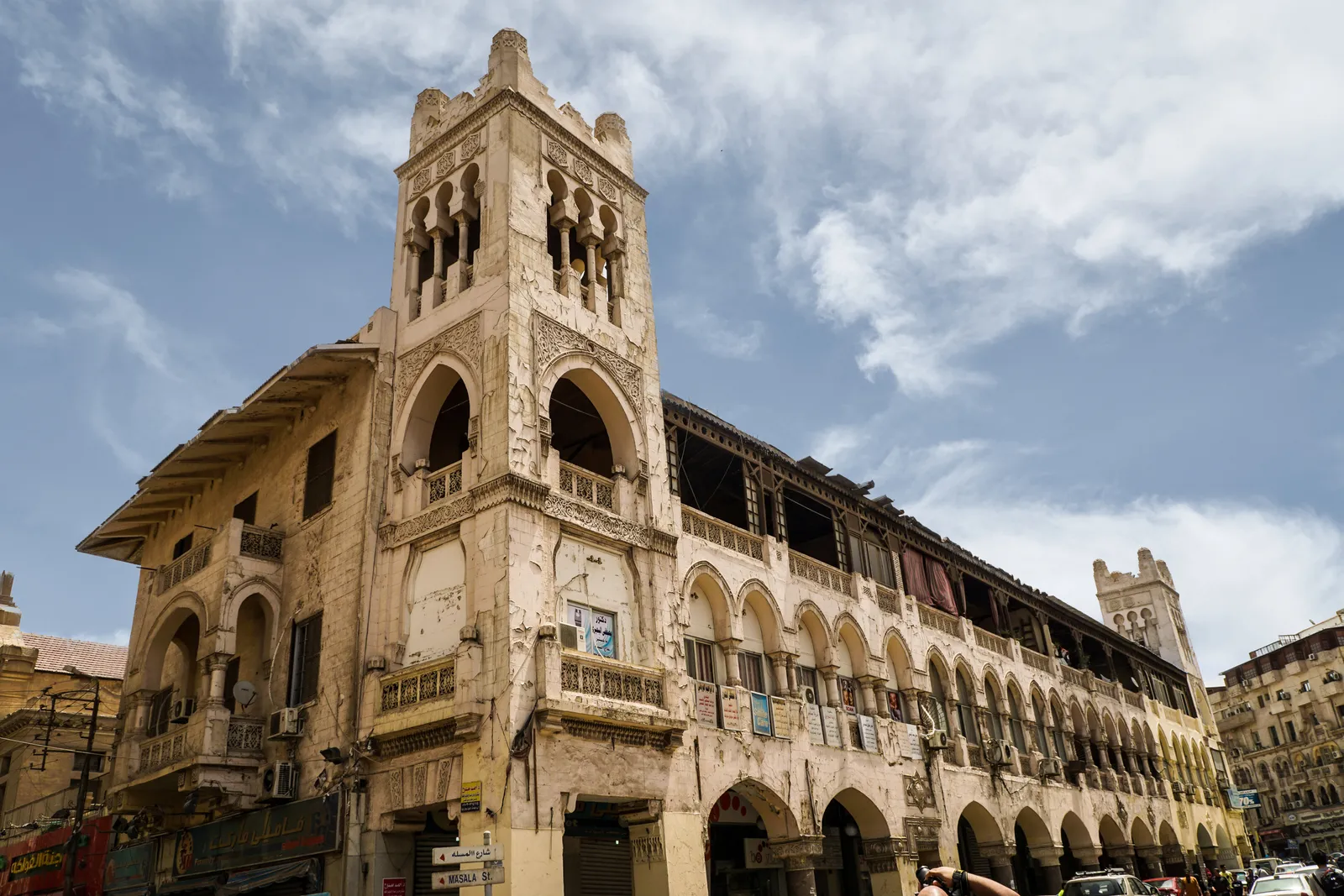
Le Paradis des Fleurs at 20 Baghdad Street has been a flower shop since 1938 and is still run as one, which is the sort of thing the arcades were built for and mostly no longer hold. Getting between any two stops out here is a taxi, and getting back to the gate means the airport’s loop shuttle on top of that, so a suitcase gets lifted in and out four or five times over a short trip.
The free shuttle between the terminals runs around the clock
A complimentary bus connects all the passenger terminals with each other and with the airport bus station, every 15 to 30 minutes, 24 hours a day. It is a loop rather than a point-to-point service, so the wait is the variable, not the ride. From the bus station, the 356 runs into Midan Tahrir and Ramses roughly every half hour and the 111 heads the same way towards Shubra, both for a few pounds in cash.
Terminal 3 has one other useful feature for a connection with nowhere to be: a 230-metre covered skyway with a moving walkway runs from it straight into a hotel, so a room, a pool and a restaurant are reachable without going outdoors or through a taxi rank. On a gap too short for Orouba Street, that is the honest alternative to sitting at the gate.
Frequently asked questions
What should I do during a layover near Cairo International Airport?
Heliopolis, which is the suburb the airport was built on the edge of. The Baron Empain Palace on Orouba Street is 15 minutes out by car, a 1907 concrete mansion modelled on Angkor Wat and the Hindu temples of Orissa, open 9am to 4pm and 100 EGP for foreign visitors. The basilica a few minutes further on is free to walk into and holds the tomb of the man who built the suburb, and the arcaded streets at Korba are the place to sit down for half an hour before heading back. With less than about three hours between flights, stay landside at the terminals instead.
Do I need a visa to leave Cairo International Airport for a few hours?
Yes, and it is the same visa as any other visitor. Passport control at Cairo is where you clear entry, so a few hours outside the terminal needs an entry visa, not a transit exemption. Since 1 August 2026 the visa on arrival here is issued as a QR code rather than a paper sticker, sold at self-service machines in the arrivals hall or online beforehand, and it costs US$36 paid by card. Nationals of the EU, the United States, Canada, Japan and South Korea are among those eligible to buy one on arrival; anyone who is not on that list needs a visa arranged in advance.
Is the rooftop ticket at the Baron Empain Palace worth the extra?
Only if the clock allows it. The palace itself is 100 EGP for foreign visitors and the roof terrace is a separate 50 EGP on top, which buys the view along Orouba Street and a close look at the carved turrets that are hard to read from the ground. On a short connection the interior alone is the better use of the time: the ground-floor rooms and the spiral staircase are the part that explains the building.
Can I reach the Giza pyramids from the airport on a short connection?
Not on a short one. The plateau is about 45 kilometres away across the whole width of the city, and Cairo traffic turns that into an hour or more in each direction, before the visit itself and the airport buffer. Eight hours between flights is the realistic floor, which is what the full Cairo itinerary is sized around. Under that, Heliopolis is the honest answer.