Salona, the Roman Capital Outside Split
Part of the full Diocletian's Palace on a Split Layover (SPU)
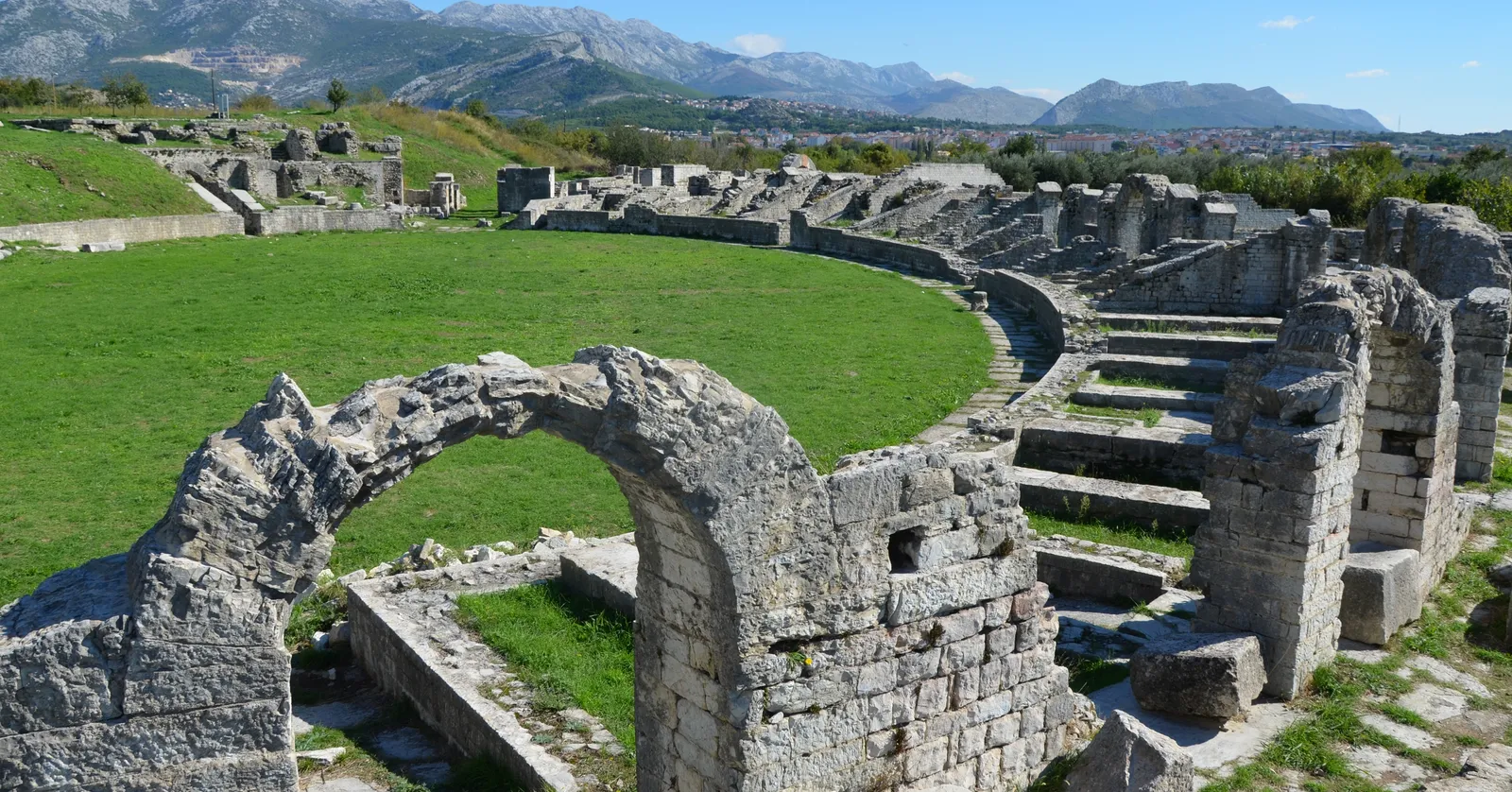
Salona, five kilometres inland from Split at Solin, was the capital of Roman Dalmatia and the city Split grew out of, and its amphitheatre, its cemetery basilica at Manastirine and the excavator’s house at Tusculum all sit inside one fence.
The amphitheatre the Venetians pulled down
Salona held something like 60,000 people at its height, possibly more, which made it one of the larger cities of the late empire and the capital of the province of Dalmatia; Diocletian was born here, and built his retirement palace on the coast five kilometres away rather than move far. The amphitheatre went up in the second half of the 2nd century at the western end of town, seating fifteen to eighteen thousand, and gladiators were still fighting in it into the 5th. During Diocletian’s persecutions it was also where Christians were executed.
It came down in the 17th century, and not by decay: Venetian commanders demolished it during the wars with the Ottomans so that a besieging force could not use the standing structure as cover. What is left is the oval, the lower arches, and enough of the seating tiers to read the shape. If you would rather have the whole area covered with someone explaining it, a guided half-day takes in Salona, Klis and Trogir together.
Manastirine, the cemetery basilica over the martyrs’ graves
Manastirine lies outside the old city walls at the eastern end of the site, where Roman law put the burials. Christians were buried around the graves of the martyrs executed in the amphitheatre, and by the 4th century a basilica had been raised over them. Among those graves was Domnius, the bishop of Salona put to death in 304; his remains were later carried down to the coast and installed in Diocletian’s own mausoleum, which is how the emperor’s tomb became Split’s cathedral and is named after a man his administration executed.
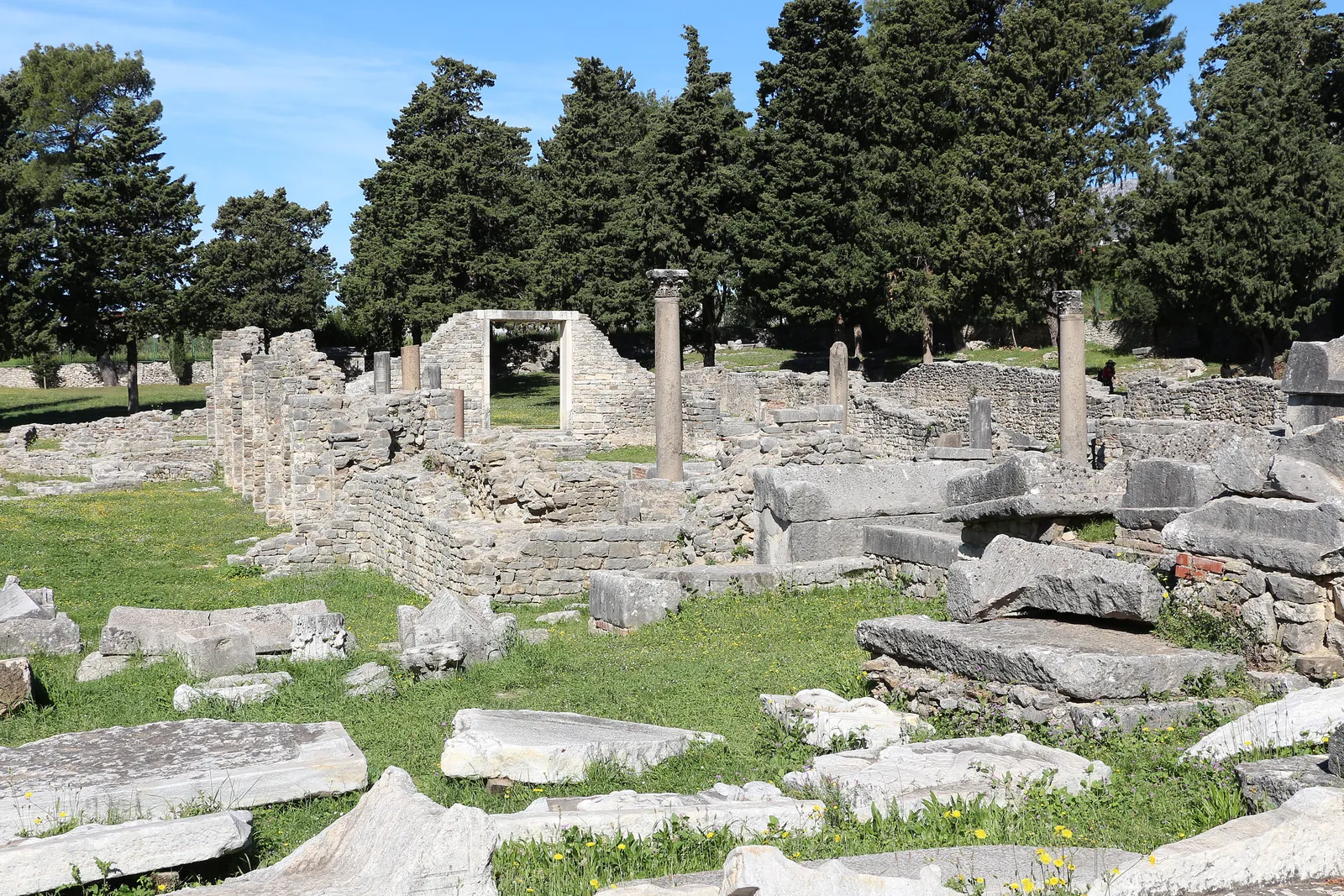
One grave here is modern and easy to walk past. Don Frane Bulić, the archaeologist who spent his career excavating Salona, arranged to be buried on the western side of Manastirine under a cypress, among the martyrs he had spent decades uncovering, in a sarcophagus he had inscribed for himself on his fiftieth birthday. The city’s own tourist office points it out; almost nobody looks for it.
Tusculum, the house built in the middle of the ruins
Bulić put up Tusculum in 1898, a stone house in the middle of the excavation, partly as a working base and partly so visiting scholars had somewhere to stay. He set Roman sarcophagi and column fragments around the garden, which is either scholarly display or the world’s most confident rockery depending on your view.
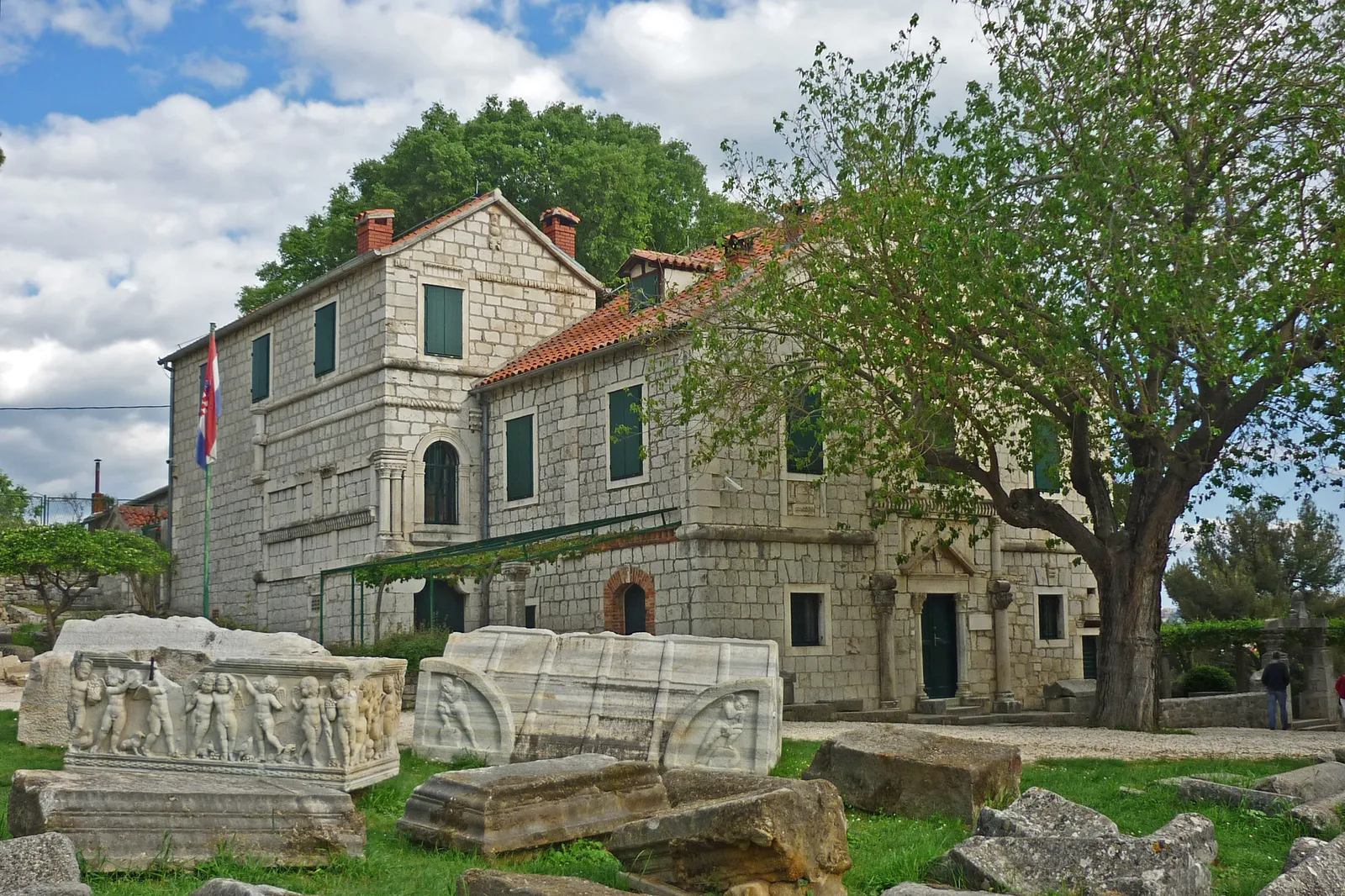
It still does the job. The ground floor holds a small memorial collection about Bulić and his era, and the floor above is working space for the archaeologists currently digging the Solin area. The same year he built it, he found the sarcophagus of Queen Jelena, dated 976, a few hundred metres away.
One fence, one ticket hut, and a kilometre and a half of walking
The ruins run roughly a kilometre and a half from the amphitheatre at one end to Manastirine at the other, with the ticket hut at the Manastirine end and nothing in between but fields, footpaths and cut stone. Everything you carry in comes back out the same way, and there is nowhere along it to set anything down.
Getting back is a bus. Promet’s line 37, between Split and Trogir, passes through Solin and continues west past Split Airport, so it can serve as the whole return leg, though it takes an hour or more and picks up out on the main road. The steadier option is back into Split and the airport shuttle from platform 1 at the main bus station, beside the ferry berths: about 30 minutes direct, 10 euros one way or 15 for an open return. Allow 90 minutes at the terminal on top of whichever you choose.
Frequently asked questions
What should I do during a layover near Salona (Solin) in Split?
Walk the site end to end; it is fields rather than a building. The amphitheatre at the western end held 15,000 to 18,000 people and still shows its arches and seating tiers. Manastirine, the cemetery basilica at the other end, stands over the graves of the martyrs executed here under Diocletian, including the bishop Split's cathedral is named for. Between them is Tusculum, the house an archaeologist built in the ruins in 1898 and never really left. Three to four hours covers it comfortably with the bus each way; nothing needs booking, but the site closes in the late afternoon out of season.
How much does Salona cost to visit?
Around 8 euros for an adult at the gate, with a combined ticket covering Split's Archaeological Museum for a little more, which is the better value if you plan to see the finds as well as the ground they came out of. There is one ticket hut, at the Manastirine end, and the whole 1.5-kilometre spread of ruins is inside a single fence, so you pay once and walk. Hours run long in summer and close earlier through the winter.
Is Salona worth it in the rain?
Honestly, not much. This is an open archaeological park of grass, gravel and cut stone with no roof anywhere in it except the Tusculum house, and the paths between the basilicas turn slick and muddy fast. The stone itself becomes genuinely slippery on the amphitheatre steps. A wet afternoon is better spent in the covered half of the city than out here, and the site keeps the same hours either way.
Does the bus to Salona carry on to the airport?
Promet's line 37, the Split to Trogir service, runs through Solin on its way west and does continue past Split Airport, so in principle one bus covers both. It is slow, around an hour or more end to end, it stops constantly along the Kaštela coast, and it picks up on the main road rather than at the terminal door. The reliable alternative is to ride back into Split and take the airport shuttle from platform 1 at the main bus station: about 30 minutes direct, 10 euros one way. Luggage on the local bus is your own problem either way, as there is no hold.