Vancouver Layover at Canada Place Cruise Port
Part of the full Vancouver Layover Guide: Stanley Park, YVR
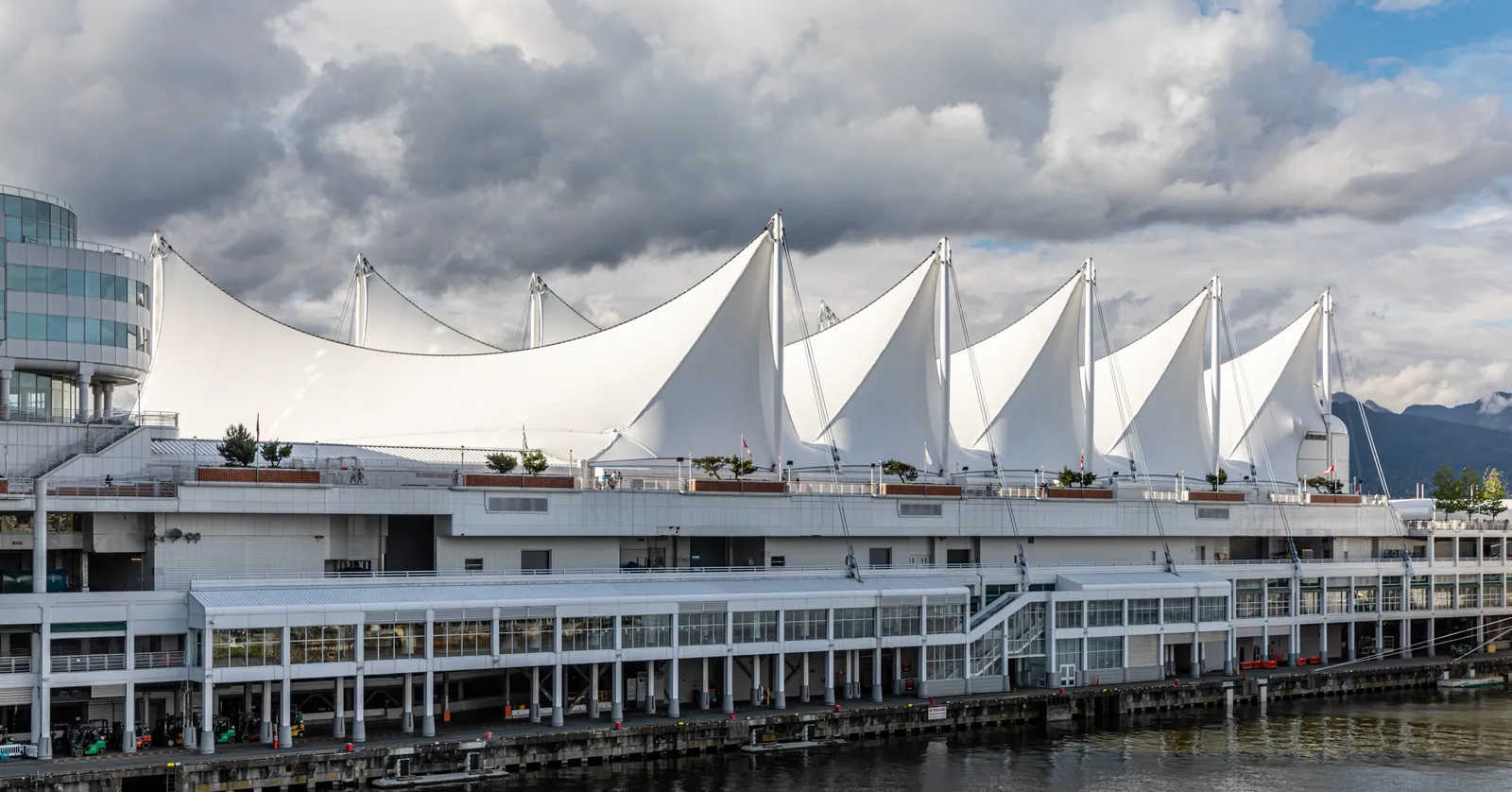
Vancouver’s Canada Place cruise terminal puts you out onto a harbour promenade at seven in the morning, with the Canadian Trail underfoot, the 2010 Olympic cauldron five minutes west on Jack Poole Plaza, and six and a half acres of planted grassland on the convention centre roof next door.
The Canadian Trail across the Canada Place promenade
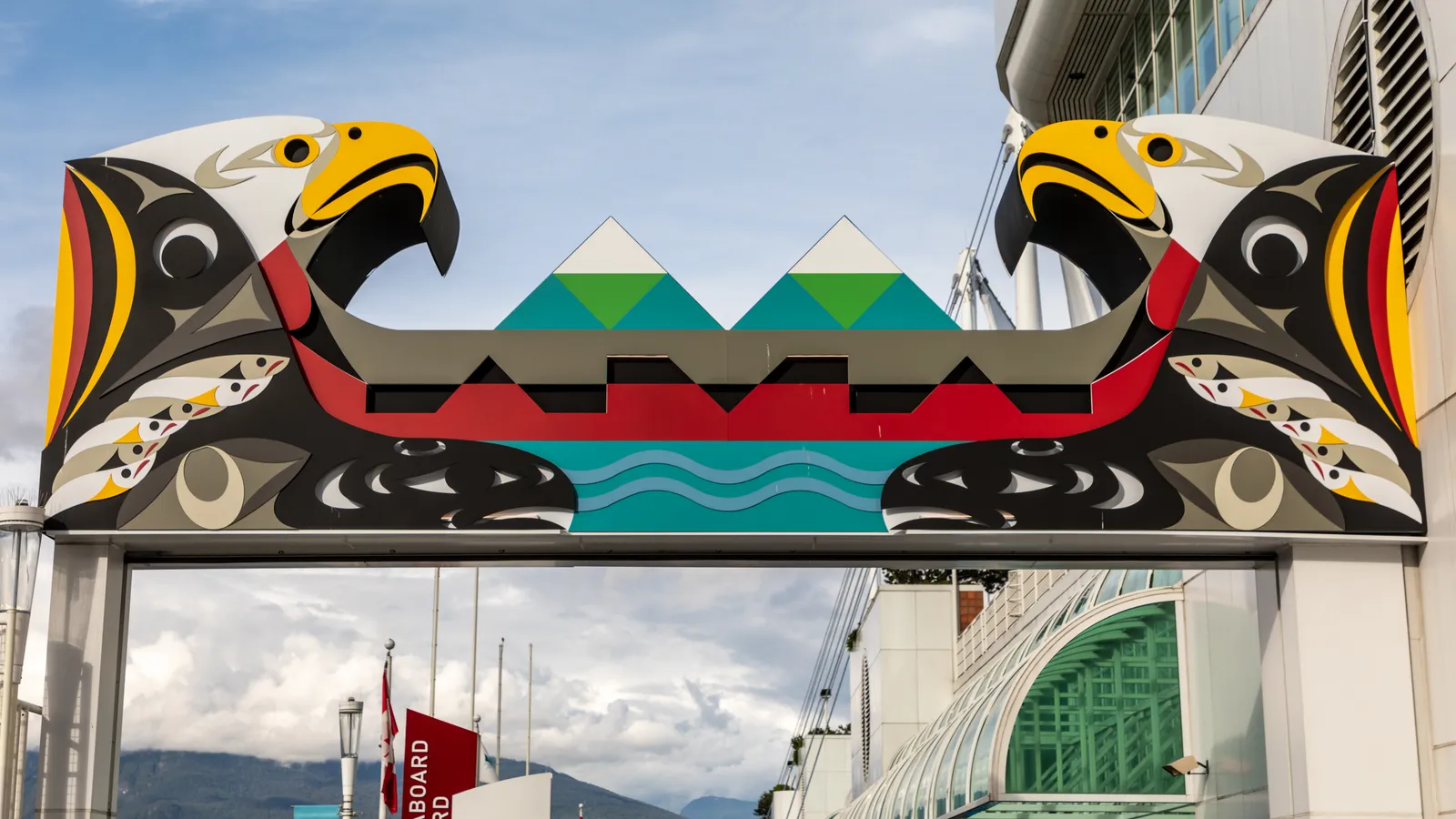
The west promenade is laid out as a walk across the country: thirteen equal stretches, one for each province and territory, marked in tile and coloured glass with the names of towns set into the paving and plaques giving each region a paragraph. It takes about ten minutes end to end if you read nothing and half an hour if you read everything, and at the west end an arch by Susan Point’s Coast Salish studio, “Salish Sea, the Journey Within”, spans the walkway with two thunderbird heads facing each other over a canoe.
Getting off a ship at seven puts you into a downtown where every museum and gallery is still shut for another three hours, so the first stretch of the morning is an outdoor one whether you planned it that way or not. Sightseeing buses pick up outside the terminal and are the low-effort way to cover ground in it; buy it before the ship docks rather than at the kerb.
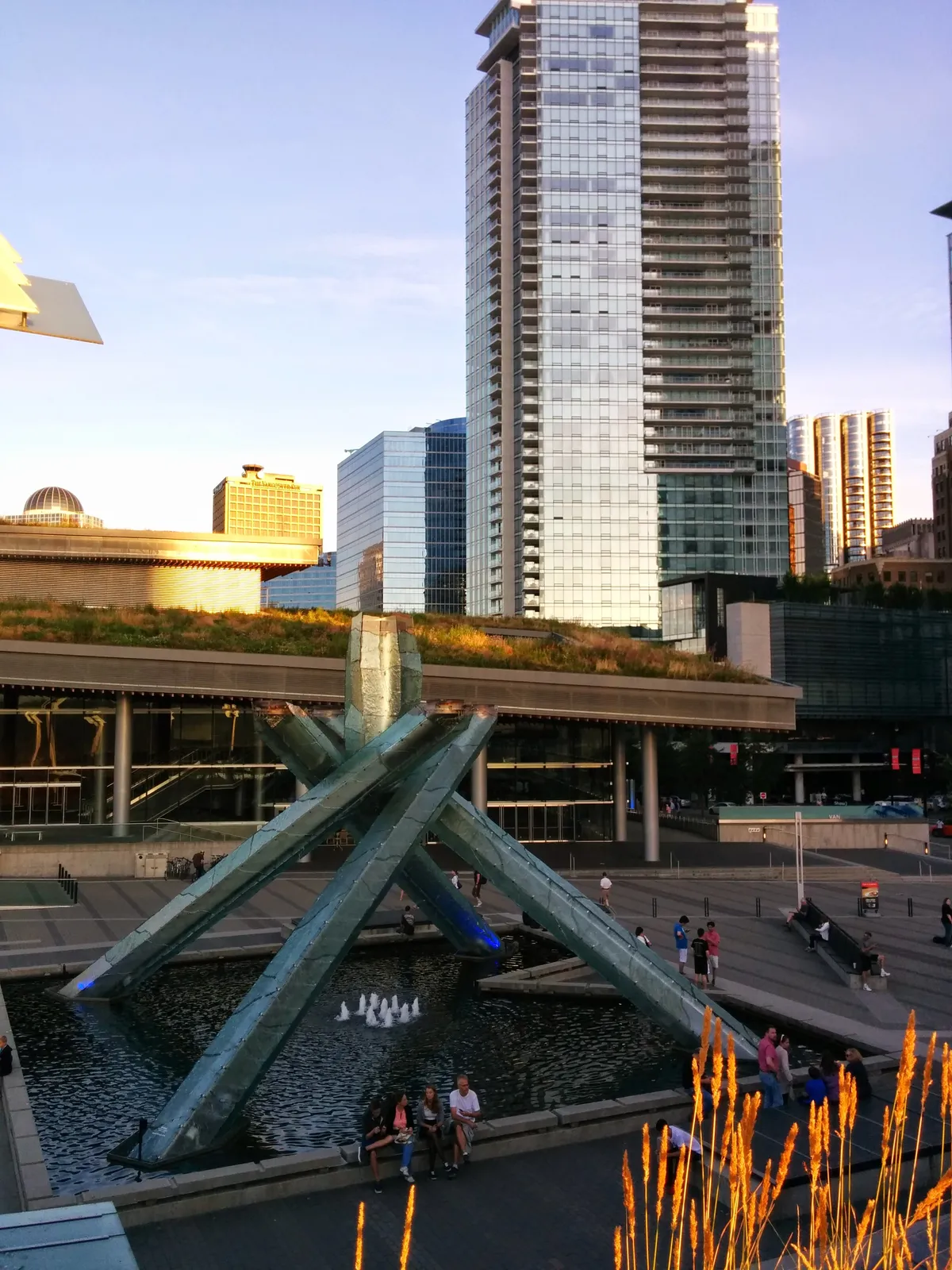
The 2010 Olympic cauldron on Jack Poole Plaza
Four angled arms of steel, polycarbonate and glass cross over a shallow pool at the western end of the plaza, 9.4 metres high with arms 16 metres long. Olympic protocol required the flame to be visible outdoors to the public rather than sealed inside a stadium, so this one was built on the waterfront and then left standing after the 2010 Games ended. It is lit only for particular occasions; the rest of the year it is a large piece of glasswork you can walk right up to for nothing.
The whole stretch from the gangway to here is open apron with nothing over it, and April and October, the two ends of the Alaska season, are wetter months than the middle of it.
Six and a half acres of grassland on the convention centre roof
The West Building’s roof is planted rather than paved: 2.6 hectares of it, sloping anywhere from 3 to 56 percent, seeded to imitate a Gulf Island coastal grassland and sitting on five million kilograms of volcanic rock and compost. It is the largest green roof in Canada. Four beehives live up there, the honey goes to the restaurant on the plaza below, and ground-nesting birds have moved in. Below the waterline, 61 metres of the building’s shoreline was built as an artificial reef for salmon and kelp.
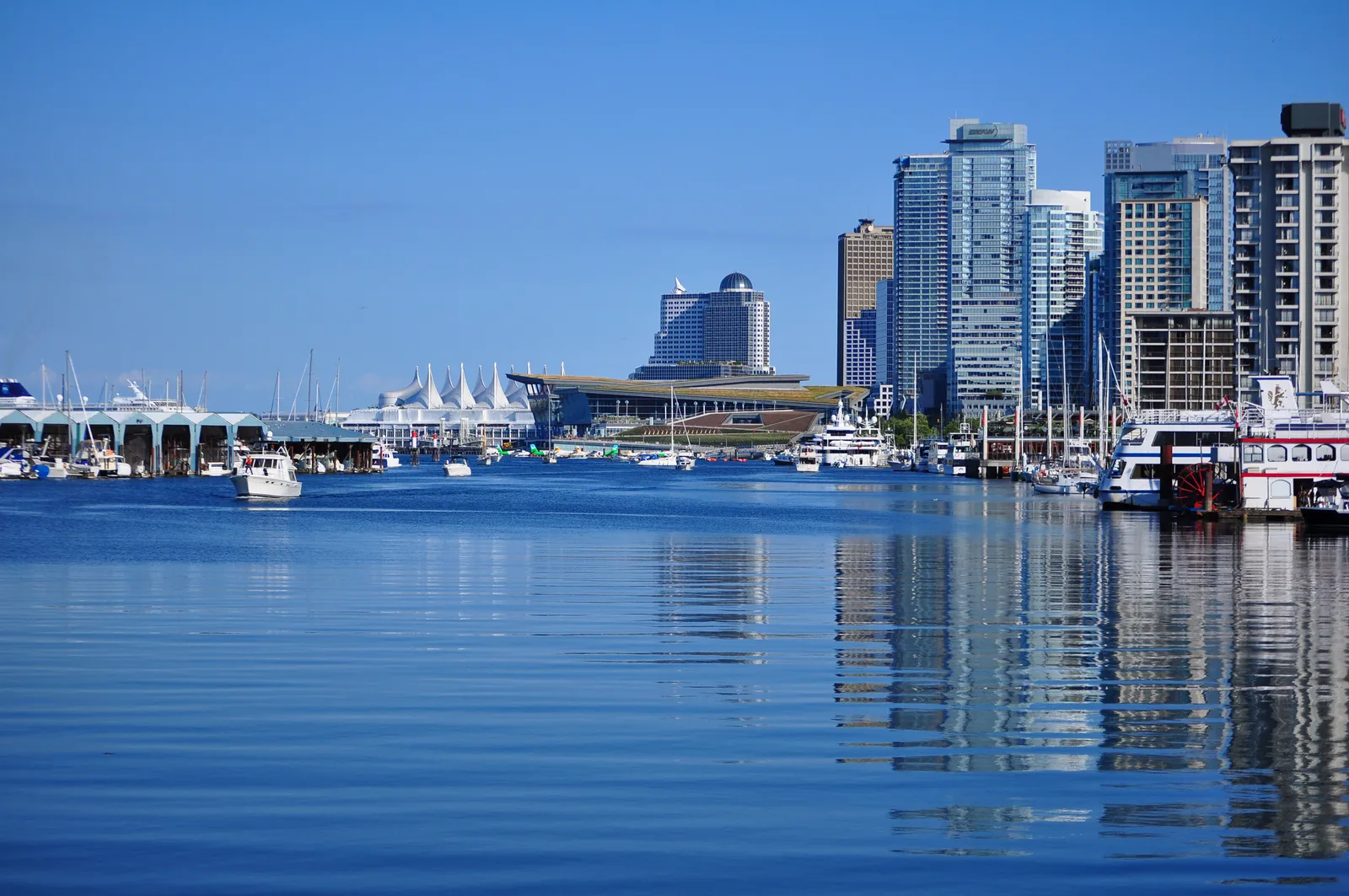
You cannot go up onto it, but the seawall runs along the water below the whole length and the slope reads clearly from the far side of Coal Harbour. Keep walking west and the same path carries on into Stanley Park, which is what the full Vancouver guide does with a longer day.
Waterfront Station is a block inland from the terminal doors
The Canada Line’s downtown terminus sits at the foot of Granville Street, five minutes on foot from the gangway with no road to cross. Trains run to YVR-Airport station in 26 minutes, every 6 minutes at peak and 8 through the middle of the day, and about 40 minutes door to door once you count the walk into whichever terminal you need. The $6.50 airport surcharge only applies to journeys that begin on Sea Island, so going this way costs the plain two-zone fare, $4.20 on a loaded card on a weekday afternoon.
Same building, incidentally, as the 1914 railway hall with the Canadian landscape murals above its columns, which is worth five minutes if you are early for your train and have nothing in your hands.
Frequently asked questions
What should I do near the Canada Place Cruise Terminal in Vancouver on a layover?
Everything worth doing here is within ten minutes of the gangway and none of it charges admission. The west promenade carries the Canadian Trail, thirteen sections of tile and coloured glass for the ten provinces and three territories, with a Coast Salish arch over one end. Jack Poole Plaza next door holds the 2010 Olympic cauldron, permanently installed and free to walk up to, and the convention centre beside it wears six and a half acres of coastal grassland on its roof. With four hours or more, a sightseeing bus pass is worth booking ahead; the rest you simply walk out into.
What time do cruise passengers actually get off at Canada Place?
Ships generally berth around 6:30am. Self-assist passengers walking their own bags off can usually start at about 6:45am, the rest go in groups between roughly 7 and 9am, and the terminal is normally clear by 9:30am. That leaves an unusually early start: at 8am nothing indoors downtown is open yet, which is exactly why the promenade, the plaza and the seawall are the right first move rather than a museum.
Does it rain on the Canada Place promenade during the cruise season?
Often enough to plan for. The Alaska season runs from April into October and the two ends of it, April and October, are meaningfully wetter than July and August. None of the promenade, Jack Poole Plaza or the convention centre seawall has anything over it, so a wet morning turns a comfortable walk into a decision about whether you want to be carrying anything at all.
How far is Canada Place from the train into the city and the airport?
Waterfront Station is a block inland from the terminal doors, at the foot of Granville Street, and it is the downtown end of the Canada Line. Trains cover it to YVR-Airport station in 26 minutes; allow about 40 door to door once you add the walk into the terminal building and the platform wait. Nothing extra is charged travelling this way, so it is $4.20 on a loaded Compass Card on a weekday before 6:30pm and $2.85 after.