Union Station Layover: Toronto's Great Hall
Part of the full Toronto Layover: CN Tower and Old Town, YYZ
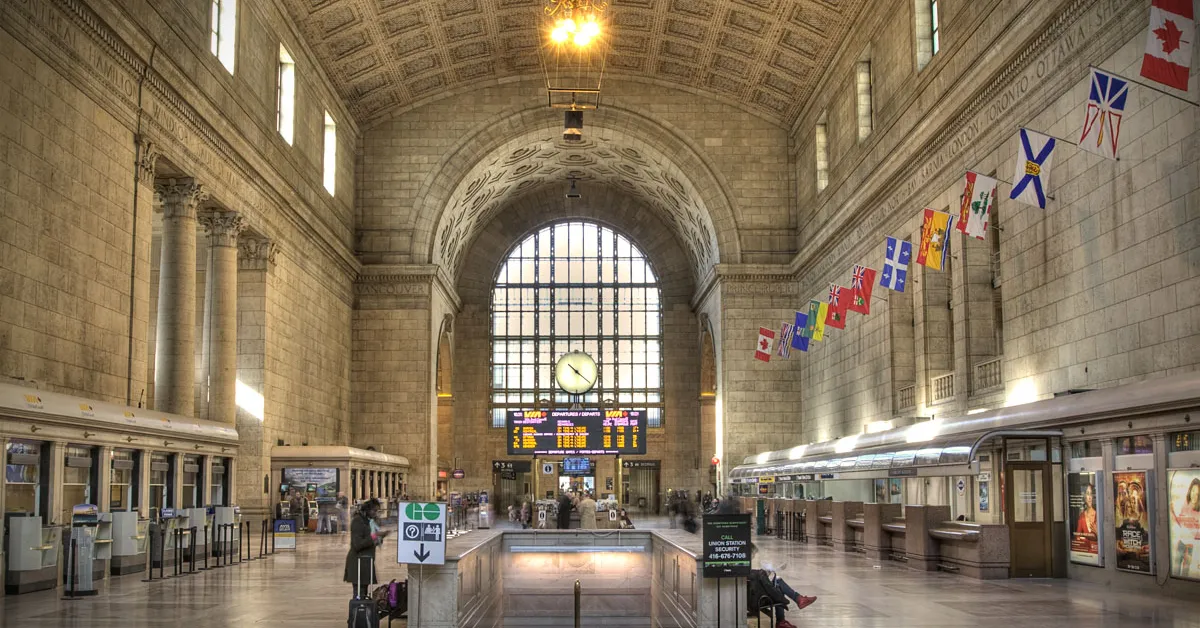
Toronto’s Union Station has the names of Canadian towns carved into the stone of its ticket hall, a domed stadium and a glass arcade full of white steel trees within a few minutes of its doors, and a food court underneath it that never requires going outside.
The carved place names in Union Station’s Great Hall
Union Station is Toronto’s main rail terminal, on Front Street between Bay and York, and the room behind its colonnade is the Great Hall: 250 feet long, 88 feet to the top of the vault, finished in 1927 to a design by the Montreal firm Ross and Macdonald with Hugh Jones and John M. Lyle. The ceiling is Guastavino tile laid in courses, the floor is Tennessee marble in herringbone, and clerestory windows run the length of both sides.
The detail worth stopping for is cut into the stone below the cornice: the names of Canadian destinations the railways served when the building opened, running east coast to Vancouver, a list of where you could get to from this room in 1927. Provincial flags hang below them now and the departure boards sit under the arch at the far end. The hall has been a national historic site since 1975.
Rogers Centre’s roof opens in about twenty minutes
The stadium immediately west of the rail corridor opened in June 1989 with the first fully retractable roof of its kind: one fixed panel, two that slide north to stack over the semicircular end, and a fourth that rotates around the rim and nests inside the stack, leaving 90 per cent of the seating bowl open to the sky.
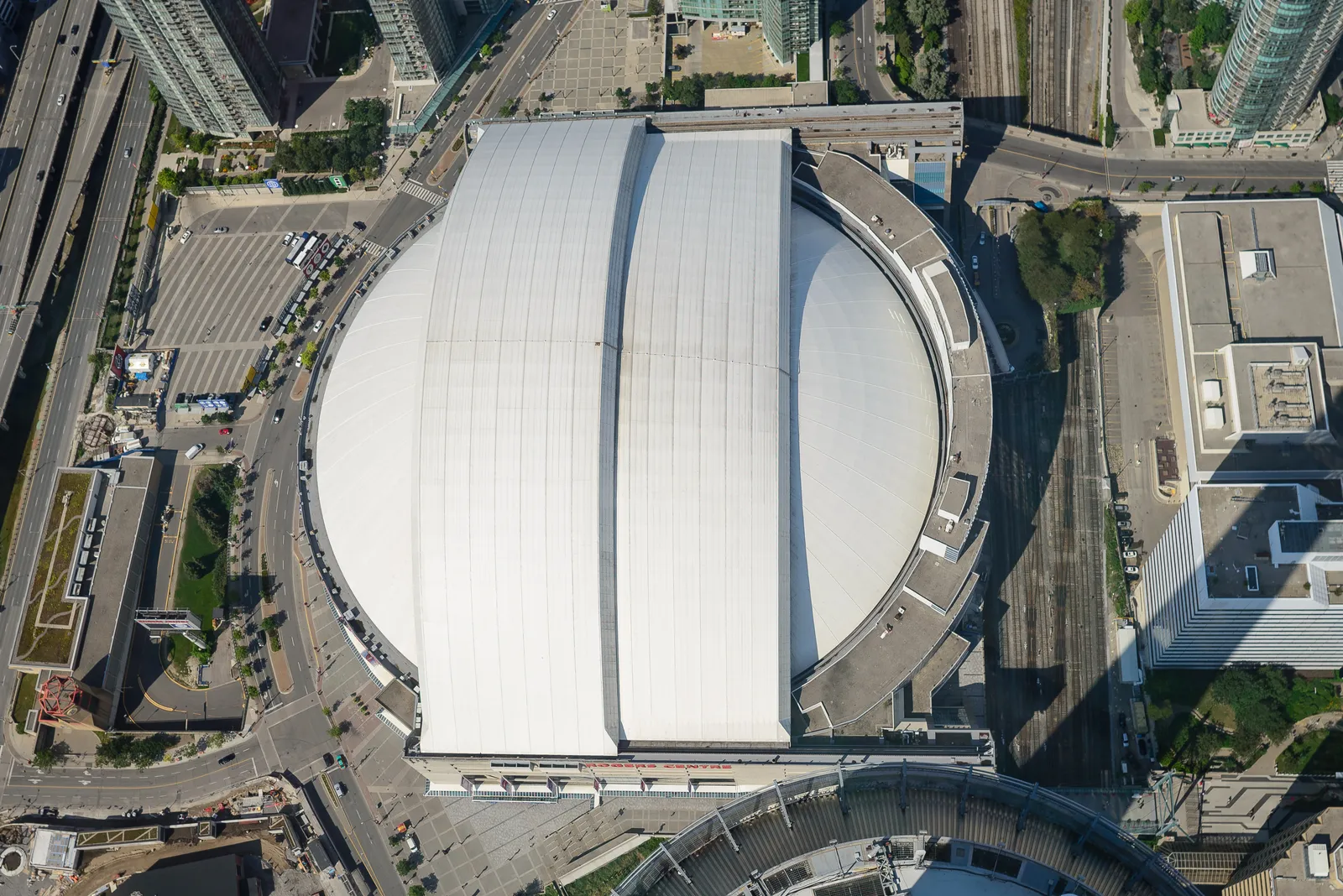
It holds about 39,150 for baseball after the rebuild finished in 2024, down from the 50,516 it opened with, and the Blue Jays are the reason most people go in. A game is a three-hour commitment before you count getting in and out, so it only fits a genuinely long gap, but tickets for a game can be booked in advance through a tours and activities platform, and the walk from the station is covered the whole way.
White steel trees hold up the Allen Lambert Galleria
Brookfield Place occupies the block bounded by Bay, Front, Yonge and Wellington, and the pedestrian route cut through the middle of it is the Allen Lambert Galleria, designed by Santiago Calatrava and finished at the start of the 1990s. It runs 360 feet between Bay and Front, 85 feet high and 45 wide, under a glass roof carried on eight pairs of white steel columns that branch once at seven metres and again at fourteen.
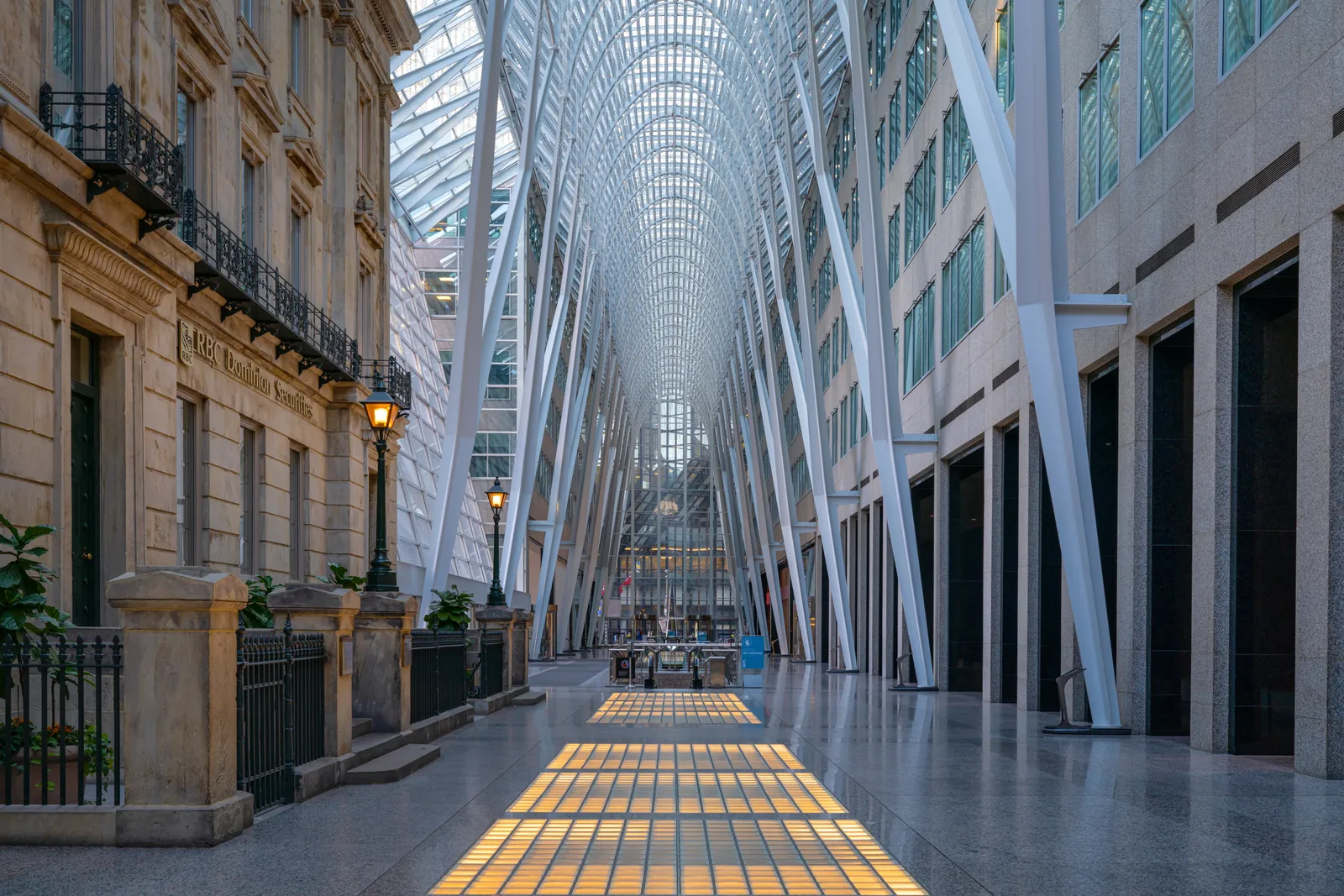
The effect from the floor is a nave, which is why it gets called a cathedral of commerce more often than an office lobby. Along one side, the stone fronts of a row of 19th-century bank and warehouse buildings were kept and rebuilt into the wall of the arcade rather than demolished. Walking through costs nothing and it is open as a public route, so it doubles as the dry way to cross this block.
The Hockey Hall of Fame sits inside an 1885 bank
Yonge Street meets Front Street at the corner of the Brookfield Place block, and the small carved stone building standing there was a Bank of Montreal branch built in 1885, with a pediment, columned arched windows and a great deal more ornament than the towers behind it.
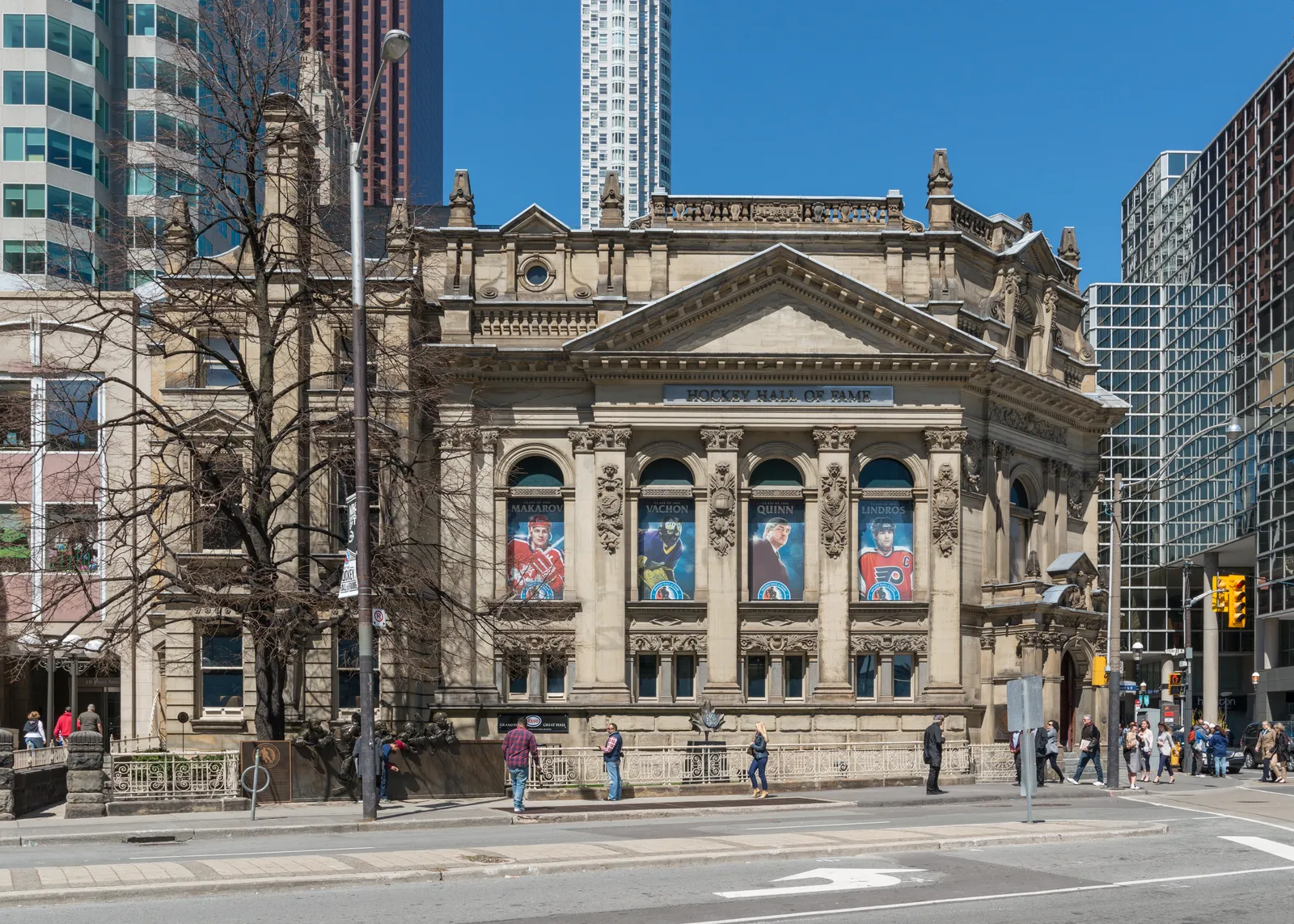
The old banking hall inside is where the Stanley Cup and the rest of the trophies sit, which makes the room itself half the visit. Adult admission is CA$25, seniors CA$20, youth about CA$15, and the doors run 10am to 5pm on 362 days a year, closing only for Christmas Day, New Year’s Day and the Monday of the induction ceremony. The 5pm close is the catch on an evening flight: this is a stop for the afternoon, not for the hours just before a late departure.
The food court and the tunnels under Union Station
Below the concourse level there is a full food court, opened in January 2019, with more counters strung along the York Concourse on the west side and the Bay Concourse on the east. From there the tunnels keep going: this is the southern end of the city’s underground walkway network, so a dry route north to the office towers and the shops starts at the same level as lunch.
Getting between all of it is the part worth planning for. The platforms, the concourses, the subway and the airport-train platform sit on four separate levels here, so every change is a lift or an escalator rather than a walk across a floor, and the lifts are at fixed points rather than beside every staircase.
If the gap is long enough that the block around Front Street will not fill it, a hop-on hop-off bus loop booked through a tours and activities platform picks up in this part of downtown and covers ground the walking radius here never reaches. For everything within reach on foot, the central Toronto itinerary runs from the waterfront out to the old distillery quarter.
The airport train leaves from the west end of the station
The UP Express platform sits at the far west end of the train shed, above the concourse, signposted from both the York and Bay sides. Trains leave every fifteen minutes from roughly 5am to 1am and reach Toronto Pearson International Airport (YYZ) in 25 to 28 minutes, calling at Bloor, Mount Dennis and Weston. An adult ticket is CA$12.35, or CA$9.25 tapped with a Presto card.
Allow more than the 25 minutes the timetable promises. The walk from the Front Street doors out to that platform is several minutes on its own, the train arrives at Terminal 1 and Terminal 3 needs the free connecting train at the far end, and the whole thing runs closer to 45 minutes door to door. The other practical advantage of ending the afternoon here is that the platform, the food court and the storage points on Front Street are all within the same few hundred metres.
Frequently asked questions
What should I do during a layover near Union Station in Toronto?
Three to five hours is enough for the block around the station and nothing further. Walk the Great Hall for the carved place names and the tiled vault, then cross to Brookfield Place for the white steel arcade and the 1885 bank building that now holds the Hockey Hall of Fame, which is the one stop here that charges. The food court under the concourses covers lunch without going outdoors. A baseball game is the only thing on this list that needs booking and the only one that will eat the whole afternoon.
Can you fit a Blue Jays game into a layover?
Only on a long one. A baseball game runs close to three hours before you add getting in and out, so a six-hour gap is realistic and a four-hour one is not. Weekday games usually start in the early evening and weekend ones in the afternoon, which decides whether the timing works at all rather than the other way round. If it does, seats at Rogers Centre are sold through a tours and activities platform, and the stadium is a covered walk from the station.
Where can you eat inside Union Station?
There is a full food court below the concourse level, opened in January 2019, plus counters and sit-down restaurants along the York and Bay concourses on either side of the building. None of it requires leaving the station or going outside, which is the reason to use it rather than the quality of any one counter. The York Concourse, the newer of the two at 62,000 square feet, is the one with room to sit down and eat without standing in the flow of people.
Can you walk through the Great Hall without a train ticket?
Yes. The Great Hall is a public room, not a gated waiting area, and it works as a through-route between the Front Street doors and the concourses behind it. Nobody checks anything on the way in. The hall has been a national historic site since 1975, and the building carries heritage railway station protection on top of that, which is why the stonework and the Guastavino tile vault are still the original ones.
Is there anything near Union Station for kids?
The Hockey Hall of Fame is the obvious one: youth tickets run about CA$15 against CA$25 for adults, and a good part of the floor is shooting and goaltending simulators rather than cases of memorabilia. The Allen Lambert Galleria next to it costs nothing and is a covered place to let someone run around in bad weather. Both are a few minutes from the station doors, which matters when the return leg has a fixed departure on it.