Nathan Phillips Square Layover in Toronto
Part of the full Toronto Layover: CN Tower and Old Town, YYZ
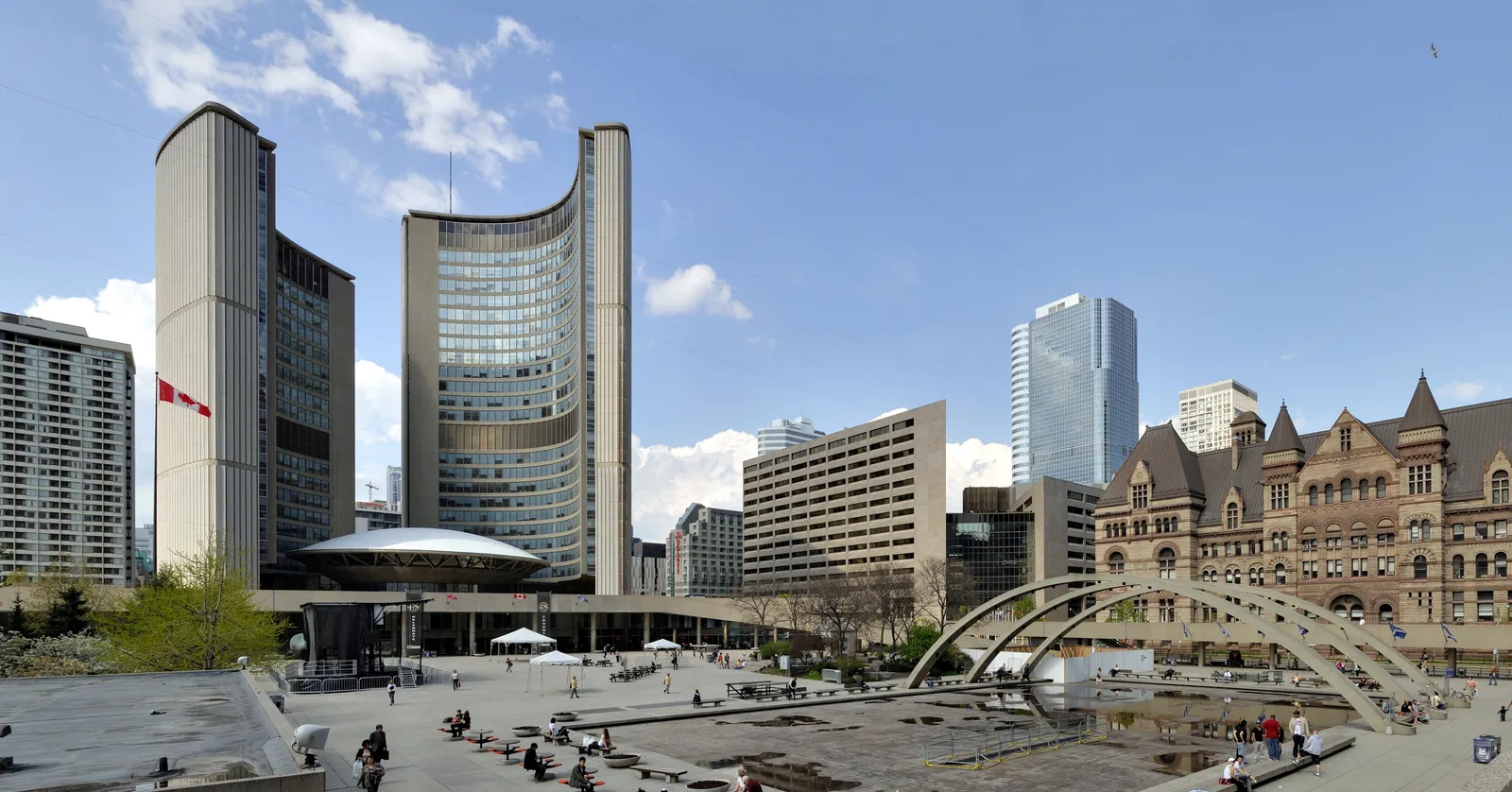
Nathan Phillips Square is twelve acres of open concrete in the middle of Toronto with a 1965 city hall curving two towers around its council chamber, a reflecting pool that becomes a skating rink in winter, and a Victorian sandstone city hall facing it from across Queen Street.
Viljo Revell’s curved towers stand over the square
Queen Street between Bay and York carries the entrance to a building Toronto chose by international competition in 1958: the Finnish architect Viljo Revell beat more than 500 entries with two curved concrete slabs of unequal height, set facing each other around a low white saucer that holds the council chamber. It opened on 13 September 1965 with the square in front of it, laid out with the landscape architect Richard Strong and named for the mayor who pushed the competition through.
The square is 4.85 hectares, the largest city square in Canada, and it works as a single open field with a raised walkway running round three sides of it. In the south-east corner a shallow reflecting pool sits under three concrete arches; they went up to carry the rink lighting, were rededicated in 1989 as the Freedom Arches, and a fragment of the Berlin Wall is set at the foot of the middle one, unlabelled enough that most people walk past it. The pool becomes a public skating rink every winter, and Henry Moore’s bronze archer stands on the paving nearby. If you would rather cover more of downtown than one square, a half-day downtown bike tour books through a tours and activities platform.
There is no cover anywhere out here. The square is a concrete deck with a pool in it and nothing overhead between the subway exit and the building doors, which is the whole character of the place in good weather and the whole problem with it in bad.
An eternal flame burns in the Peace Garden
Six hundred square metres at the western end of the square are walled off as a garden with a stone pavilion in the middle of it, and the flame inside the pavilion has been kept lit since Elizabeth II dedicated the place in October 1984 as a memorial to the bombing of Hiroshima and a statement of the city’s own position on it.
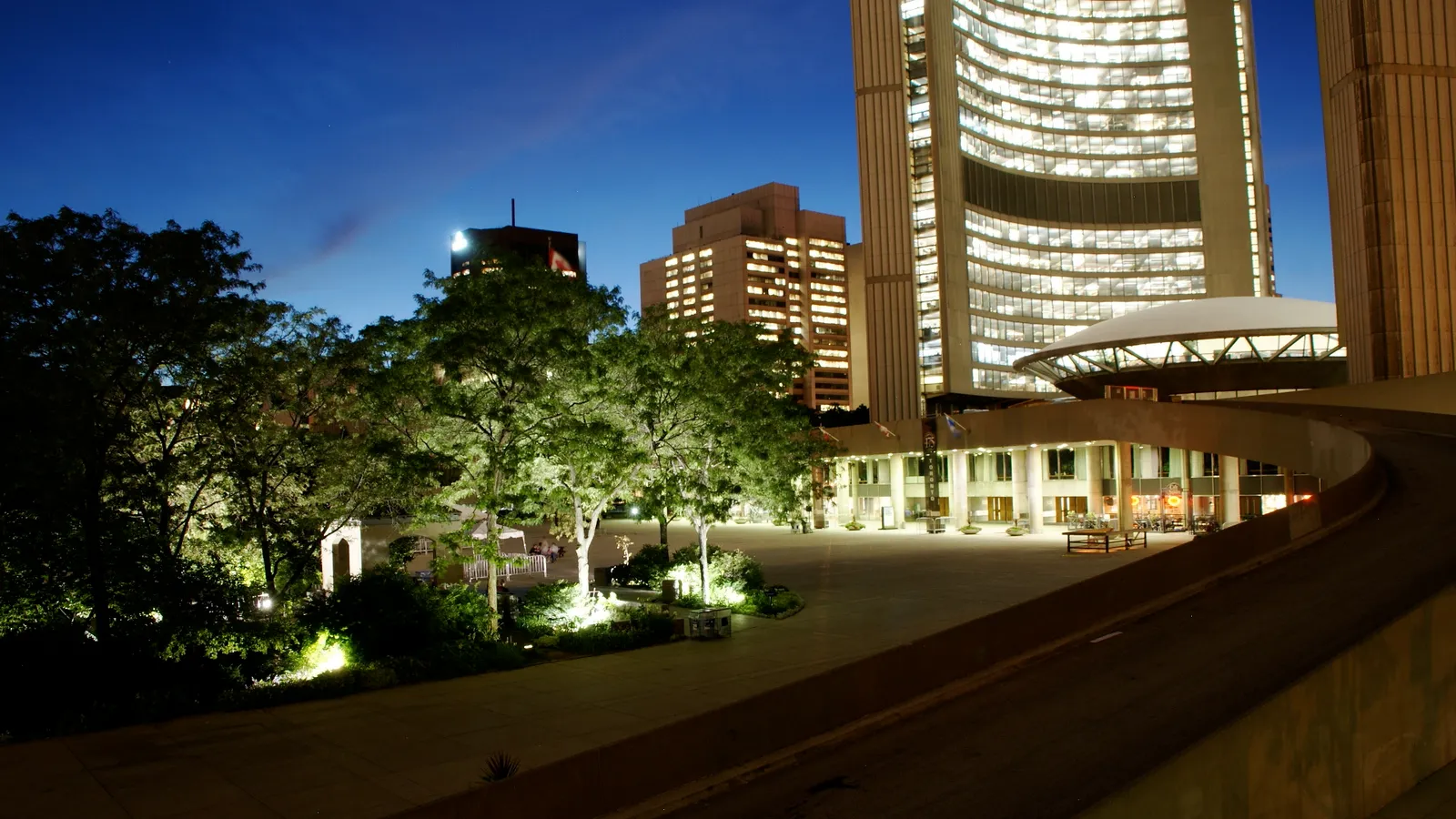
It is the one quiet corner of an otherwise very loud open space, planted and enclosed enough that the square’s noise drops away inside it, and it stays lit after dark when the rest of the paving empties out. Most people crossing the square miss it entirely, which is most of why it is worth the two minutes.
The clock tower and gargoyles at Old City Hall
Across Queen Street stands the building the modern one replaced: a sandstone pile finished in 1899 to a design by E. J. Lennox, the largest building in Toronto when it went up and, at the time, the largest municipal building in North America. The tower is deliberately off-centre, set so that it lines up with the middle of Bay Street when you look north from the financial district.
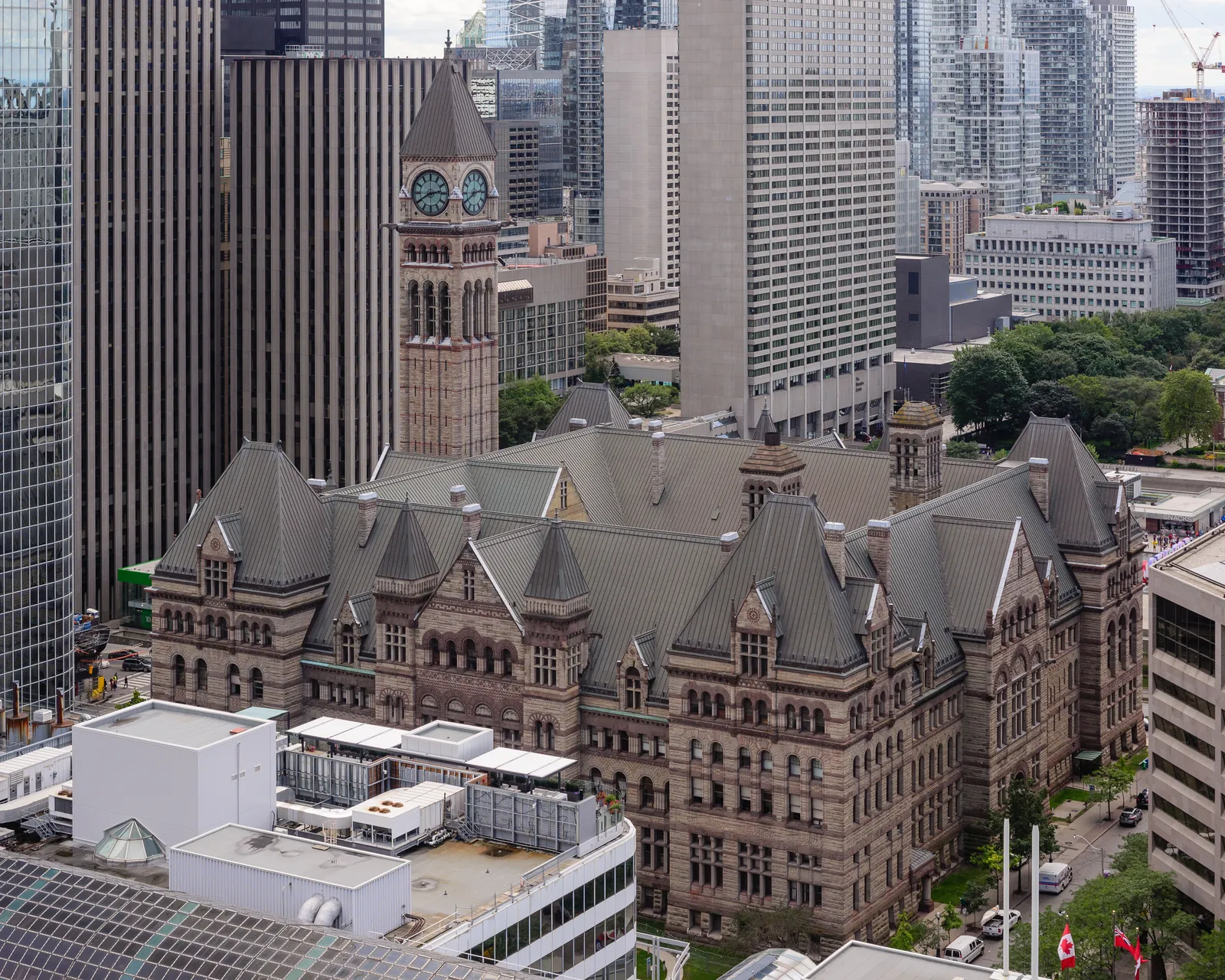
Lennox spent years fighting the councillors who commissioned it, and settled the argument in stone: the faces carved over the entrance arches are caricatures of the men he had argued with. The originals were hacked off the tower in the 1930s after a piece fell through a ceiling below, and bronze casts of them went back up in 2002. The building has spent most of the last century as a courthouse rather than a city hall, which is why the square’s two halls face each other with almost nothing in common.
Osgoode Hall has gates built to keep cows out
University Avenue meets Queen Street a minute west of the square, and the long low building behind the iron fence on that corner is Osgoode Hall, begun in 1829 and finished in 1832 to a design by John Ewart and William Warren Baldwin for the body that still licenses Ontario’s lawyers.
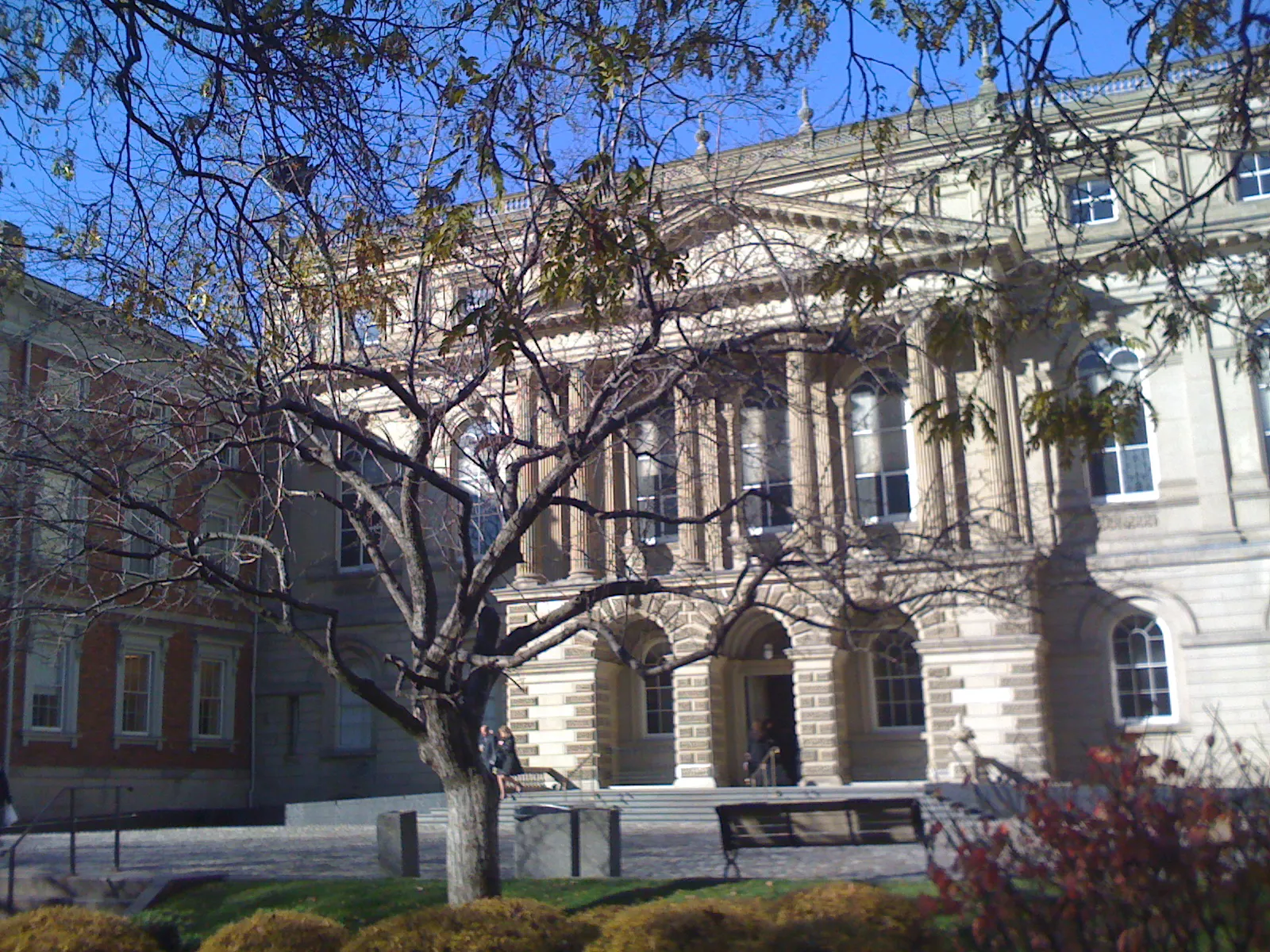
The fence is the thing people stop at. It dates from 1867 and its gates are built as a sequence of narrow baffles, awkward for a person and impossible for a cow, from the years when livestock still wandered the streets and kept getting onto the lawn. Inside, the Law Society runs free public tours on weekdays at 1:15pm, about 45 minutes, through the Great Library and the courtrooms the Court of Appeal still sits in. Nothing else around this square opens its doors for nothing, so the timing of that one o’clock slot is worth building the afternoon around.
Queen station is two stops from the airport train
The subway entrance at the north-east corner of the square is Queen station, and Union Station is two stops south from it, five minutes on the train or fifteen on foot down Bay Street. The UP Express runs from Union out to Toronto Pearson International Airport (YYZ) every fifteen minutes between roughly 5am and 1am, 25 to 28 minutes, CA$12.35 or CA$9.25 tapped with a Presto card.
That short hop is what makes this square a good last stop rather than a first one: an hour and a quarter from the paving to the check-in desk is a realistic figure, and most of it is the train at the end. For a longer afternoon that starts down by the water instead, the central Toronto itinerary covers the harbour, the market and the old distillery quarter.
Frequently asked questions
What should I do during a layover at Nathan Phillips Square in Toronto?
Two to three hours covers this block. Look at City Hall's two curved towers from the middle of the square, walk the raised perimeter walkway for the view down onto the pool, then cross Queen Street to Old City Hall for the clock tower and the gargoyles cut to look like the councillors the architect fell out with. Osgoode Hall, a minute west, is the one thing here you can get inside for nothing, on a free weekday tour. None of it needs booking, and almost none of it costs anything.
Is skating at Nathan Phillips Square free?
Skating itself is, once the reflecting pool in the south-east corner of the square freezes over for the season. The rink is city-run and open to anyone; you only pay if you need to rent skates, which you can do on the square. It is one of the few things in central Toronto that gets better rather than worse in January, and the rink actually predates the square around it, having opened in November 1964 while the rest was still being finished.
Can you get inside Osgoode Hall?
Yes, and on a free tour. The Law Society runs public tours on weekdays at 1:15pm, around 45 minutes, taking in the Great Library and the courtrooms still in use by the Court of Appeal. The grounds and the 1867 fence around them are open whenever the gates are, and the building is a working courthouse rather than a museum, so the tour is the part to plan around rather than an optional extra.
How do you get from Nathan Phillips Square to the airport?
Queen station is at the square's north-east corner, two stops on the subway from Union Station, or about fifteen minutes on foot straight down Bay Street if the weather cooperates. From Union the UP Express leaves every fifteen minutes and reaches Toronto Pearson International Airport (YYZ) in 25 to 28 minutes, CA$12.35 one way or CA$9.25 tapped with a Presto card. An hour and a quarter from the square to the check-in desk is realistic.