Distillery District Layover in Toronto
Part of the full Toronto Layover: CN Tower and Old Town, YYZ
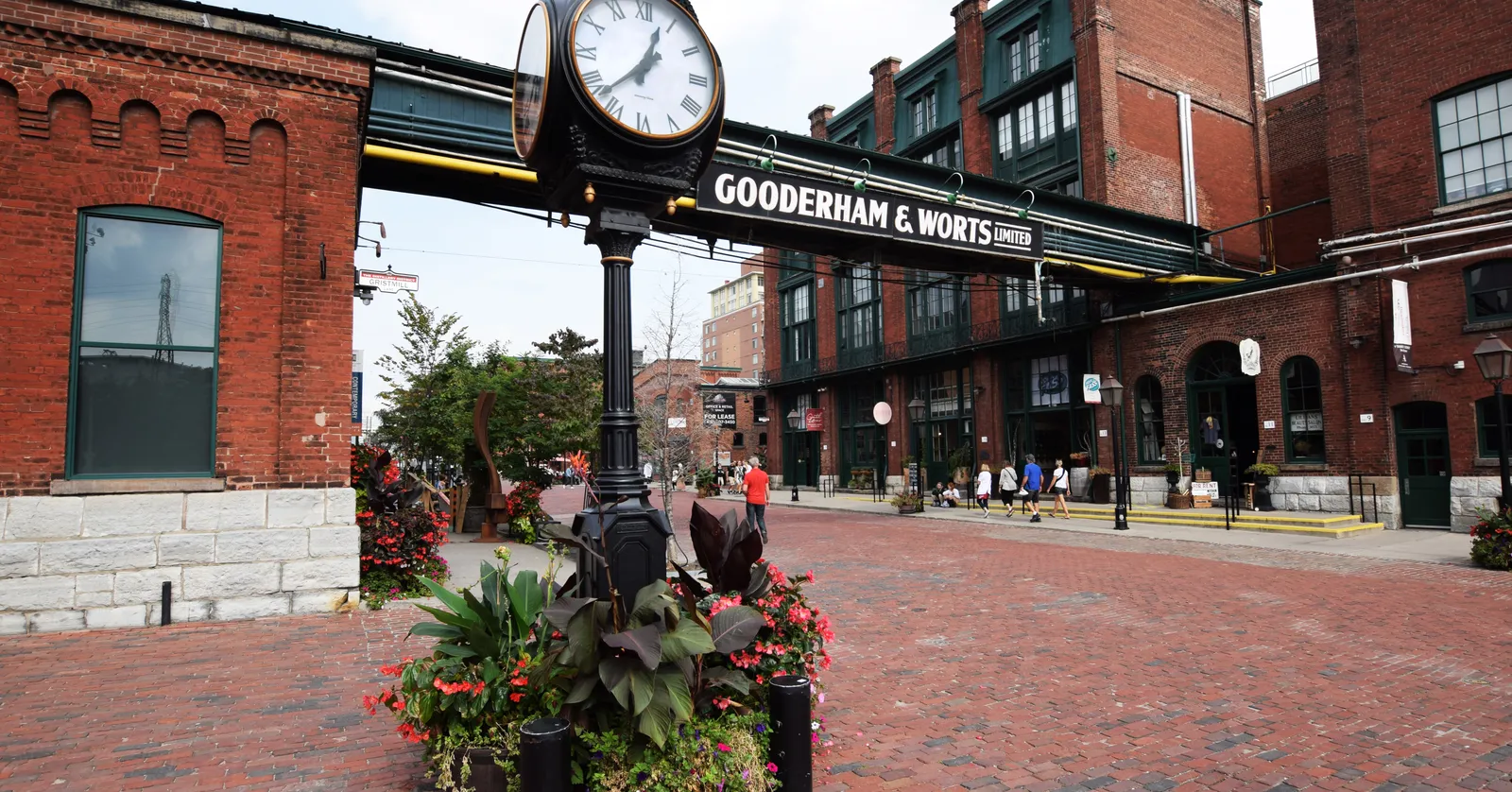
Toronto’s Distillery District is thirteen acres of 19th-century whisky works east of the old town, with more than forty heritage buildings standing on brick lanes that cars are kept out of, galleries and artist studios in the warehouses, and nothing charging at the gate.
Brick lanes run between the warehouses on Trinity Street
Trinity Street and Mill Street cross at the middle of the site, and everything worth seeing stands within a few minutes of that corner. The buildings went up between 1859 and 1927 for Gooderham and Worts, which grew from a windmill on the lakeshore in 1832 into the largest distillery in the British Empire; production stopped in 1990, the district was designated a national historic site in 1988, and it reopened as a public quarter on 22 May 2003.
Traffic is kept to the perimeter, so the lanes belong to people on foot, and the surface underfoot is the original brick paving rather than asphalt laid over it. That is worth knowing in advance: brick this old is uneven, and a wheeled suitcase crosses it slowly and loudly. If you would rather have the place explained than guess at which building did what, a full-day tour that takes in the district books through a tours and activities platform.
From mid-November until the first days of January the lanes fill with a winter market: wooden stalls, a very large lit tree, and a ticket charge after 4pm that runs from about CA$15 while it is on. It is the busiest the district gets all year. Arrive before 4pm and it costs nothing; come outside those weeks, which is most of the year, and the lanes are quiet enough to hear your own footsteps on the brick.
The Stone Distillery of 1859 anchors the western end
The largest and oldest building on the site is a five-storey limestone block with dormers along its roofline, put up between 1858 and 1861 to a design by David Roberts Sr. The limestone came by water from Kingston, the frame is double-timber, and the whole thing cost $150,000, which was a serious sum for an industrial building at the time.
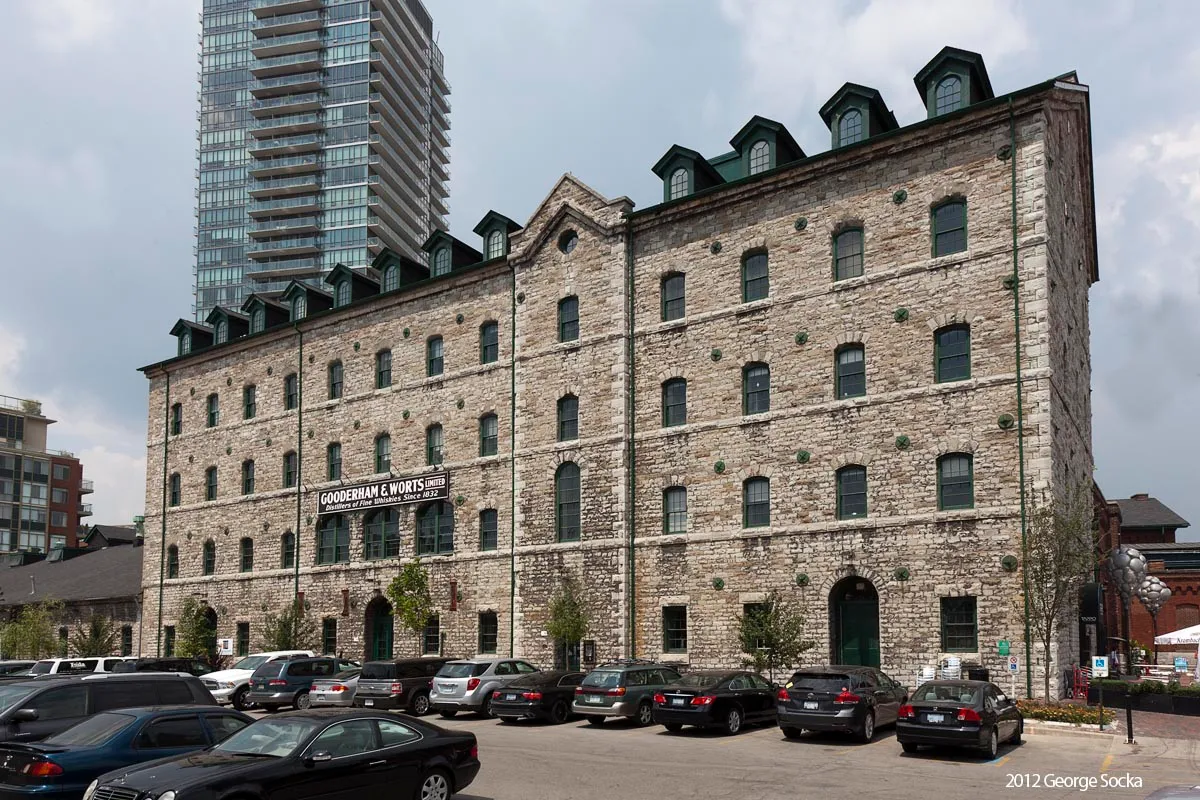
Stone is the exception here; almost everything else on the site is red brick, which is why this one reads as the original core with the rest grown around it. A glass condominium tower now stands directly behind it, and the collision of the two is the clearest picture of what this district is now: a preserved industrial yard with a city built up to its edge.
A theatre works out of two 1888 tank houses
Tank houses 9 and 10, where whisky was once stored in vats, were converted in 2006 into the Young Centre for the Performing Arts, shared by the Soulpepper Theatre Company and the theatre school at George Brown College. The brick shells were kept and the auditoriums built inside them.
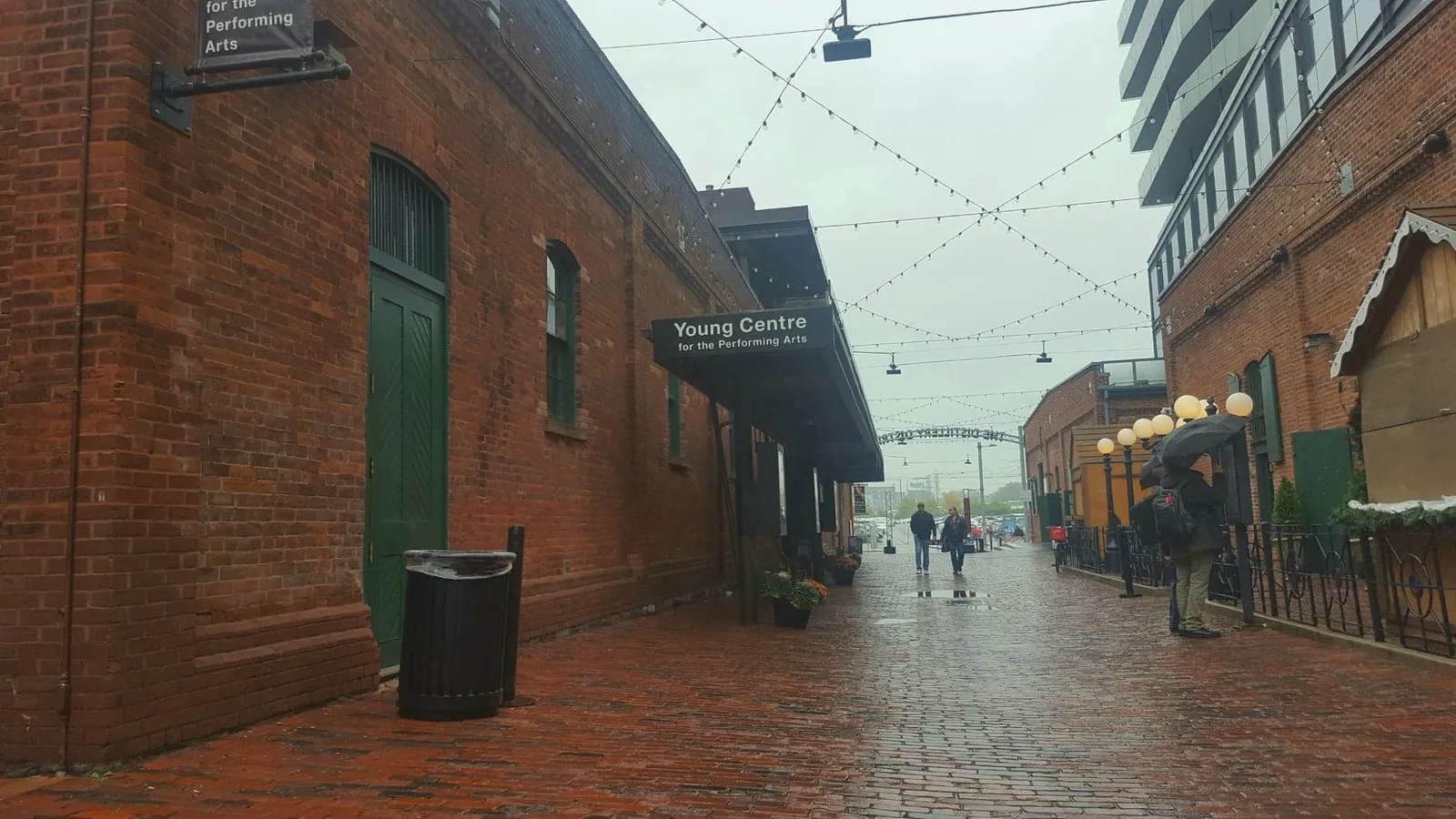
Whether it is useful on a given afternoon depends entirely on the schedule, but the foyer and café are open through the day even when nothing is on stage, and they are the warmest place in the district to sit down. The rest of what you can go into is spread across the surrounding warehouses: more than twenty galleries, a building of working artist studios where jewellers and craftspeople let visitors watch, and around forty shops. They keep shop hours rather than museum hours, so a weekday afternoon finds nearly everything open and a Monday morning does not.
The nearest streetcar stop is up on King Street
Getting out of here takes two legs whichever way you go. A streetcar on King Street reaches Union Station in about fifteen minutes, and the UP Express covers the rest out to Toronto Pearson International Airport (YYZ), every fifteen minutes from roughly 5am to 1am, 25 to 28 minutes, CA$12.35 or CA$9.25 with a Presto card. Counting the walk to the streetcar and the wait at each end, an hour and a half from the district to the terminal door is the honest figure.
That makes this a good place to spend the middle of a long gap and a poor place to spend the last hour of a short one. The central Toronto itinerary covers the stops closer to the station, which are the better bet when the flight is near.
Frequently asked questions
What should I do during a layover in the Distillery District in Toronto?
Two to four hours is right, and most of it is spent outdoors. Walk Trinity Street and Mill Street for the Victorian brickwork, look at the 1859 limestone Stone Distillery at the western end, and go into whichever galleries and artist studios are open, which is most of them during shop hours. The theatre in the old tank houses only matters if a performance happens to line up with your afternoon. Nothing here needs booking unless you want a guided tour or a show.
Does the Distillery District cost anything to enter?
No, on an ordinary day. The lanes are public, the galleries and studios are free to walk into, and you only spend money if you buy something. The exception is the winter market that takes over the district from mid-November to early January, when entry after 4pm is ticketed from about CA$15; before 4pm and outside those weeks it is free as usual.
What can you actually go inside here?
More than twenty galleries, a warehouse of working artist studios you can walk through, around forty shops, several breweries and distillers, and the theatre complex in the converted tank houses. The buildings are not museums with opening times of their own: they run on shop hours, so a weekday afternoon has almost everything open and a Monday morning has noticeably less.
How do you get from the Distillery District to the airport?
In two legs. A streetcar west along King Street reaches Union Station in about fifteen minutes, and from there the UP Express runs to Toronto Pearson International Airport (YYZ) every fifteen minutes, taking 25 to 28 minutes for CA$12.35, or CA$9.25 tapped with a Presto card. Allow an hour and a half from the district to the terminal door, which is more than the legs add up to on paper and about right once the wait at each end is counted.