Rio Layover at Galeão Airport (GIG)
Part of the full Rio de Janeiro Layover: Sugarloaf From GIG

Galeão, Rio de Janeiro’s international airport, sits on Governador Island about 20 kilometres north of the city, where Terminal 2 handles every passenger flight and the island’s own seawall beach at Praia da Bica is roughly ten minutes away by car.
Terminal 2 is the only Galeão terminal open to passengers
Two terminals stand on the apron here and only one of them is in use. Terminal 1 was closed to general passenger traffic in November 2016 for lack of demand; what still operates inside it is a passport-issuing office and a private-jet terminal, so every scheduled flight in and out of Rio goes through Terminal 2. A covered walkway with moving walkways connects the pair, ten to fifteen minutes end to end, which is the number to know if a connection, a car hire desk or a meeting point sends you across.
Landside in Terminal 2 there are shops, food counters, lounges and the bus rapid transit station, which sits on the arrivals level at Door D. That is the practical ceiling of what the airport itself offers: it is a working international hub rather than a destination, and nothing in it is worth budgeting hours for.
Five hours is the cut-off for reaching central Rio
The maths is unforgiving because there is no rail link. The TransCarioca bus rapid transit line runs from the Terminal 2 station out to Vicente de Carvalho in about 15 minutes, and Line 2 of the metro covers Vicente de Carvalho to the centre in about 32 minutes. That is roughly 45 minutes of riding, but nearer an hour and a quarter door to door once the walk out to the platform, the wait and the change of station are counted, and the same again coming back. A taxi or a ride-hailing car does it in 40 minutes to an hour each way when the expressway is clear.
With six hours or more, going in is worth it and the main Rio de Janeiro guide covers what to do with the time once you are there. If you would rather have the two big viewpoints handled without working out the buses, a half-day tour taking in Christ the Redeemer and Sugarloaf Mountain is bookable through a tours and activities platform and comes with transport at both ends. Most people standing here are between an international arrival and a domestic connection, so the bag in question is usually already checked through; if it isn’t, it has to come with you on the bus and the metro or be left somewhere first.
Praia da Bica, a seawall beach on Governador Island
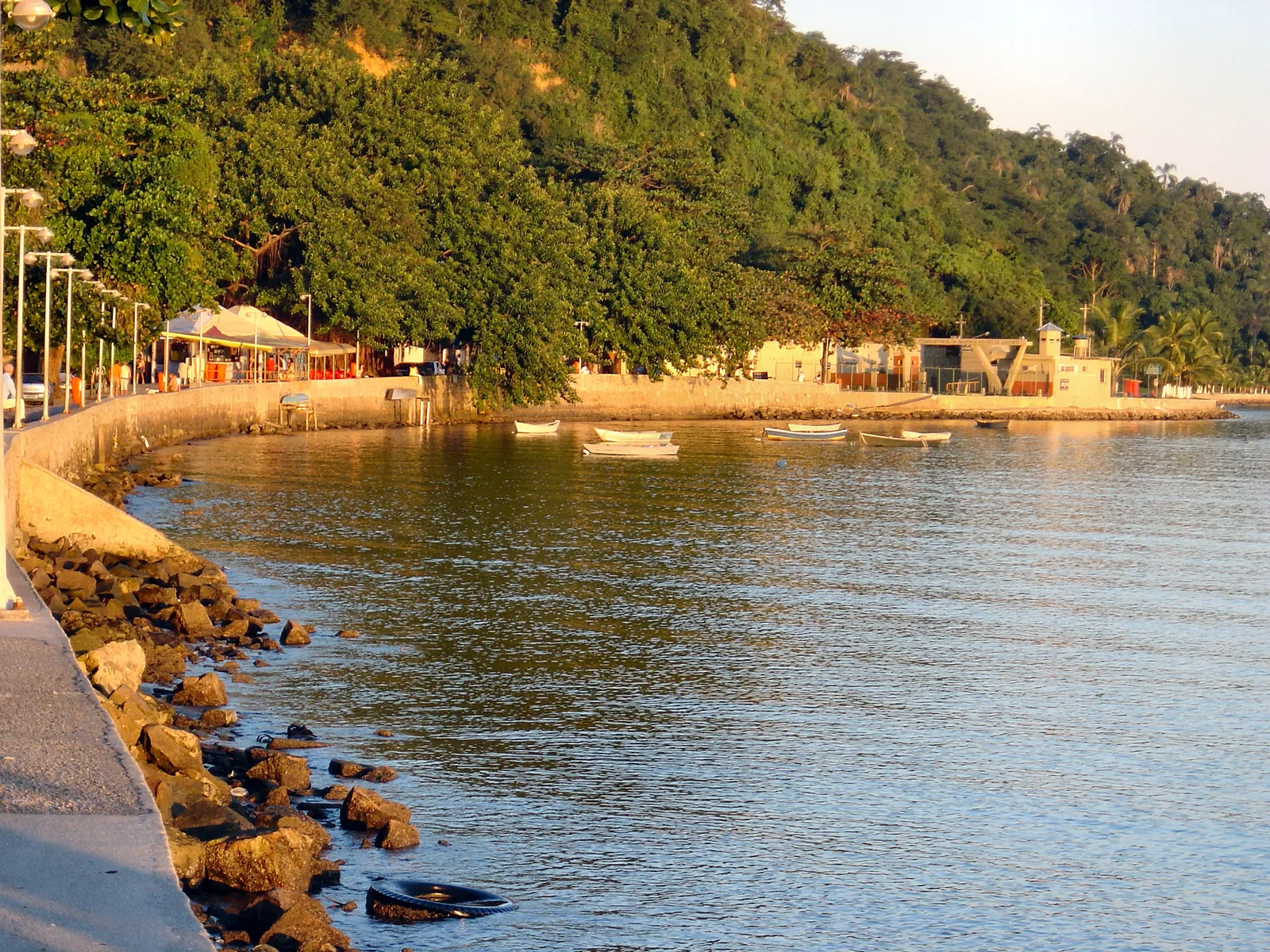
Jardim Guanabara, on the eastern side of Governador Island, has a seafront promenade running along calm bay water with boats moored a few metres off it, and that stretch is Praia da Bica. It faces into Guanabara Bay rather than the Atlantic, so there is no surf at all, and the seafront is a wall and a walkway with bars along it rather than a broad sand strip. Roughly ten minutes by car from the terminal.
The island’s other stop worth the short ride is in Freguesia, near the middle of it: a parish church begun in 1710 and finished over the following three decades, listed as national heritage in 1938, shut in 1976 when a larger church was built alongside, and reopened in February 1990 as a sanctuary. It is a plain whitewashed colonial building with a single bell tower, it costs nothing, and almost nobody connecting through Galeão knows it is there. Ribeira, at the island’s southern tip, keeps a handful of colonial houses and a small square with a fountain, and is where the island’s older bars are.
Frequently asked questions
What should I do during a layover near Rio de Janeiro/Galeão International Airport in Rio de Janeiro?
Under about five hours, stay on Governador Island or stay landside. Terminal 2 is where every passenger flight is handled, and its shops, food counters and lounges are the whole of the airport a traveller can actually use. With three or four hours, a short car ride gets you to Praia da Bica, a seawall promenade on the island's east side where the bay is calm enough to swim, or to the 18th-century sanctuary church in Freguesia. Only with six hours or more does the trip into central Rio make sense, because the run each way is a bus, a change and a train.
Can I get from Galeão to central Rio and back in a four-hour connection?
Not comfortably. The public route is the TransCarioca bus rapid transit line from its station at Terminal 2 out to Vicente de Carvalho, about 15 minutes, then Line 2 of the metro into the centre, about 32 minutes; that is roughly 45 minutes of riding but nearer an hour and a quarter door to door once you add the walk, the wait and the change. Two of those plus anything worth seeing does not fit in four hours with an international check-in at the end. A car is 40 minutes to an hour each way depending on the expressway, which helps but does not change the arithmetic much.
Is Terminal 1 at Galeão open?
Not to scheduled passengers. Terminal 1 has been closed to general passenger use since November 2016 for lack of traffic, and the parts of it still in use are a passport office and a private-jet operation; everything you fly on departs from Terminal 2. The two buildings are joined by a covered walkway with moving walkways, which takes ten to fifteen minutes end to end, so if a connection or a meeting point sends you between them, that is the time to allow.
Is there a beach near Galeão airport?
Praia da Bica, on the Jardim Guanabara side of Governador Island, roughly ten minutes by car from the terminal. It faces into Guanabara Bay rather than the ocean, so there is no surf and the water is flat, and the seafront is a seawall promenade with bars and a small boat mooring rather than a wide sand strip. It is a local beach, not a tourist one, which is most of the reason to go.